

Small Details You Missed In Ryan Gosling's Project Hail Mary
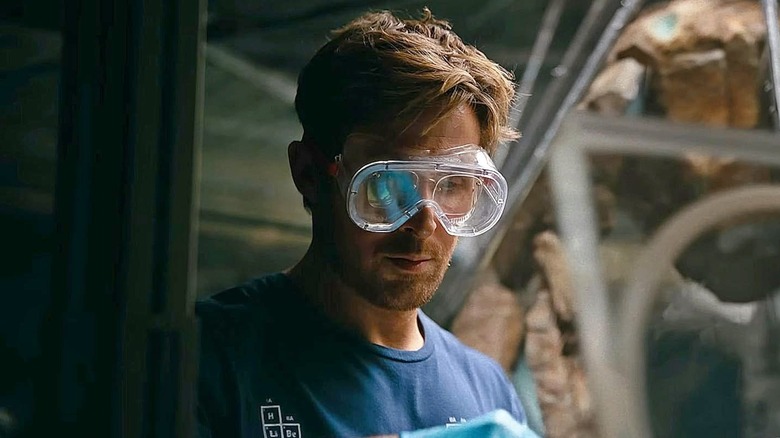
"Project Hail Mary" is a bona fide cinematic sensation. Ryan Gosling's space drama blew everyone away at the box office from day one, and it's maintained a stellar Rotten Tomatoes rating from audiences and critics alike. Even author Andy Weir reacted positively to the adaptation of his popular novel. While Gosling's feel-good story is an instant classic, though, it's also two and a half hours long — and it moves at a relentless pace.
This creates some confusing moments as directors Phil Lord and Chris Miller cram as much storytelling as possible into the narrative. It also means there are a ton of tiny details that race across the screen so quickly that even the most diehard fans can miss them. But make no mistake, they're in the movie. In fact, between the well-known creativity of the directors and the confident acting chops of the lead actor, there are a ton of quick hints and nods that are as awesome as they are hidden.
We've gone through and gathered up several of the best small details you might have missed. Let's look in the nooks and crannies of this epic and see what hidden gems the author, directors, actors, and their creative cohort worked into the mix as they brought their sci-fi masterpiece to life.
Stratt's tattoo is a wild full-circle moment
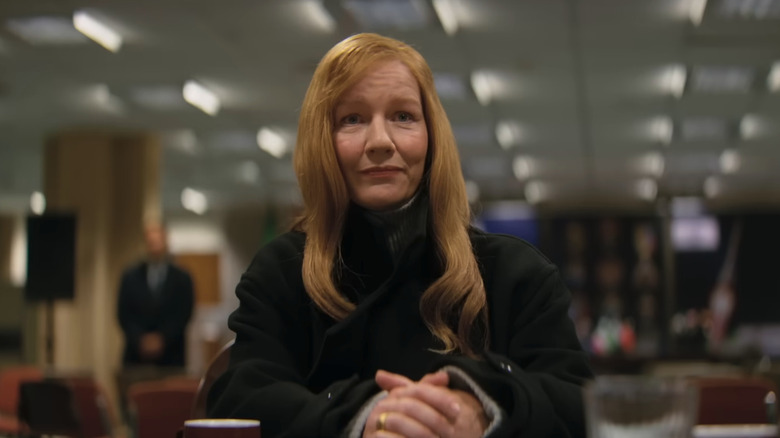
There aren't a lot of main characters in "Project Hail Mary." After Ryland Grace (Ryan Gosling) and Rocky (James Ortiz), the only other face we really see consistently is Eva Stratt (Sandra Hüller). Stratt is the brains behind the Hail Mary mission. She's given unexplained and virtually unlimited powers to address the issue of the sun-eating Astrophage, and she puts those powers to work in terrifyingly effective ways.
She ruthlessly pulls together the best and brightest minds of humanity, discovers solutions, and puts them in motion (including forcing Grace himself onto the ship). At one point, Stratt casually mentions that she'll probably end up arrested after the mission begins and her authority ends. Andy Weir doesn't revisit Stratt's fate after that comment in the book, but the author was on the set for the movie and came up with some closure for Stratt in that version of the story.
Directors Phil Lord and Chris Miller explained to Slashfilm that the movie contains a secret subplot in which Stratt is arrested and tried as a criminal off-screen before escaping and living on the lam. When we see her on a boat in the final moments of the film, she has a tattoo, a V with a line through it. That means a life sentence without parole, indicating that her statement in the book was as prescient as it was depressing. The fact that the idea came from Weir makes this one of those unique moments where the original author was able to add a detail in the adaptation that goes beyond their own source material.
Rocky and Spock share a solar system

Another easy-to-miss detail has to do with Rocky's home world. The sentient mass of minerals is from the star system 40 Eridani, which is 16.5 light-years from Earth. The crazy part is that he's not the only race humans have encountered from that neck of the galaxy in pop-culture sci-fi: Rocky and "Star Trek" icon Mr. Spock may be galactic neighbors, since they apparently share a star system.
The planet Vulcan is said to be located in the 40 Eridani system as well, and there is a lot of speculation on where Spock's fictional home world could be within its habitable regions. What's not likely, however, is that the Vulcan science officer and Rocky share the same planet. The issue here isn't the location in space — it's more about living environments.
Rocky's home world is described by Weir as 210°C (over 400°F) with more than twice the gravitational pull of Earth. It also has an ammonia atmosphere — not oxygen. Spock may be only half human, but it's a pretty safe guess that both Vulcans and humans can't survive in those kinds of conditions. Still, the fact that Spock and Rocky at least share a star is a fun connection.
Grace plays the Close Encounters five-note motif
"Project Hail Mary" is a movie full of homages to classic sci-fi films. There are moments that tip the hat to recent and vintage movies alike, from 2015's "The Martian" to 1982's "E.T. the Extra-Terrestrial." But one of the sneakiest Easter eggs points to another, even older Steven Spielberg creation: "Close Encounters of the Third Kind."
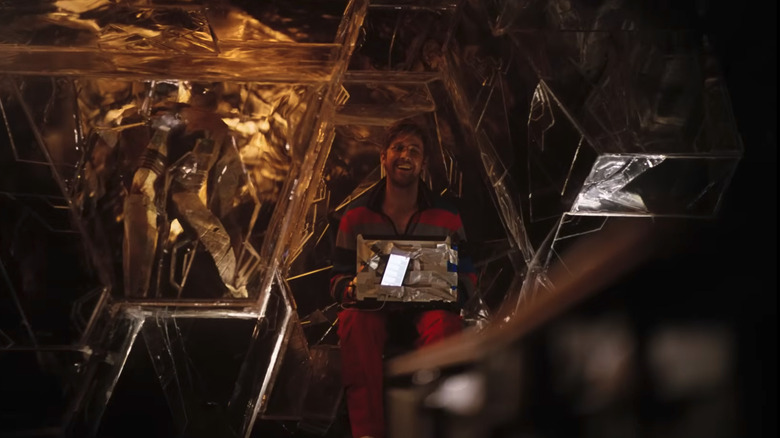
The 1977 classic's score, by the one and only John Williams, includes a well-known, five-note motif that humans use to communicate with aliens in the movie. That motif shows up in "Project Hail Mary" when Ryland Grace and Rocky meet in the tunnel Rocky has built to connect their ships using the marvelous Eridian material called Xenonite.
At one point, Rocky is trying to point at something behind Grace by tapping on a glass barrier between them. Grace thinks Rocky is trying to communicate and taps back the five-note musical message that any human fan of sci-fi would instantly recognize. It's a fun blink-and-you-miss-it moment that isn't quite breaking the fourth wall. Instead, it shows yet another layer of depth and knowledge to the goofy, middle-school teacher who ends up saving not one but two separate races.
Gosling's costar: Moppy Ringwald
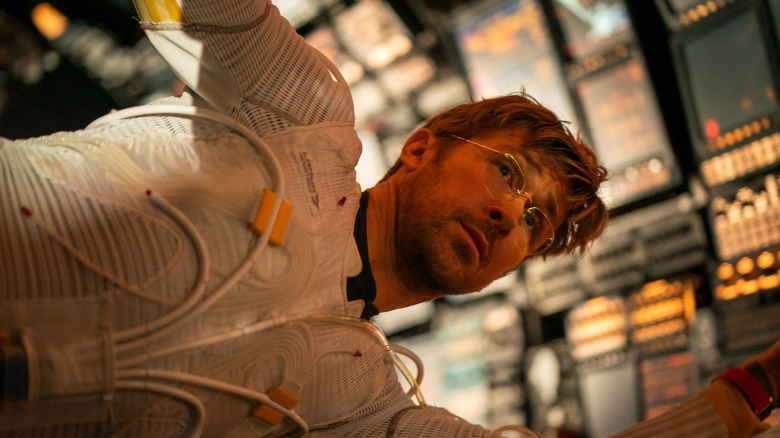
When you lack a co-star to act with, it can be difficult for even the best actors to carry a scene alone. For Ryan Gosling, "Project Hail Mary" was a particularly tough order because, apart from the flashbacks, he spends the entire movie acting against a single puppet. Even worse, for the first chunk of the film, he's just alone in space.
In an interview with People, the actor admitted that it wasn't easy, saying, "I'm used to having a costar, and I really enjoy that dynamic. So to be alone for so much of it was new ... There was one time where I felt I had been alone for like 100 days or something, and I was like, 'I need someone to talk to. I need a scene partner.'"
Of course, directors Phil Lord and Chris Miller were still there, albeit behind the camera, and they stepped in to help their struggling lead actor. Their solution? Turn a mop into a person. They gussied up a floor wand with glasses and a dress and named it Moppy Ringwald. The stunt worked so well that shots of Gosling dancing and crying with his new friend even made it into the movie. The actor shared his gratitude, saying, "This is the beauty of working with Chris and Phil: they will put their plans for the day aside and go and make you a mop friend if you need one."
Ryan Gosling's favorite line from Rocky has an inside meaning
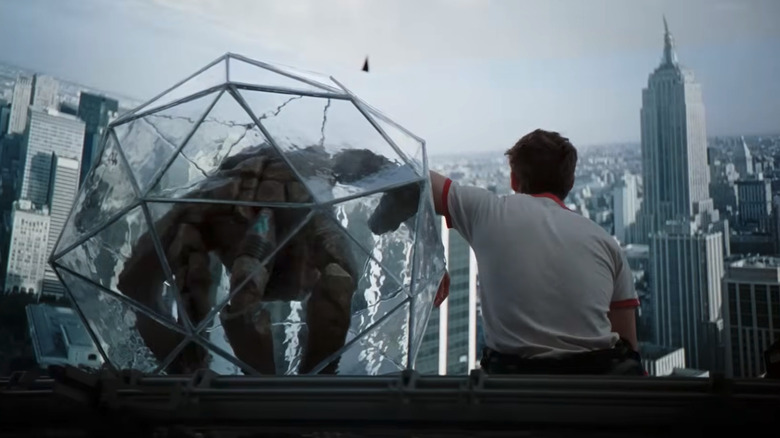
Easter eggs and minor details are often included in films for certain groups of hardcore fans to discover. Stratt's tattoo is a hidden gem for fans of the book, while the "Close Encounters" theme immediately catches the ear of millions of fans of classic sci-fi films. And then there's the occasional small detail that is included not for a group, but for a single individual.
In the "Project Hail Mary" book, we hear about Rocky having a partner back home, but there is never any real indication that Ryland Grace has a love interest — or really a love life at all. In the movie, however, he makes a quick comment about a failed past relationship. The addition came not from a bit of creative liberty on the part of the screenwriters, but rather an inside joke from Gosling himself.
Asked by hitsradiouk what his favorite line from Rocky was, Gosling responded, '"Rocky hate Mark.' I work with a guy named Mark, and we've worked together for 10 years. He was next to the camera, and I was improvising with Rocky about my ex-girlfriend, and I just said, 'Oh yeah, but now she's with Mark.' And then James said, 'Rocky hate Mark.' And we just did it to make my friend feel seen. But it made it in the movie, and so that's a fun Easter egg for me." The cute line is worth a quick laugh on its own, but understanding the meaning behind it makes it that much better.
There's a nod to the original Hail Mary design
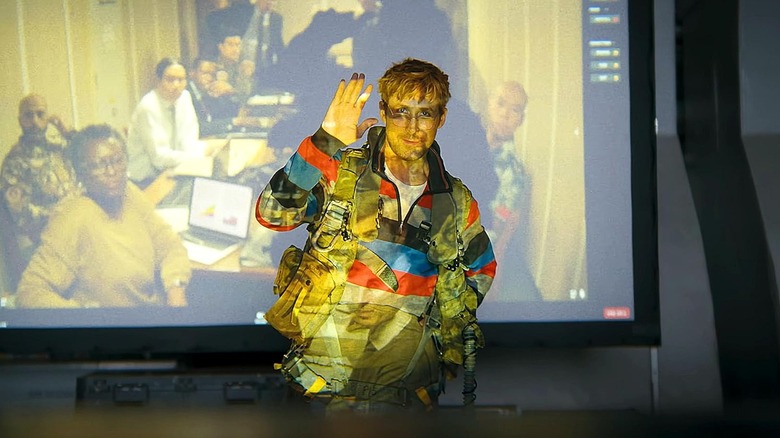
The titular ship in "Project Hail Mary" is a key element of the story. Andy Weir takes time to describe it in excruciating detail in the book, and its capabilities and limitations continue to be a key factor at every step of the story. Weir is clear that the original version of the ship is very small (just big enough for three people to operate in with significant discomfort).
The movie changed the book version of the Hail Mary by making it bigger, and the author understood the need for the change. The visual depiction of everything made it necessary to expand the physical spaces for a little more breathing room. But that doesn't mean they cut out the original version of the ship entirely.
Eagle-eyed Reddit user This-Sounds-Familiar pointed out that in one of the flashbacks, we get a version of the Hail Mary labeled "Prototype." It's only on the screen for a split second, but it shows Weir's original version of the ship. Obviously, in the movie version, that plan is expanded before the ship is built, but it's fun to see that Weir's original design at least made the cut in some form before storytelling needs took over.
Rocky's burn marks are not what they seem
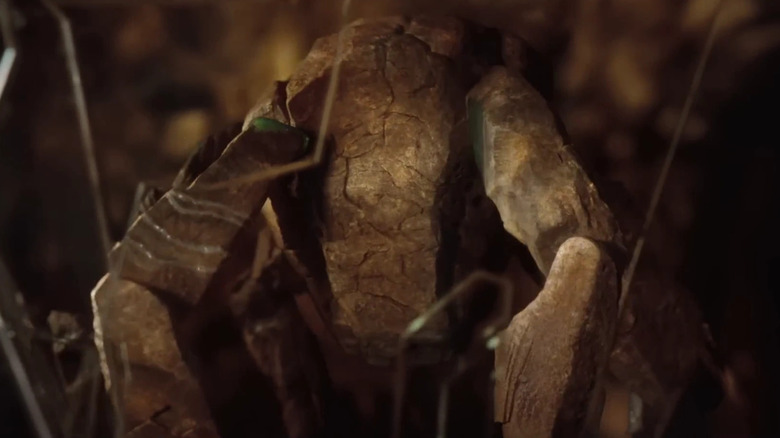
In order to save Grace's life in the harrowing expedition to capture some predatory, Astrophage-eating Taumoeba, Rocky breaks into Grace's part of the ship, exposing himself to his friend's human, oxygen-rich environment for an extended period of time as he stabilizes the ship and drags Grace to safety. When Grace wakes up, he finds Rocky back in his ammonia atmosphere, curled up and unresponsive. He sets up a warming device and spends days nearby, hoping his friend will wake up again.
One easy-to-miss detail in the midst of the drama is the trail of burnt ash-like material Grace uses to track Rocky down. That hints at a scene from the book, where Grace sees that, in Rocky's traumatic experience, his cracks have filled with a nasty layer of black dust and debris. Grace builds a simple robot that he pilots into Rocky's ammonia-filled side of the ship to blow all of the gunk out of his friend's cracks, presumably to help him heal faster.
When Rocky does wake up, though, the Eridian is shocked to hear what Grace did. He tells his human friend that he almost killed him, adding, "Black substance is not soot. My body make this. It cover damage while body repairs." It's an amusing reaction, since Rocky survives the ordeal — if it had gone the other way, it would have been a tragedy — and while the scene didn't make the cut for the movie, at least we got the sooty stuff scattered along the floor.
A romance between Grace and Stratt is implied

Ryland Grace and Eva Stratt have a strictly platonic relationship in the book. Platonic may not even be the word: They are friendly in minor moments, but apart from that, they are strictly co-workers trying to save the world. Stratt is ruthless at every step, too — a detail that the movie softens a bit. We get the scene in which Sandra Hüller sings, and she seems even more remorseful about sending Grace on the mission than she does in the book.
Then there's the added element of some possible romantic tension between the two characters. In one of the biggest changes that the movie makes from the book, there are a few lingering stares and some lightly charged conversations that hint at a deeper connection forming between the two earlier in the film, implying that there could be more to the relationship.
The implication of romance is so small that you can miss it when you watch. The fact that it's a creative addition from the book makes the shift important, too. Improvement or not, it humanizes a character that, in the book, is a stone-cold decision machine willing to do anything, including sacrificing her co-workers, to make sure humanity is saved.
A possible nod to a cut scene

"Project Hail Mary" is a fairly faithful adaptation that sticks to all of the book's major beats and follows Andy Weir's timeline. However, a few smaller details were left out of the adaptation, including a controversial scene where Eva Stratt nukes Antarctica. Why does the project leader set off 241 nuclear bombs under 50 meters of Antarctic ice? To unleash a period of global warming that will help offset the oncoming decades of global cooling from an Astrophage-plagued sun.
The scene never actually made it into the movie, not because it isn't good, but because screenwriter Drew Goddard didn't feel he could do it justice. Goddard explained, "It was in there, and I loved it. It was such a concept that was interesting and showed the desperation that we were in. But it was just too complicated to explain to an audience within a short period of time, and we just didn't have a lot of screen time to take the time to do that correctly."
While this is technically not a "small detail" since it doesn't appear in the movie, there is one tiny element that did make the movie and may point to the cut scene. The last time we see Stratt, she's living a life in exile on a boat. The boat is shown sailing through ice-filled waters — the same kind of broken-up, frozen debris you might expect to see after blowing up a huge chunk of Antarctic ice.