

15 Worst Shark Tank Pitches Of All Time
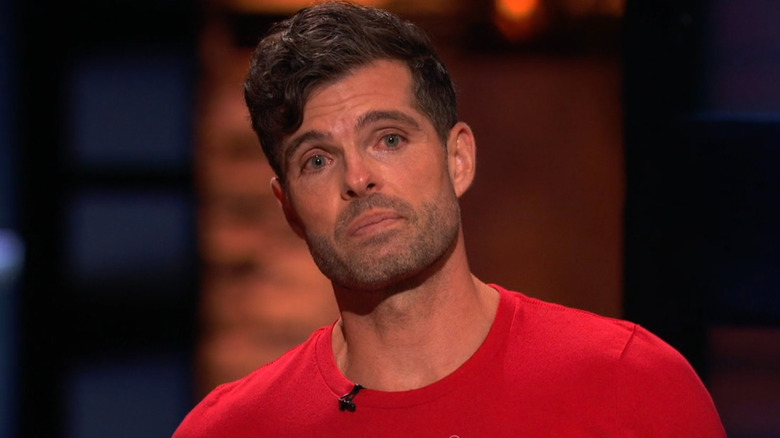
Going up in front of the sharks on "Shark Tank" can be a life-changing opportunity. Many budding entrepreneurs got the financing they needed to get their products and services off the ground, and you can find them in many stores today. Getting that initial money is only a small part of the battle — many "Shark Tank" products have failed spectacularly after getting funding. Of course, a lot of business owners don't even get that far.
It all comes down to the pitch. A bad pitch isn't even indicative of a terrible product. Sometimes the item or idea is a solid one, but the entrepreneur just can't sell it in the right way. They may not have the data to back up their claims, and the sharks are more than happy to pass if it becomes apparent the pitcher has no idea what they're talking about. Such heartbreak is common in the business world, and it's happened many time in the tank. These are the worst "Shark Tank" pitches of all time.
PDX Pet Design
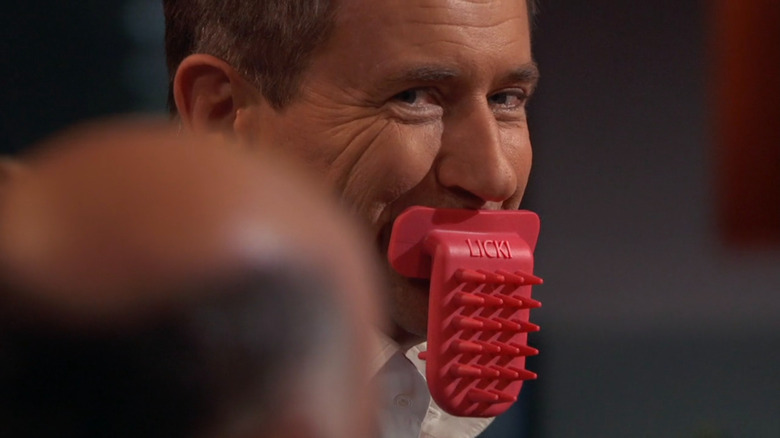
The sharks don't tend to go for items that look like they'd be better suited for a gag gift than an actually useful tool. As such, Tara and Jason O'Mara of PDX Pet Design had an uphill battle — much of their Season 8 pitch revolved around their LICKI Brush. Based on the idea that humans should groom their cats in the same way another cat would, the brush is held within the mouth as the person mimics licking a cat. Robert Herjavec was the unlucky shark who had to demonstrate this, and, like the other sharks, he wasn't convinced.
The O'Maras simply didn't have the figures to back up their demands for PDX. They wanted $300,000 for a 15% equity in the company, which they valued at $2 million. The sharks were pretty shocked when they boldly stated that they were projecting around $180,000 in sales for the following year due to their assumption the product would go viral (the internet loves cats, after all). It was probably for the best that all the sharks passed, as PDX Pet Design didn't last long after its "Shark Tank" appearance.
Cougar Energy
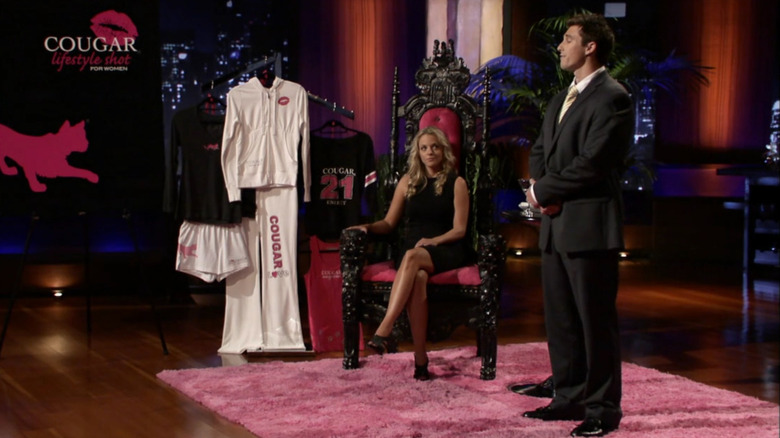
Energy drinks are a big business, but it's probably not the best idea to limit your product to a niche market. That's what Ryan Custer learned on his Season 3 episode of "Shark Tank," where he pitched the Cougar Lifestyle Shot. As one can surmise, this is an energy shot marketed toward women who consider themselves cougars, meaning they're older women seeking a relationship with a younger man. To really sell the product, Custer had an attractive woman sitting there the entire time who looked a little young to be a cougar and also barely drank the energy shot when Custer handed it to her.
While he only wanted $150,000 for 30% equity in Cougar Energy, he had only made $60,000 across three years. That wasn't great for getting any sharks on board, who felt like there wasn't enough of a market for an energy drink really only for "older" women (older in this case being 30 years and over). But the true death knell for the Cougar Lifestyle Shot appeared to be the taste, which Barbara Corcoran described as "chalky." An energy shot that tastes awful isn't going to go far, so it was no surprise that the sharks passed on this pitch.
Track Days
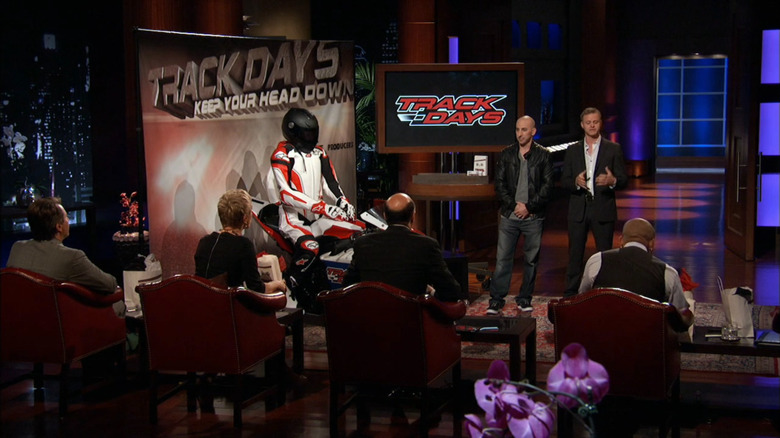
Making a movie is never a simple process, but at least most films start from a place of having a good screenplay or getting at least one actor attached. "Track Days," the proposed motorcycle flick from Brian Pitt and James LaVitola, had neither when they went onto "Shark Tank" during Season 4. Their pitch revolved around their baseless claim that they could guarantee profit even without having a script or star. The more they talked about it, the more it became clear that those components were absolutely essential, especially when asking for $5 million from a group of savvy investors.
Pitt and LaVitola explained how they wanted to upend the industry by getting enough money in the pot to attract other people to the project, like actors who might be interested in starring. It was a different way of doing things, but the would-be investors didn't see it working – the sharks immediately turned down "Track Days," with Kevin O'Leary calling it "a horrifically bad idea." O'Leary also said that the movie business is "the worst business," which is a humorous statement in hindsight given that he went on to play a role in "Marty Supreme," one of the most expensive A24 films ever.
Kymera Body Board
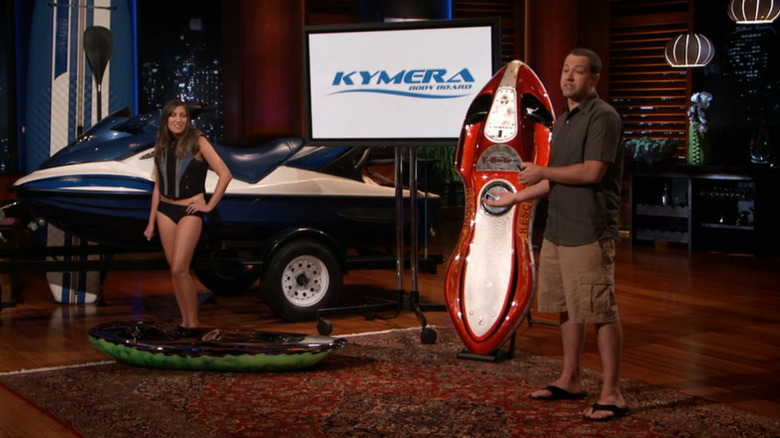
The sharks can be brutal when a pitcher is out of their element. Mark Cuban told Jason Woods of Kymera that he was a "wantrepreneur" when he pitched the Kymera Body Board — a jet-propelled body board — during Season 5. The problems soon became apparent, as Woods stated how he hadn't sold a single unit. He also initially bragged about making over $100,000 from Kickstarter — despite his goal being $250,000.
The pitch started going well off the rails when Woods revealed that he had been working on this product for 10 years and still didn't have a single sale to show for it. Despite that, he was asking the sharks for $250,000 for a 20% stake in the company. Daymond John summed up the general feeling in the tank when he called this the "worst pitch" he had ever seen.
Needless to say, Woods didn't walk away with a deal, but, in business, persistence can be key — he returned to the tank in Season 10 having sunk a lot more effort and cash into the business, which now also made electric kayaks and surfboards. Things were going a lot better for him, and he managed to strike a deal with Robert Herjavec — $500,000 for 10% equity.
RoloDoc
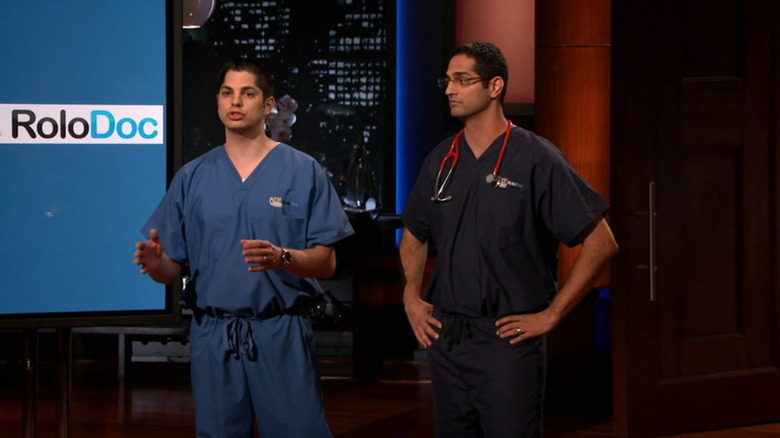
"Liability nightmare." "Worst presentation ever." Those are just some of the statements made when physician brothers Richard and Albert Amini brothers pitched RoloDoc during Season 5 of "Shark Tank." It's supposed to be a social media platform where doctors can communicate directly with patients, but their pitch didn't showcase any of those social media functions. The proposed platform basically came across like a more convoluted form of email.
What's more, the pair failed to provide any examples of how the business could eventually become profitable: There was no clear way to monetize the platform. One possibility would be targeted ads, but on a platform that deals with people's personal information where they're talking about health issues and concerns, that opens up a Pandora's box no business owner wants to deal with. They may have only wanted a $50,000 investment for 20% equity, but the sharks couldn't get out quick enough.
The Sullivan Generator

During the third season of "Shark Tank," a MENSA Society member named Mark Sullivan pitched an idea that seemed too good to be true. That's because it was — at least, according to Mark Cuban. The so-called Sullivan Generator would harness the energy of the Earth's rotation to generate electricity, and, in the process, it would spit out gold. That's right — a machine that would simultaneously create energy and pure gold.
Sullivan didn't have the full device operational. The $1 million investment he asked for in exchange for 10% of the business would have gone toward building it. Some of the sharks seemed interested, as the promise of unlimited energy and gold is obviously an enticing one, but Cuban brought logic and facts to the proceedings, telling everyone how his "BS meter" was going off the charts. Sullivan's pitch used a lot of scientific jargon that didn't fully explain the process, so the sharks sided with Cuban and backed out.
Vestpakz
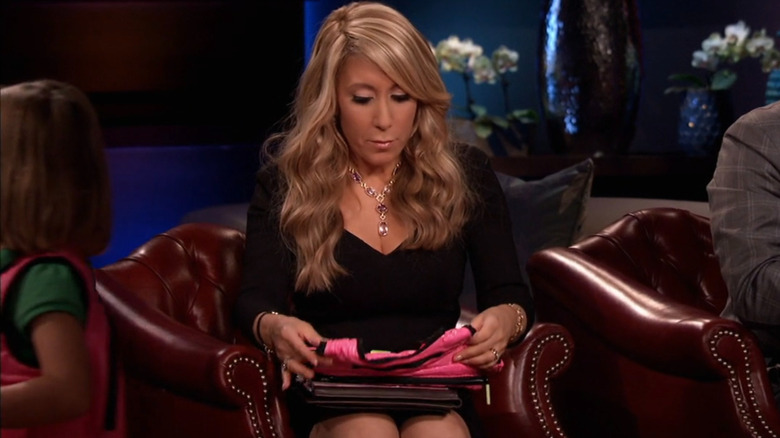
Bringing children into a pitch meeting on "Shark Tank" is a good way to tug at the investors' heart strings. It's a natural move to make for Vestpakz, which is a backpack that's also a vest for kids to wear to school that's supposed to be more comfortable than just a regular backpack. The company's CFO, Michael Wooley, even said that he got the idea from his daughter, which could've been a cute moment if the sharks didn't push with follow-up questions.
It turns out Wooley's daughter came up with the idea 16 years prior, which doesn't have the same impact as imagining a current youngster helping her dad with his business idea. Additionally, the company only had $10,000 in sales. That was far too low for the sharks, even with Wooley only asking for a $50,000 investment for 10%. Vestpakz went out of business soon after Wooley's "Shark Tank" appearance, so the sharks were clearly right to listen to their guts on this one.
EyeBloc
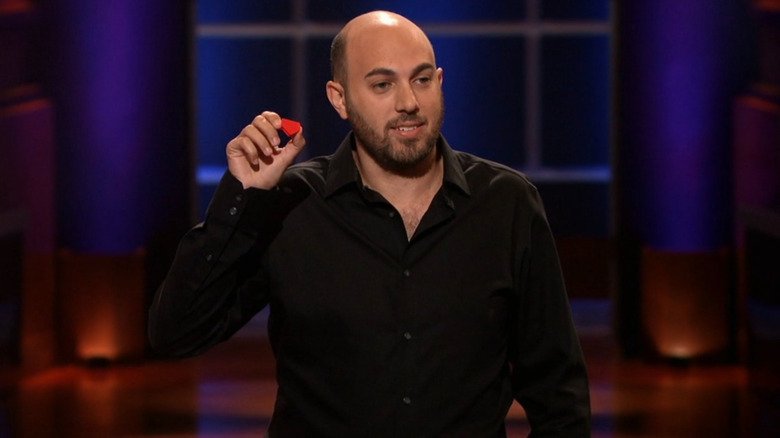
When starting a business, it's good to look at a need within the marketplace and create a product that fulfills that need. Most laptops have cameras these days, but what if they're hacked? That's where CJ Isakow came in with the EyeBloc, a piece of rubber to put over a computer's webcam so that hackers can't see anything should they access it. During his Season 5 appearance, he asked for $50,000 for 10% equity, but his pitch quickly fell apart.
When asked about how many units he had sold so far, Isakow said 45. Not 45,000. Just 45. Why? Well, to be blunt, because anyone concerned about their webcam getting hacked could simply cover it with "post it notes, a piece of gum, or whatever," as Mark Cuban pointed out. Why would anyone spend $9.99 for a tiny piece of rubber when a little piece of tape would yield the same result? EyeBloc may have been featured on one of the best "Shark Tank" episodes, but this was its low point.
Squirrel Boss
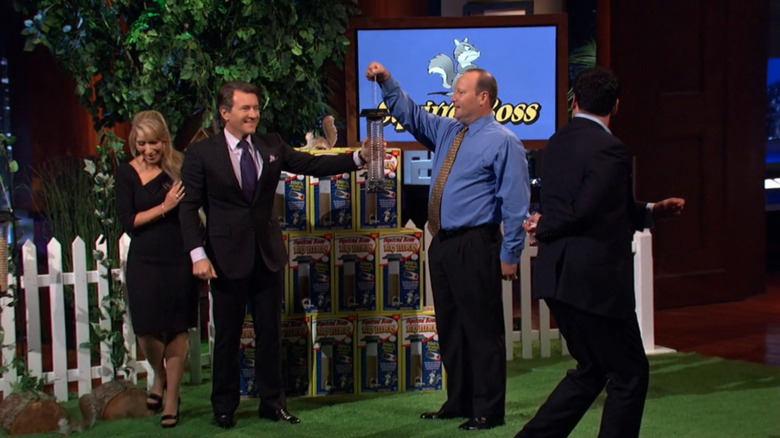
"Shark Tank" investors received quite the shock when Michael J. Desanti came in to pitch the Squirrel Boss during Season 4. It's actually a bird feeder that's outfitted with a system that shocks any squirrels that might come by with the press of a button. It's fun watching many of the sharks walk up to test the shock system themselves. If you've ever wanted to see Robert Herjavec get zapped, this is your chance. Unfortunately, the pitch itself left a lot to be desired.
The product is essentially completely centered on animal cruelty, making it a very hard sell. There's also the not-so-little matter of it requiring a button to be pushed to activate the shock, meaning the homeowner would have to constantly watch the bird feeder in case any squirrels stopped by. Desanti's fate was sealed when he revealed that his patent application had been rejected. With an ask of $130,000, the sharks were not interested, even at 40% equity.
Wake N' Bacon
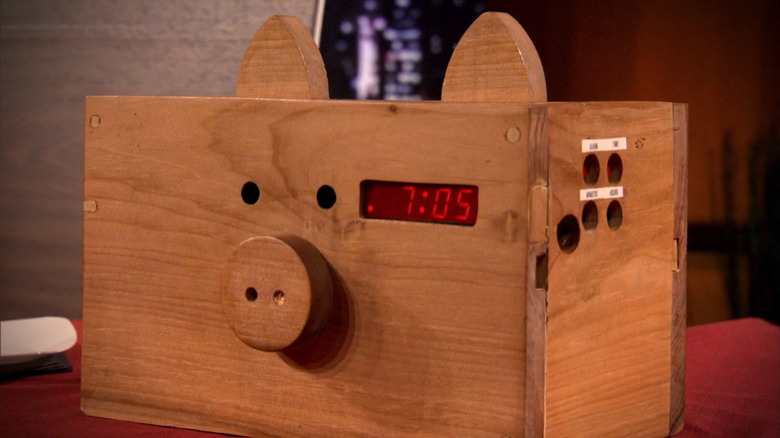
Matty Sallin, the creator of Wake N' Bacon from Season 2 of "Shark Tank," wanted $40,000 for 20% equity in his business, which revolved around selling alarm clocks that started cooking bacon first thing in the morning, right by a person's bedside. It's generally not recommended to sleep next to an oven, but that's the pitch here. Plus, it really shouldn't be that difficult for someone to wake up and walk to the kitchen if they truly have a hankering for bacon.
The pitch quickly descended into one of the most awkward moments in reality TV history. Kevin O'Leary absolutely berated Sallin, who didn't go into specifics regarding safety measures to prevent a fire from breaking out. And that's without mentioning that the product requires people sleeping next to uncooked bacon all night, as the user would need to pre-load the Wake N' Bacon before bed. Honestly, Sallin probably would've had better luck trying to sell a pig-shaped alarm clock without the bacon component.
Him & Hers Bar
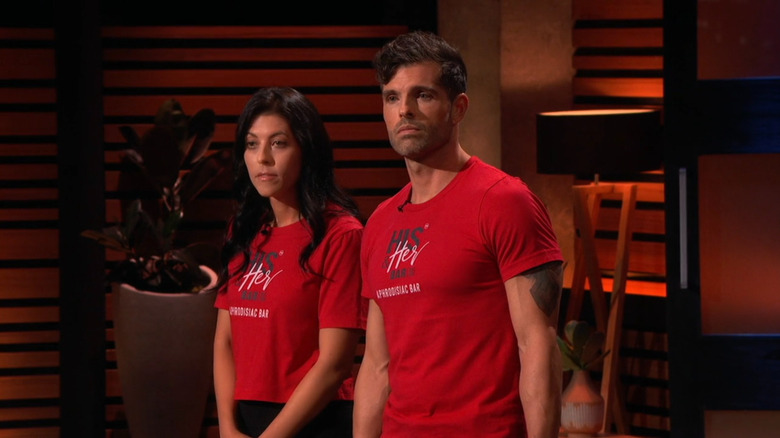
One of the most uncomfortable pitches ever seen on "Shark Tank" occurred during Season 12. Jennifer and Michael Gallagher entered the tank to pitch their His & Hers Bar, an aphrodisiac snack bar designed to help couples get more in the mood. The main ingredient was maca root, which the couple referred to as a natural "Peruvian Viagra." They wanted $50,000 for 10% equity, but their product only had about $2,000 in total sales. It turned out that they had only actually sold around 500 bars since launching the business. Granted, the business was just six months old, but it was still a shocking return, and the sharks didn't hold back when these figures were revealed to them, especially Kevin O'Leary.
Things went from bad to worse when Michael Gallagher started crying, with his wife encouraging him to tell his story. He launched into a sad tale about how he had previously suffered from an aneurysm, but instead of being moved by this revelation, the sharks just sat there looking highly uncomfortable. As a viewer, it's one of the most cringeworthy things ever shown on "Shark Tank." You can't help but feel bad for him, but that doesn't change the fact that this sad story has nothing to do with the product he's trying (and failing) to pitch. The sharks probably wanted to pass as quickly as possible just to bring the awkward encounter to a close.
Skinny Mirror
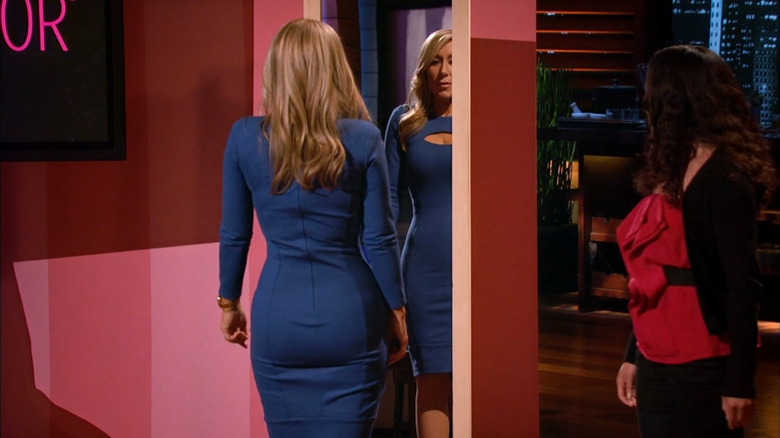
"Shark Tank" Season 7 saw Belinda Jasmine pitch her Skinny Mirror, which utilized a specific type of glass to make people look thinner than they actually are. It's basically a funhouse mirror that makes you look five to ten pounds lighter. While some of the sharks appeared interested to begin with, the mood changed when Kevin O'Leary let his outrage over the product be known — he had a huge issue with making people think they look a certain way when they don't, even if they're aware of what the mirror does.
The pitch started going sideways when Jasmine revealed that most of her sales had come from department stores and hotels. In an unprecedented move, a furious O'Leary actually forbade anyone else from investing in what he saw as a dishonest and dangerous product. Not that they needed to listen to him — in the end, no one invested because there was no patent to prevent competitors from offering something similar. Jasmine wanted $200,000 for 20% equity in her business but she walked away with nothing.
Ionic Ear

Bad pitches are essential to the "Shark Tank" experience, and they've been a thing going all the way back to the first episode. The series premiere sees Darrin Johnson pitching his idea for the Ionic Ear, which would allow for hands-free calling to replace a heavy-duty Bluetooth device resting in the ear. The way he would prevent it falling out is that the Ionic Ear would be surgically implanted within the user. Upon this revelation, the pitch flew off the rails.
This terrible "Shark Tank" pitch has a disturbing similarity to Elon Musk's Neuralink. Both require unprecedented surgery, and, on top of that, the Ionic Ear would still need to be charged, which the user would do by inserting a needle into the area while they sleep. The whole thing raises a host of legal and ethical questions, so it wasn't surprising that all the sharks backed out. The fact Johnson wanted $1 million for 15% equity probably made the decision much easier, as that's a lot of money when there are so many red flags.
Pavlok
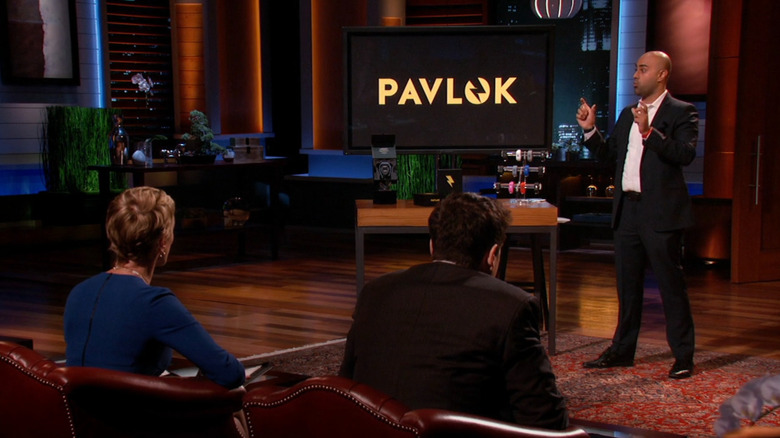
In a heated Season 7 installment of "Shark Tank," Maneesh Sethi pitched the Pavlok, a wearable wristband that delivers a shock to make the user avoid harmful habits, like eating too much or biting their fingernails. He wanted $500,000 for a rather pitiful 3.14% stake in the company, but that wasn't even the main sticking point for the sharks. Mark Cuban took issue with the lack of scientific evidence behind the product, as Sethi cited studies regarding aversion therapy conducted decades ago that his company did not personally conduct.
Sethi's attitude became downright confrontational when he was unable to answer questions related to the efficacy of his device. His pitch had some massive gaps, and his confrontational attitude didn't help, but, remarkably, Sethi actually got an offer — Kevin O'Leary was willing to give him a loan with some other caveats. He decided that he didn't want to work with O'Leary. After all that, when he had someone a little interested, he pushed them away.
Flip-n-Notes

Some of the worst pitches on "Shark Tank" deal with products that have no real reason to exist. Mary Ellen Simonsen appeared on the second ever episode to pitch Flip-n-Notes. Her idea was that instead of having a bunch of sticky notes all tacked onto a computer, you can put them into a single sleeve so that when you close your laptop, all the notes remain organized. She asked for $100,000 for 20% equity, and, despite not having sold a single one.
The sharks immediately picked her pitch apart. Kevin O'Leary pointed out how limited the market for the product actually is: Not everyone puts a bunch of sticky notes directly onto their laptop, and there are easier ways to keep one's thoughts organized. Simonsen insisted that disorganized sticky notes were a massive problem, but the sharks just didn't see a future for her product, especially at $9.50 each. Upon learning the retail price, O'Leary said, "Are you out of your mind? No one's going to give you ten bucks for that thing."