

5 TV Shows To Watch If You Like Dune: Prophecy
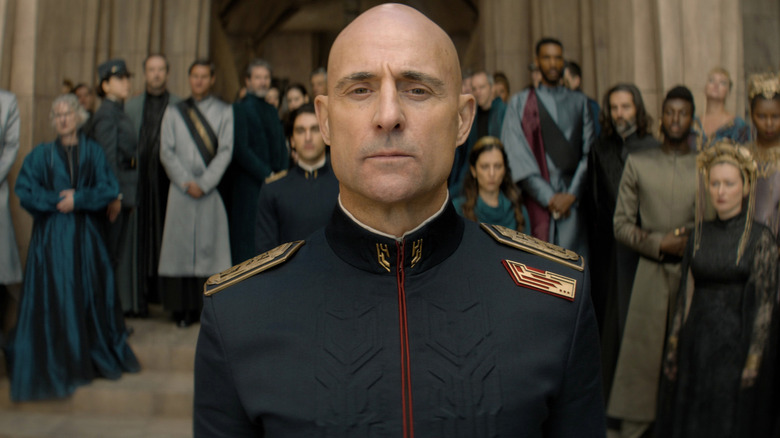
The "Dune" films have taken over pop culture. One could even argue they've superseded "Star Wars" as the science-fiction franchise of choice amongst the nerdiest moviegoers, as "Dune: Part Two" received near-unanimous praise from critics and a Best Picture nomination at the Oscars. Of course, it seems as though no franchise can exist solely on the big screen any longer. Even the most award-worthy projects need to kickstart their own cinematic universes, as the Dune movies have also entered the small screen thanks to HBO's "Dune: Prophecy."
That's not to say "Prophecy" is a massive step down by any measure. It's one of the best sci-fi shows currently streaming on HBO Max, and it's easily able to do its own thing, since it takes place 10,000 years prior to the events of "Dune." Rather than focus on Paul Atreides (Timothée Chalamet), "Prophecy" hones in on the origins of the Bene Gesserit and how they rose through the ranks to become a prominent social and religious order by the time "Dune" rolls around.
You don't need to have seen the "Dune" movies to understand what's going on in "Prophecy," but even on its own, it's a high-concept sci-fi series with a lot of political and philosophical discussions. If you're into the more heady kind of sci-fi, then these TV shows like "Dune: Prophecy" will be right up your alley.
Raised by Wolves
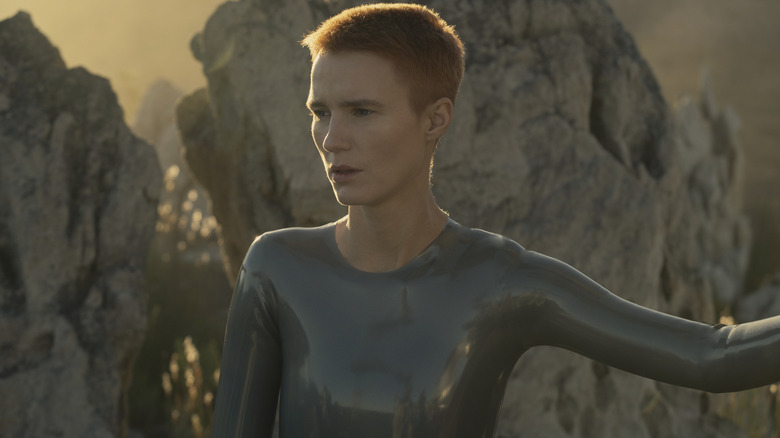
Sadly, it seems that in order for a high-budget science-fiction series to stand a chance, it needs to be attached to a pre-existing property. As such, it shouldn't have been a surprise when HBO's "Raised by Wolves" got cancelled after only two seasons, largely due to corporate restructuring after the Warner Bros./Discovery merger. But if you want to dig into sci-fi with something to say, those two seasons still have plenty of meat on the bones.
"Raised by Wolves" has an intriguing premise: Two androids — Mother (Amanda Collin) and Father (Abubakar Salim) — are tasked with raising human children on a far-off world. However, religious differences threaten to tear the colony apart. Therein lies the biggest similarity between "Raised by Wolves" and "Dune: Prophecy," as both shows focus on how religion is often used to control the masses.
The Bene Gesserit, as depicted in "Dune: Prophecy," aim to manipulate bloodlines in order to bring forth the one true messiah. "Raised by Wolves" sees a remnant of humanity far away from Earth, yet religion based on exterminating non-believers continues to foster. "Raised by Wolves" offers the interesting idea as to whether humans are naturally hardwired to believe in something greater than themselves, even when completely removed from traditional hierarchal religious structures.
The Expanse
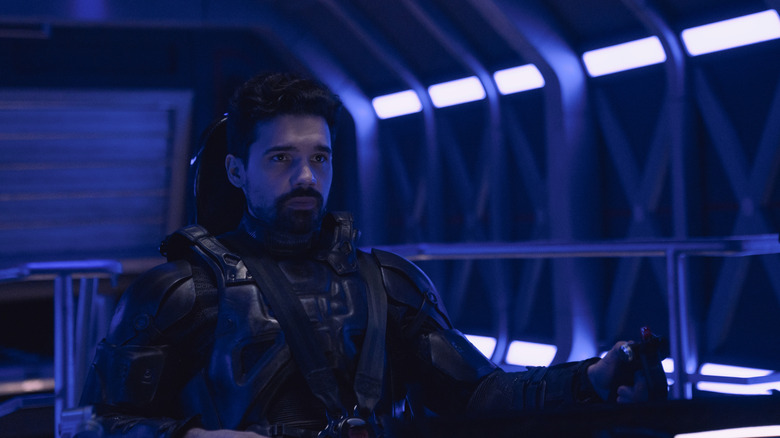
If you don't mind following along to a "Game of Thrones"-scale cabal of characters to keep track of, "The Expanse" is the kind of large-scale sci-fi most networks wouldn't dare touch. In fact, "The Expanse" had to find a home elsewhere when it was cancelled at SyFy, but it fortunately found a home at Amazon Prime Video for three more seasons.
It's a good thing, too, as there was plenty more story to tell. "The Expanse" is set hundreds of years in the future where humanity has colonized the galaxy, but that's only led to greater political turmoil, as different worlds vie for the same limited resources. "The Expanse" explodes into a gold rush-esque quest for every planet to acquire as much power as possible, leading the galaxy to the brink of war.
Like "Raised by Wolves," "The Expanse" has a lot to say about how those who control what stories get passed down through the generations ultimately hold the most power. But it's also a far more realistic portrayal of what an intergalactic humanity might look like. "Dune: Prophecy" gets more fantastical with its depictions of various factions, but "The Expanse" feels all too real with how different heads of state are willing to behave when considering what move to make next to protect their own people.
Foundation

Frank Herbert and Isaac Asimov are both highly influential science-fiction authors. They laid the foundation for where the genre was heading decades into the future, so if you enjoy Herbert's magnum opus with the "Dune" properties, then you owe it to yourself to watch "Foundation," based on the works of Asimov.
"Foundation" on Apple TV is another epic space opera about dynasties and the manipulation of information. A brilliant mathematician, Hari Seldon (Jared Harris), brings on a protege in the form of Gaal Dornick (Lou Llobell) to verify his findings and confirm that a dark age is imminent. However, the least they can do is create the titular Foundation in order to preserve humanity's knowledge so that it doesn't become lost. But even with all of their knowledge and ability to predict future catastrophes, there are some events that can't be mitigated.
"Foundation" is the rare sci-fi series that goes beyond just one set of events. It takes place over the course of centuries, showing that even though leaders and tyrants will come and go, what matters is ensuring the next generation gets started on the best footing possible. This grand story is told on an appropriately grand scale, as the budget is truly impressive. Each episode looks like its own mini-movie with superb effects, so even though it's a show fundamentally about math, it never feels slow.
Andor
There's a conspiracy that Star Wars stole a lot from "Dune," and it's easy to see certain similarities, despite both projects ultimately going off on their own paths. "Star Wars" has always been focused on being popcorn entertainment first and foremost while "Dune" has never been concerned with being palatable to the masses. The success of the movies is a byproduct of having an exceptional director behind the scenes more than anything.
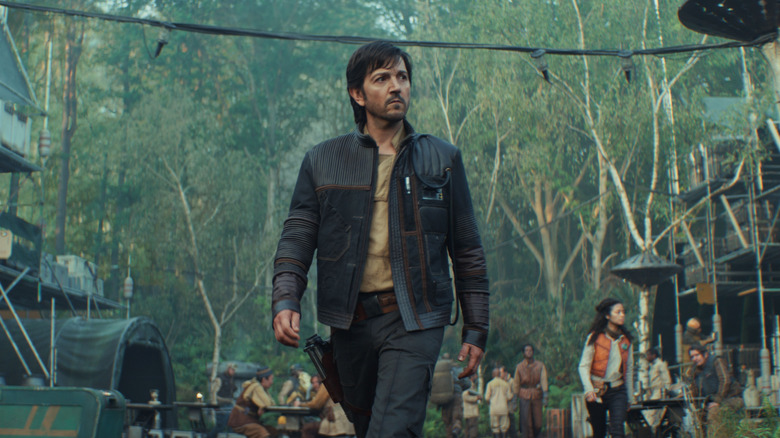
But just like how the "Dune" films got a prequel with "Dune: Prophecy," "Star Wars" got its own blast from the past with "Andor." The series follows Cassian Andor (Diego Luna) prior to the events of "Rogue One: A Star Wars Story," which directly leads into the first "Star Wars" movie. We see Cassian become entrenched with the growing rebellion movement against the Empire. And "Andor" winds up being the most relevant Star Wars project of the last several years, as it comments on how authoritarian and fascism can take over a civilization and be met with widespread apathy.
But both "Andor" and "Dune: Prophecy" aren't as interested in action as their big-screen counterparts. There's still action to be sure, but they trade epic fights for backroom dealings. We get a glimpse at how wars are truly won behind the scenes outside of the battlefield. And both shows depict how the fate of entire worlds can come down to the actions of just one individual. The "Star Wars" galaxy would look very different by the time the sequel trilogy came around if it wasn't for the actions of Cassian, who didn't even want to be a rebel in the first place.
Babylon 5

It's truly a phenomenal time to be a sci-fi fan in the current television landscape. There are so many shows that receive movie-level budgets, where you get epic visuals and grand storytelling one week to the next. But you don't want to overlook where the genre has been in the medium of cheaper TV, and "Babylon 5" is one of many low-budget sci-fi shows that's absolutely still worth watching.
"Babylon 5" may be from the 1990s, but it didn't skimp on the grand storytelling. Set in the far off future, the show follows a crew that gets wrapped up in all sorts of interplanetary political conflicts, including Earth's own descent into totalitarianism. "Babylon 5" was also a pioneer of sorts because it would regularly have storylines spanning multiple episodes. It wasn't like "Star Trek" where you had an "alien race of the week"-type of format and only had two- or three-parters infrequently. "Babylon 5" expected its audience to show up and retain the lore to know what was at stake.
And like "Dune: Prophecy," "Babylon 5" had some prophecies of its own. As you can see from this list, there are many shows where science meets myths, and in many cases, the two aren't as far apart as one would assume.