

10 Best Running Star Trek Gags, Ranked

In the egalitarian, postcapitalist world of "Star Trek," humor is one commodity that never goes out of style. When you're facing off with yet another overpowered alien who claims to be a god, bantering with a spoon-headed tailor, or enduring a self-righteous Vulcan lecture on the morality of space exploration, a little levity goes a long way. Luckily, the "Star Trek" franchise is full of great running gags — intentional or otherwise.
Take, for example, Data (Brent Spiner) from "Star Trek: The Next Generation" lavishing his "good kitty" Spot with everything from special food to a lovingly crafted ode despite the fact that Spot is a holy terror, viciously attacking Riker (Jonathan Frakes), trashing La Forge's (LeVar Burton) quarters, and even running off to have a litter of kittens. And then there's long-lived Lanthanite Commander Pelia (Carol Kane) of "Strange New Worlds" constantly dropping off-handed remarks about taking LSD or working as a roadie for the Grateful Dead. There are even a few running gags in the "Star Trek" universe that continue to unite fans down through the generations.
Since even a positronic brain could use a good laugh every now and then, here's our Trekkie-informed ranking of the top 10 running gags in the franchise.
10. The real meaning of GNDN
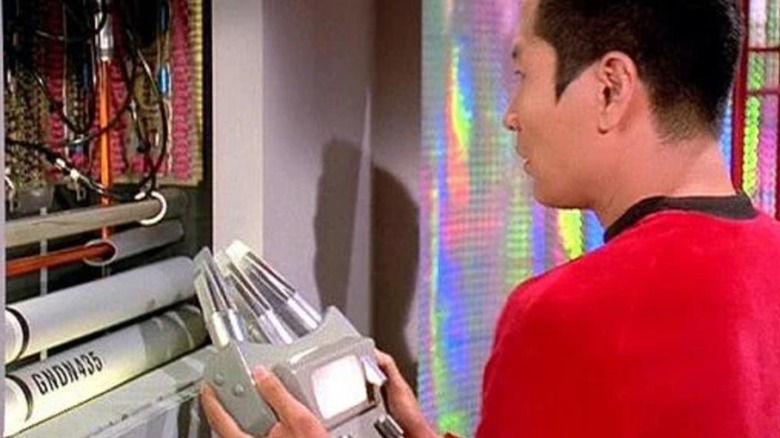
From nacelles to warp cores, the ships in the "Star Trek" universe are powered by all sorts of handy little gizmos, all of which appear to make sense in some sort of in-universe way. If you look closely in "Star Trek: The Original Series," you'll see that some of the conduits lining the walls of the Enterprise are stamped with the label GNDN. But what does that stand for, exactly?
It turns out that GNDN is an acronym that stands for "Goes Nowhere, Does Nothing," a sneaky little set designer in-joke that started on the original "Star Trek" series back in the 1960s. As a nod to the original gag, the joke was reprised in the "Star Trek: Deep Space Nine" episode "Trials and Tribble-ations," which finds Captain Benjamin Sisko (Avery Brooks) and Jadzia Dax (Terry Farrell) visiting Kirk's Enterprise to prevent his assassination.
Speaking on an Art Directors Guild panel, "Star Trek" set designer John Jefferies recalled filling up blank set walls with pipes splashed with little pops of color to make everything look more believable. "We always wanted to identify something with a form of nomenclature," Jefferies shared, recalling that one of his favorite labels involved "GNDN." When asked by the panel host what that means, Jefferies replied, "GNDN means goes nowhere, does nothing!"
9. The Great Koala
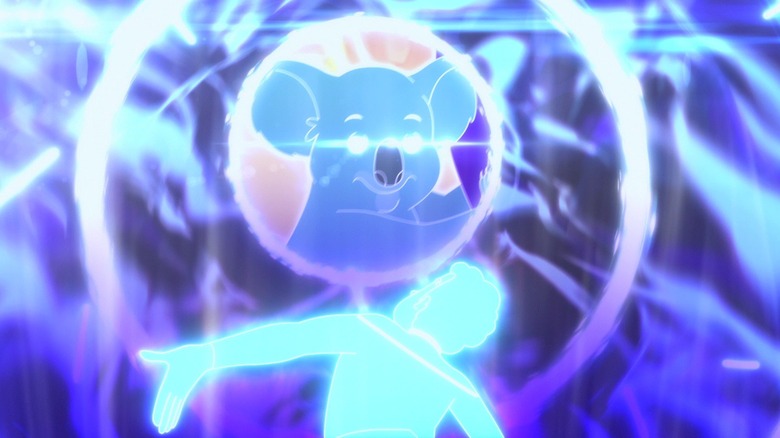
Some of the best running gags in the "Star Trek" universe are the ones that start off as a bit but end up making their way into canon. Such is the case with the Koala, a godlike entity from "Star Trek: Lower Decks" that ranks among the strongest "Star Trek" characters in terms of power, ability, and all-around coolness.
We first learn about the Koala when Lieutenant Junior Grade O'Connor (Haley Joel Osment) finally achieves ascension into a higher plane of existence after sacrificing himself for D'Vana Tendi (Noël Wells) in "Moist Vessel." As O'Connor begins to glow an electric shade of blue and transform into a being of energy, he tells Tendi, "The universe is balanced on the back of a giant Koala! Why is he smiling? What does he know? The secret of life is—" before abruptly disappearing to another realm.
The Koala's repeated appearance in various characters' near-death and very brief post-death visions throughout the series and even on the holodeck suggests there is a metaphysical quality to the Koala that supersedes all other religions in "Star Trek." The Koala even speaks when Boimler dies on Corazonia in the episode "In the Cradle of Vexilon." He comes face-to-face with the Koala, who speaks in the Twin Peaksian backwards Koala tongue to tell him it's not yet his time. Apparently, the god of "Star Trek" is adorable.
8. Redshirts die first

The whole "redshirts die first" thing became a running theme that morphed into a running gag. There's a shockingly high death rate for officers wearing red shirts in "Star Trek: The Original Series." Send a redshirt on an away mission, and that officer's chance of death gets even higher. The death of low-ranking officers wearing these uniforms was so prevalent on Captain Kirk's (William Shatner) Enterprise that the term "redshirt" has evolved into shorthand for a doomed stock character with a brief screen time whose quick death moves the plot along.
Unlike later "Star Trek" series, when red Starfleet uniforms came to signify high-ranking command officers, "The Original Series" had red shirts worn by engineering, security, and other operations officers. As security officers were typically sent on away missions, these redshirts were frequently killed off to signify the danger of a mission, with deaths ranging from vaporization to having their blood drained by the vampiric cloud in "Obsession."
The concept of redshirts has grown into an in-joke among Trekkies, turning the death of these characters from an on-screen necessity into a running gag. "Star Trek: Lower Decks" poked fun at the "Star Trek" redshirt death trope in "The Spy Humongous" when Ensign Castro (Gabrielle Ruiz) and a few others start a club called the Redshirts and she says, "Cool name, right? Makes us sound invincible."
7. Mirror Kira can't stop killing Ferengi

There are plenty of parallel realities in the "Star Trek" franchise, but none are as iconic as the lamé-drenched Mirror Universe, where the alt version of Major Kira Nerys (Nana Visitor) just can't stop killing Ferengi. While Prime Universe Kira, the senior Bajoran Militia officer on Deep Space Nine, might have a short fuse, she's hardly the type to go around murdering Ferengi just for the heck of it. However, her Mirror Universe double happens to have a very itchy trigger finger when it comes to those little guys with the big ears.
Mirror Kira's first Ferengi fatality takes place in "Crossover" when she orders the off-screen execution of Mirror Quark (Armin Shimerman). She adds his brother to her list of dirty deletions in "Through the Looking Glass," in which her next-in-command, Mirror Garak (Andrew Robinson), tortures and kills him. In "Shattered Mirror," Mirror Kira takes out Nog (Aron Eisenberg) after he frees her, and in "The Emperor's New Cloak," Mirror Kira adds Mirror Brunt (Jeffrey Combs) to her past tense list.
While it's likely Mirror Kira's tendency to kill Ferengi is a nod to Prime Kira's private distrust of the race as likely Cardassian collaborators, the pattern has morphed into a running gag among Trekkies. If you've got the Rules of Acquisition (the sacred text that shapes Ferengi society) on your audiobook playlist and you see the glimmer of the Mirror Kira's silver Jazzercize headband nearby, it's safe to say you're cooked.
6. Self-sealing stem bolts
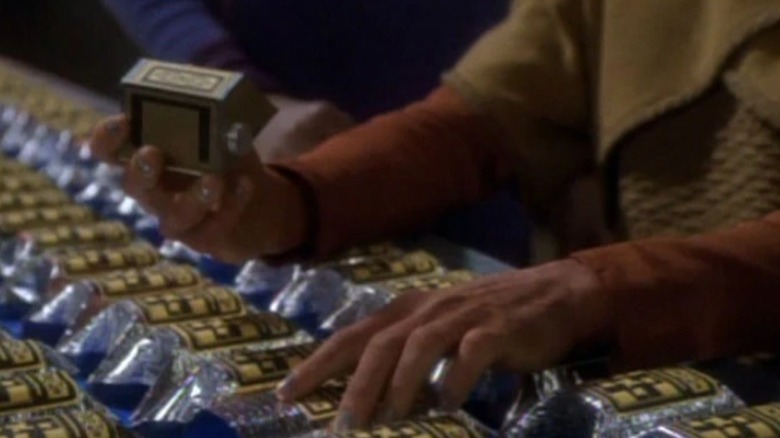
Much like the GNDN conduits of "The Original Series," the self-sealing stem bolts of "Deep Space Nine" are a handy little piece of space tech with a nebulous usage and purpose that we can only presume the spacefaring folk of Starfleet know what to do with. That's why it's kind of a shocker to learn even Starfleet Engineer Extraordinaire Miles O'Brien (Colm Meaney) hasn't the vaguest clue of what they're used for in "Progress."
These mass-produced tools first show up as something of a MacGuffin to help young investors Nog and Jake Sisko (Cirroc Lofton) try their hand at storage unit flipping after the pair score 5,000 wrappages of Cardassian yamok sauce. The bolts show up again in "Prophet Motive" when Zek (Wallace Shawn) and Quark get into a price war involving some self-sealing stem bolts. Although it's still unclear at this point what they are used for, their buyer claims the bolts can be used to produce reverse-ratcheting routing planers (whatever those are). And in "What You Leave Behind," O'Brien, who appears to have worked out what they're used for by this point, tells Dr. Julian Bashir (Alexander Siddig), "Somebody has to teach you officers the difference between a warp matrix flux capacitor and a self-sealing stem bolt."
The bit carries over to later "Star Trek" series, showing up in the "Lower Decks" episode "Parth Ferengi's Heart Place" when Mariner Beckett (Tawny Newsome) over-weathers a stem bolt to the point that Boimler remarks it likely will no longer self-seal. And after the Discovery crew permanently relocates to the 32nd century in the "Star Trek: Discovery" episode "Scavengers," they find a world where "antique" stem bolts are frequently looted by space scavengers. We never learn what they're for, though.
5. Janeway's replicator fails
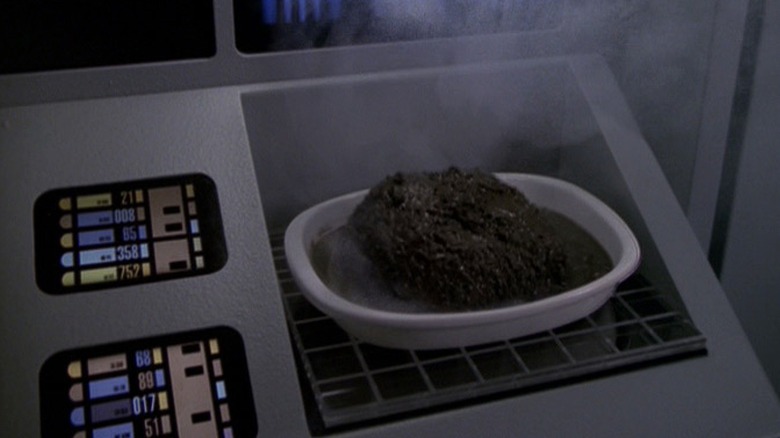
Strong, capable, and confident, Captain Janeway (Kate Mulgrew) of the USS Voyager has had some fierce moments. But she's also the 24th century equivalent of the person we all know who could burn dinner in a microwave thanks to her painfully antagonistic relationship with the ship's replicator system in "Star Trek: Voyager."
Using a replicator seems pretty straightforward — simply program in your little recipes and then tell the computer precisely what you want and wait for it to appear. And yet, for some reason, Janeway can't seem to make the darned thing work for anything more complex than her standard order of "Coffee, black" — and even that's not always guaranteed to come out right. This has to be particularly frustrating on a ship where the crew is forced to ration their replicator use.
Janeway's troubled history with the replicator comes up again and again in the series. In two separate episodes, her pot roast order comes out charred, ruining her dinner plans with Chakotay in "Shattered" and forcing her to serve Ensign Lyndsay Ballard (Kim Rhodes) peanut butter and jelly sandwiches in "Ashes to Ashes." And, due to Q's shenanigans in "Q2," Janeway's replicator responds to her coffee order with a salty "Make it yourself."
4. Klingons do not ...

As the adopted son of human parents, Lieutenant Worf (Michael Dorn) spent most of his childhood longing to do Klingon things. Later, as the sole Klingon crewman on the Enterprise-D, he spends much of his adult life serving as an onboard encyclopedia for all the things Klingon warriors do not do, with many of his claims ranging from eyebrow-raising to suspect. The "Star Trek: The Next Generation" security officer has so much to say about it that should he ever retire from Starfleet, he has more than enough Klingon-isms to pen his own coffee table book on the subject. And, because he's the only Klingon around, everyone else has to just take his word for it.
Some of Worf's claims seem fairly plausible and almost self-help oriented, such as "Klingons do not give up easily" and "A warrior does not complain about physical discomfort." But many come off as excuses or even hint that he's trolling his colleagues. Worf asserts that Klingons don't "pursue relationships," instead conquering that which they desire, despite practically crawling out of the airlock to avoid his romantic tension with K'Ehleyr (Suzie Plakson). He tells Dr. Pulaski (Diana Muldaur) that Klingons don't faint while being treated for fainting in "Up the Long Ladder." And when he claims that Klingons do not laugh in "Redemption," Guinan (Whoopi Goldberg) fully calls him out on his nonsense, quipping, "You don't. But I've heard Klingon belly laughs that'd curl your hair."
Worf's Klingon-splaining goes so far that even his kid picks up the habit, claiming his dad had told him Klingons do not listen to teachers. Unfortunately for young Alexander (Brian Bonsall, who had some legal issues after his time on "Star Trek"), Klingons do go to parent-teacher conferences.
3. I'm a doctor, not a ...

Another Starfleet officer with a lot to say about what he does and doesn't do is the sassy Dr. Leonard "Bones" McCoy (DeForest Kelley), whose insistence on maintaining workplace boundaries regarding what was and was not in his wheelhouse became a running gag in "Star Trek: The Original Series." The line would prove so iconic that it has been referenced and echoed by other "Star Trek" characters throughout the franchise. Of course, this classic "Star Trek" line, likely inspired by a 1930s movie, is the catchphrase: "I'm a doctor, not a [fill in the blank]" — generally a response to something he deems an overreaching demand on the captain's end.
Here's an incomplete list of things Bones wants everyone to know he isn't: a psychiatrist, a mechanic, an engineer, a bricklayer, a coal miner, a magician, a moon shuttle conductor, and an escalator. Dr. Julian Bashir later picks up the bit in "Deep Space Nine," telling Garak in "Past Prologue," "I'm a doctor, not—" before getting cut off. When asked to diagnose a plant in "The Wire," Bashir tells Jadzia, "I'm a doctor, not a botanist," and in "Trials and Tribble-ations," he quips, "I'm a doctor, not a historian" while time traveling. Dr. Phlox (John Billingsley) also gets in on the action in "Enterprise" when he remarks, "I'm a doctor, not an engineer."
All of those doctors walked so the Emergency Medical Hologram known simply as The Doctor (Robert Picardo) could run, delivering dozens of "I'm a doctor" gags in "Star Trek: Voyager." He might be a sentient AI with a vast database filled with occupational capabilities, but The Doctor insists he is not a bartender, butler, decorator, peeping tom, counterinsurgent, commando, zookeeper, dragonslayer, exorcist, battery, performer, or doorstop, among other things.
2. Prune juice is a warrior's drink
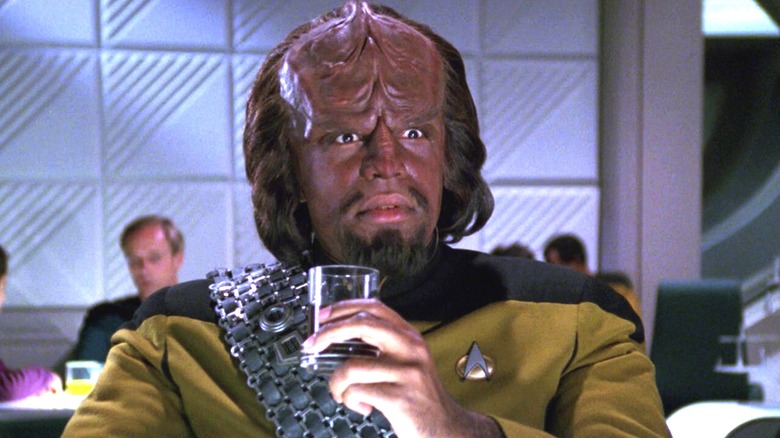
As a mighty Klingon warrior, Worf presumably knows every bit as much about the Klingon culinary arts as he does about all the things Klingons do and do not do. As a child, he even went through a phase where he refused to eat human food, forcing his poor mom to learn the recipe for the Klingon favorite dish Rokeg blood pie. In "Star Trek" canon, Klingons appear to have a rather intense palate by human standards, preferring strong flavors and uncooked meat-based recipes like heart of targ, pipius claw, and gagh, a dish made with live serpent worms.
Of course, no Klingon dinner table would be complete without a big old mug of blood wine, the official drink of warriors. So what does our bat'leth-wielding beefcake order with his slithering-fresh vat of racht? Why, prune juice, of course! Turns out the other official drink of warriors is also the official drink of senior citizens hoping for quality bowel movement. Worf was introduced to the fiber-rich Earth beverage by Guinan in "Yesterday's Enterprise," and it became an instant classic. By the time he's serving on Deep Space Nine, extra large chilled prune juice is Worf's venti macchiato.
Writer Ronald D. Moore, who penned many episodes across several different "Star Trek" series before winning an Emmy for his work on "Battlestar Galactica," adapted the idea of a fruit juice-loving Klingon from John M. Ford's "The Final Reflection." This 1984 non-canon "Star Trek" Pocket Books novel, told from a Klingon perspective, follows an orphaned Klingon named Vrenn who develops an appreciation for various fruit juices and nectars, at one point even chugging a large glass of each of the nine fruit juice flavors available in his quarters.
1. Morn the barfly
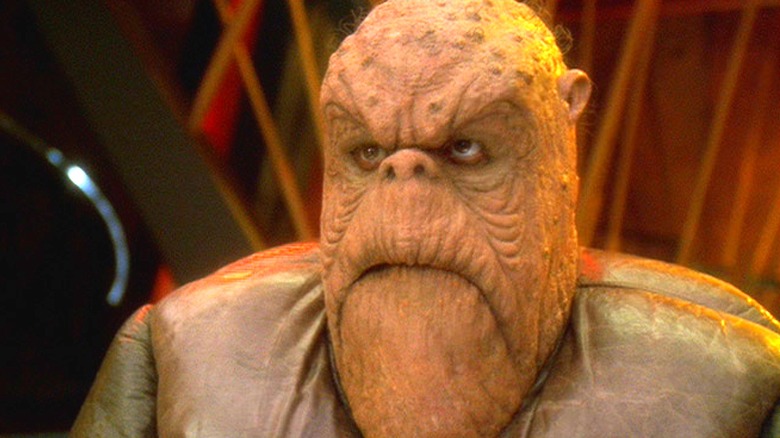
Every good neighborhood pub needs its barflies. For Quark's bar in "Star Trek: Deep Space Nine," it's Morn (Mark Allen Shepherd), the strong and silent Lurian courier who has become such a fixture at Quark's place that he has his own special barstool. His mere presence is so essential that Quark calculates a very real impact on his business when Morn isn't around, a problem he solves by installing a Morn holograph so his business doesn't take a dip when he's off doing other things.
A nod to Norm (George Wendt), the beloved "Cheers" patron who spends hours each day perched atop his own special barstool with a mug of beer in his hand, Morn never says a word onscreen despite showing up in 93 episodes. However, through other characters, we learn that he's anything but simple stage dressing. It is often implied that Morn can't stop talking, with Quark unironically remarking that Morn never closes his mouth on several occasions. He's even prone to some pretty wild antics, like the time he apparently faked his own death in "Who Mourns for Morn" or the crashout that saw him running around in his birthday suit and walloping Quark on the noggin with his barstool in "Blaze of Glory."
"Deep Space Nine" continues to build up the Morn lore as the series progresses, adding texture to his personality with details like his rather interesting bachelor pad, where he sleeps in a mud bath with a matador painting on his wall. The fact that we only see a silent, stoic barstool jockey despite Morn allegedly being one of the most interesting "Star Trek" characters makes this the best running gag in the history of the franchise.