

5 John Wayne Box Office Flops That Every Fan Has To Watch At Least Once
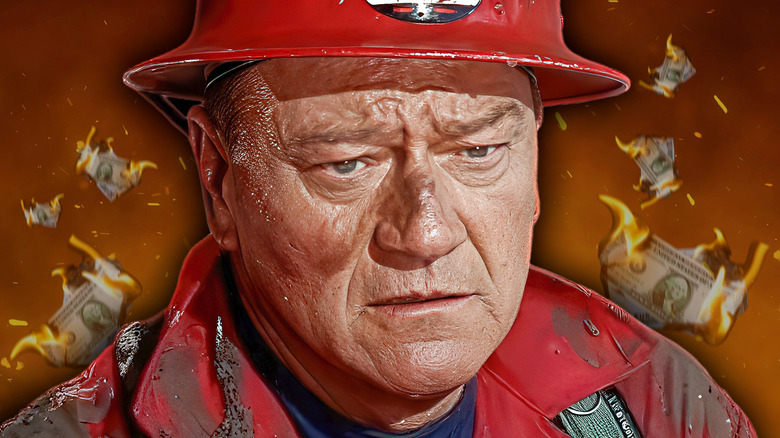
Throughout his career, John Wayne appeared in more than 150 films — and by the law of averages, some of them didn't turn out quite as well as the others. Even Hollywood's most iconic stars have their off days, and the Duke's filmography contains infamous disasters as well as unqualified triumphs. However, true fans know that the box office flops are just as pivotal to his movie star arc as his many masterpieces.
The five movies on this list are a mix of acclaimed but underseen movies which didn't get their due when initially released, and a string of roundly panned efforts that all arrived at fascinating moments in his career. Some will be a joy to watch while others may feel a bit outdated, but they're worth seeing by every fan; through the financial lows in his filmography, you can understand the decisions that informed his next moves. Many of these flops needed to happen so he'd be back on the track towards another major masterpiece — and if you can stomach the lows in the selection, you'll have a better appreciation for the highs that followed, including the best Western films Wayne ever made.
The Big Trail
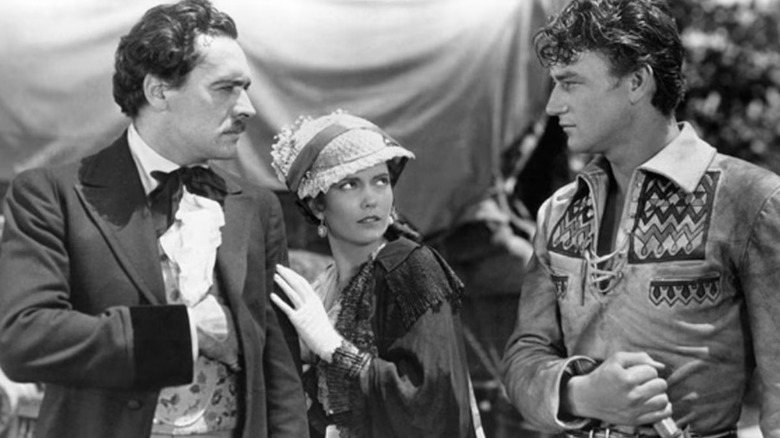
In 2026, John Wayne's first lead vehicle, "The Big Trail," entered the public domain, a welcome fate for a movie that spent several decades in limbo. Released in 1930, director Raoul Walsh shot his Oregon Trail adventure in an experimental format known as 70mm Grandeur film, a gloriously epic form of celluloid pioneered by the Fox Film Corporation that left critics stunned by its beauty.
Very few audiences could agree; an industry still adapting to sound had little room for other technological advances, and the Great Depression meant many theaters couldn't afford to upgrade, with only two theaters in the whole country showing it as it was intended to be seen. It was a financial failure in 1930, which relegated Wayne to B-movies until 1939's "Stagecoach," but it has maintained a strong critical reputation over the years.
A standard 35mm print of the movie was released more widely at the same time, but this differed from Walsh's preferred vision significantly, as the director didn't simply adapt the grander footage to suit a more accessible format, and it ran 14 minutes shorter. He shot many scenes simultaneously on 35mm and 70mm, with notable angle changes in several sequences (shot preference was always given to the 70mm camera), and staged dialogue completely differently. The preferred 70mm cut didn't utilize close-ups to emphasize the sweeping, epic scenery around the characters, whereas the 35mm would restage those conversations nearer to the actors' faces.
For several decades, this iteration of "The Big Trail" was the only accessible version, and it appeared that the 70mm wouldn't be restored due to damage to the original nitrate camera negatives, which were too fragile to be copied after years of decomposition. Film technician Karl Malkames spent a year building a special printer that it could be transferred to, and Walsh's intended cut was accessible again by the late 1980s.
The Conqueror
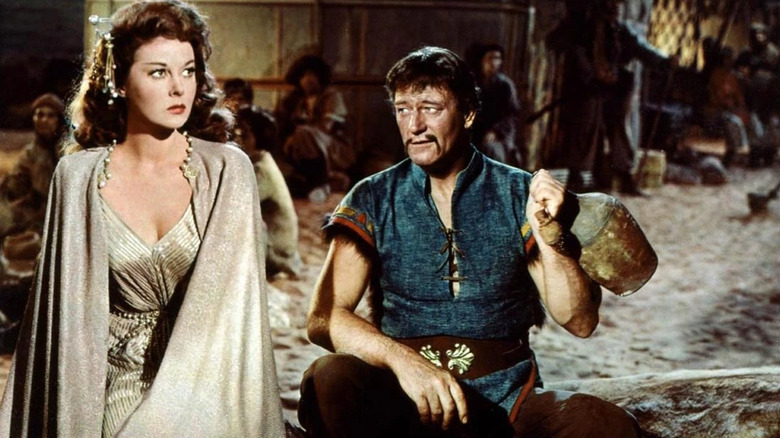
Can you really call yourself a fan of the Duke if you haven't subjected yourself to what is widely regarded as not just his worst movie, but one of the biggest stinkers in cinema history? Director Dick Powell's misguided 1956 biopic, "The Conqueror," was initially set to star Marlon Brando as Genghis Khan, but he made the wise decision of backing out — John Wayne heard this news and started actively lobbying for the role of the Mongol leader, with Powell relenting and casting him despite thinking he was ill-suited for the role. By all accounts, the shoot was a complete disaster, ballooning in budget to become studio RKO's most expensive production at that time, with Wayne stumbling in drunk to set most mornings.
It resulted in a movie panned by critics right out of the gate for its script and performances — although some of the action sequences were commended — and it only grew in infamy from there. Producer Howard Hughes spent $12 million buying back every print of the movie to keep it out of circulation. In the years that followed, 91 cast and crew members — including Wayne – were diagnosed with cancer, which many believe can at least partially be attributed to radiation exposure, as the Utah filming locations weren't far from the Nevada site used to test nuclear bombs a few years earlier.
It added another cursed layer to an already wretched production, with 21% of the cast and crew members dying of cancer in the years that followed. It's easy to say that people shouldn't make bad movies, but all the signs were telling producers to stay away from this one; some would argue that it's unwatchable today, but we think that any fan needs to experience this train wreck for themselves.
The Alamo
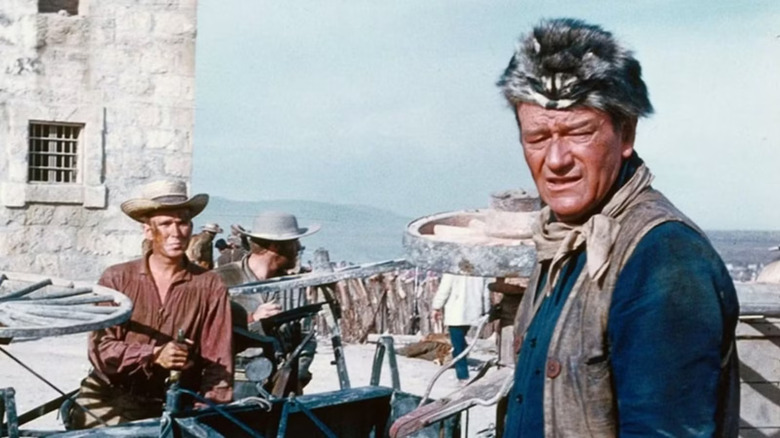
On paper, John Wayne's directorial debut appears to be an unqualified success; a Best Picture nominee with several other Oscar nominations to its name, this personal project for the Duke (reportedly 15 years in the making) seemed to have been realized to the highest standard. However, those headline accolades are suspected to be the result of the star's intense lobbying, as 1960's "The Alamo" didn't get close to making back its budget and suffered from mixed-to-negative reviews, with its lack of historical accuracy particularly singled out for criticism — to this day, it's the rare Best Picture nominee that boasts a rotten Tomatometer score. And yet, this historical epic about the pivotal battle in the Texan Revolution, starring Wayne as Col. Davy Crockett, remains of keen interest because it offers the clearest insights into his political worldview.
Various monologues about "freedom" emphasize Wayne's Cold War-era anti-communist views, with the historical conflict restaged to draw parallels between Santa Anna's Mexico and the Soviet Union. It's a grand historical tale which, in this retelling, becomes the actor's most personal project; a soapbox to project his own opinions, which his usual directorial collaborators rein in. And it's not like they didn't try here — John Ford showed up on set uninvited, and all the footage he shot got lost on the cutting room floor.
Few would argue that the movie didn't need that master filmmaker's polish, but "The Alamo" is an intriguing curio in its final form: a work of pure movie star ego that offers a clearer window into its creator's mind than any of his other starring vehicles.
Hellfighters
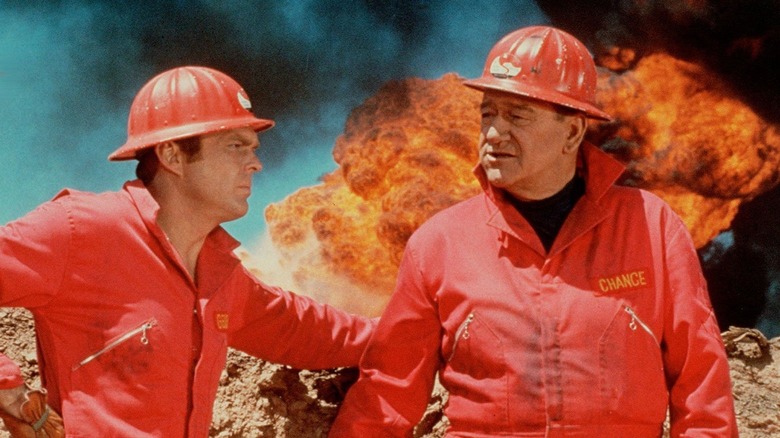
By the 1960s, many of Wayne's vehicles were self-produced via his company Batjac Productions, which makes the movies he agreed to star in outside of that run of particular fascination. Some of those he had no behind-the-scenes involvement with were among the highest regarded of his late period, such as reteaming with John Ford for "The Man Who Shot Liberty Valance," or his career Best Actor win for playing Rooster Cogburn in "True Grit." And then you have a completely bamboozling star vehicle like "Hellfighters," which it appears Wayne only agreed to sign up for as it was the first time he received a $1 million salary – a major career landmark that has been largely forgotten, brushed from the cultural consciousness by his Oscar-winning performance a year later.
Based extremely loosely on the life of oil well firefighter Red Adair, Wayne plays Chance Buckman, who travels around the world to put out some of the deadliest blazes. However, this action takes a backseat to the soapy melodrama, as he longs for the ex-wife who left him due to her fear he'd be killed on the job, and grows closer to his daughter after she marries one of his fellow hellfighters. The disaster sequences were considered to be standouts, as very little else in the movie did; it maintains a stinky 14% Rotten Tomatoes rating, as critics were generally unmoved by the core character drama. It's a curio for the true Wayne completists, but due to the money he made off the back of it, this forgotten would-be blockbuster is a milestone in the final stretch of his career.
The Train Robbers
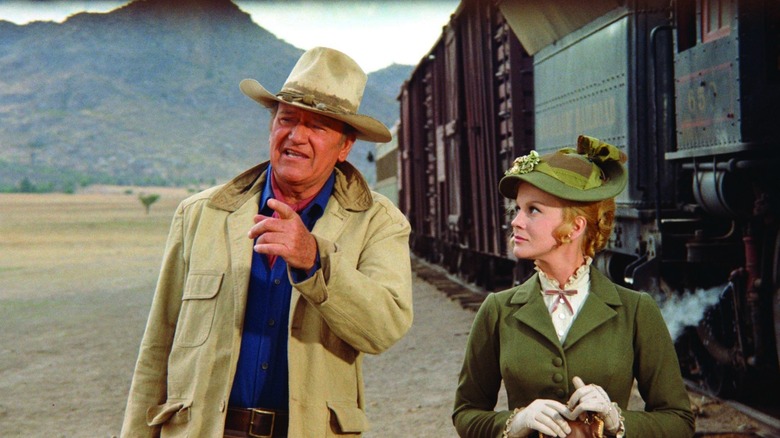
Burt Kennedy was considered one of the finest western screenwriters of them all, and this 1973 directorial effort is one he described as "really good" in his 1997 memoir. Not many would agree with him, though. "The Train Robbers" received positive reviews from the likes of Roger Ebert, who gave it 3 out of 4 stars, but it was generally written off, and the overall mixed-negative reaction resulted in its present-day 40% Rotten Tomatoes rating. This is far from John Wayne's worst-reviewed starring vehicle, but it is among his lowest-rated Westerns – which is unusual, as the reviews trended more mixed than downright negative, with many critics finding some old-school charms in this laid-back tale of a gang hunting down gold hidden in Mexico. Fans of the Duke need to see "The Train Robbers" purely to correct the historical record.
One of the reasons it struggled to connect with audiences in 1973 is because it felt like a relic of a bygone Western era. The genre was fashionable again thanks to the ultraviolence of Spaghetti Westerns, and darker revisionist stories that were all the rage during the moody New Hollywood era — a nostalgic throwback that overlooked the bleaker historical perspectives offered by the critical darlings of the period was never going to command the same attention. Nobody will proclaim that "The Train Robbers" is one of Wayne's best, but its reputation is in large part due to the cultural context it was released into. Its traditionalism has helped it age better than you'd expect.