

5 Classic John Wayne Movies That Are Unwatchable Today
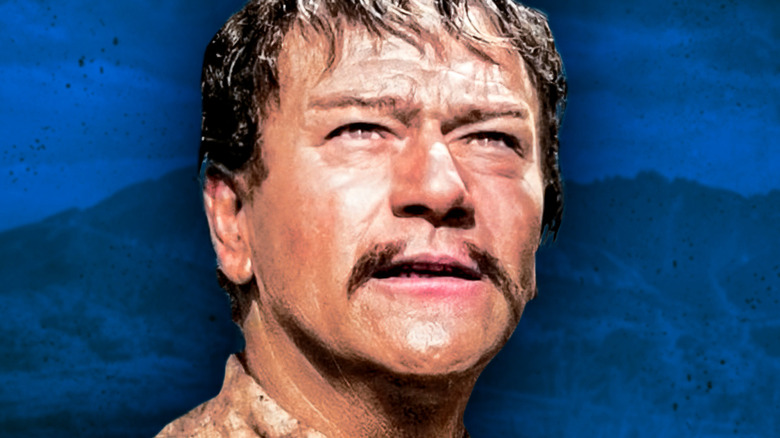
John Wayne's status as one of the biggest movie stars in history cannot be questioned. However, this doesn't mean that all of Wayne's movies rank among his best – especially when viewed through contemporary eyes.
The man who was born Marion Morrison acted in no fewer than 185 projects between 1926 and 1976. The sheer size of his five-decade output saw some quality dips along the road, with some of his films being far better than others. Given the era he worked on, he also sometimes ended up in movies that are incredibly hard to watch today, for a variety of reasons.
Some of the actor's least savory movies are uncomfortably political, while others can be seen as propaganda. There are Wayne films out there that wear their misogynistic attitudes on their sleeve, as well as ones that come across as racist or otherwise hateful. The reasons vary, but one thing is constant: The following five John Wayne movies are all but unwatchable for today's audiences.
Big Jim McLain
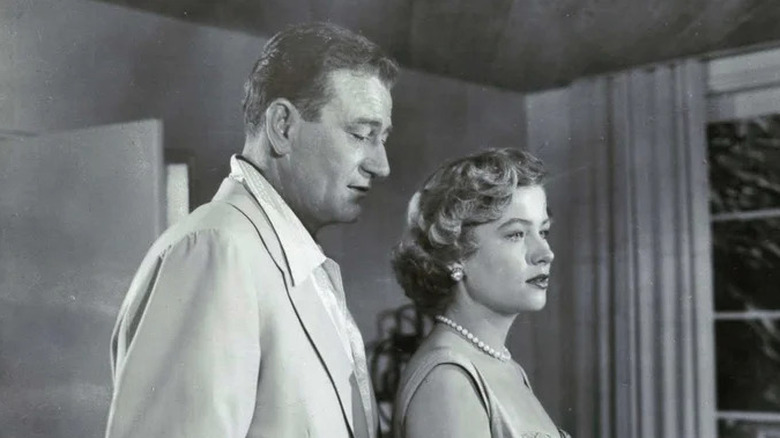
John Wayne famously leaned very right when it came to politics, and 1952's "Big Jim McLain" is a celluloid testament to his views. Here, Wayne plays the titular House Committee of Un-American Activities (HUAC) investigator who's sniffing out communist activity in Hawaii with his sidekick, Mal Baxter (James Arness). In the grand context of history, the end result is a grim affair that a modern viewer will likely only appreciate if they are in the habit of using the word "woke" as an expletive.
In all fairness, "Big Jim McLain" did come out during the comparatively early stages of McCarthyism when it wasn't yet quite apparent how badly the movement would damage reputations and falsely accuse people of being "communists" just because their views didn't fall in line with the right . Still, it's wild to see the well-known conservative Wayne play a HUAC accuser in one of the most notorious witch hunt campaigns in modern politics — especially since we're supposed to consider him the hero.
The Barbarian and the Geisha
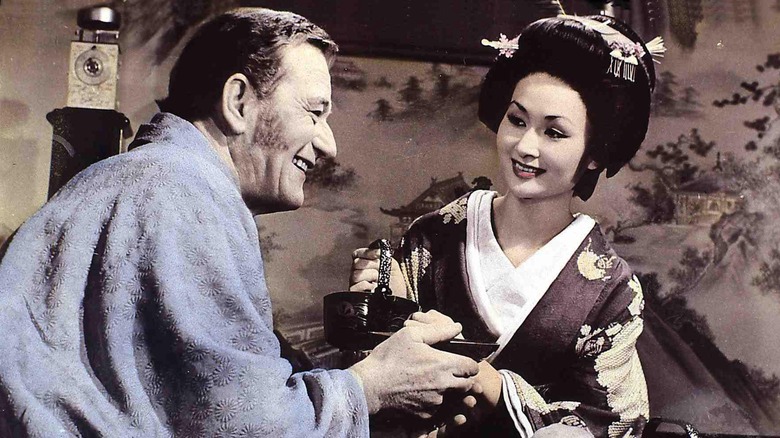
The 1958 John Huston movie "The Barbarian and the Geisha" is exactly the kind of culturally insensitive misfire you might expect from a film that put John Wayne in his usual mode during the era's stereotype-ridden portrayal of Japan — as an official ambassador of the U.S., no less. You can already imagine the unsavory collection of clashing cultural tropes when Wayne's persistent diplomat Townsend Harris hits Japan.
Unsurprisingly, Harris' all-American charm and brash tactics inevitably win over the locals and gains the attention of the beautiful geisha Okichi (Eiko Ando), originally meant to spy on the ambassador. However, what might surprise you is that "The Barbarian and the Geisha" is a comparatively muted affair that makes Wayne's larger-than-life presence all the more inexplicable.
There are some indications that "The Barbarian and the Geisha" could have been a better movie. Huston's relationship with Wayne was tense, and the director doesn't think very much of the film, with Wayne and the studio tampering with it after Huston exited the project. Regardless of the post-Huston tinkering of the end product, the fact remains that Wayne is spectacularly miscast in the movie, making it a difficult watch.
McLintock!
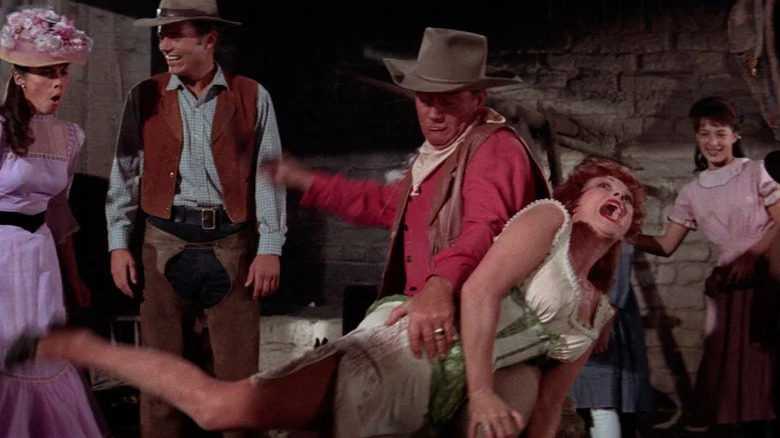
"McLintock!" is one of John Wayne's worst Western movies for many reasons. Apart from it simply not being very good, casting the unfunny actor in a comedy that draws inspiration from William Shakespeare's misogyny-themed play "The Taming of the Shrew" makes it extra uncomfortable on two different fronts. The third swing and a miss comes from Wayne's own behavior during filming. Wayne mistreated co-star Maureen O'Hara during filming, and happily recounted a time when she threw the non-consenting actress down a muddy hill in a 1976 episode of "Donahue" – all to show off in front of some hesitant stuntmen, apparently.
"I said, 'Maureen, you ready?' and she said, 'Yeah,' I said, 'Get over there!'" Wayne said. "She got over there. I said, 'Stick me with a hatpin!' She did and I went 'Wham!' Down she went, cursing at me all the way down, and the stuntmen had to change the amount that they felt that stunt was worth."
Wayne and O'Hara were on good terms in real life, and this particular incident didn't seem to have hurt their relationship in the long run. Still, from a contemporary point of view, knowing what O'Hara went through during filming doesn't score Wayne any "McLintock!"-themed brownie points — especially since O'Hara wrote in her memoir, "'Tis Herself," that a spanking scene in the movie was also legitimate and left her bruised for a week.
The Green Berets
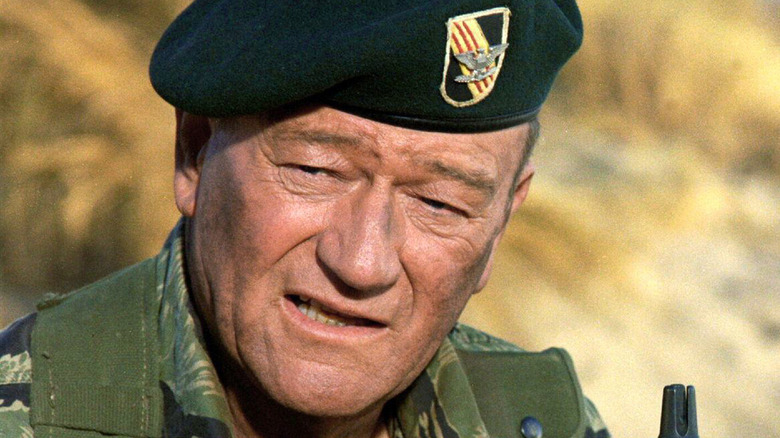
One of the many things you may not have known about John Wayne is that he made an infamous pro-Vietnam War movie despite many around him criticizing the conflict. Said film was 1968's "The Green Berets," and is far from one of the best Vietnam War movies out there.
The story behind "The Green Berets" is that the Pentagon provided the film with a vast amount of access to military bases and equipment. In exchange, the movie's script was reworked into an uncomfortable propaganda machine that presented Colonel Mike Kirby's (Wayne) titular special forces as the greatest people in the free world, while liberal reporter Beckworth (David Janssen) is a doofus who will eventually come to see the error of his anti-war ways. "Star Trek: The Original Series" star George Takei has the uncomfortable task of playing South Vietnamese Captain Nghiem, sprouting clipped, accented dialogue that backs the movie's pro-American themes.
Full of pro-war ballyhoo and uncomfortable plot developments, "The Green Berets" was co-directed by Wayne and Ray Kellogg, and rightly panned by the critics. History hasn't been any kinder to the movie, which shows that Wayne's famous patriotism could be deeply flawed in the wrong hands.
The Conqueror
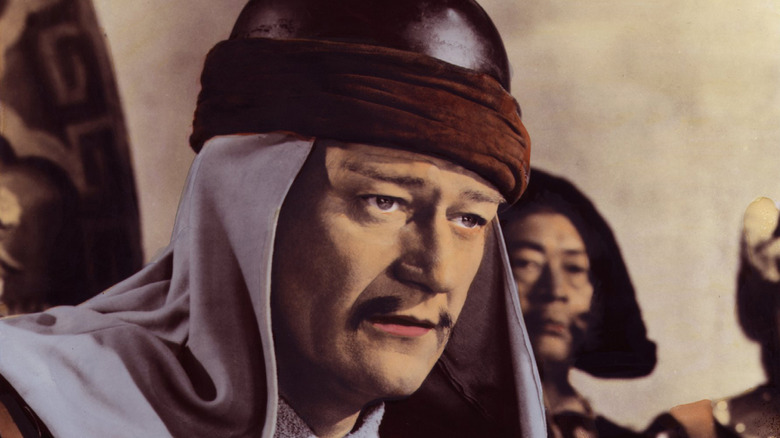
John Wayne could be self-aware when he needed to be. The fact that the 1956 Howard Hughes epic "The Conqueror" was a biopic the actor genuinely regretted filming is proof of the actor's ability to look back and shudder at certain career choices.
If "The Barbarian and the Geisha" miscast Wayne in the role of a diplomat navigating the sociopolitical divide between the U.S. and Japan, "The Conqueror" takes things to a completely other level by making him play the Mongol leader Temujin — also known as Genghis Khan. Yes, this is John Wayne in blatant yellowface, delivering his lines in his signature Western drawl in a movie that treats an entire culture and period of history with the sensitivity and nuance of a pro wrestling gimmick.
Wayne wasn't the only person who recognized that "The Conqueror" was a misfire, incidentally. The film was a disaster at the box office, marking the end of Hughes' association with the movie business. The mogul hated "The Conqueror" so much that he embarked on a painstaking mission to buy every copy of it. He also habitually rewatched "The Conqueror" himself during the reclusive stage of his life, perhaps as a type of self-induced "A Clockwork Orange"-style penance.