

6 Sci-Fi Movies Recommended By Christopher Nolan
When Christopher Nolan talks about movies, you should pay attention. The British director and producer has been making stone-cold bangers ever since he broke onto the scene in a big way with "Memento" in 2000 (following his feature film debut, ironically titled "Following," in 1998), a twisty, confusing, and deeply satisfying non-linear film about a man whose short-term memory loss prevents him from figuring out who killed his wife. After that, Nolan established himself as a true visionary and a lover of film, thanks to his commitment to practical effects (even when CGI would be much, much easier), his knowledge of the medium as a whole, and his astounding eye for incredible, unforgettable cinematic images.
Across films like his Dark Knight trilogy, "Inception," "Interstellar," "The Prestige," "Dunkirk, and "Tenet," Nolan carefully honed his craft. Then, in 2024, he finally achieved a major career milestone by winning best picture, best director, and best adapted screenplay at the 2024 Academy Awards for his 2023 masterpiece "Oppenheimer," which he followed, three years later, with his next masterpiece "The Odyssey," an adaptation of the famous Greek poem attributed to Homer. Ask any film nerd around and they can probably tell you their favorite Nolan film and explain why they love it so much; frankly, even his detractors should recognize that Nolan has a movie to suit any potential viewer, and the way he challenges the audience is truly special. Nolan doesn't make movies that you can watch while you're scrolling on your phone. Nolan's movies demand your attention, and in this day and age, that feels important and even vital.
So what movies does Nolan himself love? Well, probably a lot, but we definitely know he loves these six flicks. Here are six science fiction movies championed by Christopher Nolan that you should watch.
Alien
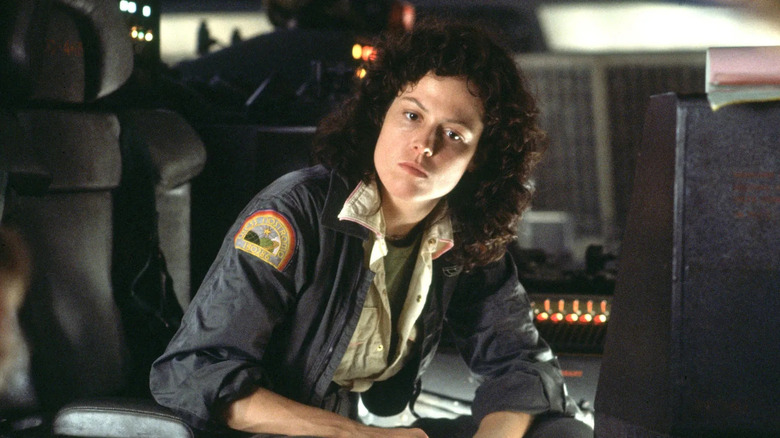
Few science fiction films are as influential as Ridley Scott's 1979 film "Alien," and frankly, Scott is so important to the genre as a whole that he has not one, but two entries on Christopher Nolan's list. "Alien," which follows a commercial spaceship called the Nostromo that's invaded and subsequently attacked by an alien race capable of laying eggs and bursting out of people's chests at will, stars Sigourney Weaver as Ellen Ripley, the ship's warrant officer who ends up commanding her fellow survivors after several others end up dying thanks to said insidious aliens. Ripley is one of the greatest action heroines of all time, and as "Alien" builds to the point where she's alone on the ship (save for the ship's loyal cat Jones), you really understand precisely how talented of a performer Weaver is. (It's not surprising that, despite years in the entertainment industry, Ellen Ripley is still arguably Weaver's defining performance.)
Back in 2015, Nolan told Media Company that Scott was an enormous influence on him, thanks in large part to this particular film. "The director I have always been a huge fan of... Ridley Scott and certainly when I was a kid. 'Alien,' 'Blade Runner' just blew me away because they created these extraordinary worlds that were just completely immersive." Put a pin in "Blade Runner," though; we'll definitely be circling back.
Close Encounters of the Third Kind
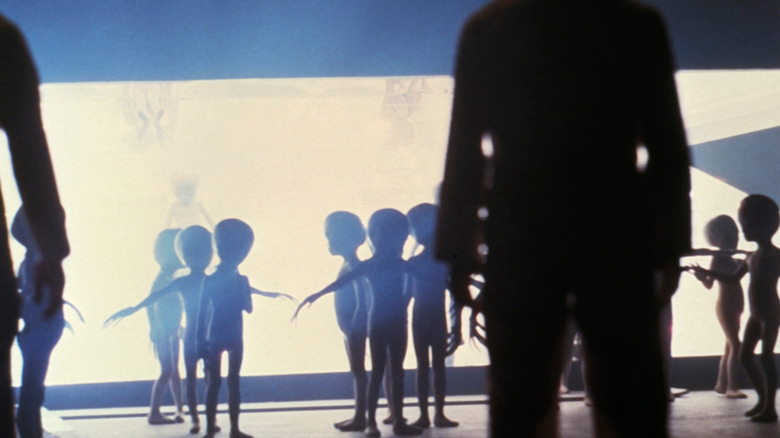
Christopher Nolan's movies really run the gamut, but basically all of them have some sort of sci-fi bent or angle; arguably, his "hardest" sci-fi movie is "Interstellar," even though that's actually a deeply human story about family, time, loss, love, and grief that happens to take place partly in space. Still, when you consider his approach to that story, it's easy to see why Steven Spielberg's "Close Encounters of the Third Kind" really struck a nerve with the future filmmaker.
In Spielberg's 1977 sci-fi film, blue-collar guy Roy Neary (Richard Dreyfuss) develops an intense and frankly polarizing obsession with UFOs after he spots one during his job as an electrical utility lineman, fully freaking out his wife Ronnie (Teri Garr). Ultimately, a young boy is abducted by the aliens, and using tones emitted by the UFOs, people are able to trace the activity to Devil's Point in Wyoming, and contact is made.
So why does Nolan love "Close Encounters of the Third Kind" in particular? "I liked the idea of combining that story with this story that speculates about a potential moment in human evolution where mankind would have to reckon with its place in the wider universe," Nolan told IndieWire in 2014. "With films like 'Close Encounters' and the way that addressed the idea of this moment when humans would meet aliens from a family perspective and a very relatable human perspective. I liked the idea of trying to give today's audiences some sense of that form of storyline." (Wonder what Nolan thinks of Spielberg's 2026 alien film "Disclosure Day," which feels almost like a spiritual sequel.)
Metropolis
If you're not familiar with the name Fritz Lang, you may want to brush up on your cinema history; not only did he help bring German expressionism across the pond thanks to his extensive work in the United States as a filmmaker, but the "Father of Darkness," as he was once called, helped pioneer creative filmmaking techniques we still see on screen today (like the rocket launch pad seen in his 1929 movie "Woman on the Moon."
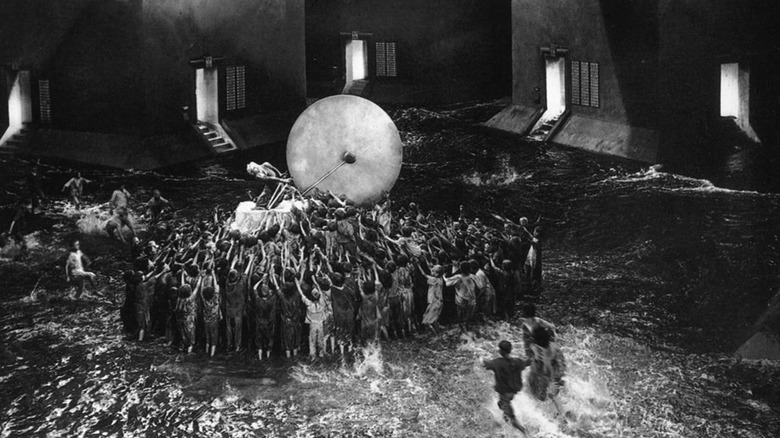
We're here, though, to talk about "Metropolis," Lang's 1927 movie that's basically considered the original science fiction film. A product of Lang living through Germany Weimar era, "Metropolis" follows a young man named Freder (Gustav Fröhlich), son of the powerful Joh Fredersen (Alfred Abel), who live above the riffraff in the titular city while the poorest citizens keep the futuristic and industrialist city running. So what's Nolan's connection to Lang's film, other than its general influence on filmmaking as a whole? In a story that ran again in 2020 in Empire Magazine, Nolan explained how, specifically, "The Dark Knight Rises" was inspired by Lang's "Metropolis." As he put it:
"It's all about historical epics in conception. It's a war film. It's a revolutionary epic. It's looking back to the grand-scale epics of the past, really, and for me that goes as far back as silent films. [...] It's my attempt to get as close to making a Fritz Lang film as I could. There's an attempt to visualise certain things in this film on this large scale that are troubling and genuinely threatening to the idea of an American city. Or, to put it another way: revolutions and the destabilising of society have happened everywhere in the world, so why not here?”
Blade Runner
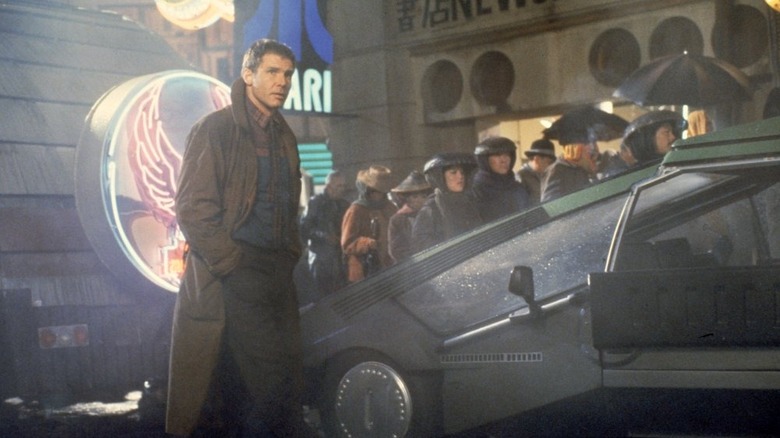
The second Ridley Scott film on this list of Christopher Nolan's favorite science fiction movies shouldn't come as a big surprise; not only did he mention it while discussing "Alien," but it's a pretty universally adored classic. That wasn't true of "Blade Runner" when Scott first released it in 1982, though, adapting Philip K. Dick's novel "Do Androids Dream of Electric Sheep?" and centering his focus on "replicant" hunter Rick Deckard (Harrison Ford). In fact, "Blade Runner" flopped hard upon its initial release, but throughout the years, it's been re-evaluated as a classic ... and it got a big budget sequel titled "Blade Runner 2049" in 2017. (Sadly, "Blade Runner 2049" also flopped at the box office. Maybe it runs in the family.) As a refresher, Ford's Rick lives in a futuristic Los Angeles (hilariously in hindsight, the film is set in 2019) and, even though he was once a police officer, operates as a titular "blade runner," searching for humanoid replicants and taking them out.
Apparently, this film had a huge impact on Nolan. As he said in a 2017 appearance on the "Happy Sad Confused" podcast:
"[A] really seminal film was Ridley Scott's Blade Runner. All this science fiction, somewhere in there you've got the Bond films. It's just signified to me the potential of the blockbuster, and of the globe-traveling sort of glamorous filmmaking. But Ridley Scott's Blade Runner, I first watched it on VHS. I was too young to go see it in the cinema, you know it was an R-rated film. And even on that smaller screen, something about the immersion of that world, and the creation of that world really spoke to me. And I watched that film hundreds of times, literally hundreds of times."
2001: A Space Odyssey
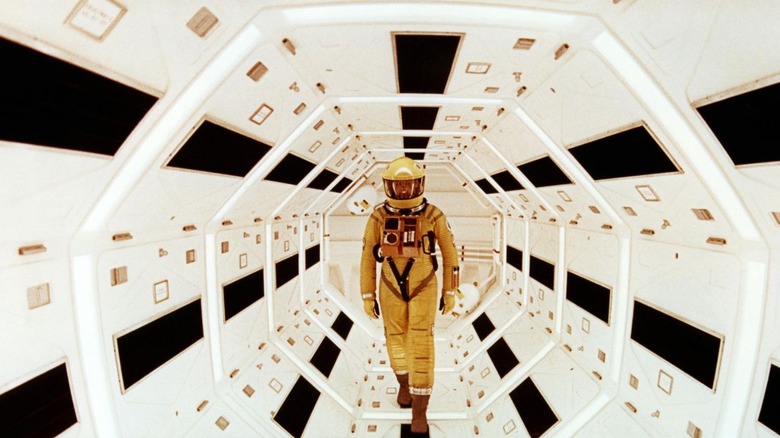
It's likely impossible to talk about great and influential science fiction movies and not mention Stanley Kubrick's 1968 epic "2001: A Space Odyssey," and Christopher Nolan repeatedly name-checking it as a favorite feels like a total no-brainer. As a group of scientists helmed by Dr. Heywood Floyd (William Sylvester) attempt to investigate an alien monolith in the galaxy, their spacecraft, Discovery One, seems to develop a mind of its own ... thanks to HAL, the computer that runs the ship and ultimately decides to take control of the journey by any means possible.
Speaking to Entertainment Weekly in 2013, Nolan said he saw "2001: A Space Odyssey" far too yopung, but still appreciated it. "I was seven years old, so I couldn't claim to have understood the film. I still can't claim that," he admitted. "But as a seven year old, I didn't care about understanding the film. I just felt this extraordinary experience of being taken to another world. You didn't doubt this world for an instant. It had a larger than life quality."
Not only that, but Nolan said he faces questions about his experience to this day. "When I tell people this story, they often find it unusual that a child of that age would want to see '2001,'" he remarked. "But the truth is all of my friends went to see '2001' in the year after 'Star Wars," Nolan continued. "We would all sit and talk about what it meant. It was 'pure cinema.' The fact that it's challenging cinema in an intellectual sense doesn't bother you when you're a kid. You just appreciate the feeling of the movie." He makes a great point, and speaking of "Star Wars," there's another movie left to discuss that greatly influenced Nolan.
Star Wars: A New Hope
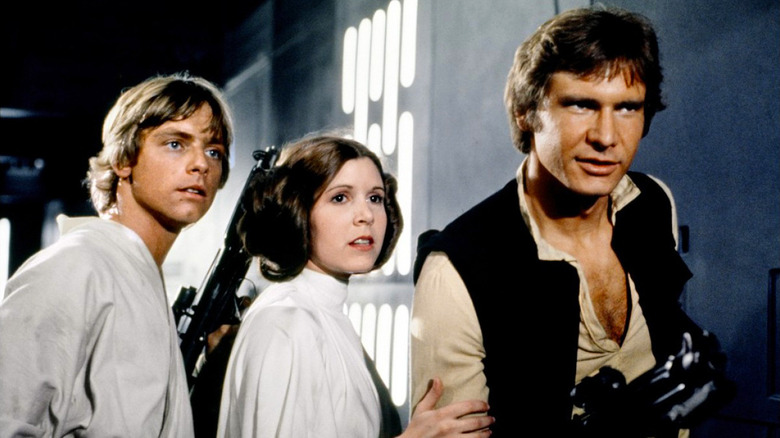
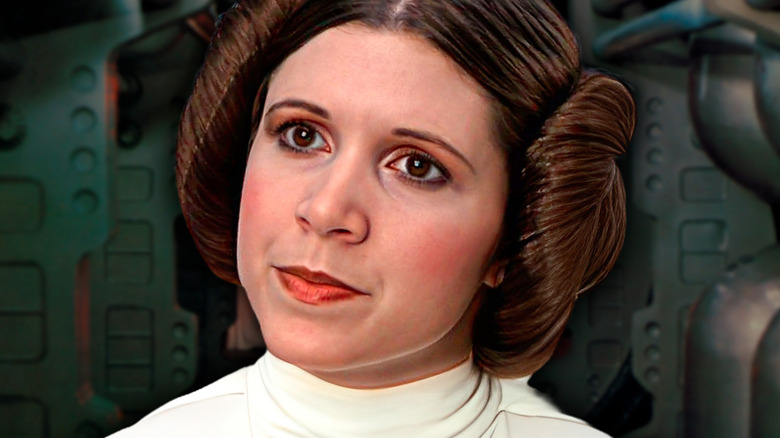
Last but certainly not least, Christopher Nolan has, of course, paid homage to "Star Wars," the franchise created by mastermind George Lucas that launched in 1977 with his deeply fun, clever, and enthralling film "Star Wars," which was retroactively subtitled "A New Hope" when sequels came into play. This, of course, is the movie that introduced the entire world to Mark Hamill's Luke Skywalker, a young man living a quiet life with his aunt and uncle on the planet Tattooine who dreams of greatness. Luckily, he discovers two droids in the desert one day — C3PO (Anthony Daniels) and R2D2 (Kenny Baker) — who were sent by Alderaan royal Princess Leia Organa (Carrie Fisher) to ask for help fighting the evil Galactic Empire. After learning about the Empire's leader Darth Vader (David Prowse and the voice of James Earl Jones) from his mentor and Jedi master Obi-Wan Kenobi (Alec Guinness), Luke teams up with the rapscallion smuggler Han Solo (Harrison Ford in his breakthrough role) to find the princess and save the universe.
Obviously, after 1977, "Star Wars" became ... well, the biggest thing on Earth, and Nolan certainly wasn't immune. "That came out in the '70s and I'd been experimenting using Super 8 films and stuff," Nolan told Business Insider of the original "Star Wars" film. "And then from the second I saw 'Star Wars' everything was space ships and science-fiction." One has to wonder what Nolan thinks of the prequel trilogy and the sequel trilogy, but he's certainly right; "Star Wars" is one of the most important sci-fi movies ever made.