

5 Most Historically Accurate Viking Movies, Ranked
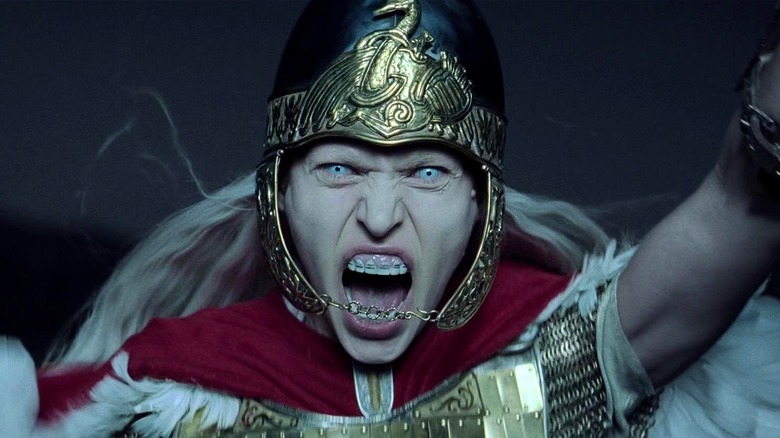
It's rare for the Viking age to be depicted with total accuracy onscreen, with most movies covering the era making it appear every bit as mythical as the titular creatures in the "How to Train Your Dragon" series. It isn't a coincidence that the films on this list all struggled to find an audience upon release, quickly becoming obscure arthouse curios after leaving critics puzzled or immediately flaming out at the box office — if a filmmaker is going to depict such a violent period onscreen with true authenticity, then the result is unlikely to be friendly to general audiences. They wouldn't be included in a list of the most historically accurate Viking movies if they were joyous crowd pleasers.
Historical records from the Viking age (which dates from around AD 800 to 1050) are sparse compared to other eras that filmmakers like to cover, which is why many tend to fill in the gaps with whatever best suits their story. But the five movies below all did their research and committed to depicting the brutality of the Viking era in all of its grisly glory. We commend each of them for getting most of the historical details right, but accuracy alone doesn't make an effective Viking movie, so our ranking also takes the overall quality into account. Some of these movies had a greater impact than others, but they all made us feel like we were watching a vivid, lived-in depiction of Norse life.
5. The 13th Warrior
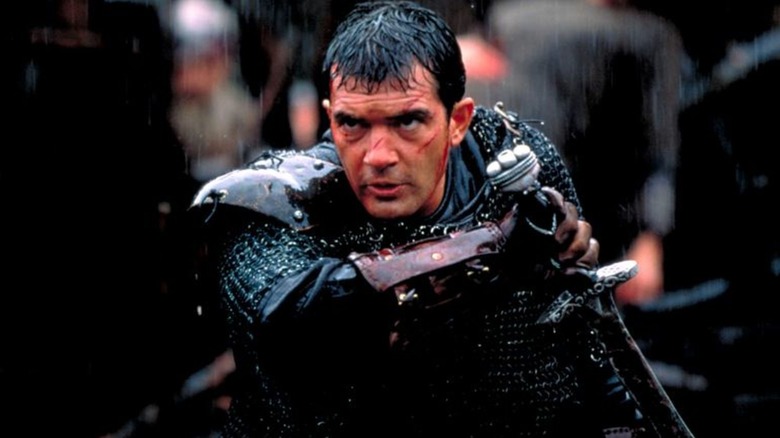
After the barnstorming success of "Jurassic Park," Hollywood spent the rest of the 1990s attempting to adapt any Michael Crichton book it hadn't already touched. It was "Die Hard" director John McTiernan who got his hands on his 1976 novel "Eaters of the Dead," inspired by Ahmad ibn Fadlan's 10th century writings that have long been a fascination for historians as the first outsider account of life with the Vikings. Crichton's source material, and this 1999 adaptation, don't hide that they are works of historical fiction, but they extensively draw from those centuries-old documents as inspiration.
"The 13th Warrior" was a critical dud and a box office bomb, with McTiernan fired during production for going over budget and replaced by Crichton himself for reshoots. Various accounts suggest that multiple interesting subplots were left on the cutting room floor, with set dresser Patrick Kearns saying that the runtime could have been at least half an hour longer. The final cut therefore lacks the spark that made McTiernan's previous action blockbusters such massive hits, which is a shame, because, even though there are supernatural elements to the story, "The 13th Warrior" takes a ripped-from-the-history-books approach to documenting Viking culture.
Many Muslim viewers have reclaimed the movie due to it being the rare Hollywood production with a positive, heroic depiction of a Muslim character who remains devoted to his faith even as he must prove himself as a fish out of water to the Viking tribe. That this has made it easy to overlook Antonio Banderas being cast as an Arabic character probably says more about the lack of positive Hollywood representation than the quality of the movie itself, which is easily the weakest on this list.
4. Outlaw: The Saga of Gisli
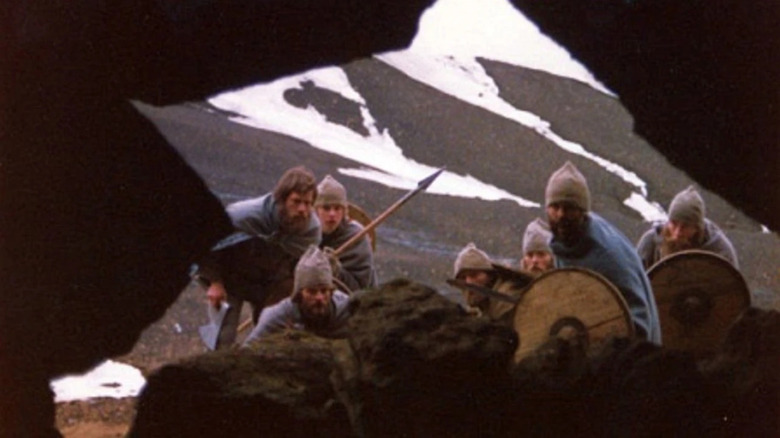
The Gísli saga is one of the most famous tales in Icelandic folklore, an epic, decades-spanning revenge tale about the fallout from the titular tragic hero's attempt to avenge one brother-in-law by killing another, forcing him to go on the run for several years. Even as it deviates from its epic source material in certain ways, Ágúst Guðmundsson's 1981 film "Outlaw: The Saga of Gisli" is still often cited as one of the most accurate screen portrayals of Norse culture, particularly as it captures the unrelenting bleakness and unflinching approach to violence so prevalent within the medieval culture. The incorporation of supernatural themes places it in conversation with the Scandinavian folk story of Amleth (the inspiration for Shakespeare's much-adapted play "Hamlet"), another tale dating back to the 14th century which deals with the morality of revenge and the otherworldly nature of guilt.
"Outlaw: The Saga of Gisli" is all the more impressive due to how it never hides the clear constraints of its shoestring budget, effectively bringing to life a bygone age with a richer attention-to-detail than films with ten times the scale. However, when placed next to another 1980s Icelandic Viking epic on this list — more on that in a second — it feels more like a trial run to see if an expansive revenge saga can be made in the homeland of this folklore. This is another case of a movie where the extensive research of the era is apparent, but the intrigue of the source material hasn't translated to the screen with it — though, admittedly, it's hard to judge due to the awkward English subtitles on the only available copy, languishing in low quality on YouTube. A remaster and more faithful translation could bump this higher.
3. When the Raven Flies
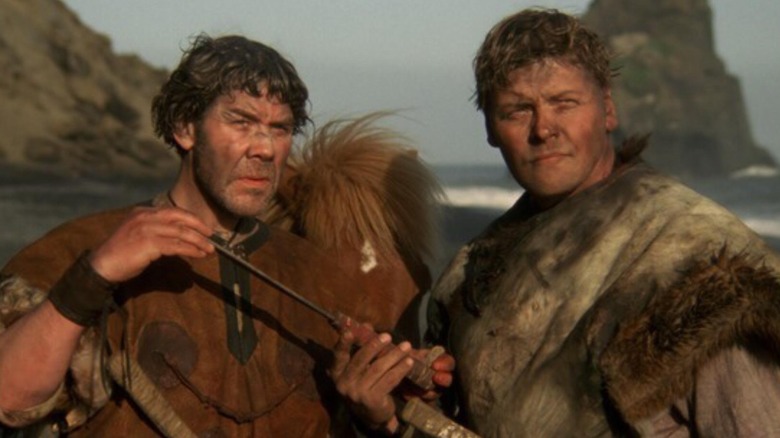
Inspired by Sergio Leone's spaghetti Westerns, Icelandic director Hrafn Gunnlaugsson set out to make a Viking revenge film which was more historically accurate than what he was seeing from Hollywood. "Those times were more cruel and primitive than the romantic way of seeing them, the swords were like clubs. The Vikings who came to Iceland were political fugitives," Gunnlaugsson told The Reykjavík Grapevine. "I wanted to make a film that would portray Vikings more authentically."
The end result was 1984's "When the Raven Flies," the first entry in a trilogy that authentically portrays the settlers who arrived in Iceland from Norway not as action heroes with horned helmets and outsized axes, but as violent outcasts who were forced to leave their homeland after committing crimes. Nothing is romanticized by the director/co-writer, as his deconstruction of Viking stereotypes is as straightforwardly brutal as any revenge movie can be.
The film tracks a young Irishman named Gestur (Jakob Þór Einarsson) who travels to Iceland to get revenge on the raiders who killed his parents two decades prior, playing different gangs against each other and letting carnage unfold. The attention to period detail is there, but is unfortunately smothered by an unusual score that combines funk with panpipes, heavily dating the movie to the 1980s even as everything onscreen has vividly recreated an era from many centuries before.
2. Valhalla Rising
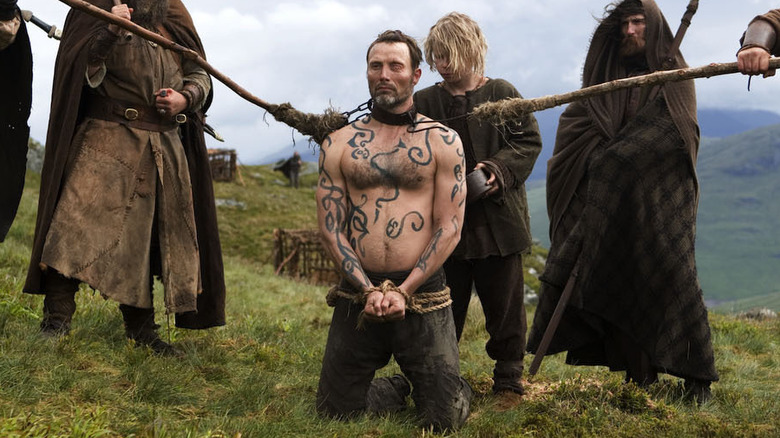
With the notable exception of the cult Ryan Gosling-led movie "Drive," Danish director Nicolas Winding Refn has specialized in shockingly violent works that are meditative to the point of alienating (his films "Only God Forgives," "The Neon Demon," and "Her Private Hell" were all booed at the Cannes Film Festival). Released prior to "Drive," his 12th century Viking tale "Valhalla Rising" might be the most challenging work in his filmography. It's set in the dying days of the Viking age with Mads Mikkelsen playing a mute, one-eyed Norse warrior in Viking-occupied Scotland — who may or may not be Odin himself.
You won't find anything in the way of a concrete explanation about the warrior's true identity, but the presence of a possible Pagan god alongside a group of Christian crusaders on a mission to find the Holy Land invites vast interpretations about the entanglement of religion and myth making. Refn throws you in at the deep end with those ideas and refuses to spoon feed the audience, asking you to contemplate them through extensive stretches of punishing silence. But for all its challenging sequences, the film is entertaining and based on real history.
"It is very accurate," Refn said during an interview with Film Comment. "There were Christian Vikings for a hundred years, before they were completely sucked up into Christianity. Around the time the movie takes place, Christianity was spreading rapidly around Europe, especially the North, and Jesus was sold in many different ways. To the Vikings, he was sold as a warrior who died in battle, because that was what the Vikings could understand." The film's accuracy was no doubt helped by the fact that the script was co-written by the late Norwegian author Roy Jacobsen, an expert on Nordic literature.
1. The Northman
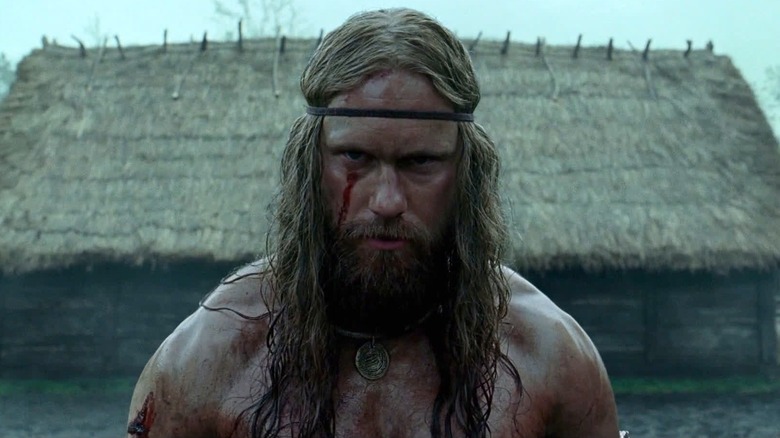
Director Robert Eggers' third film "The Northman" brought a Viking legend to life on the big screen. While "Outlaw: The Saga of Gisli" has shades of the Medieval folklore tale of Amleth, this film is a direct adaptation of it, following the familiar beats of that epic revenge saga but with the bloodier, bruising, and nightmarishly surreal edge you'd expect from the man who gave us "The Witch" and "The Lighthouse." Working with his first major budget of approximately $90 million, Eggers was afforded his broadest cinematic canvas so far and spent a considerable amount of time studying old Norse poetry, textbooks, and early accounts of Icelandic life.
Eggers went as far as lifting period-appropriate language from these sources for his screenplay and incorporating as many historically accurate details into the design of his world as possible. His pre-production work didn't end there: He talked to several historical consultants including an archaeologist, an Icelandic folklorist, and a Viking historian to ensure there were no inaccuracies or distracting anachronistic details. Even as the story he was telling was adapted from a folk tale handed down for countless generations and adapted numerous times, he still approached the mythic source with a researcher's eye to detail, ensuring every aspect had a basis in historical record.
Of course, none of this would matter if the movie weren't an invigorating retelling of this famous revenge saga, but Eggers' transition from supernatural horror to action epic proved he could easily craft conventional blockbuster thrills without losing his distinctive touch. Although it underperformed at the box office, word of mouth helped "The Northman" become a critical success — the film is Certified Fresh with a score of 90% on Rotten Tomatoes. It's by far the best of all the historically accurate Vikings films out there.