

Everything Christopher Nolan's The Odyssey Gets Right And Wrong About The Story
Contains spoilers for "The Odyssey"
Ahead of the release of his film "The Odyssey," Oscar-winning director Christopher Nolan sat down with The New York Times and answered a vital question: why adapt this poem? The sprawling, epic screed attributed to the Greek poet Homer has been translated by several different people and depicted in offbeat adaptations like "O Brother, Where Art Thou?" before Nolan decided to deliver his vision of the story. As he says, it was a challenge. Nolan opined:
"I was looking to challenge myself with a completely different type of storytelling and I was looking for a gap in the culture. I'm looking at Greek mythology, 'The Odyssey' itself, why hasn't it become part of modern cinema? That's very exciting as a filmmaker. Then as you drill down — what is there to get your teeth into? 'The Odyssey,' as with 'Oppenheimer,' the reason these are great stories is they have these resonances, these knotty problems, ethical dilemmas. It's about impossible situations. That's what makes for a terrific story."
It's safe to say that this is the largest undertaking of Nolan's career to date, and it may well be the venerated British director's masterpiece. But it is faithful to the book? That, like "The Odyssey" itself, is complicated. While Nolan kept the essence of this fabled story the same — Matt Damon's Odysseus wins the Trojan War but finds himself unable to get home safely after the battles are over — he made tweaks and changes, some of which work and some of which don't. Here's what Nolan's version of "The Odyssey" gets right and wrong, according to the poem itself.
Gods and their magic play a lesser role in Christopher Nolan's version of The Odyssey
If you've read "The Odyssey," you know that Homer puts Greek gods front and center, letting their machinations and manipulation play a large part in Odysseus' attempts to return home to Ithaca from Troy after the long, bloody war. Hermes tails his son Telemachus (Tom Holland in the film) as he searches for news of Odysseus, and other gods play around with the fates of men. That is, frankly, almost a non-issue in Christopher Nolan's take on "The Odyssey."
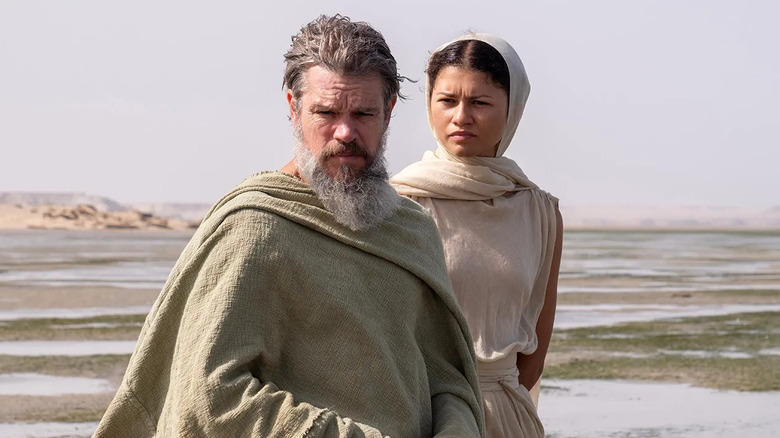
Yes, the gods exist in Nolan's movie, but they're largely unseen save for "Euphoria" and "Dune" star Zendaya's terrific interludes in which she appears only to Odysseus himself. Even though characters reference that any human can be a god in disguise and, after Odysseus injures Polyphemus the cyclops (Bill Irwin), Polyphemus' father Poseidon wreaks havoc on the seas in revenge, we don't get to see the gods. Why? As Nolan explained during an interview with Time about the making of the film, he wanted to put the audience on the same playing field as his characters. As he put it:
"I became more interested in the idea that to people in that period, evidence of gods was everywhere. The wonderful thing about cinema, and IMAX in particular, is that you can take an audience to a place of immersion, feeling close to events like storms, turbulent seas, high winds. You want the audience to be on the boat with them fearing the ocean, fearing the wrath of Poseidon, the way the characters do. That to me is so much more powerful than any individual image you can have [of a god]."
Christopher Nolan uses modernized language to retell this epic story
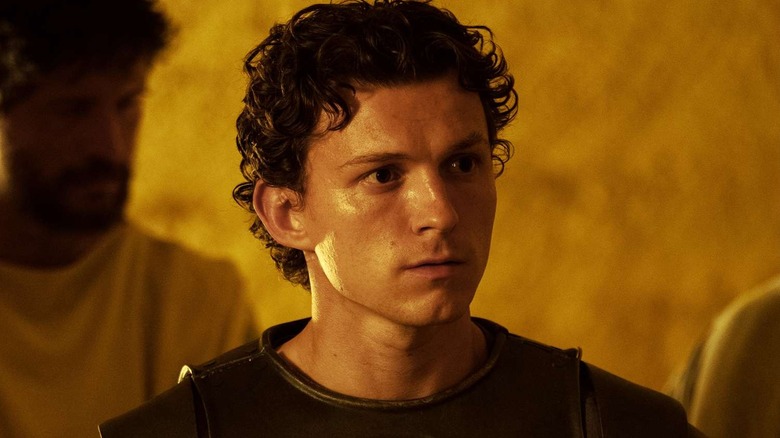
When you sit down to watch "The Odyssey," one thing becomes immediately apparent: the script, written by Christopher Nolan himself, uses extremely modern language. If you're a total purist, don't fret. Nobody says "dude" or peppers their sentences with "like," but some words stand out, like when Telemachus refers to Odysseus as "dad" or calls his long-suffering but steely mother Penelope (Anne Hathaway) "mom." There are other smatterings of modern terminologies, but nothing too offensive, and generally, the cadence used by the characters is informal rather than lyrical. So what prompted this change?
In an interview with the Los Angeles Times, Nolan said that he wanted to make a conscious choice to deploy "language that has emotional not intellectual meaning to people," apparently hoping to make the dialogue as accessible as possible. "I was maybe being naïve, it might bite me on the a**, but I wanted an earthy narrative," Nolan continued. "To me it was a no-brainer." Love it or hate it, "The Odyssey" definitely diverges from the lyrical style of the poem ... although if you do love it, Emily Wilson's 2017 translation isn't quite this casual, but still fresh and modern.
An entire Circe storyline is cut
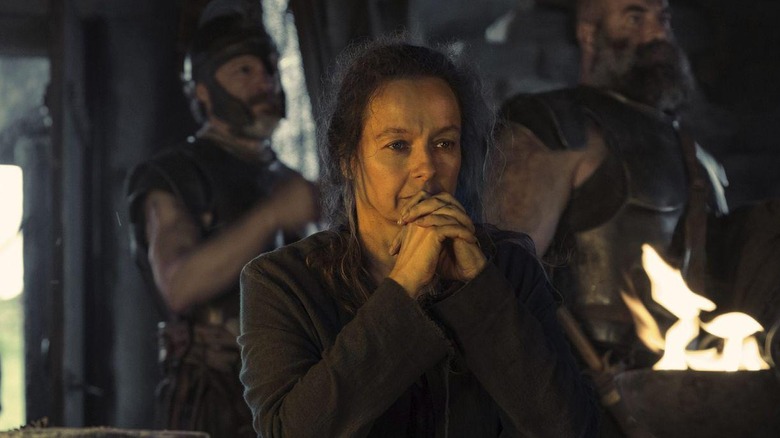
During the long, doomed journey undertaken by an overly confident Odysseus and his men — in which Odysseus leads them disastrously off-course multiple times — the group of soldiers, including Odysseus' beleaguered right-hand man Eurylochus (cast MVP Himesh Patel), keep needing to stop at random islands for supplies. After getting attacked by the massive, man-eating, armored Laestrygonians (who are never named in the film), they discover a small isolated cabin that houses one woman, Circe (an outstanding Samantha Morton), who's surrounded by animals ranging from a lonely bird to a massive lion. The frustrated men leave Odysseus behind and enjoy Circe's stew only to get turned into pigs; the canny Odysseus figures out what happened when he shoots a deer that transforms into a man and forces Circe to return his men to their human forms, at which point they just leave.
This skips a pretty major Circe plotline from the poem, though. In the poem, Odysseus receives help from Hermes and utilizes an herb called "moly" to avoid Circe's magic, and after she turns his men back into humans, the two spend a year as lovers before they set sail again. It makes sense that Christopher Nolan trimmed this plotline, to be honest, but it's a little bit of a shame that we didn't get to spend more time with Morton's cunning, frightening, and captivating Circe.
Christopher Nolan changed a big part of the cyclops storyline for a silly reason
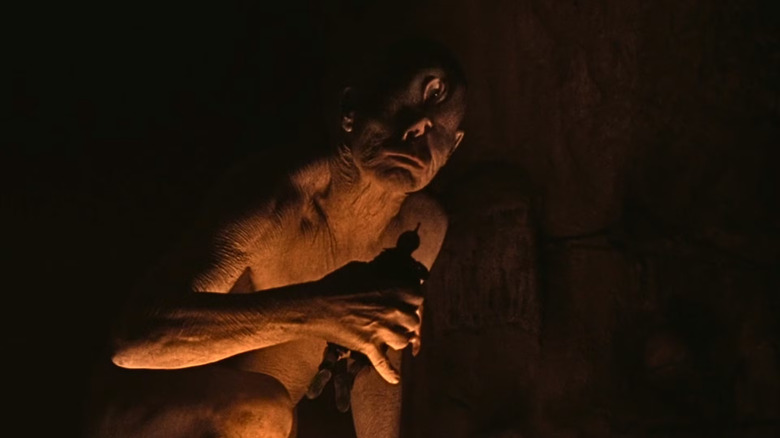
The very first trial that Odysseus and his men encounter during their journey home is a chance meeting with the cyclops Polyphemus when they enter his cave, following his flock of sheep as they hope to find livestock to hunt and eat. This provides one of the most tense and thrilling sequences in Christopher Nolan's film as Polyphemus, hungry and confused by the fact that he has company, starts chomping on those soldiers like Saturn in the famous painting by Francisco Goya (a direct influence, according to Nolan himself in the Associated Press). The cyclops barely speaks, except to mutter his dad's name, Poseidon ... which is how we learn that the sea god keeps sending storms and winds to mess up Odysseus' boat after the war hero tussles with his big, weird son.
That's not how it goes down in the poem, though — instead, Polyphemus speaks and Odysseus says his name is "Nobody." After he delivers brutal physical attacks and injures Polyphemus and fellow cyclops come to check on their friend, they ask who's attacking him, and Polyphemus responds, "nobody." So why did Nolan cut this, aside from the fact that he'd need Bill Irwin to, presumably, play multiple cyclops?
As Nolan revealed on "The Daily Show" to host Jon Stewart, he knows people will be upset, but he had a reason (per The Hollywood Reporter). "I understand," Nolan said of purists being put off by the change. "It's a pun. Puns in translation are tough. I tried. It was not possible to work in it." If you say so, Mr. Nolan.
A major part of Odysseus's journey does not appear in the movie version of The Odyssey
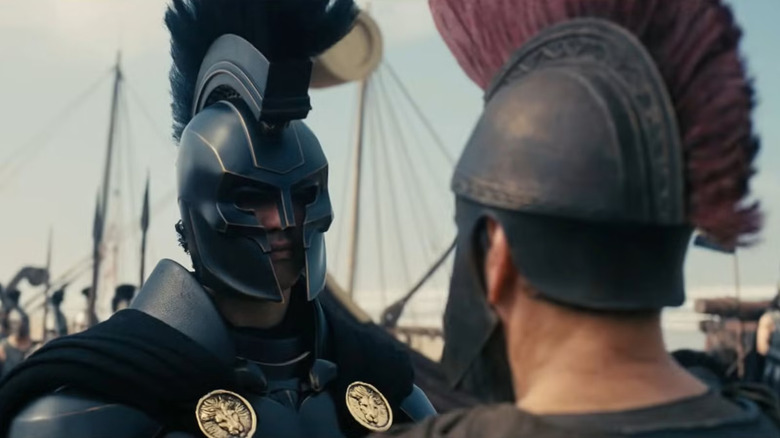
Before we tackle one big plotline that didn't make it into Christopher Nolan's big-screen adaptation of "The Odyssey," let's be honest: this is a long movie adapted from a very long poem, and not every single aspect of the story could realistically make it into the adaptation. Things shift in transit all the time when it comes to adaptations, point in fact. With that in mind, it's pretty reasonable that Nolan cut Odysseus' entire interlude on the island of Scherie, where he essentially crash-lands thanks to the kindness of the sea nymph Ino after leaving Calypso's island. (Calypso is another issue entirely; put a pin in that for now.) Athena tells the Phaeacian princess of Scherie, Nausicaä, to heal Odysseus, and after he excels at sporting events on the island, he gains the trust of the Phaeacians and tells them the story of his previous journey.
We get this exposition through Odysseus in the movie, but in a different situation ... and it's one that makes a lot more sense for a film adaptation, honestly. Still, if you love the Phaeacian storyline in the poem, go ahead and mentally fancast the princess Nausicaä to your heart's content.
The Argos storyline remains the same as in the original poem
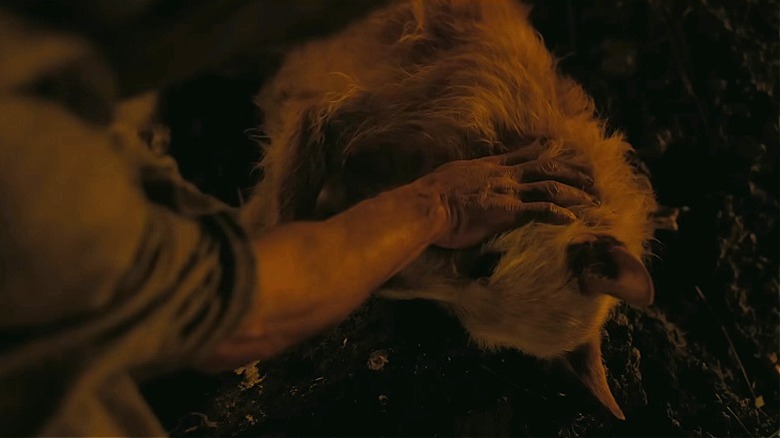
We've got bad news for you. If hurt or dying dogs are a cinematic line you just can't cross, "The Odyssey" has a few moments that might turn your stomach — and they concern Odysseus' loyal hunting hound Argos. Early in the film, Odysseus' friend and Ithacan swineherd Eumaeus (John Leguizamo) is telling Telemachus about Argos, now an elderly dog sitting by Eumaeus' feet who growls at pretty much anyone that's not Odysseus, which is when we're treated to a flashback and see Eumaeus tossing a puppy from a new litter off of a clifftop. Thankfully, Odysseus puts a stop to that when he plucks a pup from said litter who immediately kisses his face, and that dog grows up into Argos, Odysseus' intrepid hunting dog.
Unfortunately, audiences are also forced to watch as Penelope's odious and drunken suitors Antinous (a smarmy, perfect Robert Pattinson) and Polybus (Corey Hawkins) kick Argos as he begs for scraps of food in the palace's great hall, and Antinous eventually carries the injured dog to a manure heap just outside of the palace and leaves him there to die. Argos does pass away, but not until Odysseus returns to Ithaca disguised as a beggar and reunites with his dog ... which is precisely what happens in the poem.
Calypso plays a totally different role in Christopher Nolan's adaptation of The Odyssey
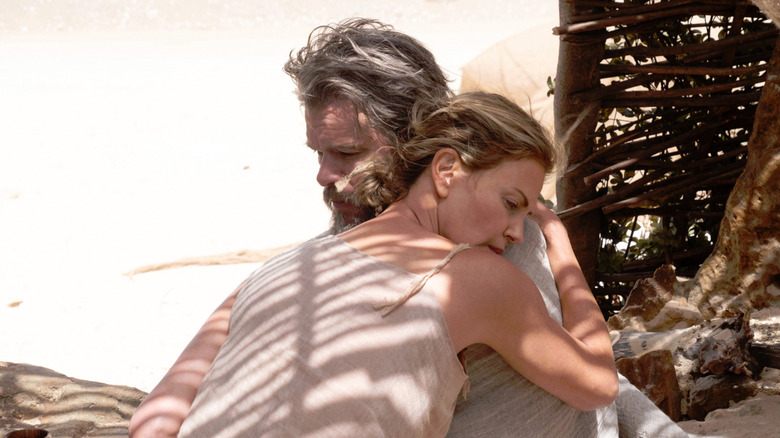
In the original poem of "The Odyssey," Odysseus is revealed to be a captive of the nymph Calypso, and when he escapes, that's when he heads to Scherie. There's also a plotline in the poem where Odysseus and his crew happen upon a random island filled with the lotus-eaters, who feed them magical flowers that make them forget about their quest to return home. In Christopher Nolan's take on "The Odyssey," however, Calypso is played by Charlize Theron ... and her role is radically expanded.
Not only does Odysseus not visit Scherie between Calypso's island and Ithaca, he goes directly form Calypso's island of Ogygia to Ithaca on a humble raft, begging all the while for Poseidon's forgiveness. It's also Calypso, in this story, who feeds Odysseus the lotus flowers, though she explains why: when he washed up on shore after the rest of his crew perished in a horrifying storm, Odysseus's body could be repaired with natural medicine, but his mind remained troubled. To try and help him, Calypso fed him lotus flowers to put him at ease ... but as she fell in love with him, she continued plying him with flowers so he wouldn't want to return home to Penelope and Telemachus. Ultimately, in the film, Calypso confesses her deceit to Odysseus, helps him regain his memories, and lets him go. This is another change that does make sense as far as the adaptation process is concerned, and Theron is so excellent as Calypso that it works perfectly.
Telemachus and Penelope's characters remain largely the same
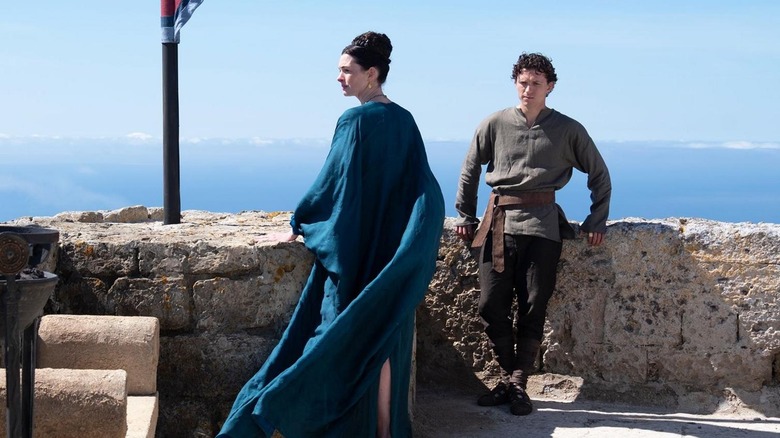
While a lot of characters in "The Odyssey" got tweaks and adjustments courtesy of Christopher Nolan, two remain essentially the same: Telemachus and Penelope. Let's start with Telemachus, performed by a doe-eyed and meek Tom Holland, whose only goal is to figure out whether or not his missing father Odysseus is alive in the first place ... and, if he is alive, to find him and return him to Ithaca to retake his rightful place on the throne. Aside from the lack of his literary sidekick Hermes, Telemachus is pretty true to his character in the poem, as a young man who doesn't have instinctive fighting skills but is ready to learn and battle alongside his allies whenever he's needed.
Then there's the long-suffering Penelope, who pretends to entertain a house full of hopeful suitors while saying she'll marry when she finishes weaving a shroud; unbeknownst to most of them, she unplucks her progress by hand every night so that the shroud will never be completed. Anne Hathaway, gunning for her second supporting actress Oscar, plays Penelope with a steely glint in her eye and a backbone made of pure iron — best on display in a stunning scene where she lambasts her own son for being weak and flies into a rage over the fact that she's received no credit for ruling Ithaca for years — and she also stays essentially true to the original character.
The climactic battle between the suitors and Odysseus also remains the same
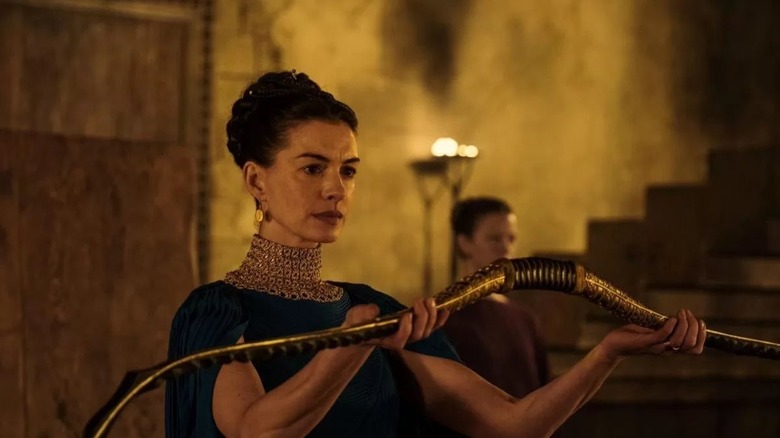
Another element of the story that specifically concerns Telemachus and Penelope that remains true to the epic poem is the final showdown between Penelope's awful suitors and her long-lost husband Odysseus, who returns to Ithaca disguised as a humble and dirty beggar. Though Telemachus figures out Odysseus' true identity thanks to Argos in the film (and Odysseus simply reveals himself in the poem), the major beats are the same: as Odysseus and Telemachus quietly arrange to have all of the displayed weapons in the palace hidden in a secure storeroom, the suitors torment and beat Odysseus in his disguise. Then, Penelope makes a startling announcement: she will remarry, but only to a suitor who can string Odysseus' famed hunting bow and win an archery contest. (In Christopher Nolan's film, the suitor in question must exactly copy Odysseus by re-stringing the bow and shooting it through a line of twelve axes to hit a target.)
Naturally, none of the suitors can string the bow at all until Odysseus steps up and completes the challenge — and bloodshed ensues. After a hard-fought battle, Odysseus kills the suitors alongside Telemachus and presents himself to Penelope as her long-lost husband. That, however, is where the ending of Nolan's film does diverge.
With that said, the final beats of Christopher Nolan's The Odyssey take a different turn
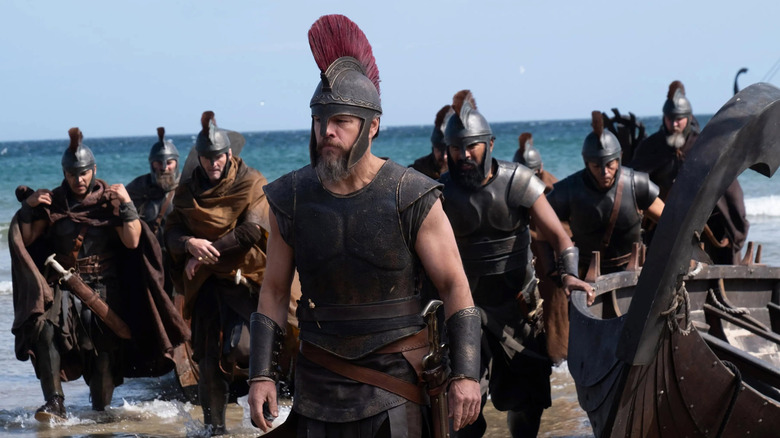
In the poem, Odysseus is asked to prove his identity to Penelope when she insists that he move their marital bed; knowing this is a trick because the bed physically can't be moved, Odysseus refuses, and the two are finally reunited. In the aftermath, Telemachus has scores of female servants hanged for consorting with the now-dead suitors, and even though the powerful families of the suitors attempt to avenge their fallen sons and brothers, Athena steps in and prevents any more blood from being spilled.
The film takes a different approach. Throughout the runtime, we see Odysseus caress a pin in the shape of Athena, which we also watch Penelope pin to his robes before he leaves to fight in the Trojan War ... and that's what he gives Penelope upon his return to prove that it's him. Telemachus also does not hang anyone; instead, he becomes the King of Ithaca as Penelope and Odysseus fulfill a long-held dream and sail into the unknown west together to finally escape the pressures of Ithaca. It's a beautiful, peaceful ending — and it's not how Homer's epic poem concludes.
"The Odyssey" is in theaters now.