5 TV Shows To Watch If You Like Dark
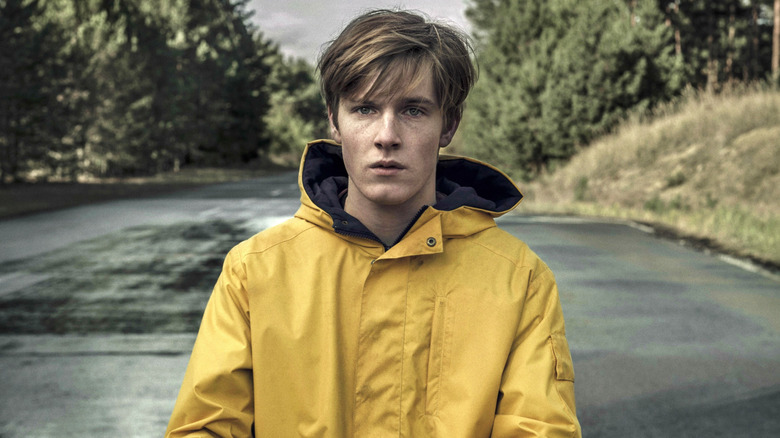
When it first aired on Netflix in 2017, few would have suspected that the German-language sci-fi thriller "Dark" would be destined to blow up big time. Haunting, atmospheric, and contemplatively beautiful, the series takes off with the ambience of a brooding, dark crime drama like "Broadchurch" and quickly spins out into a cerebral mind-bending time travel journey with profound existential implications. As first-time viewers began to process the strange, fascinating trip down the rabbit hole that creators Baran bo Odar and Jantje Friese were taking them down, word about the show spread like a fast-moving wildfire among international audiences outside of Germany.
Set to a darkly cinematic soundtrack against the background of Germany's dense Black Forest, "Dark" weaves a gorgeous and devastating science fiction yarn. Told mostly through the perspective of Jonas Kahnwald (Louis Hofmann), the series follows the residents of Winden, Germany, which is home to a nuclear power plant built above a winding cave system leading into the heart of the forest and a host of mysteries. When one thread is pulled on a generations-spanning pattern of missing children, a bizarre narrative begins to unravel, one that reveals four families central to the community to be intertwined across time, space, and parallel dimensions.
Closing the book on its twisted narrative of a tangled family tree in 2022, "Dark" finally came to an end with its third season, leaving fans desperate for more. We can't go back in time and start that first watch again — especially if we don't want to accidentally become our own great-great-great grandparents. But we can give you the next best thing: a handful of mind-bending sci-fi series to fill the void. These are the shows you need to check out if you're looking to fill that "Dark" shaped hole in your life.
12 Monkeys
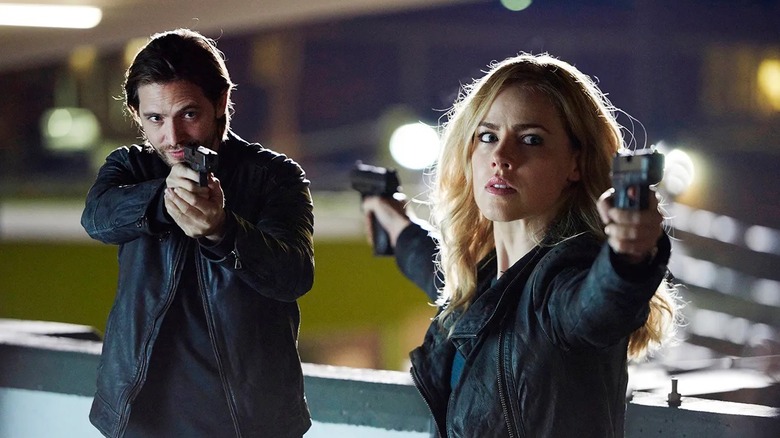
Both thematically and aesthetically, "12 Monkeys" will feel familiar to fans of "Dark." It weaves a wonderfully complicated time travel narrative that builds on the "Back to the Future" causality paradox trope, aka the "bootstrap paradox" – "Dark" is packed with "Back to the Future" references and "12 Monkeys" has a bunch, too. But, unlike "Dark" (and the original "12 Monkeys" film it is adapted from), the 2015 series bears a decidedly more optimistic tone, and, without giving away too much, one of the most satisfying endings fans could have expected from such a thematically dark concept.
Written by Travis Fickett and Terry Matalas (who took over as sole showrunner for "Star Trek: Picard" Season 3), the series follows James Cole (Aaron Stanford), a scavenger struggling to survive in 2043 after a devastating virus wiped away most of the Earth's population decades earlier. A child at the time of the crisis, Cole has watched what remains of the world slowly crumble and die as humanity, in turn, becomes cruel and animalistic amid the post-civilization world. That is, until Cole makes acquaintance with physicist Katarina Jones (Barbara Sukowa), who convinces him to use her time machine and prevent the manmade virus from ever being released in a "one-and-done" operation. Except it's never really that simple, is it?
Brilliantly balancing emotional storytelling, mind-bending science fiction, and the perfect blend of comic relief in much the same way "Battlestar Galactica" did across its four seasons, "12 Monkeys" is the type of addictive, binge-worthy series you could end up watching in one hygiene-deprived week. Once you're done, be sure to check out that third and final season of "Star Trek: Picard" to tally up all the "12 Monkeys" references hidden throughout the narrative.
1899
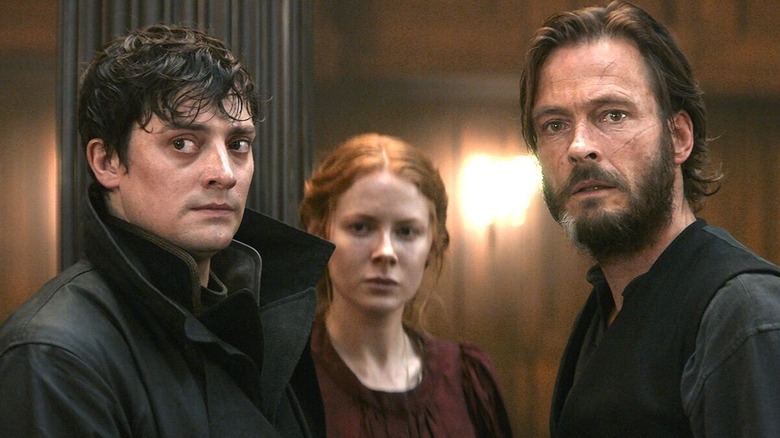
Yes, it's true that "1899" viewers didn't think that it lived up to the phenomenal "Dark," but Jantje Friese and Baran bo Odar's follow-up to their hit Netflix sci-fi is still absolutely worth your time. "1899" is yet another deeply cerebral and complex science fiction series that "Dark" fans will find very stylistically similar. Sadly, while many people loved this series, they'll never get to learn how it was meant to end, since "1899" got its walking papers after just one season on Netflix. Even so, the series is still a must-watch for anyone who enjoys a good puzzle box mystery or gets a kick out of the fan theorizing side of sci-fi.
It's not primarily an English or German language series; rather, it's fascinatingly multilingual, with characters variously speaking English, Danish, Cantonese, Portuguese, Spanish, French, and Polish, giving a sense of what life might have truly been like aboard an international turn-of-the-20th-century vessel. Set primarily aboard the Kerberos, a steamship bound for New York City from the United Kingdom four months after its sister ship, the Prometheus, went missing, the series depicts a ship full of details that increasingly feel wrong.
A jeweled scarab beetle leads to a strange black tetrahedron, a sliding puzzle holds the power of teleportation, a mysterious symbol and notes appear. At one point, a strange, metallic substance begins growing all over the ship. An incomprehensible ticking compels passengers into a trance, causing them to march to the deck and throw themselves overboard. From visions to doorways into various times and realities, "1899" is an everything casserole brimming with so many fascinating sci-fi tropes it can be hard to get a grip on what's happening — and that's exactly where the writers want you.
Westworld
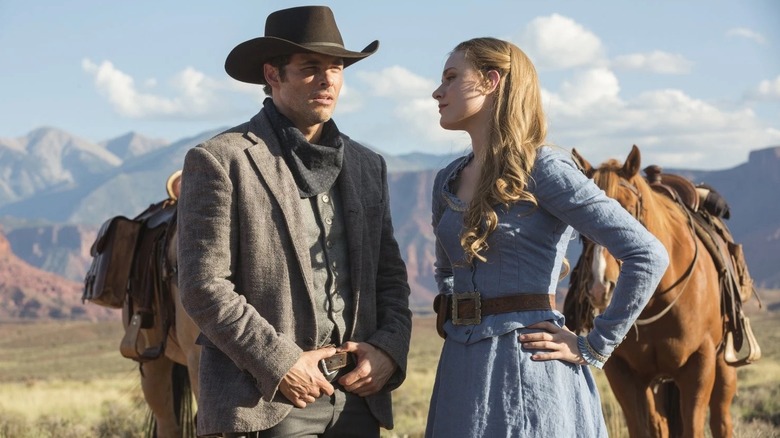
A philosophically challenging reimagining of the 1973 sci-fi Western movie "Westworld," this 2016 series hits even harder in the post-AI era. It follows a handful of characters but is told primarily from the perspective of Dolores Abernathy (Evan Rachel Wood), the oldest artificial intelligence still in active use at Westworld, one of several theme parks for the ultra-privileged. Disneyland this is not — Westworld is anything but a family-friendly theme park with its lifelike AI "hosts," meant to be used and abused however park guests choose.
Effectively killed and resurrected ad nauseum, these hosts are continuously rewritten and uploaded, their programming erased along with any potential trauma from the abuse they've endured. That is, right up until hosts begin to experience consciousness differently. Told through different timelines to drive home the sense of a shifting reality, "Westworld" can be hard to follow at times, but the payoff is excellent. Gorgeous sprawling landscapes evocative of frontier painters Albert Bierstadt and Thomas Moran provide a breathtaking backdrop for a tale that prods at the very nature of reality and human existence.
"Westworld" is full of crazy, mind-blowing reveals, and that's what kept viewers glued to the series during its four-season run. It's a fascinating watch aided by a seemingly never-ending list of outstanding actors like Thandiwe Newton, Anthony Hopkins, James Marsden, Luke Hemsworth, Jeffrey Wright, Gustaf Skarsgård, Zahn McClarnon, Ed Harris, and Jimmi Simpson. Husband and wife co-creators Jonathan Nolan and Lisa Joy went all out here, and even though HBO pulled the plug on "Westworld" earlier than expected, it's still one of the best shows of the last decade.
Severance
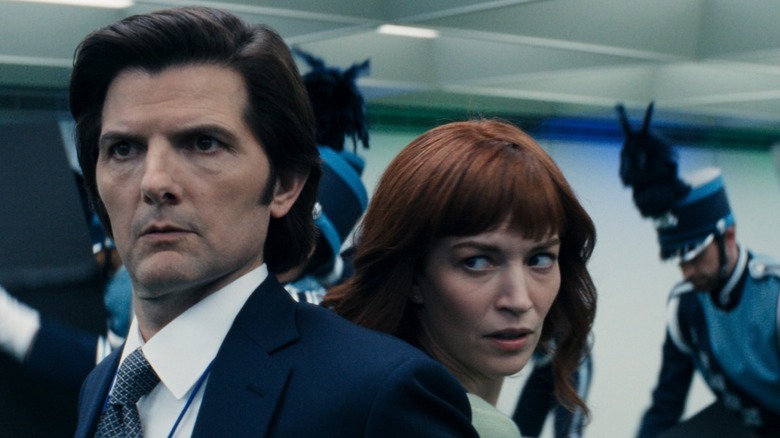
Surprisingly sober for a Ben Stiller-directed series, "Severance" is a Backrooms-inspired dark comedy sci-fi psychological horror mystery box that imagines a world where it's possible to physically separate the functionality, memories, and lived experiences of a human being into two halves: one for work, and one for everything else. In such a world, overworked laborers are free to enjoy the entirety of their lives without so much as a thought for what it's like to be the poor schmuck having to clock in and dine on disappointing lunchbox cuisine. The only problem? There's another, nearly-identical version of everyone who can never leave their job, experience recreation, or even sleep. The moment they attempt to, their day effectively resets with no memory of the time, family, or world outside.
"Severance" is told from the perspective of severed floor worker Mark S. (Adam Scott) as he slowly begins to question the reality around him in the wake of a co-worker's sudden disappearance. With no life, communication, or contacts outside of the office, the loss of Mark's work bestie hits almost like a death as the missing guy effectively no longer exists for his colleagues. One of the best shows streaming on Apple TV, it presents ambitious sci-fi constructs and themes wrapped up in uncannily mundane dressing. Through its occasionally disorienting and often surreal examination of labor and freedom in an alternate universe, "Severance" opens the door for many conversations exploring how human lives are valued in a system where the rights of laborers come second to a company's nebulous goals.
Russian Doll
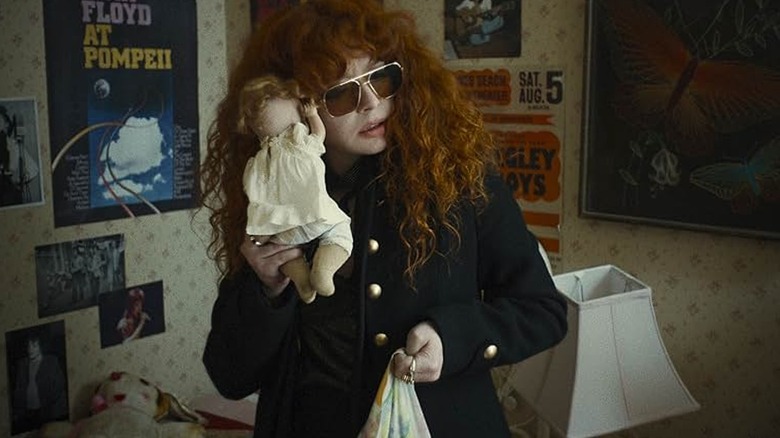
Starring Natasha Lyonne as its central POV character Nadia Vulvokov, "Russian Doll" is a wild ride of a sci-fi comedy drama series that boasts one of the best TV time loop stories in recent memory. Nadia wakes up day after day in the same place, seemingly helpless to change events around her beyond experimenting and learning from the things she tries. She keeps respawning in front of a mirror in her friend Maxine's (Greta Lee) apartment in the middle of a pretty hopping 36th birthday party being thrown on Nadia's behalf. There are worse places to keep popping up, but, despite every effort she makes to change things, Nadia can't seem to survive the night.
In one run-through, she slips on the stairs. In others, she gets hit by a taxi cab, dies from a gas leak, chokes on a chicken bone, and so on, dying dozens of times as she struggles to unravel the mystery keeping her trapped in the same day. A brilliant take on a tried-and-tested sci-fi trope, "Russian Doll" is a showcase for Lyonne's fast-talking talent and whimsically snarky, in-your-face NYC energy. The show underwent drastic changes from pitch to screen, and they were ultimately for the best — "Russian Doll" scooped three Emmys and scored rave reviews from critics, boasting a near-perfect 97% rating on Rotten Tomatoes.