

10 Most Disturbing Movie Endings Of All Time, Ranked
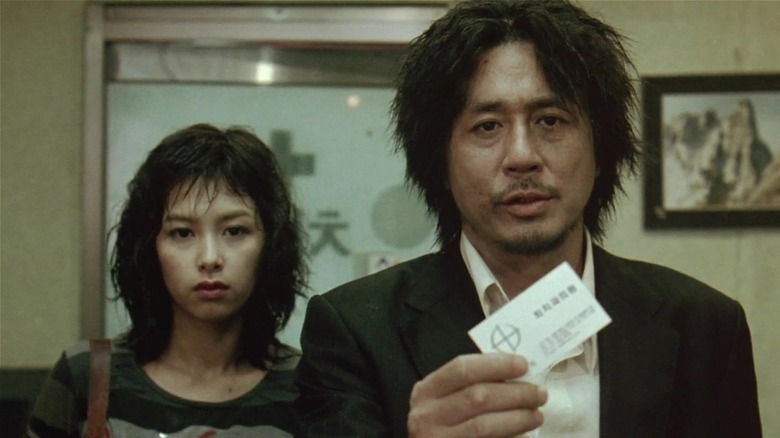
A typical movie ending leaves an audience on a high note, assuring them that all is right in the world and no matter how much you may struggle, things will turn out fine. However, some films leave audiences with a feeling that's more unsettling, much to the chagrin of studio executives who fear that an unhappy ending might negatively affect ticket sales. While a happy ending is usually de rigueur in Hollywood, the rare unhappy ending can sometimes sneak its way onto movie screens, sparking passionate debate amongst audiences as they make their way to the parking lot.
A film may also opt for a disturbing ending, which forces audiences to grapple with the darker implications of human existence. An unsettling finale can leave us feeling upset and uneasy; but in their own way, they can enrich our lives, because they allow us to confront horrors that we would rather not think about. To do so in fiction allows us to do so in our real lives, and in that way, they're easier to deal with than actual tragedies that may one day befall us.
Here are the 10 most disturbing movie endings of all time, ranked. In assembling this ranking, we looked not so much at violent or explicit movie endings, but conclusions that left us feeling deeply troubled by their implications. These final scenes aren't so much disturbing for their content, but for what they have to say about the world we live in. And, of course, major spoiler warnings for the following 10 films.
10. Chinatown
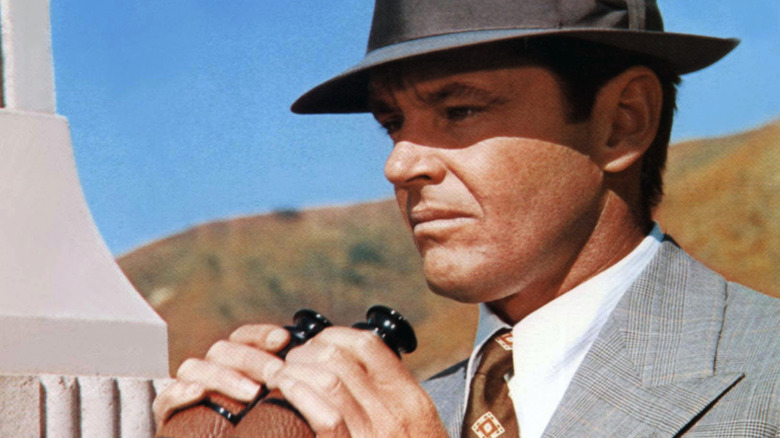
1974's "Chinatown" takes viewers to 1930s Los Angeles, where private detective J.J. "Jake" Gittes (Jack Nicholson) makes a living off of run-of-the-mill infidelity cases. So when he's hired by a woman he believes to be Evelyn Mulwray (Faye Dunaway) to spy on her husband Hollis, he thinks he's just trying to catch another philanderer. But when Hollis turns up dead, Gittes becomes entangled in a web of murder, corruption, and incest at the hands of Evelyn's father, wealthy businessman Noah Cross (John Huston).
Having learned that Cross has fathered his own daughter's child, Gittes tries to get the two out of Los Angeles. He instructs them to meet him in Chinatown, where he learned to do "as little as possible" as a vice cop. Cross forces Gittes to take him to them, where a shootout leaves Evelyn dead. As Cross ensnares his screaming granddaughter, Gittes is instructed by the police to leave, even though he knows the old man will get away with everything.
Widely considered one of the best detective movies ever made, Robert Towne's Oscar-winning script for "Chinatown" has also frequently been hailed as one of the greatest ever written. If nothing else, it's certainly the bleakest noir ever — especially for its ending, which finds a protagonist unable to prevent injustice and violation. The film's final line drives home the idea that the world is too evil to save, so why try? "Forget it, Jake. It's Chinatown."
9. Requiem for a Dream
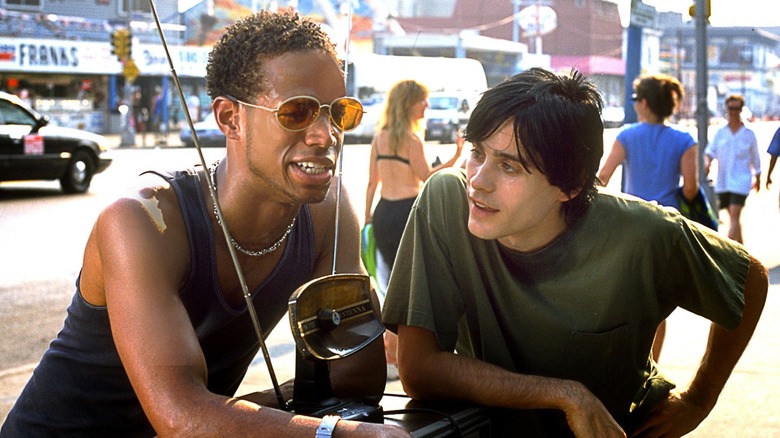
In "Requiem for a Dream," Harry Goldfarb (Jared Leto) is a heroin addict who frequently scores drugs with his best friend, Tyrone (Marlon Wayans). He dreams of opening a clothing store with his girlfriend, Marion (Jennifer Connelly), who will stock the store with her designs. His mother, Sara (Ellen Burstyn), receives an invitation to appear as a contestant on her favorite game show, and gets a prescription for diet pills so that she can fit into her favorite red dress. Harry's life unravels when gang warfare causes the local heroin supply to dry up, causing a spike in prices. To raise money, he encourages Marion to work as a prostitute, while he and Tyrone travel to Miami in search of drugs.
Desperate to lose weight, Sara increases her drug usage, causing her to hallucinate and act erratically. She is eventually hospitalized and given electroshock therapy, leaving her in a catatonic state. Harry is hospitalized when his arm becomes gangrenous from heroin use, leading to its amputation. Tyrone is arrested and imprisoned, causing him to go through withdrawal behind bars. After participating in group sex for money and drugs, Marion is left alone and traumatized.
Darren Aronofsky pulls no punches in bringing Hubert Selby Jr.'s novel "Requiem for a Dream" to the screen, dramatizing addiction in harrowing detail. There is no euphoria at the end, as every character is reduced to rubble by their dependence on drugs. Burstyn earned an Oscar nomination for her performance, which is devastating in its depiction of how easily someone can slip into addiction.
8. Henry: Portrait of a Serial Killer
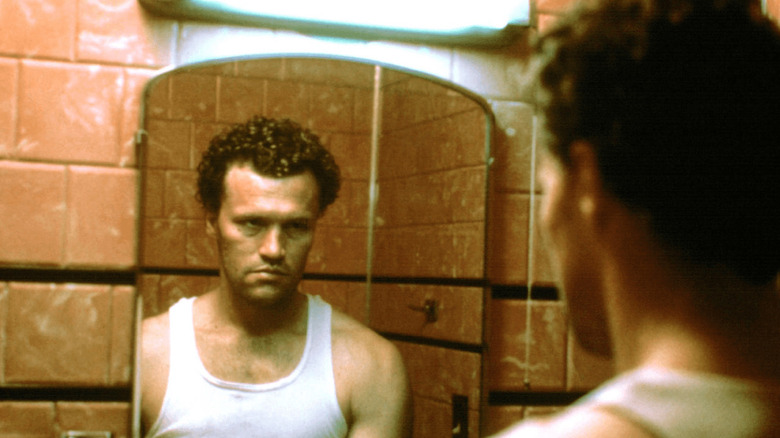
"Henry: Portrait of a Serial Killer" follows drifter Henry (Michael Rooker) as he travels through the Midwest and kills innocent people, eventually making his way to Chicago. He shacks up with his friend, Otis (Tom Towles), who brings home his sister, Becky (Tracy Arnold). Although he's a cold-blooded killer, Becky finds herself attracted to Henry, especially after he stops Otis from making an incestuous pass at her. After killing a pair of prostitutes, Henry encourages Otis to indulge in his own murderous instincts. But Henry soon learns that Otis is even more deranged than he is.
After learning her ex-husband has been sent to prison, Becky decides to leave town to be with her daughter. When Otis returns home drunk, he tries to rape and murder her. Henry stops him, and kills him with Becky's help. After dismembering the body, Henry drives off with Becky, who is unsettled by the killing. Becky tells Henry she loves him, and he tells her he loves her too, which doesn't stop him from killing her.
The directorial debut of John McNaughton, "Henry" was filmed on a tiny budget on the streets of Chicago. Drawing from the real story of Henry Lee Lucas, the film stared into the deepest depths of despair and depravity, so much so that it was held from release until 1990 — despite being filmed and screened a few years prior – as it struggled to obtain an R rating. The ending is particularly unsettling, as Henry shows that while redemption is possible for some, it isn't for many.
7. The Wicker Man
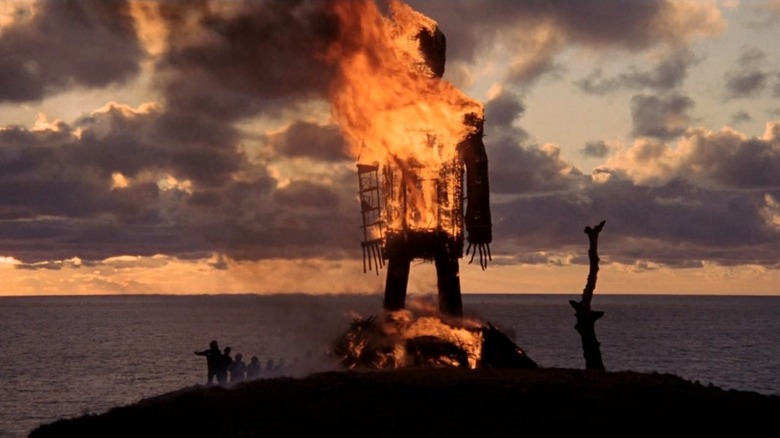
Police sergeant Neil Howie (Edward Woodward) travels to the remote island of Summerisle to investigate the disappearance of a young girl named Rowan Morrison (Geraldine Cowper). A devout Christian, Howie is appalled to discover that the island inhabitants are practicing pagan rituals. Most appalling of all, the locals seem to disabuse the notion that Rowan ever existed, let alone went missing.
Eventually, Howie learns that Rowan has been sacrificed to appease the gods after a disastrous harvest. After exhuming her grave, he finds not a little girl, but a hare. To his horror, he learns that the towns magistrate, Lord Summerisle (Christopher Lee), has led him to the island under false pretenses; Rowan was never sacrificed to the gods, but Howie will be. Despite his protestations about the islands inhospitable climate being the cause of the bad harvest, the villagers follow through with their plan to burn Howie alive inside of a giant wooden structure known as the Wicker Man.
One of those classic horror movies that hold up better than their remakes, "The Wicker Man" snuck a darkly funny satire of religious fundamentalism into the marketable package of psychological terror. Released in 1973, its bleak ending felt perfectly in line with a sense of helplessness and cynicism that permeated throughout the decade. Although the 2006 Nicolas Cage version tries to replicate that finale, it bungles the rest of the approach so badly it becomes one of those reboots that completely missed the point of the original movie.
6. Jacob's Ladder
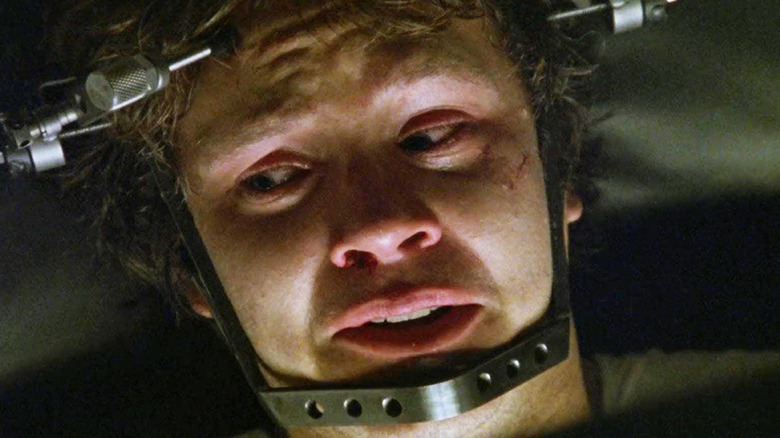
"Jacob's Ladder" tells the tale of Vietnam War veteran Jacob Singer (Tim Robbins), who has been seeing strange sights on the streets of New York City. Working as a mailman and living in a rundown apartment with his girlfriend Jezebel (Elizabeth Peña), Jacob is unsettled by the presence of demons. Convinced he isn't losing his mind, he begins to suspect this has something to do with an incident that occurred while he was deployed in Vietnam, when his fellow infantry men came under attack and suffered strange medical episodes.
As Jacob searches for answers, he continues to have visions involving his old family and his dead son, Gabe (Macaulay Culkin). He soon learns that his platoon was exposed to a powerful form of LSD known as "the Ladder," which caused hallucinations and aggressive behavior. His chiropractor friend, Louis (Danny Aiello), helps Jacob not just with his back, but with his fear of death. Eventually, Jacob realizes that he was fatally stabbed during the attack in Vietnam, and everything he has experienced since then has been his resistance to dying.
If there ever was a movie that needed an ending explained, it's "Jacob's Ladder." Directed by Adrian Lyne, it weaves back-and-forth through time, blending fantasy, reality, and memory into a disturbing mosaic of a distressed mind. What makes the ending so unsettling isn't so much the final reveal, but a title card that reveals the United States Army has long denied the use of psychological drugs on unwitting cadets, making one wonder how many vets have experienced what Jacob has.
5. Funny Games
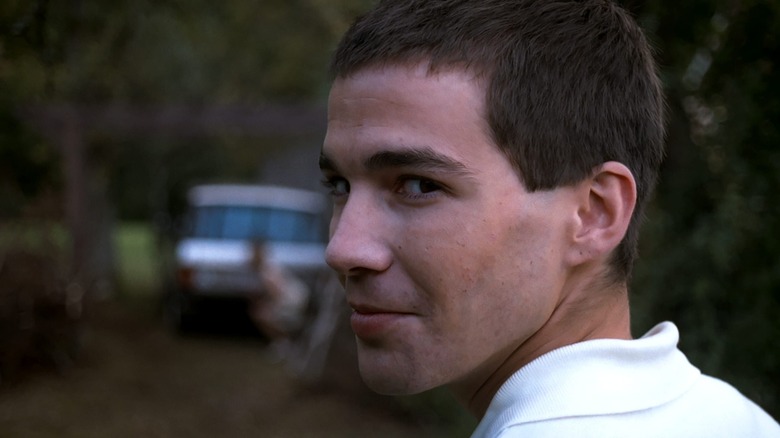
A typical German family — father George Schober (Ulrich Mühe), mother Anna (Susanne Lothar), and son Georgie (Stefan Clapczynski) — arrive at their lakefront vacation home for some rest and relaxation in "Funny Games." They spot their neighbors with a pair of young men they don't recognize, and before long, the men have shown up at their house, introducing themselves as Paul (Arno Frisch) and Peter (Frank Giering). Although they appear pleasant at first, Paul and Peter are actually sinister, and their behavior becomes increasingly violent.
Before long, Paul and Peter have taken the Schobers hostage, and place a bet that they will not survive the night. As the pair engage in a series of sadistic games with the family, George and Anna try desperately to fight back. By the end, George and Georgie have been shot dead, and Anna is dumped in the lake to drown. After engaging in a discussion about the plot of a science fiction film, Paul and Peter go to another house to start the game all over again.
"Funny Games" is perhaps the most disturbing film ever directed by Michael Haneke, which is saying a lot for the man who made "Benny's Video," "The Piano Teacher," and "Caché." What makes this 1997 release so unsettling is its implication of the audience, done through such alienating devices as direct address, rewinding, and self-referential winks to the camera. It's as though the director is acknowledging that the viewer has come to watch something dark and depraved, and won't let them enjoy it in peace.
4. The Vanishing
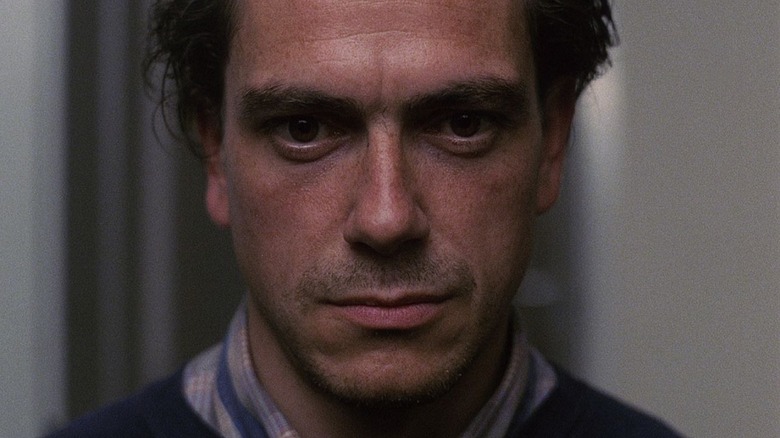
While on holiday in France, Rex Hofman (Gene Bervoets) and his girlfriend Saskia (Johanna ter Steege) stop at a rest area to get gas and food. Saskia enters the convenience store, and Rex become increasingly frantic as she fails to return. After some time, he realizes his girlfriend has disappeared, and begins a years-long search to find her. Unbeknownst to him, Saskia has been kidnapped by Raymond Lemorne (Bernard-Pierre Donnadieu), a seemingly normal family man with a disturbing double life.
After Rex makes a public plea for Saskia's return, Raymond reaches out and agrees to tell him the truth of what happened. But first, Rex must agree to meet him, and listen to the kidnapper relate his history of psychopathy. He tells the victim's boyfriend that the only way he can understand what happened to Saskia is to experience it for himself, and after drinking some drugged coffee, Rex awakens and finds himself buried alive. Raymond returns to his family, with no one suspecting his crimes.
When George Sluizer remade his 1988 French-language thriller "The Vanishing" for American audiences in 1993, he changed the ending to something more befitting of a Hollywood action film. That's a shame, because few movie endings are as unsettling as the one he concocted for the original. Because there's no mystery as to the kidnapper's identity, we expect the final twist to be an enactment of justice. Yet, as Rex learns in his final moments, there are some questions that are better left unanswered — for our own good.
3. Don't Look Now
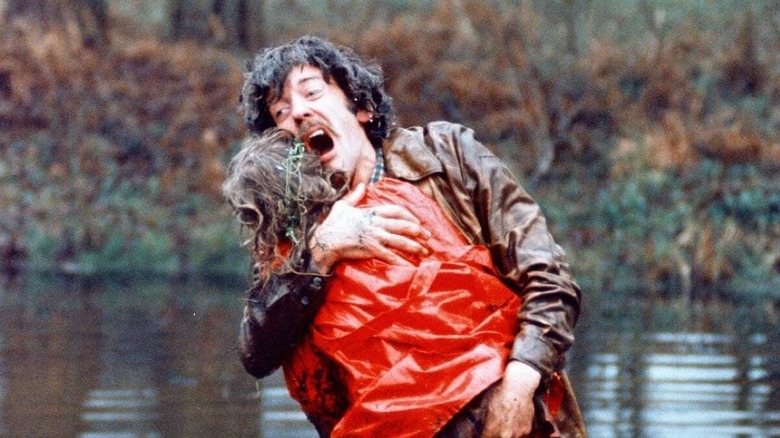
Following the death of his daughter, art restorer John Baxter (Donald Sutherland) accepts a commission refurbishing a decaying church in Venice. While in Italy, his wife Laura (Julie Christie) meets an elderly woman (Clelia Matania) and her clairvoyant sister (Hilary Mason), who claim to be communicating with her daughter from beyond the grave. Laura holds a séance with the sisters, and tells John that their daughter's ghost warned her that his life is in danger. John refuses to take these omens seriously, and Laura departs for England without him.
After nearly falling to his death while working on the church, John is shocked to see Laura in a funeral procession with the sisters. He's also disturbed by the appearance of a mysterious figure wearing the same red raincoat that his daughter had on when she drowned. After chasing the figure down, he's shocked to find not his daughter, but an elderly serial killer who slashes his throat. As he dies, John realizes he has been seeing premonitions of his own death.
Directed by Nicolas Roeg, "Don't Look Now" is remembered as a disturbing '70s horror movie that still shocks viewers. Featuring a notorious sex scene that felt anything but staged and a storyline constructed in a fractured, nonlinear format, the powerful ending of "Don't Look Now" is so confusing that it needs a second watch to fully understand it. Yet it's that uncertainty that makes the final scene so shocking and disturbing, as it supposes there are evils in the world beyond explanation.
2. Oldboy

On the night of his daughter's fourth birthday, businessman Oh Dae-su (Choi Min-sik) is arrested for drunkenness. After getting released from jail, Dae-su is abducted, and awakens in a windowless room with a door he can't unlock. Dae-su spends 15 years locked in the room, watching television and learning martial arts. Then, one day, he is mysteriously released, and sets about exacting revenge against his captors. He is aided in his search by Mi-do (Kang Hye-jung), a young woman who quickly becomes his love interest.
After leaving a trail of dead bodies, Dae-su learns the man behind his imprisonment was Lee Woo-jin (Yoo Ji-tae), who holds a grudge from their years in boarding school. Woo-jin had an incestuous relationship with his sister (Yoon Jin-seo), who committed suicide when rumors of a pregnancy spread. Through his elaborate scheme, Woo-jin conspired to have Dae-su sleep with his own daughter: Mi-do. Horrified by this revelation, Dae-su begs Woo-jin not to tell Mi-do, cutting out his own tongue as penance. Woo-jin kills himself, and Dae-su hires a hypnotist to remove his memory of incest, allowing him to live in peace with Mi-do.
From the moment Park Chan-wook's "Oldboy" premiered, it became notorious for its ending, which was as shocking and depraved as humanly imaginable. What made the ending so disturbing wasn't the final reveal, but rather the implication that somehow, Dae-su could continue living after doing the unthinkable to his own flesh and blood. Perhaps he would've been better off locked in that room (as happens at the end of Spike Lee's remake).
1. Se7en
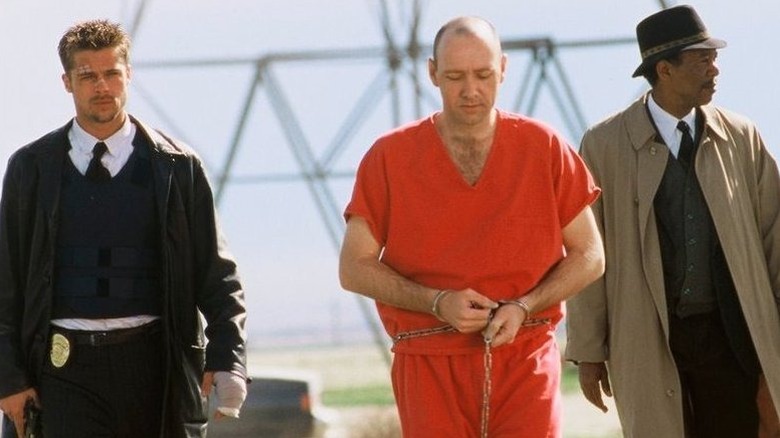
"Se7en" takes place in a violent, rainy city, where veteran police detective William Somerset (Morgan Freeman) is paired with rookie David Mills (Brad Pitt) to investigate a series of bizarre homicides. As the body count piles up, Somerset realizes the killings are all related to the seven deadly sins. During their investigation, Somerset grows close to Mills and his wife, Tracy (Gwyneth Paltrow), who tells him she's pregnant — a secret she's keeping from her husband.
Their investigation eventually leads to John Doe (Kevin Spacey), a killer who has shaved off his fingerprints with a razor blade. Doe agrees to wave an insanity plea if Somerset and Mills escort him to the burial site of his two final victims: envy and wrath. The three travel to the middle of the desert, where Somerset receives a package containing Tracy's severed head. Although he desperately tries to stop Mills from exacting vengeance, Somerset is unsuccessful, and John Doe claims his final victim.
When it was released in 1995, David Fincher's "Se7en" became a sort of Rosetta Stone for twist endings. The brilliance of the final scene isn't the reveal of what's literally in the box, but its metaphorical meaning. Throughout the film, Somerset tries to tell Mills that he doesn't really want to know how bad life can get. The younger man refuses to listen to him, and he pays the ultimate price.