

5 Comedy Movies That Received A Perfect Rating From Roger Ebert
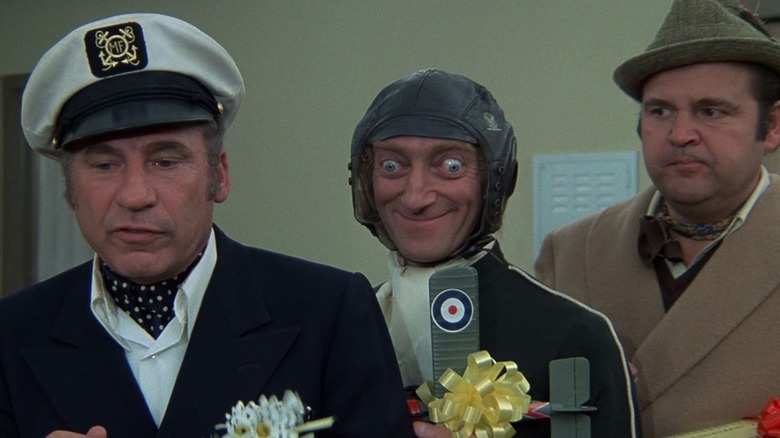
One of the reasons that Roger Ebert became one of the most famous film critics of all time, and whose opinion was trusted by multiple generations of moviegoers, is that he didn't only like artsy-fartsy movies. To be clear, Ebert's 10 best movies of all time are definitely dominated by the kinds of films you'd expect a prestigious film critic to love. But over the course of his very long career, Ebert also showed plenty of love for popcorn movies as well, and he most certainly had a fondness for comedies.
Obviously, Ebert loved the all-time great comedies that even the snootiest of movie buffs give reverence to: "Annie Hall," "Dr. Strangelove," "Fargo," etc. He also included one such unimpeachable comedy, the Buster Keaton classic "The General," on his aforementioned top 10. But Ebert also doled out plenty of four-star reviews to some slightly more surprising comedies, which is what we wanted to highlight here.
Full disclosure, not all of these will knock you out of your chair by their inclusion. But we still feel it's a good cross-section of comedies that Ebert gave a perfect score to that demonstrate his wide range of tastes, his championing of comedies that didn't always get as much love from his fellow critics, and his ability to forgo deeply nitpicking a movie if it made him laugh hard enough.
This Is Spinal Tap
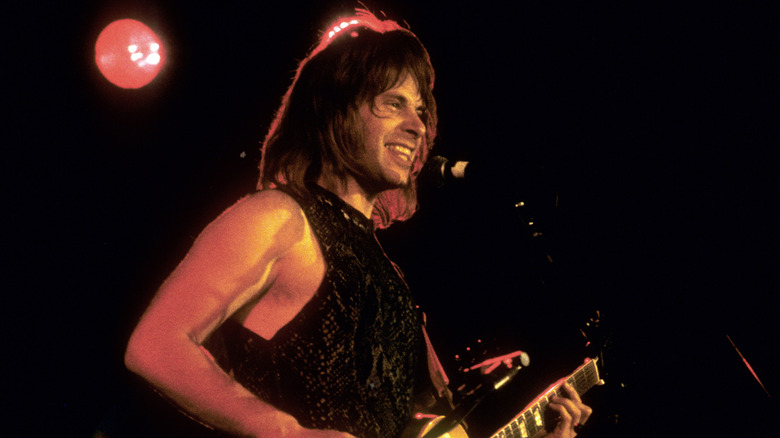
We start off with what might be the least shocking inclusion on this list. It isn't tough to find a critic who loved "This Is Spinal Tap" — the mock rockumentary about a washed-up band trying to push through a tour that is falling apart, a fact that is obvious to pretty much everyone but them — and it's generally hailed as a cult classic movie everyone needs to watch. But we included it because Ebert proclaimed it "one of the funniest films ever made" in a retrospective review in 2001, when he added to his list of Great Movies.
In his original four-star review, Ebert was no less effusive with praise for "This Is Spinal Tap." He commended the film for its then-novel approach to presenting itself as a documentary, and appreciated that the movie trusts the audience to get what it's trying to do and pick up on the sometimes quite subtle satire on display. On his year-end top 10 for 1984, he not only included "This Is Spinal Tap" but even ranked it above the best picture Oscar nominee, "The Killing Fields."
L.A. Story
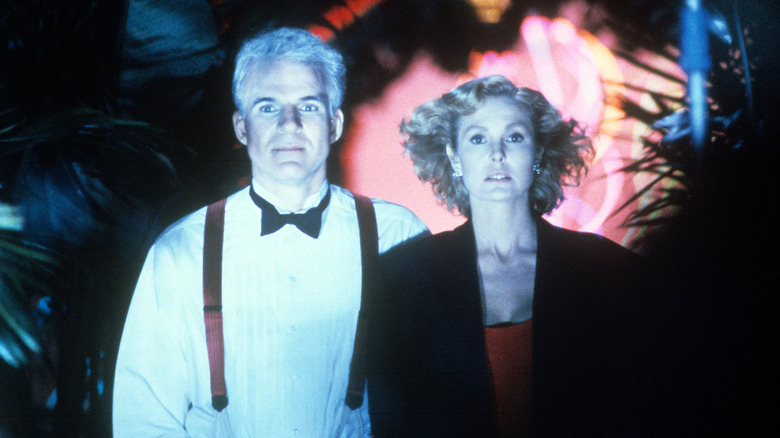
When considering the film career of Steve Martin, most people either default to early classics like "Three Amigos" and "Planes, Trains and Automobiles," or they associate the comedian more with bigger box office hits like "Father of the Bride" and "Cheaper by the Dozen." As such, some of his greatest movies get overlooked — such as 1991's rom-com satire "L.A. Story," which Martin wrote and stars in as an unlucky-in-love TV weatherman. We put it right in the middle of our ranking of Martin's best movies — not a bad showing, but seemingly not befitting a film that Roger Ebert deems worthy of four stars.
In his review, Ebert says "L.A. Story" represents Martin finally finding "the right comic presence for the movies," toning down the chaotic energy of his earlier performances for a more effortless — but still hilarious — charm. For context, Ebert hated "Three Amigos" and wasn't crazy about "The Jerk" either. Ebert also points out that Martin's working on the script for "L.A. Story" for seven years was time well spent, resulting in an expertly crafted and tightly polished comedy gem. "There's never the feeling that anything is being punched up, or made to carry more than its share," Ebert writes.
Silent Movie
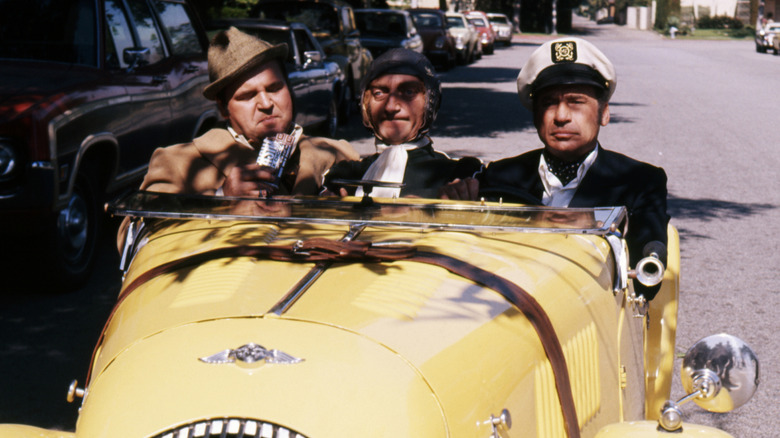
Mel Brooks has been so prolific in the spoof genre that we included four of his films on our list of the best spoof movies of all time — "Young Frankenstein" and "Spaceballs" are two of his most popular; "High Anxiety" is an underrated send-up of Alfred Hitchcock thrillers; and cult favorite "Robin Hood: Men in Tights." And that isn't even all of his great spoofs. Another of his lesser-known entries, "Silent Movie," is a favorite of Roger Ebert — far more so than "High Anxiety," "Men in Tights," or "Spaceballs," which he liked far less, based on his reviews.
"Silent Movie" didn't half-ass its premise, with only one word spoken audibly in the entire film. The movie's very meta concept is that silent-era filmmaker Mel Funn (Brooks) wants to make a new silent movie in the 1970s. And he becomes convinced that a studio will fund the film if he can get big stars to be in it — cue an impressive procession of Hollywood royalty playing themselves in cameos.
Ebert loved the movie, saying in his review, "On the Brooks-Laff-O-Meter, I laughed more than in 'Young Frankenstein' and about as much as in 'Blazing Saddles.'" High praise indeed. Much of the last paragraph of his review is just listing what he deems "classic" moments in the movie, coming up with six of them before having to stop himself, clearly having more in mind.
Withnail and I
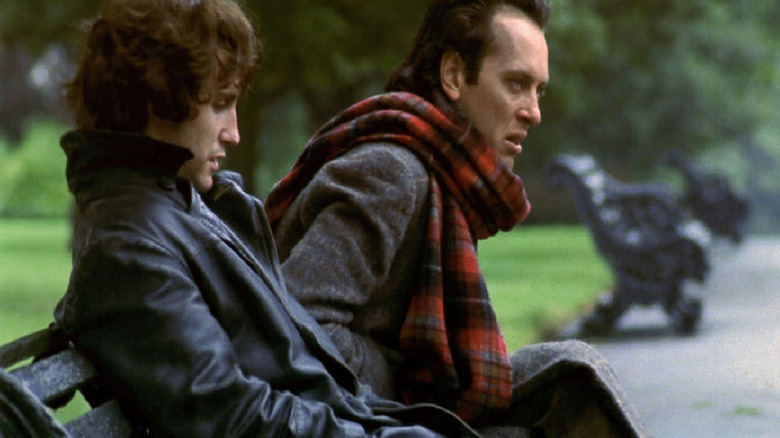
One of the funniest comedies you've never seen is "Withnail and I," a 1987 dark buddy comedy that Roger Ebert added to his Great Movies list. The semi-autobiographical film based on writer/director Bruce Robinson's life stars Paul McGann as Robinson's stand-in, Marwood, and Richard E. Grant as his pal, Withnail. They're two struggling actors who lazily fumble their way into wild misadventures in both urban and rural England.
Ebert actually got pretty personal in his 2009 review (he didn't review it upon its original release) of "Withnail and I," relating to the film's protagonists by admitting that he and his friends also thought they had the world figured out as they'd hang out and drink — and of course, knowing now that nothing could've been further from the truth. "'Withnail and I' [...] conveys the experience of being drunk so well that the only way I could improve upon it would be to stand behind you and hammer your head with two-pound bags of frozen peas," he wrote.
Elsewhere, Ebert asks, "Why does the film, which I have made sound so depressing, remain so popular after more than 20 years?" To which he answers his own query thusly: "It achieves a kind of transcendence in its gloom. It is uncompromisingly, sincerely, itself. It is not a lesson or a lecture, it is funny but in a consistent way that it earns, and it is unforgettably acted."
Rango
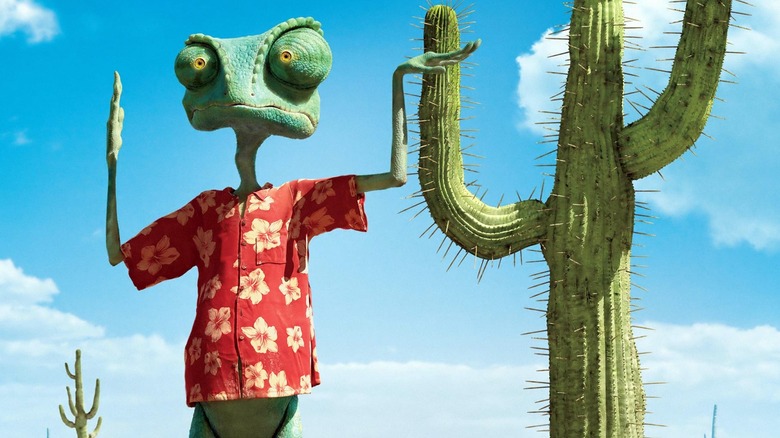
As you are no doubt aware, Roger Ebert passed away in 2013 from the thyroid and salivary gland cancer that took away his ability to speak seven years prior. But Ebert continued to write movie reviews until the end, with his final review actually being published posthumously. With all that in mind, we wanted to include a comedy he raved about in the final stretch of his life and career. "Rango" would end up being one of his final 4-star reviews of a comedy.
"Rango" was an odd film indeed, marketed as a typical kids' animated romp but actually best appreciated by older audiences who will get all the references to movies of the '60s and '70s. To be sure, there are many things only adults notice in "Rango," the story of the shy titular anthropomorphic chameleon (voiced by Johnny Depp) who somehow finds himself the sheriff of a frontier town. After attempting to get by just cosplaying as a lawman, Rango is soon left with no choice other than to actually become the brave hero he was always meant to be.
Ebert was completely smitten with "Rango," calling it "some kind of a miracle" in his review because it is "wonderfully made, great to look at, wickedly satirical." He also clearly had a bone to pick with 3D movies, all the rage when "Rango" was released, as he mentions several times how great it is that "Rango" didn't have a 3D version, and hoped it would convince more people how unnecessary 3D is.