

Small Details You Missed In The Backrooms Movie

Contains spoilers for "Backrooms"
"Backrooms" is blowing the critics away and raking in cash at the box office, and its success has left viewers wanting to know more about the mysteries of its setting. With an ambiguous ending designed to inspire audience debate, many of these mysteries remain open to interpretation. However, there are some clues throughout which might help you gain a greater understanding of what you're dealing with here.
"Backrooms" is a self-contained entry point into director Kane Parsons' sci-fi/horror universe, which began with a web series on YouTube that was inspired by the Backrooms Creepypasta. The film contains some nods to the series, though Parsons wanted to make sure the movie stood on its own two feet, so you'll have to look hard for them. Here, we've outlined nine of the most crucial small details, either because they have wider implications in the franchise timeline, reveal far more about the mostly unexplained lore of the lifeform and the vast universe behind the walls, or are simply cute nods for the super fans that might go over the heads of casual viewers.
This is a movie that has been intricately designed to reveal new secrets with each rewatch, but there are plenty of small details immediately apparent at first glance which sent us down rabbit holes after the credits started rolling (and don't worry, there's no post-credit scene in the "Backrooms" movie, so you haven't missed any further clues there). More than just typical Easter eggs, these tiny details will enhance your understanding of the universe and its ongoing timeline.
The dates on the found footage and CCTV
One of the very first things to note is the date of the extended (and utterly terrifying) found footage recording that opens the movie: June 19, 1990. The movie doesn't dive too deeply into the lore of the web series, although Kane Parsons has said he has ensured it remains consistent with the continuity of the series, which makes this choice of date within the timeline particularly interesting. It takes place less than a month after the Async Corporation (which is experimenting with the Backrooms) dealt with employee Peter Tench, whose death it faked after a failed exploration mission. Per the web series, Tench's mental health rapidly deteriorated after spending extensive time in the Backrooms. It was through his story that we learned it's possible to travel through time while navigating this space.
Tench died shortly after attempting to escape from Async's observation facility, which is when the company reluctantly revealed to employees that they had faked his death in the first place. What this means is that, when Clark (Chiwetel Ejiofor) enters the Backrooms on June 29, the realm is being more closely monitored than before to lessen the risk of a repeat incident. His therapist Mary (Renate Reinsve) follows behind Clark a matter of days later — it's unclear how long of a gap there is, but presumably no later than mid-July — and after being taken in for questioning by Async, she's told that her fate is being decided upon, just not by the scientist in front of her. With someone driven mad by the Backrooms and stopped from returning to the real world just weeks earlier, it's clear they'll be taking extra precautions with Mary.
The name of Mary's book
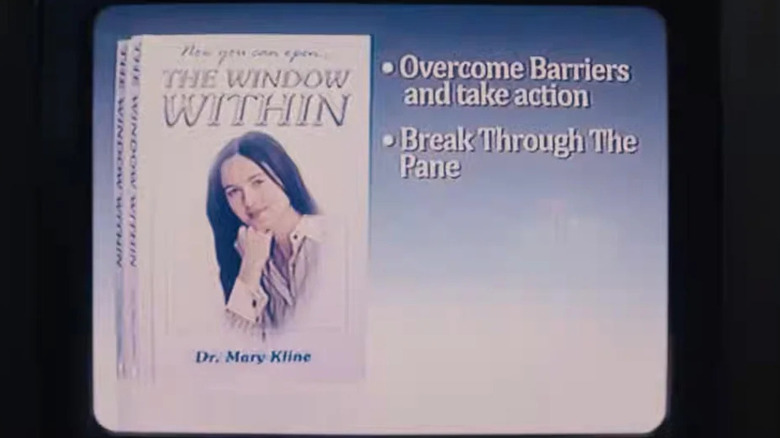
Mary never became the best-selling author she likely wanted to become following the publication of her self-help book "The Window Within." Instead, she's stuck with many of the same clients as before in her therapy sessions. The evocative nature of that book title is ripe for interpretation, with the cover tagline suggesting that following these rules will help you open it and "break through the pane." The guidelines she laid out in the book aren't particularly helpful for Mary — she's either been killed or left to gradually mutate, based on your interpretation of the final shot — but the title itself does seem to allude to one of the less easily explained moments.
The last we hear from Kat (Lukita Maxwell) before her offscreen death is that she's trapped in a room adjacent to Clark — he can't see her as a wall is in front of him, but on her side, it's a window, and she can see the creature behind him. We cut away before we learn his fate, but when we pick up with Mary in her office, Clark has since left a mysterious voicemail, saying that he's "opened the window" and "won't be coming back." Rather than just referencing his therapist's book, this could be cryptically alluding to Kat's fate on the other side of the wall she perceived as a window, as well as just generally signifying how he believes to have reached a moment of clarity from getting stuck in there. It also tells us that men would literally rather stay in the Backrooms than go to therapy.
Reverchon Ventures
This one is a blink-and-you'll-miss-it Easter egg for fans of Kane Parsons' other YouTube series, "The Oldest View." This is another liminal space horror set behind the walls of the recently closed Valley View Center mall in Dallas. There, the vlogger protagonist gets chased by a gigantic puppet known only as The Rolling Giant (named because it has wheels instead of feet), which is generally thought of as one of the scariest and most fascinating analog horror villains by the subgenre's fans. The design is based on the likeness of the real French botanist Julien Reverchon, who began studying plant life in Texas after moving there in the mid 19th century (he appears as a character in the first episode of "The Oldest View").
Reverchon Ventures is the name of the company demolishing Mary's childhood home in "Backrooms," which makes for an interesting nod to his prior work, though formal connections between "Backrooms" and "The Oldest View" begin and end with this. It's simply a neat little in-joke for fans — after all, there's a lot of time between the 1990 setting of "Backrooms" and the mall in "The Oldest View" being closed down and subsequently haunted by Reverchon's ghostly puppet. Still, as far as Easter eggs go, it's an interesting one, and this will no doubt lead Parsons' newest fans down a very fun rabbit hole, taking in not just another of his series but an equally expansive lore that makes fiction and reality indistinguishable.
A toy parrot foreshadowing the finale
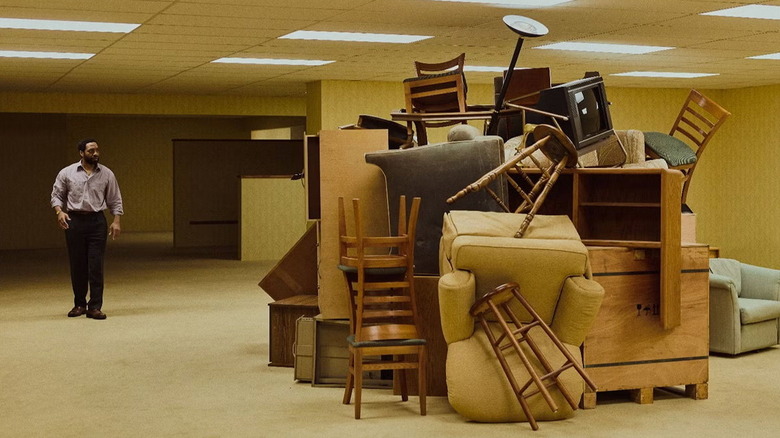
As fantastic as the name of Clark's furniture store — Cap'n Clark's Ottoman Empire — is, it hardly rolls off the tongue and doesn't entirely justify the pirate theme. When he first discovers another dimension behind the downstairs walls of his showroom, he initially just encounters furniture untidily piled up, which looks like it could have been dragged through the walls by one of his disgruntled junior employees. Exploring further, however, we get our first reveal of the newly introduced aspect of Backrooms lore: that the individual memories of anybody who enters can be warped and replicated by this space.
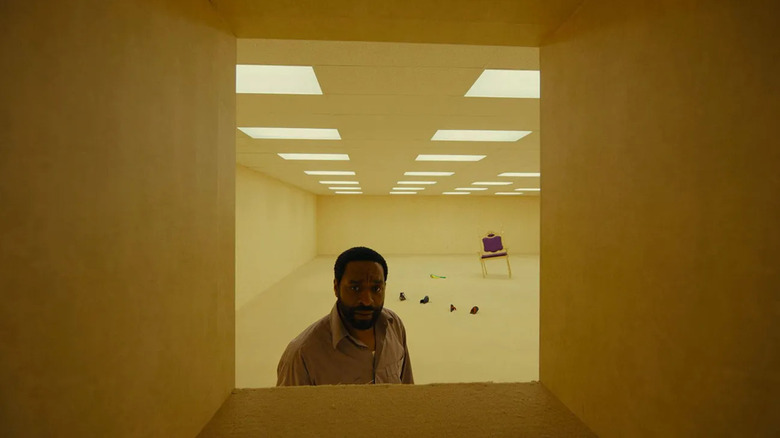
Between corridors leading towards endless chairs and the bag hidden in the wall featuring items seen in the cold open, things start getting a little personal for Clark. He finds a stuffed toy parrot in a room also featuring a lopsided throne, and shoes integrated into the carpet itself. It's in this room where Clark first hears the footsteps of the creature beginning to approach him, and the appearance of the toy parrot is the earliest suggestion that it has already taken his form from the store's lackluster TV commercial.
The toy parrot marks the first clear moment of foreshadowing, giving us a subtle hint about what the finale will entail. The unpredictable geography of the Backrooms and the surprises which lurk behind each corner wouldn't have made us guess straight away that the ultimate villain would resemble something we were introduced to before either of the two lead characters made their way through the walls for the first time. But the Backrooms doesn't rely on the unknown — it's all about taking what you do know and twisting it to frighten the life out of you.
The t-shirt Clark wears to bed
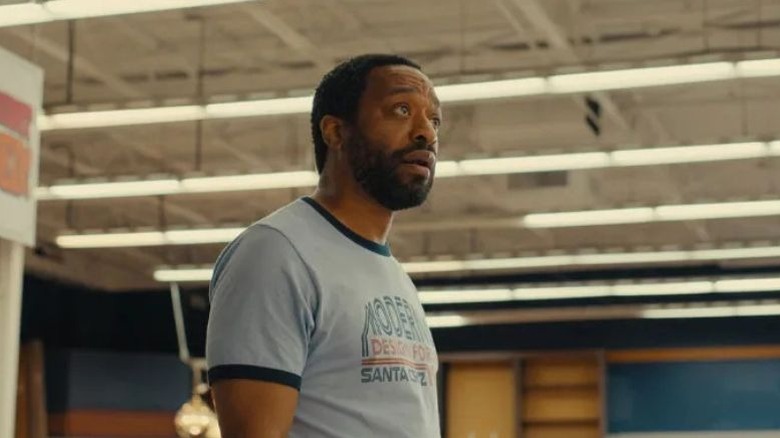
We hope that "Backrooms" costume designer Mica Kayde — who has previously collaborated with director Osgood Perkins on several movies, including "Longlegs" and the Stephen King adaptation "The Monkey" — gets her rightful flowers for her work here, because a single shot of a T-shirt manages to say even more about a character's psychology than exposition in the therapy room can. Nothing gets under Clark's skin more than being told he's no longer an architect, his dream profession which he's long since abandoned to run a failing furniture outlet. Sleeping in the store after being booted out by his wife, he goes to bed wearing a faded T-shirt with the logo of the Modernist Design Forum 1970 on it, suggesting that he's now two decades removed from his glory days in that profession, and that he must be delusional if he still calls himself an architect after so much time has passed.
Part of the way the Backrooms lures Clark in is through the architecture, playing on his undying passion. He finds himself struggling to find the words to describe it even after mapping it out; it's like "describing a dog to someone who has never seen one before," as he puts it. A later observation that it looks like it was "made by a bunch of construction workers on acid" feels more accurate. Holding on to the glories of his past like he has done with the T-shirt is what eventually dooms Clark. He's drawn in by the intoxicating nostalgia of a former failed career that he still deeply longs for. The signs were always there that he'd never want to leave the Backrooms once he found them.
The clothes in the laundry room
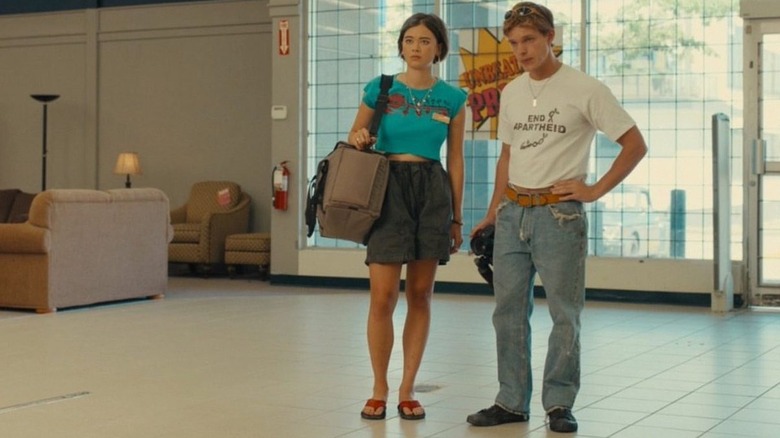
Here's another example of a scene that Mica Kayde deserves accolades for, because the costume design says an awful lot. After Bobby (Finn Bennett) is wired up and sent down a steep Backrooms passage to film what's inside, he enters a room filled with endless piles of clothes, which he very quickly describes as "stinky." Is this where the creature puts its victims' belongings after a kill? Not exactly, as mixed in with the pile of clothes you will see the tee Bobby was wearing in the earlier scene where he filmed Clark's commercial, the white "End Apartheid" one.
This is another indication of how the "Backrooms" lore has expanded to reveal that it warps an individual's memories upon entering rooms, feeding off Bobby's subconscious to replicate items from his wardrobe. The fact he is swiftly dragged back down and killed by the creature after filming there suggests that, when enough of your personal memories have been regurgitated, it's easier for you to be located in this vast network of rooms.
We don't see the shape of the creature that kills Bobby as he is dragged further underground, but, based on the fact that Clark was dressed in his pirate costume while Bobby was wearing the specific tee that was seen at the top of one of the piles, it may have already morphed into the giant pirate Clark by this point. By the time Kat and Clark fall down, too, it's already left the scene of the crime, and they're very quickly separated.
The signage during the chase scene
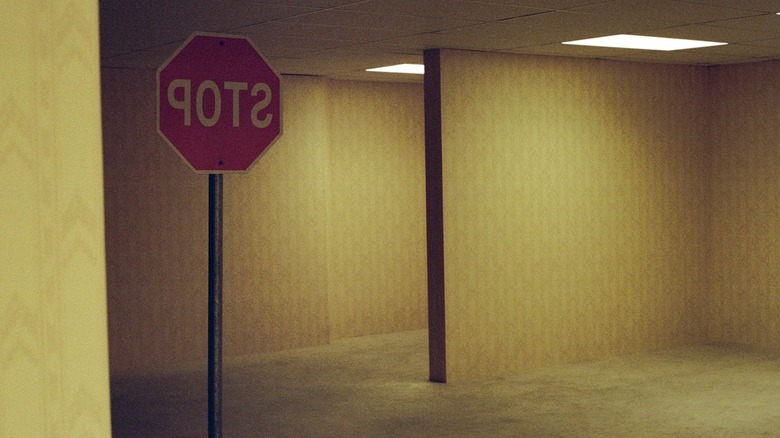
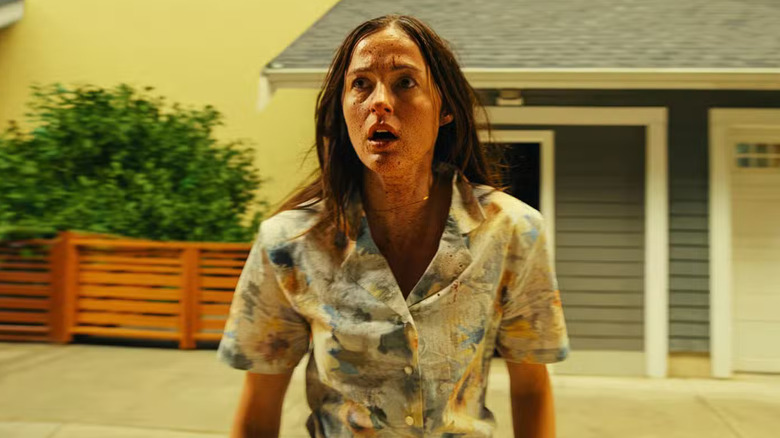
In the cold open, we see banners in the Backrooms which have grown out from their walls with mirror-image typography, and the same is true when Clark first steps through and he encounters a stop sign which has been mirrored. As he later states to Mary after tying her up, the Backrooms is a place that "remembers things slightly wrong," and the uncanniness of the replications is because they have quite noticeably got one key detail wrong. After Mary escapes from Clark's clutches and attempts to outrun the giant pirate Clark that's just killed him, her route takes her past a suburban street and an endless room of doors, leading her back to a replica of Clark's furniture store she can't escape from.
Here, the details are better observed: signage around the store hasn't been reversed, appearing in perfectly legible English. Later, as we see more of her memories manifested in the Backrooms, others have been copied effectively, too; a shelf of her books and a missing poster are duplicated correctly, although a copy of the fast food restaurant next to Clark's store has a sign in what appears to be the Cyrillic alphabet, so it's still far from perfect. In Looper's "Backrooms" ending explained feature, we teased the possibility that the movie might be an anti-AI allegory, and this would back that up. The Backrooms has grown to better resemble manmade structures and letters, but it still feels off the mark — it might get you at first, but a closer look will expose it as fake.
The storage room full of cardboard cutouts
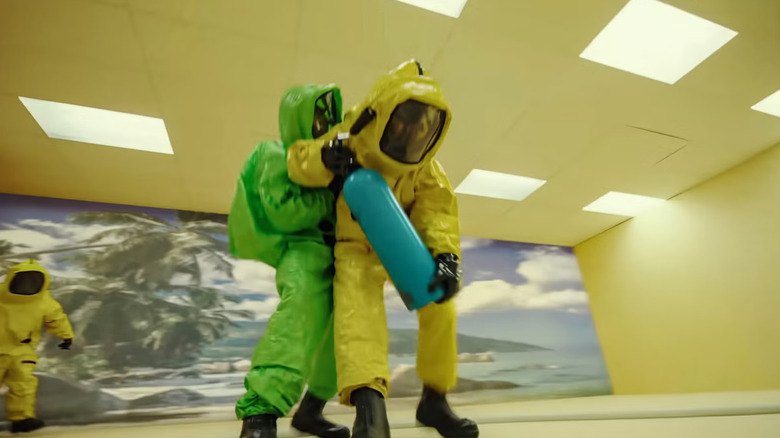
When Mary escapes from pirate Clark down a very narrow corridor, she's sprayed with a mysterious gas by Async employees, who conduct a full medical scan on her unconscious body before she wakes up in an interrogation room. As they take her there, we get an explanation for one of the more intriguing items in the Backrooms; the cardboard cutout of the caveman with a multilingual cassette recording attached. The intention of this object isn't immediately clear — it's playing a welcome message in every language but English — but this brief shot confirms that it was placed there by Async and wasn't conjured up by the Backrooms.
As Mary is carried through the building, we see a window to a storage room featuring endless rows of these cardboard cutouts. This makes sense, considering that when Clark is alerted to the presence of a creature earlier, it's via the tape recorder being stopped and the cutout presumably getting knocked over: They probably need endless backups on hand to maintain consistent contact. However, this doesn't clarify the definitive use case for the cutouts, which have long been the subject of fan theories since first being glimpsed in the web series.
With the cutouts resembling a caveman, stereotyped as the earliest human lifeform, it's been suggested that it might have not been about making contact with the creature so much as attempting to begin human evolution from the start, knowing that the space attempts to replicate objects. We never get a definitive answer, but we can see it's clearly a priority in Async's research.
The redacted image shown to Mary
When Mary wakes up to be interrogated by Phil (Mark Duplass, star of the found footage "Creep" movies), she is questioned specifically about Clark and her relationship to him: Did she see him down there, and was she deliberately entering the space to try and find him? Curiously, the evidence Phil provides is a CCTV photo from his first expedition there approaching a cutout — which has been covered by a black square, redacted from being viewed by anybody but official personnel.
Phil is reluctant to give her any additional information about the space, what Async is researching specifically, or even what her fate will be once the questioning is over. But from this shot of the redacted image, it's clear the big wigs don't want to make this information public. Could it be because the cutout's existence indirectly implies they're attempting to make contact with something, or is it for a more sinister reason like they're attempting to create a whole new lifeform altogether? An argument in favor of the latter interpretation is that the creature is now more recognizably humanoid than in the web series, where it had a spindly, jet-black, abstract body.
This single shot of a redacted image leaves us with more questions than answers and opens a whole world of fan theories. For the time being, it only communicates in cavemen-style grunts. We dread to think how the lifeform will have evolved by the next time we see it if this theory turns out to be true.