

Why Monica Dutton's Marshals Death Is The Yellowstone Universe's Biggest Mistake

Contains general spoilers for "Marshals" Season 1
After months of speculation, "Marshals" pulled the trigger on a long-predicted storyline twist during the first few moments of its pilot — and immediately ruined the series by killing off Monica Dutton (Kelsey Asbille). As a longtime fan of the show I could definitely see it coming, and I knew it would be disastrous for the new drama. Just as I predicted, though the character is given much reverence by her son, husband, and friends, the writing sheds her like a piece of used Kleenex on its way to freeing up Kayce (Luke Grimes) for the next phase of his life. And while fans may have tuned into the series premiere of "Marshals" in droves, this is the kind of plotline that will encourage them to tune back out just as quickly.
I'm sad to say that Monica doesn't get to have a next act, mostly because the show's more invested in making Kayce a tragic widower than to explore any unplumbed depths Monica has to offer. While it might have been interesting to find out how an Indigenous woman feels about having a husband who works for the U.S. Marshals — especially because her people at the Broken Rock Reservation have worked so hard to find success and autonomy from government interference — the plotline will never be explored. Instead, she's been fridged, sacrificed to turn Kayce into a primetime widower, a stolid single dad much like the hundreds before him who have underpinned constant action dramas that have already met with the axe. There's no denying the fact that her death has turned "Marshals" into just another CBS procedural — and doesn't bode well for the next "Yellowstone" spin-off, "Dutton Ranch."
Monica's fridging completes Yellowstone's full-circle devolution
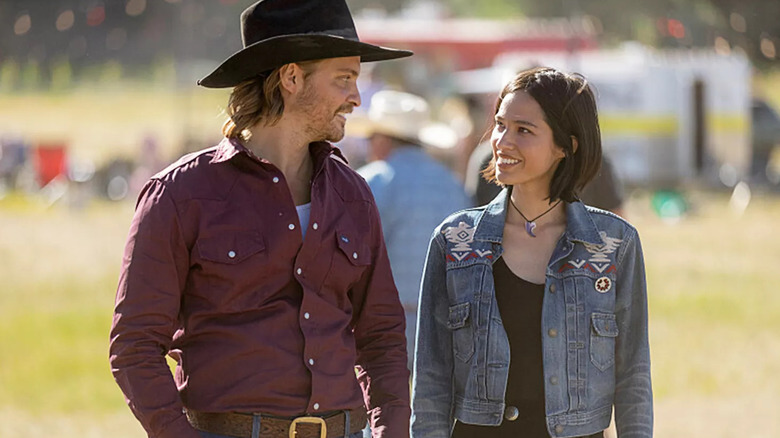
In its first few seasons, "Yellowstone" balanced thoughtful commentary on life in the dying west with action set pieces and disquieting family drama. There were true, actual layers to be had in its characters. Somewhere along the line it became a soapbox for Taylor Sheridan's opinions and feelings about ranching life. In its dying days, it became a way for him to beat Kevin Costner with a stick for leaving the program. Toss in a little family melodrama and a lot of violence, and you have "Yellowstone" in a nutshell — but along the way, the characters were simplified and flattened.
The dumbing down of the Duttons was especially egregious in Monica's case, compounded by the fact that her storyline is so laden with repetitive trauma. In five seasons, she's subjected to her brother's murder, an accident that leaves her temporarily paralyzed, and a miscarriage from a car wreck. The only thing she wants is for her husband and son to be safe, and it's a goal she finally reaches at the end of "Yellowstone."
Monica's storyline was personally revelatory; her desire for a simple life, something she doesn't have to fight the Duttons for, is understandable and gripping as someone who had to struggle against similar authority figures to climb toward my own happy ending. Keeping her alive would have added interesting nuance to Kayce's fight, or perhaps changed her perspective on keeping her family together. She could have even stood in opposition to the way federal agents have involved themselves in life down in Broken Rock. Instead, Monica is just gone — and the show suffers without her presence.
Her death is a big sign that "Marshals" is going to continue to devolve into a simplistic case-a-week procedural with no sign of nuance to be had, the same way "Yellowstone" became another blood-and-guts macho cowboy drama just like "Landman" and most of Sheridan's other TV shows.
Monica's fridging explained
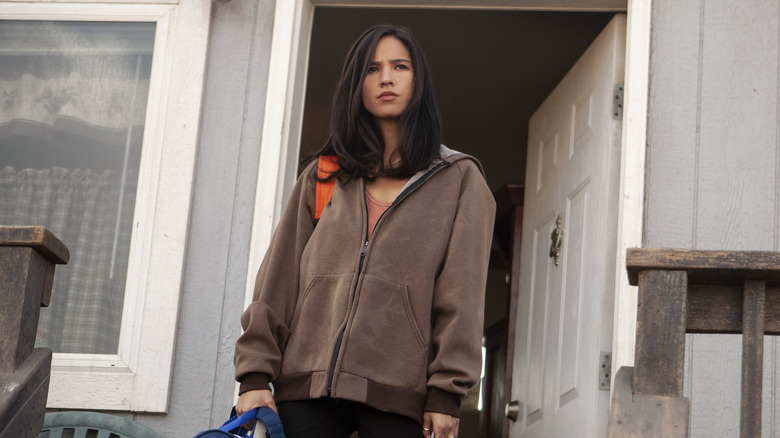
"Fridging" is a term that's colloquially used to describe the death of any character — usually female — who dies in service not of their own tale, but to serve and grow the story of another character. Typically, the dead woman is either the daughter or romantic partner of the person who ends up suffering due to their death. The trope was coined by comic book writer Gail Simone, who was inspired of the events of "Green Lantern" Volume 3, #54, where Alex DeWitt, girlfriend of Green Lantern Kyle Rayner, is killed and literally stuffed in a refrigerator for Rayner to find when he comes home.
Monica's death is a crystal-clear example of the trope; she dies not to serve her storyline, or as a result of her own behavior, but to inspire change in Kayce's life and force their son, Tate (Brecken Merrill), to grow up and develop his own values. She suffers nobly and dies quietly, with a shrug. This is an outlier in the "Yellowstone" universe; most of the deaths fans have been subjected to throughout the course of the drama and its spin-offs are a result of the character's hubris, choices, or behavior.
John Dutton (Kevin Costner), for instance, dies from a combination of his inability to love his adopted son Jamie (Wes Bentley) as an equal and his stubborn desire to keep the family's land from passing out of Dutton hands. Even Elsa Dutton (Isabel May) dies while trying to protect her family. While her dead body helps her family stake out a place in Montana, it comes as a result of her own choices and causes anguish, not determination, in her father. Monica's death exists to motivate the men in her life, and only that.
Why this is uniquely punitive to Monica
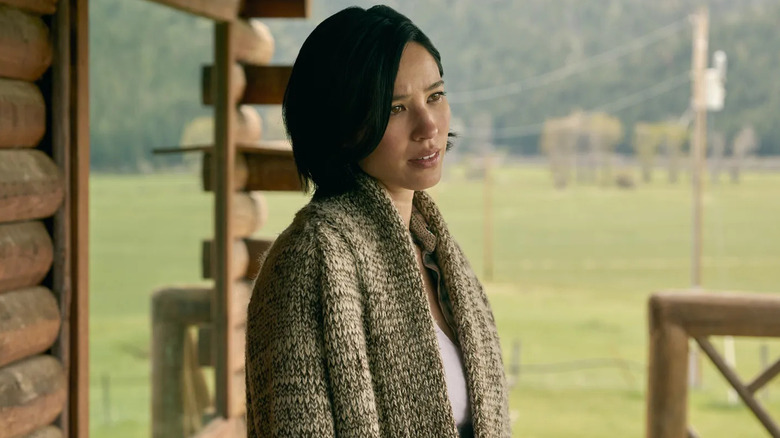
While it might be mildly annoying for any other character to meet a fate like Monica's, there's something extra horrific about her death because of what she represents to the "Yellowstone" world at large. She is as of this writing the only major female Indigenous American character on the entire modern "Yellowstone" canvas. That "Marshals" takes place next to and within a reservation and yet there are no other women or girls who have native ancestry in their blood around is dismaying and makes Monica's offscreen demise even worse to behold. While her exit isn't violent, making her a martyr for her husband's suffering is just as bad.
Initially, Monica was introduced to the narrative as a voice for the people on the rez; a schoolteacher yearning to tell the world about how they had been whitewashed out of the historical record. Monica ends up spending her whole time on the show trying to fight back against the world the Duttons represent; the casual violence, the unquenchable thirst for power, the careless treatment of the vulnerable. The narrative supports the Dutton way of life, positing John as perfectly right and the old ways as the best possible ones.
Only John's death gives Monica's hopes a fair shot at growing. Her success is marred by her own expiration in "Marshals." While Monica's storyline is an attempt at telling a story about what real Native Americans have to deal with on reservations across America, it would be much more powerful if she were alive to tell the tale instead of dying and leaving Tate to tell it — and the show is all the poorer for that absence.
Why this is so, so, so bad for Yellowstone as a whole
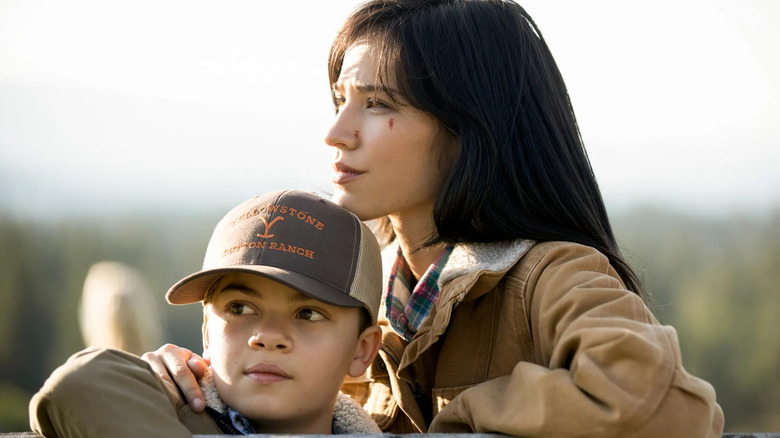
"Yellowstone" lost any hope of returning to its more nuanced roots years before it finally closed up shop, but Monica's death is the final death knell of that more enlightened time in that world as a whole. If "Marshals" is a much more ordinary look into the world of the Duttons, then one can imagine what "Dutton Ranch" is going to feel like. Beth (Kelly Reilly) and Rip (Cole Hauser) are rebel-rousing hellions, but anchoring a show of their own might require some major changes to their personalities — and "Marshals" is a pretty good indicator that the show's producers are eager and willing to homogenize other branches of the Dutton family tree for fun and profit.
The impact of Monica's passing has affected the story in other, worse ways as well. Kayce's entire arc once revolved around finding his real home and building it with Monica — her fridging not only undoes five years of inner turmoil which was finally put to rest by the series finale, but it belittles it. And Tate deserves better than his simplistic teen rebellion storyline. Whatever happens to Kayce next, it's bound to be uninspired — and, I'm sure, much less wonderful than anything he might have experienced with Monica at his side. I've been a "Yellowstone" devotee since the very first season, and after years of investing my time in Kayce and Monica's story, it's an incredibly frustrating end.