

12 Sci-Fi Movies That Flopped Despite Strong Opening Weekends

Most movie genres ebb and flow over time, with periods of passionate popularity and stretches when audiences need a break. Science fiction is an outlier of this trend; not only is it one of the oldest film genres, but moviegoers also never seem to become disinterested in it as a whole. Point of fact, some of the longest-running movie franchises of all time — "Star Trek," "Star Wars," "Alien," "Mad Max," and so many more — are sci-fi franchises.
However, not every sci-fi movie is a hit. Some fail spectacularly, due in part to how much most sci-fi movies need to earn to break even, let alone turn a profit. Some bombs fizzle right out of the gate, but others show promise with a big opening weekend only to quickly fall off and eventually join the flop club. That is what unites all of the entries in this list. And just so we don't need to restate this fact in every single entry as we will mostly only be discussing production budgets (typically the only concrete figure released to the public), movies need to earn back their production costs as well as their marketing costs and other such expenditures, which can often be at least double the production tally. So when we say a movie flopped even though it earned $150 million on a $75 million budget, that's why.
To be clear, we aren't saying these movies are bad — several are sci-fi box office bombs that are actually worth watching, and none are truly terrible. They just didn't get enough butts in seats to bring in sufficient bank.
Star Trek Beyond (2016)
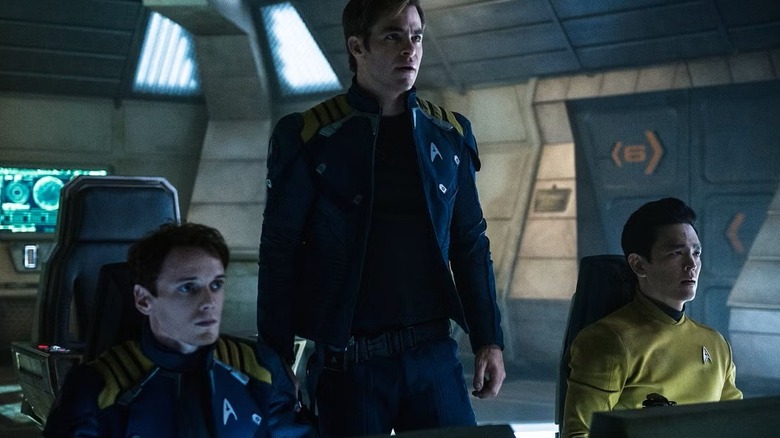
Things were pretty tough for the so-called "Kelvin Timeline" of the "Star Trek" franchise, which never managed to last beyond a movie trilogy. One of the reasons things stalled was that "Star Trek Beyond," the third film in the series after "Star Trek" and "Star Trek Into Darkness," underperformed at the box office. It not only fell well short of the worldwide tally of "Into Darkness," but it couldn't even beat the take of the first movie in the trilogy either.
However, the disappointing ending the entire trilogy wasn't apparent after "Beyond's" opening weekend. The film debuted to nearly $60 million, less than its predecessors, but an impressive haul by any measure. Unfortunately, starting lower than the other two also lead it to finish lower as well, bringing in only $335 million worldwide total on a $185 million budget.
It didn't help that "Beyond" was an extremely rough experience for director Justin Lin, to the point that both he and co-writer Simon Pegg nearly quit the movie entirely.
Ant-Man and the Wasp: Quantumania (2023)

Everyone is going to have a slightly different opinion on what specific point marked the beginning of the Marvel Cinematic Universe's period of uneven creative returns, but most would agree it occurred sometime during the Multiverse Saga, which began with Phase Four. "The Eternals" was the first MCU movie to get a Rotten score from Rotten Tomatoes, and that was definitely a pivotal moment. However, "Eternals" managed $401 million worldwide on a $200 million budget, meaning it might have at least broken even, or got fairly close.
The same can't be said for the second MCU movie to get a Rotten rating, Phase Five's "Ant-Man & the Wasp: Quantumania." It was said that the third "Ant-Man" movie needed at least $600 million to just break even, and its $476 million worldwide box office didn't come close to that. Even Doctor Strange himself would've had trouble predicting that outcome, after "Quantumania's" incredibly strong $106 million opening weekend just in the U.S. alone. It's not often that a movie can bring in nine figures right out of the gate and still end up being a flop.
Predator: Badlands (2025)

After 2018's "The Predator" marked a new low point for the standalone "Predator" franchise (not the "Alien vs. Predator" crossover films) in terms of critical reception, the series took four years off to reassess. It then came back with a creative vengeance, with the excellent two-hit combo of prequel "Prey" and animated debut "Predator: Killer of Killers." But those were both streaming movies, so it wasn't known if the "Predator" franchise could still draw in crowds at the theater.
Initially, when 2025's "Predator: Badlands" blew everyone away at the box office, things looked promising. Except that it was only the opening weekend tally that was impressive. After a franchise-best $40 million debut weekend, "Badlands" saw a devastating 68% drop between its first and second weekends at the domestic box office. It limped to a measly $184 million worldwide against a $105 million budget by the end of its run.
While that makes it the highest-grossing "Predator" movie to date, it was also the most expensive "Predator" movie, so it needed to do a lot better.
Cowboys & Aliens (2011)

Filmmaker Jon Favreau helped lay the foundation for the entire Marvel Cinematic Universe when he directed "Iron Man." He was also a key figure in launching the world of live-action "Star Wars" television when he created "The Mandalorian." In between, he did some live-action Disney remakes, a passion project about being a chef, and another comic book adaptation that people often forget about entirely. The year after he directed his last Marvel movie with "Iron Man 2," Favreau helmed the quirky "Cowboys & Aliens."
With Favreau behind the camera — and Harrison Ford, Daniel Craig, Olivia Wilde, and Sam Rockwell in front of it — there was a fair amount of excitement for "Cowboys & Aliens." Well, and the intentionally silly premise that easily puts it among the best guilty pleasure alien movies. Its domestic opening weekend haul of $36 million landed it at No. 1 its opening weekend, as well as tripling the opening weekend tally of fellow 2011 heavy hitter "Mission: Impossible – Ghost Protocol" – which went on to gross almost $700 million worldwide. But it was all downhill from there for "Cowboys & Aliens," falling off its horse with just $174.8 million earned in total.
Lightyear (2022)

After 2019's "Toy Story 4," Pixar followed with four consecutive original movies — a refreshing change after sequels dominated the studio's output in the 2010s. But Pixar couldn't stay away its franchises forever, breaking the streak of originals with "Lightyear." Everyone assumed it was just going to be a Buzz Lightyear movie, as the fictional hero had already been presented within the reality of the "Toy Story" movies, but it ended up being a different thing entirely. And that weird choice, and the public's confusion as to what the hell "Lightyear" actually was, didn't do its box office tally any favors.
To be fair, "Lightyear" did pretty well in its opening weekend, earning $50 million. This might not sound that impressive on its own, but there is some important context to consider here. First, "Lightyear" was the second Pixar movie to release that year, following "Turning Red." Second, it was released during a period where the movie industry was still not reaching pre-Covid numbers. And third, it being the first Pixar movie since Covid to release in theaters instead of Disney+.
All that in mind, $50 million was seen as a strong start. But its strong start did not a strong finish make, with the final tally of $226 million worldwide, equating to a reported loss of about $106 million for Disney. We also ranked it dead last in our list of all Pixar movies ranked worst to best, so it's safe to say that "Lightyear" was a flop.
Black Adam (2022)
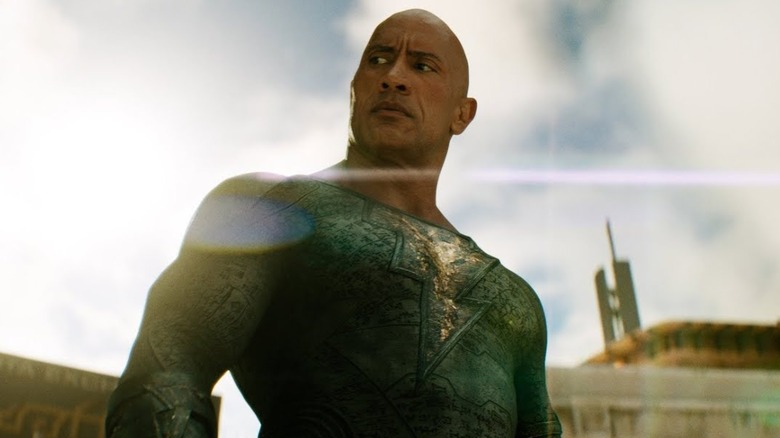
Though it managed a few genuine smash hit movies, the DC Extended Universe was ultimately a failed experiment. More specifically, it was a failed attempt to provide a true counterpart to the Marvel Cinematic Universe. After the outstanding "The Suicide Squad" in 2021 failed to even make its production budget back at the worldwide box office, even the most diehard DCEU fans had to finally admit that the dream was over.
Still, there were several DCEU movies too far along in production to just pull the plug right then and there. One of those was "Black Adam," which saw Dwayne Johnson finally play the titular character after years of teasing that debut. Johnson, as both actor and producer, definitely did his best to sell the public on the character being able to turn the tide of the fledgling DCEU. And for a fleeting moment, it seemed like he could — "Black Adam's" $67 million opening weekend was more than double that of "The Suicide Squad" and was the strongest of any DCEU movie since "Aquaman" back in 2018.
However, "Aquaman" went on to cross the $1 billion mark while "Black Adam" bombed at the box office despite making close to $400 million, thanks to a massive production budget and otherworldly marketing costs.
Solo: A Star Wars Story (2018)

All three main installments of the "Star Wars" sequel trilogy easily cleared $1 billion at the worldwide box office. In fact, "The Force Awakens" did it twice. The spin off films — sometimes referred to as the "anthology" films — have thus far been much more of a mixed bag in terms of financial performance. At this point, only "Rogue One: A Star Wars Story" joined $1 billion club. "Solo: A Star Wars Story," on the other hand, didn't come anywhere close. Leading up to its release, nobody could've possibly seen that coming.
Advance sales were incredibly strong, surpassing even "Black Panther" in that category — a movie that also ended its run with over $1 billion in box office returns. The fact that "Solo" reportedly needed to hit $500 million just to break even didn't have anyone worried leading up to its release. The movie's $85 million opening weekend wasn't quite the target Disney wanted to hit, but "Star Wars" movies tend to have long legs in theaters, so optimism still hadn't faded.
However, when all was said and done, "Solo" couldn't even pass $400 million, let alone its $500 million goal. At just $393 million worldwide, it is second only to the 2008 animated "Clone Wars" film for lowest-grossing "Star Wars" movie of all time.
Power Rangers (2017)

"Power Rangers" is one of those properties that refreshes itself every few years. Though some characters and plotlines carry over, the show changes to something completely different every few seasons — a new subtitle, a mostly new cast of Rangers, and a largely new suite of villains. It has been a consistently airing on TV since 1993, and maintained a fairly steady fanbase over that time. However, the original incarnation — "Mighty Morphin Power Rangers" — remains the most fondly remembered out of all of its iterations.
So when an attempt was made in 2017 to reboot the brand with the simply named "Power Rangers" film, nobody was surprised that it was a new version of the "Mighty Morphin" era. They say nostalgia is strongest for pop culture from 20 years prior, so it was definitely the right time to do it. Even opening against the live action "Beauty and the Beast" remake, which would prove to be a box office juggernaut, "Power Rangers" came in at a strong $40 million in its opening weekend.
But the second weekend drop off was severe, and the Rangers' powers couldn't combine into anything more impressive than $142 million total worldwide — equating to an estimated $74 million loss for Lionsgate and nixing the studio's original plan for as many as seven additional films.
Starship Troopers (1997)

"Starship Troopers" is another example of a movie being the victim of its own confusing marketing. Like director Paul Verhoeven had so masterfully done with "Robocop," his "Starship Troopers" movie was meant as a takedown and parody of the values that a surface-level reading of the movie seemed to revel in. But that type of satire is a tough thing to market, and doesn't always bring in the audience needed to make a movie a massive box office success. So instead, as often happens with movies like this, "Starship Troopers" was pitched to the moviegoing public of 1997 as a straightforward action movie about blowing up giant alien bugs.
Well, as it also tends to go with this type of thing, that deception worked — until it didn't. Enough people showed up to see the mindless sci-fi action romp that "Starship Troopers" was sold as to land the film at the top of the box office in its opening weekend, with a $22 million haul. That might sound meager today, but four of the eventual top 10 highest grossing movies of 1997 had opening weekends in that ballpark — including a little movie called "Titanic."
But word of mouth seemed to get around that "Starship Troopers" wasn't any good — that is to say, not the movie people expected. And that led to a second weekend nosedive that the movie never recovered from, managing a mere $121 million worldwide against a spendy $100 million budget.
Green Lantern (2011)
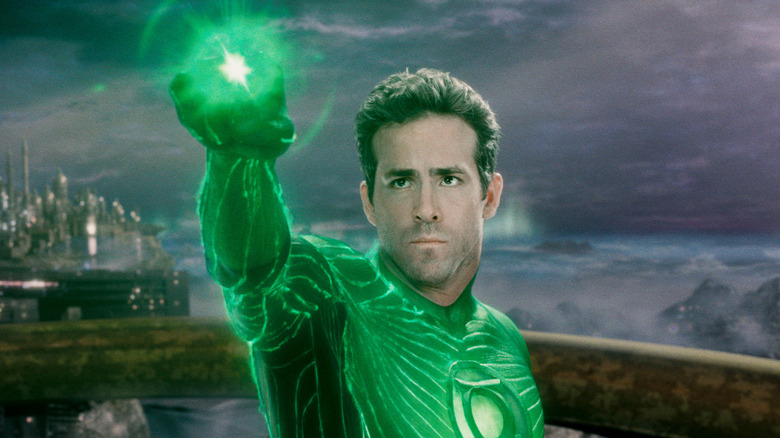
All anyone remembers about the 2011 "Green Lantern" movie is how bad the all-CGI suits were, and how dreadfully the movie performed at the box office. Well, future-married couple Ryan Reynolds and Blake Lively also remember it as the movie where they met, but that's neither here nor there. There have since been better DC movies, and better comic book movies starring Reynolds, so there hasn't been any reason to really dig back into the whole "Green Lantern" fiasco — except to make jokes about it in passing.
Interestingly, what history seems to have forgotten is that "Green Lantern" didn't immediately fall on its face at the box office. In fact, it did a pretty respectable $53 million in its opening weekend, not much less than what its 2011 superhero peers "Thor" and "Captain America: The First Avenger" did in their own debut weekends. But "Green Lantern" didn't maintain that success over subsequent weekends.
Whereas both of the aforementioned Marvel Cinematic Universe movies picked up a lot of the domestic slack with international tallies that measurably exceeded what the movies made in the U.S. — "Thor" in particular — "Green Lantern's" international receipts were negligibly better than its domestic ones. Combined, it equated to just $237 million worldwide, barely even breaking even on just the movie's $200 million production costs.
Alien: Covenant (2017)

Not unlike its sister franchise "Predator," the "Alien" movies haven't traditionally been massive box office successes, despite being a series that 20th Century Studios can't seem to stop pouring money into. But considering that the solo "Alien" franchise came back stronger than ever in terms of box office tallies with comeback movie "Prometheus," it's not hard to see why it has gotten so much financial might behind it in recent years.
The most recent entry thus far, "Alien: Romulus," was considered a box office success with its fairly modest $350 million worldwide haul — but that's due in large part to its equally modest $80 million budget. And 20th Century Studios was probably more conservative with what it was willing to spend on "Romulus" because of what happened with previous entry, "Alien: Covenant."
Emboldened by the success of "Prometheus," the studio threw nearly $100 million at its follow up. The movie brought in $36 million in its opening weekend, coming in first place and bringing the franchise its second-best opening weekend ever. But the final haul of $238 million was almost half of what "Prometheus" brought in, and only 30% of which was in the U.S. — meaning that it's only because international markets stepped up that "Covenant" was just a regular-sized bomb and not a massive one.
Watchmen (2009)

Before Zack Snyder became the DC Extended Universe guy, he cut his teeth in the superhero genre with two adaptations of graphic novels. First was the massively successful "300," and next was "Watchmen," which was only successful in its opening weekend. Perhaps if making the film cost the mere $65 million it took for "300," it would've actually turned a profit, but "Watchmen" cost more — a lot more.
"300" was one of those movie successes that gives a filmmaker a blank check for his next project, and Warner Bros. spent over $130 million on Snyder's "Watchmen." Clearly, the studio overestimated not only Snyder's name recognition, but also the mainstream public's familiarity with the legendary limited comic series. The diehards came out for the opening weekend, leading to a respectable $55 million for a movie that didn't star members of the Avengers, the X-Men, or the Justice League.
That ended up being the majority of people who cared about a "Watchmen" movie, with it only hitting $185 million worldwide. Internationally, where even fewer people know about the property than they do here, the take was a paltry $77 million.