

8 Star Trek Episodes With Twists No One Saw Coming
"Star Trek" fans have been taken on hundreds of memorable adventures over the decades, from nuanced sociopolitical dramas to weird holodeck LARPing romps and everything in between. While some of the best story arcs in the franchise are long ones spanning several episodes or even seasons, just as many are formulaic one-and-done tales. There are feel-good "Star Trek" episodes to restore your faith in humanity and there are "Star Trek" episodes that are actually horrifying when you consider their implications.
Every once in a while, the writers toss audiences a curveball so wild and totally out of left field it would throw Sisko's Niners for a loop. From shocking deaths of beloved characters to betrayals, conspiracies, and reversals of fortune, the "Star Trek" universe is full of unexpected twists and turns, but a few are so surprising that not even the most tuned-in Trekkie could have seen them coming. If "What the tribble?" plot twists really steep your cup of Earl Grey, be sure to add these eight "Star Trek" episodes to your watchlist.
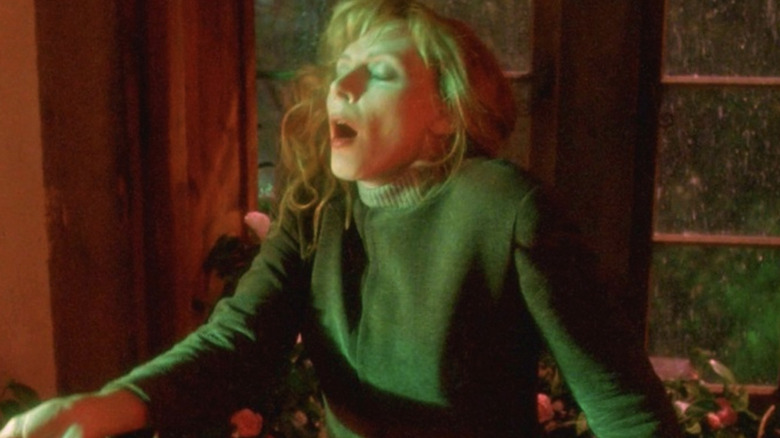
Grandma's ghost candle in Sub Rosa
Warp 10 salamanders in Threshold
Another baffling twist can be found in the "Star Trek: Voyager" episode "Threshold," a Tom Paris (Robert Duncan McNeill)-focused Season 2 entry that starts off with a simple enough premise. Working with his favorite science buds B'Elanna Torres (Roxann Dawson) and Harry Kim (Garrett Wong), Tom thinks the trio are close to breaking the Warp 10 barrier with an experimental shuttlecraft. It's a development that would have significant implications for their decades-long journey back to the Alpha Quadrant since, theoretically, breaking the universal speed limit would give them simultaneous contact with every point in the universe.
Thanks to a Neelix-induced breakthrough, Harry has the Eureka moment that cracks the code. After the new modifications work out just fine in Tom's holodeck simulation, it's time for the IRL test run in which the shuttlecraft does, in fact, exceed Warp 10, causing Tom to report experiencing every point in the universe all at the same time, from his own ship to unknown galaxies, as if viewing all of them from outside his body. Even better, he's got the data to prove it, including the makings of star charts for the entire sector.
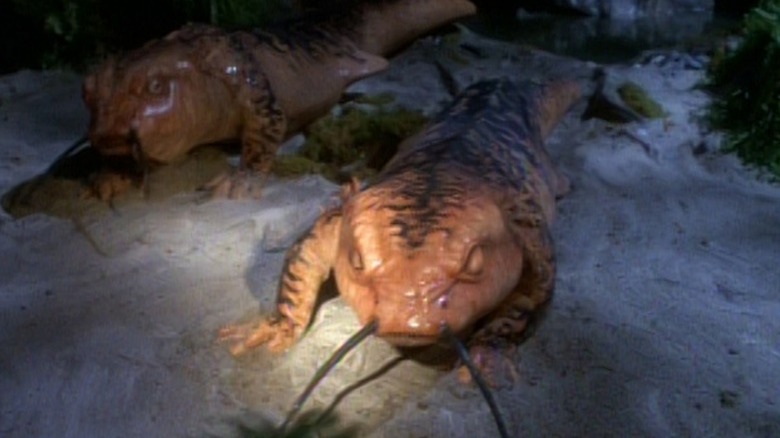
But the celebration is cut short when Tom passes out. A few scans later, the Doctor (Robert Picardo) reveals Tom's DNA is somehow mutating as a result of the Warp 10 crossing. Some time after he apparently dies, Tom comes back online with a few new neat accessories aboard. By the end of the episode, both he and Captain Janeway (Kate Mulgrew) have absconded with the Warp 10 shuttle and evolved into giant, puddle-dwelling salamanders with a litter of salamander pups that the Voyager crew ends up abandoning on some planet.
M'benga's dark secret in Under the Cloak of War
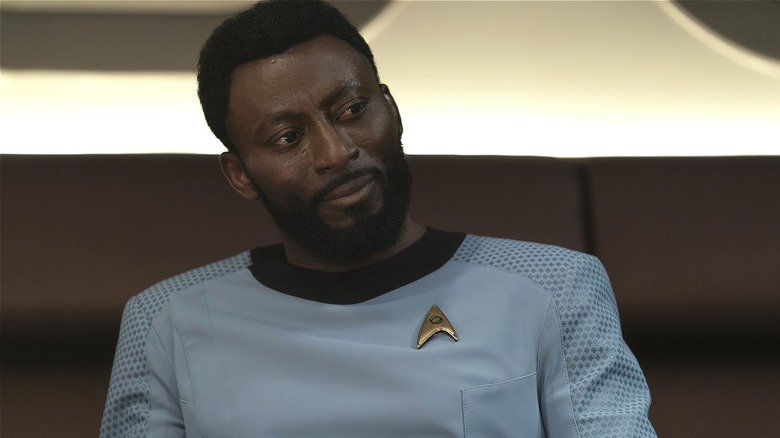
Dr. Joseph M'Benga, played by Booker Bradshaw in "Star Trek: The Original Series" and Babs Olusanmokun in "Star Trek: Strange New Worlds," is a legacy character who gets a well-deserved elevation to a more dynamic characterization in the prequel series. But part of that characterization is a more complex moral tapestry, as revealed in the shocking twist toward the end of the "Strange New Worlds" Season 2 episode "Under the Cloak of War," when M'Benga does the one thing no doctor ever should and takes a life.
The M'Benga of "Strange New Worlds" is a focused and professional Enterprise Chief of Medicine, a deeply compassionate healer with a gentle spirit. But we learn that he is far more than — as our "Deep Space Nine" friend Garak might say — "just a simple doctor" in the "Strange New Worlds" Season 2 opener "The Broken Circle." Here, we gain some serious insight into M'Benga's role in the Klingon War, where he served on J'Gal in a battle so bloody it turned the moon's rain red. Far from just patching up soldiers, M'Benga was engaged in a black-ops mission.
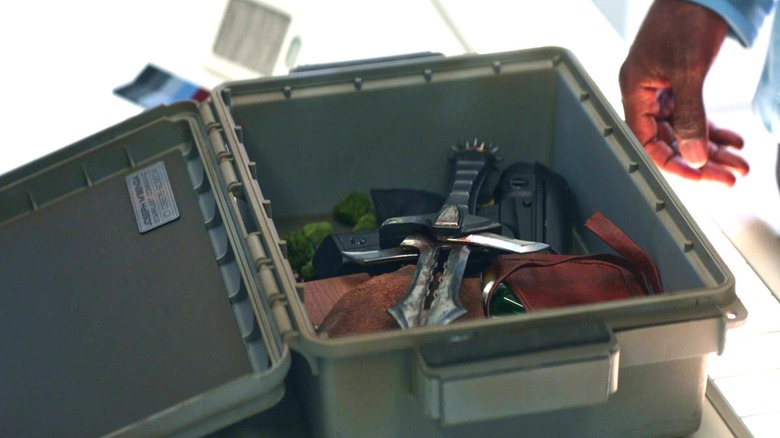
M'Benga used a combat-enhancing adrenaline and pain inhibitor drug cocktail Protocol 12 to transform regular Starfleet soldiers into overpowered superhumans capable of putting the smackdown on a Klingon warrior. Things get even crazier in "Under the Cloak of War" when M'Benga crosses paths with the Klingon defector Dak'Rah (Robert Wisdom), a former general known for slaughtering civilians. The revelation that M'Benga has killed before becomes even more shocking when it's followed by the doctor's un-Federation-like slaying of the general.
The melting Voyager crew in Course: Oblivion
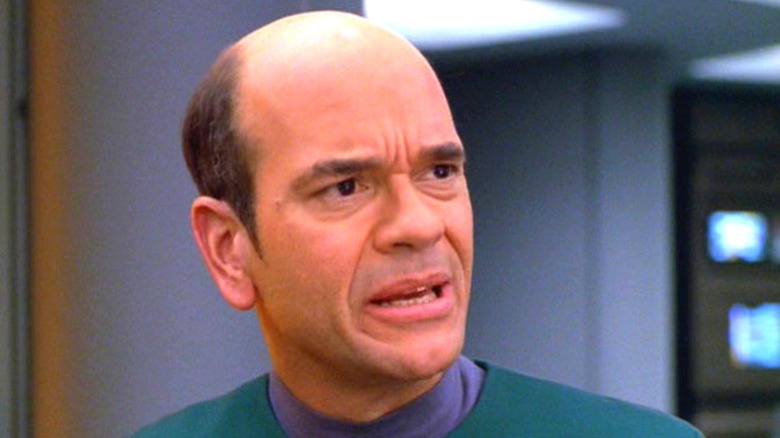
When it comes to sad "Star Trek" storylines infused with a heavy dose of existential dread, no series beats "Star Trek: Voyager." The ominously named Season 5 episode "Course: Oblivion," which finds the Voyager crew dealing with a mysterious ailment, is a perfect example. It begins with a happy moment for the displaced Alpha Quadranters as the Voyager crew celebrates B'Elanna and Tom's wedding. Everyone is also stoked to have a new and improved warp drive capable of getting them home in a mere two-year hop across the galaxy.
However, things quickly take a turn for the weird as strange phenomena start popping up all over the ship, from wedding day rice slipping through the deck into the Jefferies tube below, to the frightening illness rapidly debilitating members of the crew. After the Doctor discovers it's caused by acute cellular degradation, the crew races to better understand the affliction, soon coming to realize that every item aboard their ship that wasn't recently acquired is also experiencing degradation. Things become truly serious when members of the crew start dying.
Working against the clock in astrometrics, Tuvok (Tim Russ) and Chakotay (Robert Beltran) discover the horrifying truth — this Voyager isn't the real Voyager, and its crew isn't the real Voyager crew. Rather, they are bio-mimetic clones that think, feel, and act just like the original Voyager crew, having generated from the silver fluid known as "Silver Blood" that's found on the hostile Class Y demon planet they encountered in Season 4's "Demon." Worse, their Hail Mary bid to either survive or tell their own story fails, with the real Voyager crew encountering only their residual space debris.
Changeling Bashir from In Purgatory's Shadow
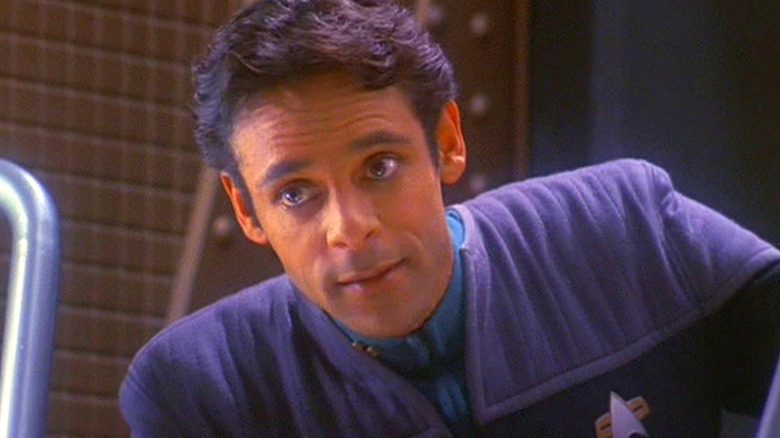
Few "Star Trek" races can mess up a good time like the Changelings in "Star Trek: Deep Space Nine." Of all their meddling and other various shenanigans, the Changelings' replacement of Dr. Julian Bashir (Alexander Siddig) with their own devious doc doppelgänger arguably takes the cake, but it makes for one of the best twists in the Trek canon. This plot twist comes in the "Deep Space Nine" Season 5 episode "In Purgatory's Shadow" as Garak (Andrew Robinson) and Worf (Michael Dorn) discover the real Dr. Bashir in the Dominion prison Internment Camp 371.
Garak and Worf are understandably shocked to find Bashir there as they hadn't realized he was missing at all. The fake Bashir had gone totally under the radar, even performing surgeries on Federation officers without anyone noticing that something was amiss. After doing a blood test to try and prove his identity, the real Bashir shares his story with the others. According to the doctor, he got nabbed while attending a conference on Meezan IV more than a month prior, waking up in the prison facility.
Exactly how long Bashir was missing and how many episodes the audience spent tricked by a copy is a matter of some controversy, seeing as the Changeling would have had to carry out complex medical work. Discussing the arc in 1997, "Star Trek" writer Ronald D. Moore said, "Never take the Stardates too seriously. Remember that Gene [Roddenberry] never wanted them to make ANY sense at all, and that although we do try to keep them in order and bring some rationality to them, that at the end of the day they're still just made up numbers."
Locutus of Borg in The Best of Both Worlds
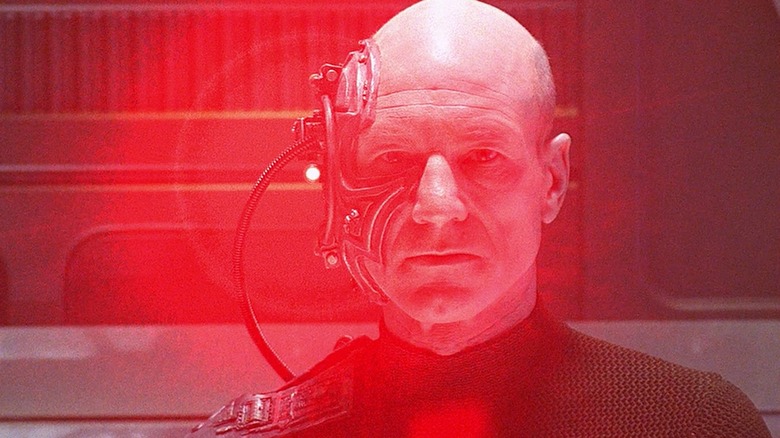
Captain Jean-Luc Picard (Patrick Stewart) has a history of being protected by many layers of plot armor, but the writers of "Star Trek: The Next Generation" did away with all that and added even more trauma to Picard's tragic backstory in the two-parter "The Best of Both Worlds." This would result in a story arc that many Trekkies consider to be one of the finest in the franchise, with the end of "The Best of Both Worlds, Part 1" — the final episode of Season 3 — closing on a mind-blowing twist.
The trouble begins when the colony New Providence is mysteriously wiped off the map, with a massive crater in its place. Convinced the Borg are behind it, Vice Admiral J.P. Hanson (George Murdock) and Lieutenant Commander Elizabeth Shelby (Elizabeth Dennehy) join the Enterprise to investigate the site. Mid-investigation, the Enterprise is engaged by a Borg cube demanding Picard transport himself aboard their vessel. Despite the Enterprise undergoing some major modifications since Starfleet's last encounter with a Borg ship, the enemy puts up a good fight, leading to double-digit casualties for the Enterprise crew and forcing them to take cover in a nebula.
Eventually, the Borg manage to flush them out, getting past the ship's defenses and beaming aboard to abduct Picard. As the Enterprise crew, now under Riker's command, works out a plan to recover him, there's always a sense that he'll make it back. That makes it all the more chilling when the Season 3 finale concludes with a newly-assimilated Picard, decked out in metal implants, appearing on the Enterprise viewscreen to introduce himself as Locutus of Borg. The jarring revelation makes for one of the best in "Star Trek" history.
The paradox twist in Ouroboros
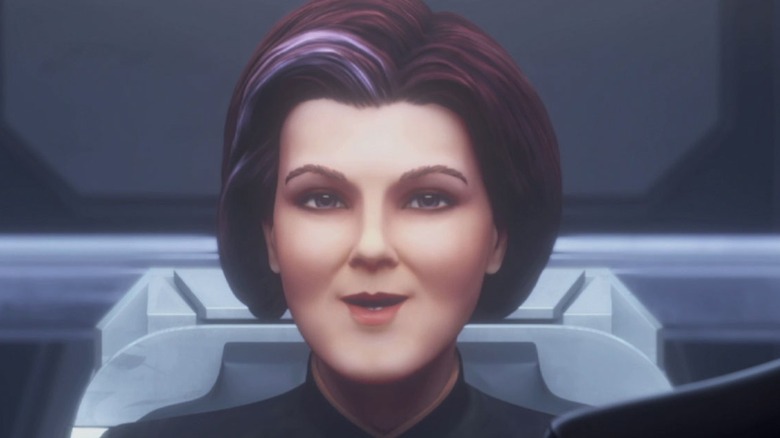
If you haven't yet watched "Star Trek: Prodigy," you're missing out. Although the series is aimed at a younger audience, many "Star Trek" fans say its writing is some of the best in the franchise and maintain the series was cut way too short. It includes one of the most outstanding plot twists and best time travel stories in the "Star Trek" universe. The animated series follows a group of youthful 24th-century aliens from various races who escape the Tars Lamora Labor Camp (a Delta Quadrant prison colony) aboard the USS Protostar, an abandoned Starfleet ship they find and steal.
After adventuring around the galaxy for a while under pursuit from the Diviner (John Noble), they manage to save Starfleet by destroying their ship with the help of a hologram version of Admiral Janeway (Kate Mulgrew discussed returning to the role of Janeway for "Prodigy" in an exclusive interview with Looper). After the youths join the real Admiral Janeway aboard the USS Voyager-A, they begin experiencing trouble with their place in reality thanks to a disruption in their timeline caused by their sacrifice of the Protostar. Their effort to right time leads them to Wesley Crusher (Wil Wheaton) and, eventually, to a marooned Chakotay, the original captain of the Protostar.
The two-part series capper "Ouroboros" finally resolves their troubles with the revelation that the kids' entire adventure was one big bootstrap paradox and they were always meant to be the ones who abandoned the Protostar in the past for themselves to find and steal in the first place. It's a fun time-travel twist that will feel familiar to fans of the time-travel storyline in "Star Trek: Picard." It gives the underrated 3D CG series a sense of completion that almost makes up for its too-short run.
The replacement Harry Kim in Deadlock
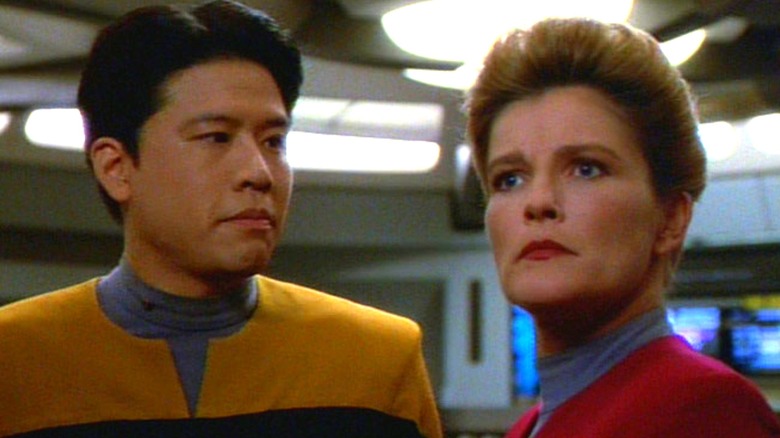
One of the greatest existential horrors in the "Star Trek" franchise slips by almost unnoticed in the "Voyager" Season 2 episode "Deadlock" when a couple of crew members are killed and replaced with exact duplicates as if nothing ever happened. Although fairly early in the series, at least in terms of their holodeck cosplay adventures, the fact that Harry and Tom are already well on their way to having a bromance for the ages makes it that much more disturbing when Tom's bestie suddenly dies and he simply accepts that the dude was replaced with an identical parallel universe copy. It seems that Harry Kim's inability to land a Voyager promotion is the least of his worries.
The crisis takes place when the Voyager and its crew, in an effort to avoid two planets' worth of Vidians, take a detour through an expansive plasma drift spanning half the sector, hoping its interference will help them avoid detection. On their way out of the drift, they hit some spatial turbulence they will later come to realize is a subspace divergence field capable of duplicating matter. Although it takes the two crews a while to work it out, passing through it duplicates the Voyager and its crew without duplicating the ships' antimatter. This turn of events leads to severe damage on one of the ships, including the death of both Harry and the newborn Naomi Wildman (Emily Leibovitch). But why waste time mourning the dead when there's a perfectly good copy/paste version to replace them with?