

12 Strongest Star Trek Characters, Ranked By Power
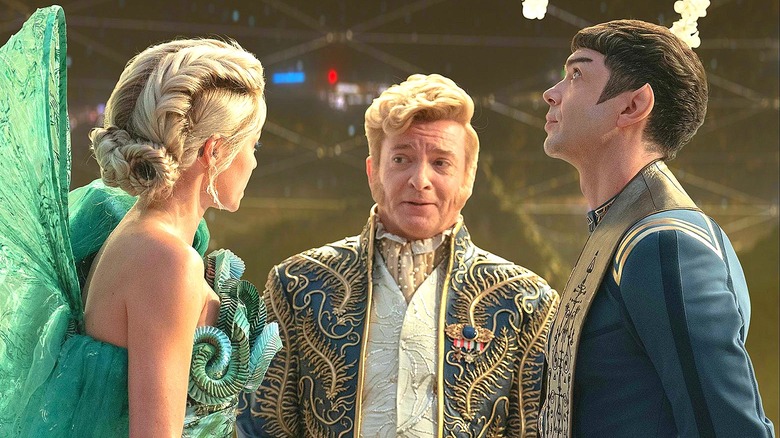
The world of "Star Trek" is full of powerful figures, from those who falsely purport to be gods only to get called out as posers to beings so legitimately powerful some worlds can't help but worship them. One thing is for sure: no matter where you're heading in a Starfleet vessel, there will most certainly be an overpowered entity somewhere along the way to contend with, whether or not it goes by the one three-letter name "Star Trek" has banned.
Take Ardra (Marta DuBois) from the "Star Trek: The Next Generation" episode "Devil's Due," who pretends to be the devil in a confidence game ploy meant to fleece the kind but superstitious people of Ventax II. Then there's the malevolent being claiming to be the Vulcan god Sha Ka Ree in "Star Trek V: The Final Frontier" or the Pah-Wraith versus Prophet wormhole god drama of "Star Trek: Deep Space Nine."
Still, the ability to do a little reality-adjusting seems like a mere parlor trick when compared to the most truly omnipotent entities across the franchise. From overpowered tricksters to genocidal narcissists to benevolent all-seeing life-givers, here's a ranked breakdown of the 12 strongest beings in the "Star Trek" universe.
12. Charlie Evans
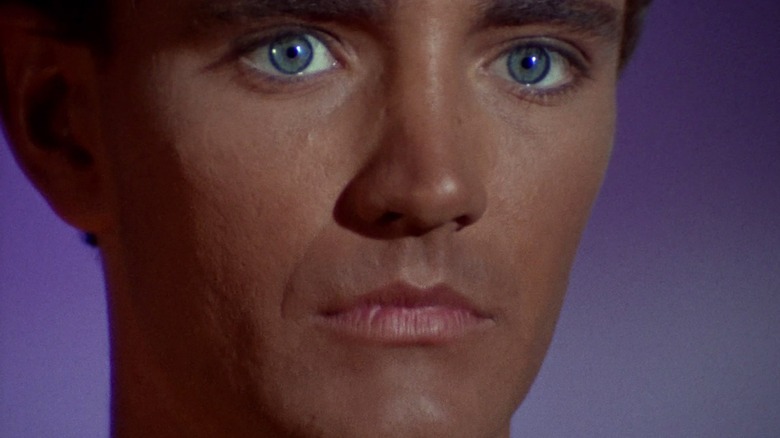
When the cargo vessel Antares discovered a teenage castaway who somehow survived alone on a desolate planet from the age of 3, someone should have asked a few more questions before bringing him aboard. But apparently no one did, which is how Captain Kirk (William Shatner) became saddled with a creepy, entitled teen with mysterious powers and nowhere near the maturity level needed to use them wisely.
Pretty quickly after Charlie Evans (Robert Walker) boards the Enterprise in the "Star Trek: The Original Series" episode "Charlie X," it's fairly apparent that this kid could use some serious adult guidance. He behaves inappropriately, interrupting others and creeping out poor Yeoman Janice Rand (Grace Lee Whitney) with his incessant unwanted advances.
More alarmingly, the volatile Charlie exhibits superhuman abilities like telepathy, mind control, and matter manipulation, all of which he uses to abuse those around him. When the crew try to warn the captain, Charlie destroys their ship to shut them up, killing them in the process. Charlie responds to a chess loss by melting the pieces, makes a crewman who laughed at him disappear, and relentlessly stalks Yeoman Rand. Although we learn Charlie's powers were conferred by the non-corporeal natives of Thasus, his unhinged, godlike powers are nonetheless formidable.
11. Debra the nebula consciousness
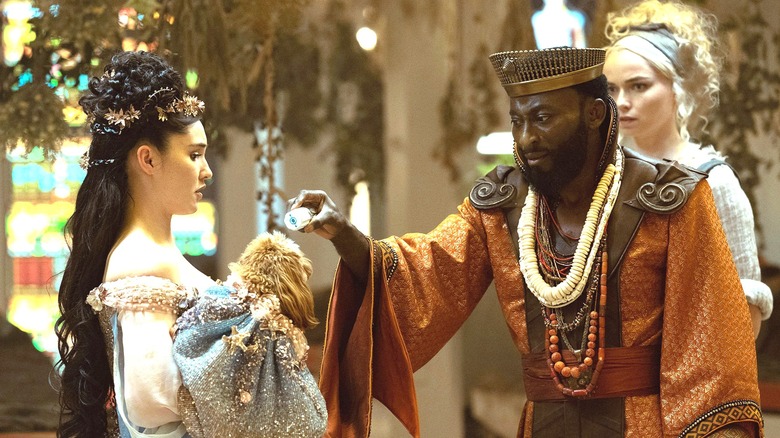
A Boltzmann brain is a cosmological and philosophical thought experiment that proposes an infinite, chaotic, and fluctuating universe. It would be more likely for a singular sentient non-corporeal brain to randomly emerge and hallucinate an entire reality than for the universe as a whole in all its complex glory to arise. In the "Star Trek: Strange New Worlds" episode "The Elysian Kingdom," the Enterprise encounters such a being, or at least one very similar to it, in Debra, a nebula-dwelling disembodied alien consciousness who traps the crew in a fairytale reality.
The entity is initially attracted to the consciousness of young Rukiya M'Benga (played by Sage Arrindell and Makambe Simamba), the dying daughter of Doctor Joseph M'Benga (Babs Olusanmokun), as he has secretly been keeping her energy signature in the ship's transporter to buy time while working out a treatment to save her. As both are profoundly lonely, Debra (named by Rukiya after her late mother) creates the Elysian world from a storybook Dr. M'Benga has been reading his daughter.
While the extent of Debra's abilities are never fully explored, the being can both create alternate realities and synthesize them using energy. Debra is telepathic, pulling Elysia's world from Rukiya's mind. She also has the power to temporarily heal and transform Rukiya into a being of pure consciousness, merging together to live in the nebula.
10. Activated Gary Mitchell
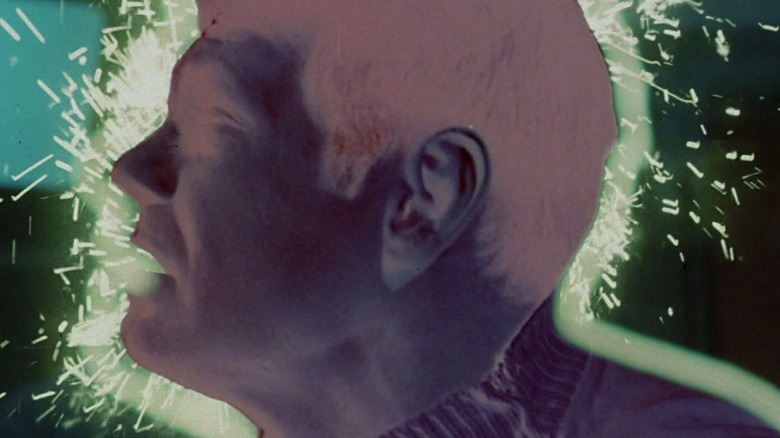
Although the concept doesn't get much attention in later "Star Trek," it's established early in "The Original Series" that extrasensory perception (ESP) is common enough among humans that Starfleet deems this worthy of tracking in personnel records. And it's information that comes in handy when Kirk's first trip to the galaxy's edge triggers a crisis that transforms his ship's ESPers into godlike beings, including his old Starfleet buddy Gary Mitchell, played by Gary Lockwood of "2001: A Space Odyssey."
In the world of "Star Trek," human ESPers have their share of nifty abilities. The ship's psychiatrist and ESPer Dr. Elizabeth Dehner (Sally Kellerman) explains the gift simply as having "flashes of insight," to which Spock (Leonard Nimoy) adds that some can see through solid objects or even possess pyrokinesis. But when the ship passes through an energy barrier at the galaxy's edge, its human ESPers experience an intense supercharge to their abilities, while leaving other telepathic species seemingly unscathed.
Among the Enterprise crew, Dehner and Mitchell are affected, with their eyes turning a glowing silver as they exhibit godlike powers like resistance to phasers, matter manipulation, and highly advanced telekinesis and telepathy. Although both ESPers seem to display the same abilities, Mitchell is far more eager to use them to control others off the bat, making him a much more formidable foe.
9. Kevin Uxbridge of The Douwd
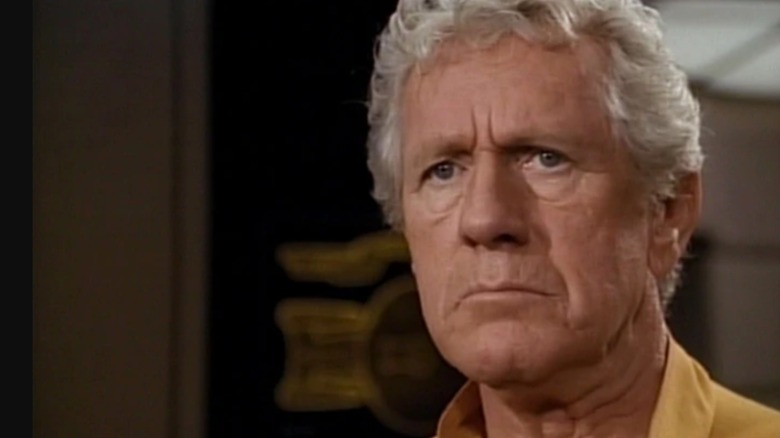
One of the biggest dilemmas experienced by the Starfleet is how tricky it can be to distinguish regular people from sneaky aliens cosplaying as humans. Such is the case with Kevin Uxbridge (John Anderson), a regular-enough looking older gentleman the Enterprise-D crew makes acquaintance with in the "Star Trek: The Next Generation" episode "The Survivors."
In all fairness, there's plenty reason to feel just a little sus about Mr. Uxbridge and his wife Rishon (Anne Haney), married botanists living on the Federation's Rana IV colony. The crew learns the Husnock race wiped out almost everyone living there, leaving only the couple and their home perfectly undamaged. Just as strange is the fact that they managed to get by all this time with nary a replicator in sight. Eventually, it's revealed that Mr. Uxbridge is a member of the powerful and pacifistic race the Douwd who fell in love with a human woman only to watch her die at the hands of the Husnock species he subsequently wiped out in retaliation.
As a member of the Q-like Douwd, Uxbridge's powers include immortality and essokinesis, or the ability to manipulate reality and create worlds. While the limits of his powers are unclear, Uxbridge boasts Star Trek's highest kill count.
8. The Caretaker
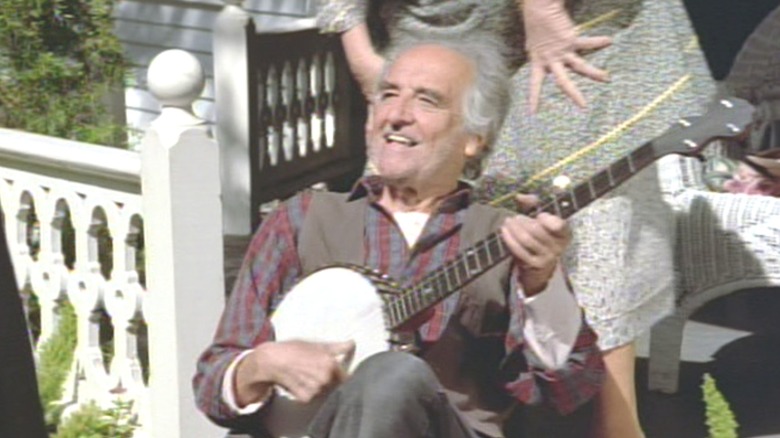
Not long after the Voyager crew first enters the Delta Quadrant, they encounter one of the most fascinating and overpowered aliens in the "Star Trek" universe in the form of the Caretaker (Basil Langton), an extragalactic entity who serves as the subspace-dwelling foster parent for the entire Ocampa species. Although known as "Caretakers," the Caretaker is a member of the Nacene race, a highly advanced sporocystian lifeform with a gelatinous, energy-based appearance when not in corporeal form.
Although not necessarily immortal, the Nacene enjoy extensive lifespans to the tune of millennia. While never clarified how much of their power comes from technology and how much is innate to their species, the Caretakers can manipulate matter, take on human form, and travel across space at vast speeds. They also have the power to manipulate spacetime, a fact that's revealed when we learn the Caretaker himself produced the displacement wave that brought Voyager across the galaxy in hopes of finding his pet species a new space parent. And in "Star Trek: Discovery," 32nd century Federation security mentions the Nacene as one of the few species powerful enough to potentially create the Dark Matter Anomaly (DMA).
7. Evolved Kes
Of the races encountered by Janeway's (Kate Mulgrew) crew in "Star Trek: Voyager," the Ocampa species ranks among the least powerful — not to mention the derpiest. Sure, they're naturally telepathic with a touch of precognition and varying degrees of telekinesis, but their severely abbreviated lifespan makes an aging Labrador Retriever look positively ancient. Each Ocampa female can only have one offspring in her lifetime, making the species mathematically nonsensical as that would logically produce negative population growth. And that's to say nothing of the species' absolutely bonkers mating process involving a sluglike gluing of the couple that lasts for nearly a week — an absurd amount of time given the Ocampans' nine-year expiration date.
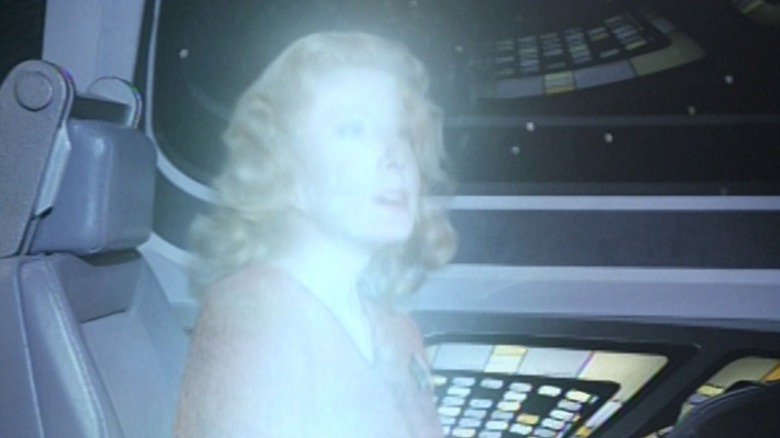
It only makes sense that any Ocampan would be itching to graduate up the evolutionary food chain as Kes (Jennifer Lien) unexpectedly does in "The Gift" after realizing her communication with Species 8472 has left her Ocampa with a level-up cheat code. After working with Tuvok (Tim Russ) to hone her psionic abilities, Kes realizes they are exponentially expanding after using her mind to repair Seven of Nine (Jeri Ryan), and from there, her powers kick into overdrive, with new powers developing rapidly. She ultimately develops the ability to manipulate matter, no longer seeing a distinction between thought, energy, and matter before shedding her humanoid form.
6. The Traveler
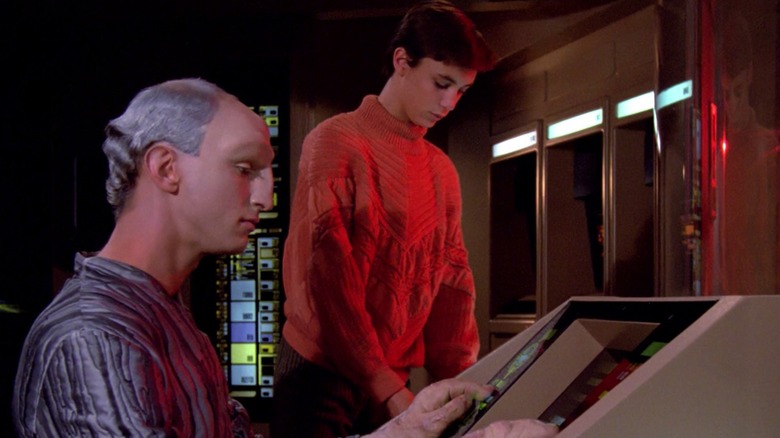
One of the more mysterious beings in the "Star Trek" universe, the Traveler (Eric Menyuk), is introduced in the Episode 5 of "TNG, "Where No One Has Gone Before." He calls himself the Traveler for two reasons: First, because no human can pronounce his real name, and second, because he considers himself a traveler within the general sense of time and reality experienced by the good folks at Starfleet. In other words, this guy is literally from another plane of existence.
What makes the Traveler so fascinating are not just his abilities but the effortless manner in which he employs them, almost as if he's one step above taking a nap. And those abilities, which appear to fall somewhere between technology and psionics, include spacetime, matter, and dimension alteration using only his mind, phasing in and out of various realities in the process. For the Traveler, who perceives thought and reality as intertwined, our universe is one of many, a concept explored further in "Star Trek: Prodigy." Besides the ability to move ships through space, the Traveler has the power to untangle some of "Star Trek's" messier time travel stories, shape shift, and in some cases, create reality from thought.
5. Strange Energies Jack Ransom

Even without a power-up, Lieutenant Commander (and eventually, Captain) Jack Ransom (Jerry O'Connell) of "Star Trek: Lower Decks" is one formidable dude. A serious gym bro, gifted martial artist, and natural at fisticuffs, Ransom is the kind of guy you want on your side in a bar fight against a handful of Nausicaans. But his beefcake status takes on another dimension after transforming into a literal god in the episode "Strange Energies" when hit with some weird energy during a second contact mission on Apergos.
While sonic power washing soot-covered buildings in the Apergosian cultural center, which has been long neglected amid the species' industrial revolution, Beckett Mariner (Tawny Newsome) accidentally triggers the release of a strange energy that appears to be harnessed inside an orb atop a temple. When Ransom gets hit with the energy, temporarily knocking him out in the process, it is discovered that he was hit with a full dose of "strange energy" to the cortex not unlike the energy that once triggered Gary Mitchell (Gary Lockwood).
Almost instantaneously, Ransom transforms into a godlike being, drunk with new power. Ransom's eyes glow and head detaches from his body as he makes the moon disappear, changes the shape of public buildings, levitates a mountain, and creates his new race of "Ransomites" from the Apergosians. Even Ransom believes his powers put Gary Mitchell's to shame.
4. Trelane
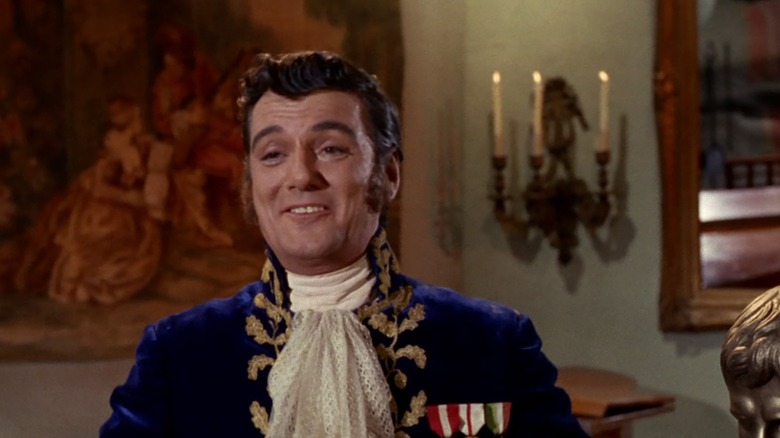
"The Original Series" episode "The Squire of Gothos" introduces Trelane (William Campbell), the whimsical, 18th-century tailcoat-wearing trickster who captures several members of Kirk's Enterprise crew to keep as pets and playthings. In his first appearance, "The Squire of Gothos," Trelane demonstrates the ability to abduct and transport Starfleet officers to his home, freezing and unfreezing them with a mere wave of his hand. He can also create matter, even if the food he makes is rather bland, and play harpsichord on Uhura (Nichelle Nichols) with the same simple gesture.
When he reappears in the "Strange New Worlds" episode "Wedding Bell Blues," Trelane (Rhys Darby) demonstrates many of the same powers as he hijacks the Enterprise crew in an event that technically precedes his first appearance in "TOS." In addition to showcasing his aforementioned powers, Trelane can also manipulate memory or alter reality itself as it takes the crew a while to figure out what's going on with him. As a result, it's no big surprise when "Strange New Worlds" Season 3 confirms a major fan theory and Trelane is revealed to be a youthful Q at the end of the "SNW" episode.
3. Badgey

The "Star Trek" version of the MS Office's anthropomorphic paperclip Clippy, Badgey (Jack McBrayer) is a Starfleet combadge-shaped holographic mascot developed by Ensign Sam Rutherford (Eugene Cordero) as part of a holodeck training program in "Terminal Provocations." At first, he's a cute little virtual tutor equipped with Starfleet training programs. But when his code goes glitchy, Badgey's artificial intelligence takes a hard left turn, transforming him into a violent and vengeful holoprogram that turns on his "father" Rutherford and D'Vana Tendi (Noël Wells). While they eventually escape when Badgey freezes, allowing Rutherford to break his "badge neck" before the program reboots with a fresh, friendly Badgey, the corrupt program continues to evolve in "No Small Parts," "The Stars at Night," and "A Few Badgeys More" as the code makes its way into Starfleet's Texas-class ships.
By the end of his run, the bloodthirsty Badgey has achieved god-like powers by connecting to every system throughout the galaxy in pursuit of his genocidal plan. However, in doing so, he absorbs all the knowledge of the universe, transforming into a more benevolent being in a sort of Badgey-esque Overview Effect. Empowered with infinite knowledge and the power of creation, Badgey ascends to a higher plane of existence after apologizing for the drama he caused.
2. Q of the Q Continuum
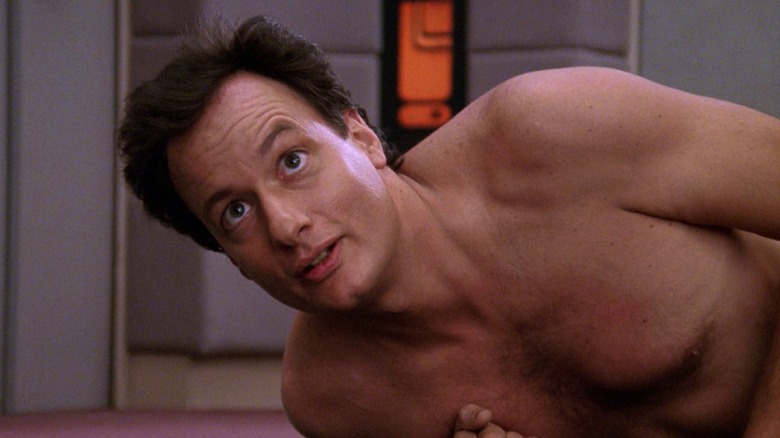
A member of the omniscient Q Continuum, Q (John de Lancie) is one of the most overpowered "Star Trek" beings. First appearing in the "The Next Generation" pilot episode "Encounter at Farpoint," Q perceives the universe almost as a playground, one he can hop around with little effort. While Q doesn't possess telepathy with just anyone, the Q as a whole have the ability to communicate with the collective across the universe. He has the ability to alter and transport matter, as seen when he effortlessly generates a mariachi band on the bridge of the Enterprise in "Deja Q." He can shape shift and move the Enterprise thousands of light years away from its starting point, as he does in "Q Who" when he introduces the Federation to the Borg.
Q's abilities also include the power to travel back and forth through time and create alternate timelines, a major plot point in "Star Trek: Picard." And while it was once believed that Q would be immortal in his original form, the ending of "Picard" heavily implies that he evolves to another form of existence.
1. The Koala

Of the various life forms both corporeal and non-corporeal across "Star Trek," one being stands above all others as a watcher of the universe from a higher plane. Koala, an entity that appears a few times in "Star Trek: Lower Decks," bears the appearance of a giant glowing blue marsupial with a faint smile and glowing eyes. It is accessible to various members of the Cerritos crew when in some sort of elevated state of consciousness.
The being is first mentioned by Lieutenant Junior Grade O'Connor (Haley Joel Osment) in "Moist Vessel" when the officer achieves spiritual ascension to a higher plane after transforming into a being of light and energy. During that process, O'Connor reports seeing everything in the universe balanced on the back of a giant Koala in a place where time has no meaning. At several other points in the Cerritos' tenure, the Koala is reported by other crew members experiencing near-death visions. As a godlike being balancing all creation who exists outside of mankind's natural lifespans, it's safe to say that thus far, the Koala is truly the most powerful character in the Trek universe.