

The Hunger Games: Sunrise On The Reaping's Biggest Book Changes Explained

Contains spoilers for "The Hunger Games: Sunrise on the Reaping"
Things can change quite a lot during the adaptation process, and that's to be expected ... especially when a book is being adapted for a movie instead of a TV show or a miniseries. When you're adapting, say, a 400 page book dystopian young adult novel about a sadistic set of games that take place under a totalitarian government, it can be a bit tricky to squeeze everything important into a major motion picture unless you want a sprawling, long runtime. So what changed between the book and film of "Sunrise on the Reaping," the 2025 Hunger Games prequel written by Suzanne Collins that focuses on the Games played by Haymitch Abernathy?
Honestly, this is a very faithful adaptation when all is said and done. With Francis Lawrence returning to the director's chair (he's directed every Hunger Games film except for "The Hunger Games," which was helmed by Gary Ross) and a screenplay by Billy Ray and Michael Lesslie, the 2026 film "The Hunger Games: Sunrise on the Reaping" casts Joseph Zada as the younger version of Woody Harrelson's 50th Hunger Games victor and reluctant District 12 mentor Haymitch and explains how he ends up in the Second Quarter Quell, a vicious exercise where 48 tributes are reaped from all 12 districts to compete in the deadly Games rather than 24. With Mckenna Grace, Kieran Culkin, Elle Fanning, Jesse Plemons, Kieran Culkin, Whitney Peak, Ralph Fiennes, and Glenn Close on hand for pivotal roles, the film adaptation of "Sunrise on the Reaping" mostly sticks to its source material ... but here are some key differences.
Haymitch's important striker discovery

At the very beginning of "The Hunger Games: Sunrise on the Reaping," the sun does indeed rise upon the reaping in District 12, and everyone anxiously prepares to see two girls and two boys chosen to compete in the Second Quarter Quell. That day also happens to be Haymitch's sixteenth birthday, so after getting a reprieve from work, he meets up with his girlfriend Lenore Dove Baird (Whitney Peak) in their favorite meadow amongst her geese and she gives him his gift in the form of a necklace that's also a flint striker. (Put a pin in her name. We'll come back to it.) In the film, Haymitch immediately clocks that there's an inscription that says "I love you like all-fire" and Lenore Dove's initials. In the book, someone else discovers this ... and unfortunately for Haymitch, it's discovered by President Coriolanus Snow, played by Ralph Fiennes in the film.
During a meeting with Snow before the Games, the president of Panem asks to see the necklace, making Haymitch immediately worry that he'll notice it would be useful in the arena. (In both versions, Haymitch brings it with him as his "token.") "Snow rubs his thumbs over the bird and snake heads," Haymitch says in the book. "'There's a pretty pair.' He flips it. 'And an inscription.' An inscription? I must've missed it in the whirlwind of reaping day." Then, Haymitch watches as Snow reads the inscription: "Without asking for permission, he pulls a pair of specs from his breast pocket and tilts the striker to catch the light. 'Ah, very sweet. From L.D. Who might that be?'"
Caesar Flickerman meets the tributes
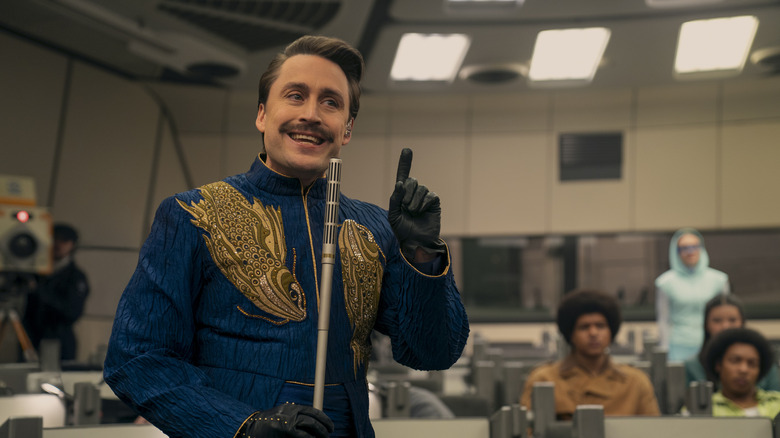
The Flickerman legacy remains strong in both versions of "Sunrise on the Reaping." Back in the 2023 prequel and film adaptation "The Ballad of Songbirds and Snakes," we saw a Flickerman ancestor, Lucky, played by Jason Schwartzman, and Stanley Tucci originates the role of Caesar Flickerman in the original Hunger Games movies, but the gambit is the same: the Flickermans are consummate showmen who serve as bombastic announcers for the Games themselves. In "Sunrise on the Reaping," we see a younger version of Tucci's Caesar played to perfection by "Succession" veteran and Emmy and Oscar-winning actor Kieran Culkan. However, his introduction differs from page to screen.
In the novel, Haymitch's first glimpse of Caesar is during the pre-Games interviews. "Caesar descends from the ceiling perched on a crescent moon, stars shooting behind him. He's a young guy wearing a suit so dark blue it's almost black, embedded with tiny light bulbs that make it twinkle," Haymitch observes. "The suit never changes, but every year he dyes his hair a different color, tonight a deep pine-forest green, and paints his eyelids and lips the same color." In the film, Caesar corrals all of the tributes for a meeting before the interviews and essentially implores them to be vivacious and interesting; honestly, this was probably done to give Culkin more screen time.
President Snow isn't quite as feeble
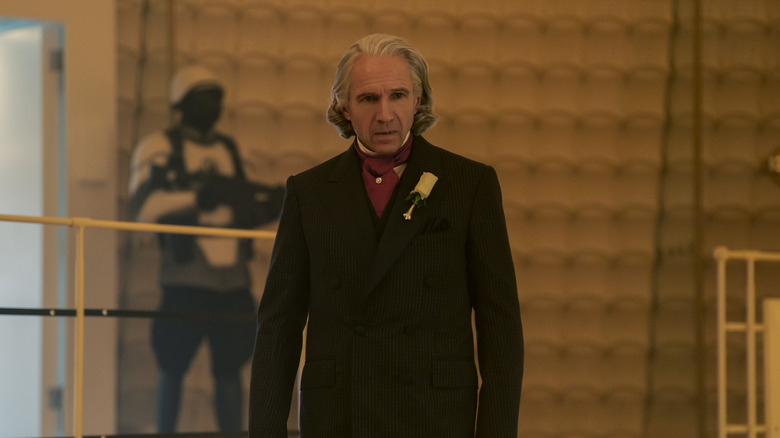
You're going to notice a trend as we continue, which is that some of the most gruesome elements of the literary version of "Sunrise on the Reaping" are cut from the theatrical version. The most glaring example of this is the aforementioned President Snow, who, at this point in the Hunger Games timeline, is forcing himself to develop an immunity to poison by ingesting it while he poisons other people. In the movie, he spits up a little bit of blood to sell this storyline, but that's about it. The book is far more ... evocative.
When Haymitch first meets Snow, he describes him as "clearly unwell" before continuing. "Perspiring and breathless and white as a sheet," Haymitch thinks. "His regal bearing abandoned as he hunches over his gut. For once, despite his cosmetic treatments, he looks his fifty-eight years." After Snow heartily vomits up some poison, Haymitch and Plutarch Heavensbee — at this point a Capitol cameraman and future Gamemaker, played in the original films by Philip Seymour Hoffman and in this one by Jesse Plemons — pull him out of the puddle.
"I secure Snow's other side, holding my breath to avoid inhaling the noxious smell of puke and flowery perfume that rises from him," Haymitch tells us. "Bodily contact with him in this state makes me a little braver. He's just a man, as mortal as the rest of us. For all I know, he's on his way out right now." Snow seems basically fine in the film, so clearly, they dialed this grotesque scene back just a bit.
Lucy Gray Baird is mentioned by name
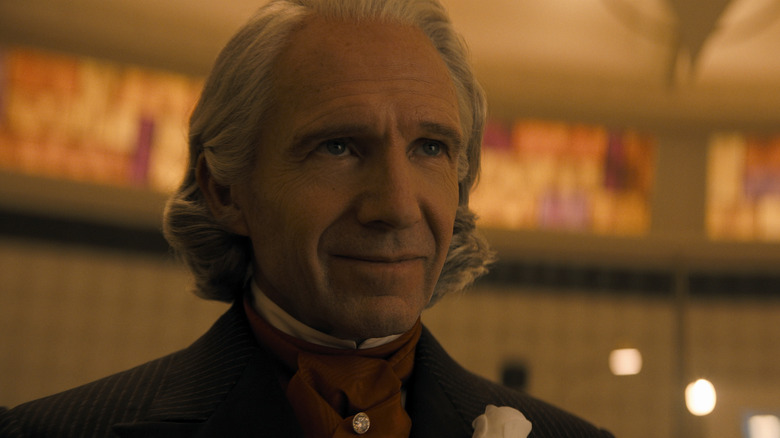
Let's briefly return to "The Ballad of Songbirds and Snakes" again, where we learn that a young Coriolanus Snow, played by Tom Blyth in the film adaptation, ends up hating the entirety of District 12 when he falls in love with and is summarily "betrayed" by a girl from its Covey, or a group of singers, songwriters, and bards. (It's a betrayal to Snow, but you can definitely argue that he's the one in the wrong; we digress.) That girl, Lucy Gray Baird (Rachel Zegler in the movie), wears bright colors and sings, and after Snow clocks Lenore Dove Baird's striker inscription in the novel, he also asks if she's named after a "color." As Haymitch notes, only someone familiar with District 12 could know that:
"The milk has soured in my stomach at his musings and what they reveal. He knows Lenore Dove is Covey; only they name their children this way. First name from a ballad, second a color. Amber and Ivory are actual family names. How has he unearthed this obscure fact about a pocket of musicians in the throwaway district of 12? Capitol informers?"
In the novel, Snow goes on to say that "all the birds [he's] encountered are vicious" and presumes that Lenore is "'delightful to look at, swishes around in bright colors, and sings like a mockingjay.'" Snow continues: "'You love her. And oh, how she seems to love you. Except sometimes you wonder, because her plans don't include you at all.'" In the movie, though? Snow names Lucy Gray Baird, leaving us with no doubt that he knows that Haymitch's love Lenore is probably a descendent of the girl he loved, lost, and now despises.
The Cornucopia plays a bigger role in the film

As with many changes and tweaks here, we can probably chalk the differences in opening of the 50th Games between page and screen up to a more cinematic approach. In the book, Haymitch decides to not even bother fighting at the Cornucopia, the traditional structure which is stocked with weapons and supplies at the very start of the game but which is usually the place where a whole bunch of tributes get killed trying to grab said weapons and supplies. As Haymitch says in the book:
"Then the gong rings out and the treads of my new boots grip the meadow grass as I sprint for the backpack. Barely breaking pace, I scoop up a spear in my left hand and a knife in my right, which I use to hook the strap of the backpack. I allow myself one quick glance over my shoulder, which is enough to reassure me that the Careers are late to the party, some still on their plates, others slow on the uptake and just reaching the weapons [...] And then I just run for those distant trees."
Haymitch continues: "It's only moments before the screams begin, but I force myself to stay on course, knowing that seeing a District 12 tribute or any Newcomer at death's door could pull me into the fray." In the movie, he's forced to fight as he heads towards the backpack, and most horribly, he watches as his fellow District 12 tribute Wyatt Callow (Ben Wang) dies; in the book, he finds out about Wyatt's death later.
Ampert's death is toned way down in the film

A major character in "Sunrise on the Reaping" — in both the book and movie — is Ampert Latier, played by Percy Daggs IV in the film. (Want to feel old, "Veronica Mars" fans? That's the son of Percy Daggs III, who plays Wallace Fennell on the teen drama.) Ampert has been specifically reaped for the Second Quarter Quell to punish his rebellious father and former District 3 victor Beetee Latier (Jeffrey Wright in the original films and Kelvin Harrison Jr. in the prequel), with his father tasked to serve as his mentor. Ampert and Haymitch form an alliance, partly to get an explosive device into the bowels of the arena and blow its water tank to drown its "brain," but after Haymitch attempts this, Gamemakers send violent squirrels after Ampert as revenge. As Haymitch says:
"I never even get a glimpse of Ampert, just writhing furry bodies fighting for a piece of him. Finally, as if someone blew a whistle, audible only to them, hundreds of heads pop up and turn in unison toward an unseen master. A mad dash ensues, and in seconds the squirrels have vanished into the foliage [...] Then I turn back to what I am meant to witness. A small white skeleton, stripped clean to the bone. No flesh or clothing remains, only an ax at its right side, my knife at its left. My lips move, but no sound comes out. "Buddy?" I stumble forward, spotting his tracker, wedged just below his elbow. There is no one to comfort, to ease out of this world. Ampert's been swallowed up by the Capitol, and his coffin will hold only these pearly white bones."
Ampert dies in the movie, but it's not ... quite this gross.
A Gamemaker showdown and a massive monster are completely cut
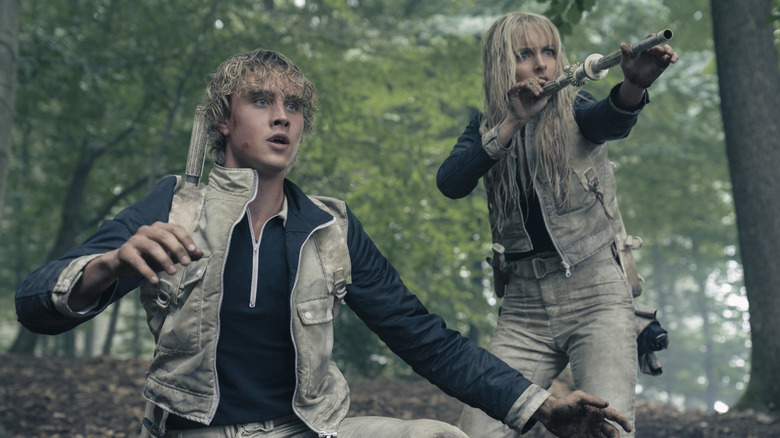
There are two big last-ditch arena showdowns that don't appear in the movie version of "Sunrise on the Reaping," and in one, we watch as District 4's Maritte (Sky Frances) and District 1's Silka Sharp (Laura Marcus) inadvertently tangle with some Gamemakers doing maintenance in the arena. As they try to escape, Haymitch watches as "Maritte's arm snaps back and I think I'm a goner, but the trident whistles over my head and lodges in the mopper, sending him into a pillow of poppies," with another Gamemaker catching a poison dart and the third falls into an open manhole of sorts and dies on impact.
If you're keeping track at home, that means three Gamemakers are hurt or killed by the tributes, complicating quite literally everything. There's another major arena tussle that gets cut as well, and that's the giant porcupine that kills three other tributes. "It's the size of a bear — in fact, it might have been crossed with one in the lab, given its claws and teeth. Like everything in the arena, it's striking in its way," Haymitch observes. "The rows of pure gold, silver, and bronze quills adorning its back, sides, and tail gleam in the sunlight. But I'm long over being seduced by the arena's beauty." This porcupine doesn't appear on screen, and it makes sense why. Both of these sequences are interesting, but they also can easily be cut and not affect the story.
Wellie's fate doesn't play out on screen

As Haymitch prepares for the Games, he ends up allying himself with Ampert and several other tributes who nickname themselves the "Newcomers" (in stark contrast to the "Careers" from Districts 1, 2, and 4, who train their entire lives to fight in the Games). One of those is the diminutive Wellie from District 6, played in the film by Rada Rae. She and Haymitch develop a special bond, and in the film, Silka uses a dead Wellie's token of a bicycle bell to lure Haymitch into a fight, and we don't see her fate play out. In the book, though, Haymitch discovers a starving Wellie in the arena — "She lies along a slender branch, belly down, like a possum in the moonlight, her bell tucked under her chin, a child-sized knife clutched in one hand" — and cares for her, leaving only to find more supplies. That's when he hears a cannon go off, revealing that a tribute is dead, and he makes his way back to Wellie's hiding place. What he sees next does not appear on-screen for presumably obvious reasons:
"Rounding a final clump of saplings, I freeze in horror at what awaits. Silka stands like a statue, her snot-green outfit splattered in bright red. In her right hand, her ax. Her left holds Wellie's head, eyes still open, mouth agape. The only movement, the only sound, comes from the blood dripping into the pine needles on the forest floor. Wellie's body lies crumpled in a heap a few feet away. The shiny silver bicycle bell. The blowgun. The child-sized boots. The tiny knife in her bird claw. Dove-colored feathers. Headless baby chick. I could live ten thousand years and never erase this sight from my memory."
One of Haymitch's District 12 friends is sidelined in the film
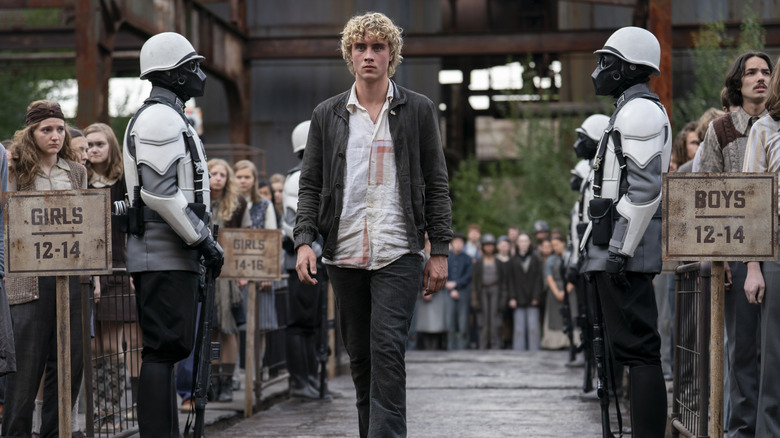
This change is pretty small, but still feels important. Though we only see Haymitch spend any actual meaningful time in District 12 at the beginning and end of both versions of "Sunrise on the Reaping," we do get to know his friends Burdock Everdeen and Blair (the latter of whom isn't given a last name in the book). Burdock — who is, of course, the father of Jennifer Lawrence's eventual heroine Katniss Everdeen and who dies before her story properly begins — has a decently significant role in the movie and is even shown singing, a clear reference to the beautiful voice Katniss talks about in her Hunger Games books and movies. Blair is ostensibly played by Devon Singletary in the books, but he's only briefly seen at the Reaping.
At the end of the film, when Haymitch returns home to find his mother and brother trapped in a burning house, he's held back by Burdock and Burdock's girlfriend Asterid March (Grace Ackary), who, yes, is Katniss's mother. In the book, Blair is there. "Blair, kneeling on my right arm, leans in. Tears cut channels through his soot-blackened face," Haymitch tells us. "'We're so sorry, Haymitch. We tried. You know we did. We just couldn't save them.'" Characters get combined all the time, and folding Blair's small plotlines into Asterid's makes obvious narrative sense, but in that case, it's a little strange that they didn't just cut Blair all together.
The ending of The Hunger Games: Sunrise on the Reaping takes a more optimistic tone than the novel

The ending of the film adaptation "The Hunger Games: Sunrise on the Reaping" includes the moment we've all been waiting for — the return of Jennifer Lawrence and Josh Hutcherson as Katniss Everdeen and Peeta Hutcherson. As Hunger Games fans know well, Katniss and Peeta are Haymitch's mentees when they compete in their first Games, the 74th iteration, and after Katniss tricks the Capitol into allowing both of them to declare victory, the two of them return to the arena for the Third Quarter Quell — sparing Haymitch when only previous victors can be reaped. Through the third book and film, "Mockingjay," Katniss and Haymitch work tirelessly with the rebellion to bring down the Capitol, and when Peeta is able to shake off the brainwashing he endured while a captive of the Capitol, he helps them too ... and they free Panem from the Games and the totalitarian Capitol.
The film shows Katniss, Peeta, and Haymitch gathering on Haymitch's birthday — once the annual day of the reaping — at District 12's old reaping site, which is grown over with flowers. It's an optimistic and sweet ending, all things considered, and Haymitch's health seems ... fine. So what about the book? Haymitch describes spending time with the married Katniss and Peeta, but it's more somber as Haymitch prepares for death. As he concludes:
"I'm not sure I'll be here in the old therebefore much longer. My liver's wrecked and I only dry out when the train's late. I drink differently these days, though, less to forget, more out of habit. When my time comes, it comes, but I've no idea when that will be."
"The Hunger Games: Sunrise on the Reaping" is in theaters now.