

Small Details You Missed In The Hunger Games: Sunrise On The Reaping
Contains spoilers for "The Hunger Games: Sunrise on the Reaping"
The Hunger Games film franchise just added a film to its ranks, and if you're a fan of the world created by original series author Suzanne Collins that centers around a dystopian version of North American where children annually fight to the death in the titular televised Games, you're in luck. "The Hunger Games: Sunrise on the Reaping" is here, and it's a mighty fine addition to this beloved literary and cinematic universe.
"Sunrise on the Reaping," which hit shelves in 2025 and is finally getting the big screen treatment, centers around Haymitch Abernathy — the disgruntled District 12 victor portrayed by Woody Harrelson in the original movies and Joseph Zada in this prequel that puts him firmly in the spotlight. After an incident at the reaping (the event where "tributes" are chosen from each of Panem's 12 downtrodden districts to fight in the Hunger Games) for the Second Quarter Quell, a particularly horrifying "celebration" of the 50th anniversary of the event that demands 48 child tributes instead of 24, Haymitch ends up in the fray alongside his fellow tributes Maysilee Donner (Mckenna Grace), Wyatt Callow (Ben Wang), and Louella McCoy (Molly McCann), fighting to become District 12's first victor in decades.
If you're familiar with the Hunger Games universe and timeline, "Sunrise on the Reaping" contains a few references and Easter eggs ... and it's also packed with foreshadowing. From a vital American poem to a hint about how one of the tributes meets a bitter end, here are some small details you may have missed in "The Hunger Games: Sunrise on the Reaping."
The opening song references a poem that's pivotal to the narrative

When we meet Haymitch in District 12 — before he's reaped into the Games — we see him with his girlfriend Lenore Dove Baird (Whitney Peak), a group of musicians in the district known for their performances, bright clothes, and color-related names. ("Dove" here refers to a shade of gray, which also references Lenore's apparent ancestor Lucy Gray Baird, the character portrayed by Rachel Zegler in the other prequel "The Hunger Games: The Ballad of Songbirds and Snakes" that we'll circle back to in just a bit.) As the entire film opens, though, we hear a song from the soundtrack called "The Raven I" which opens with the lyric "Once upon a midnight dreary, while I pondered, weak and weary."
This is, of course, lifted directly from Edgar Allan Poe's poem "The Raven," which is directly referenced multiple times throughout "Sunrise on the Reaping" and is the source of Lenore's name. (Inexplicably, Poe is the only real pop culture figure to make an appearance in the Hunger Games universe.) This is a reference to Lenore's eventual fate and death, because if you're familiar with the poem, and if you go read it on, say, The Poetry Foundation, you'll understand that Haymitch's Lenore is doomed based on her very name. As it reads in one passage:
"Ah, distinctly I remember it was in the bleak December;
And each separate dying ember wrought its ghost upon the floor.
Eagerly I wished the morrow;—vainly I had sought to borrow
From my books surcease of sorrow—sorrow for the lost Lenore—
For the rare and radiant maiden whom the angels name Lenore—
Nameless here for evermore."
Asterid March gives gifts to two tributes

Because Haymitch's story is so intertwined with that of our eventual District 12 co-victor Katniss Everdeen (Jennifer Lawrence in the movies), it makes total sense that she's referenced throughout "Sunrise on the Reaping." In the book and film, Asterid gives Haymitch a flower for his lapel. As Suzanne Collins describes the scene: "Asterid gives me a fair price and throws in a sprig of chamomile. 'For today. They say it's good luck.' I slide the stem into a buttonhole." Grace Ackary's Asterid, the future mother of Katniss Everdeen, also presents Haymitch with a flower in the movie.
There's a slight difference with Asterid's second gift to a tribute between the book and film, but logistically, director Francis Lawrence and his team may have tweaked this to really tie one important Hunger Games artifact more firmly to Katniss. In the book, Maysilee Donner is the original owner of the mockingjay pin that ultimately symbolizes the resistance and becomes Katniss' token in the arena. In the film version of "Sunrise on the Reaping," you can clearly see Asterid affix it to Maysilee's collar as she's reaped. A tiny difference, to be sure, but it's also important that we see this famous piece of jewelry get passed around by District 12 tributes before it ends up with Katniss.
Drusilla's District 12 entrance includes some medical assistance
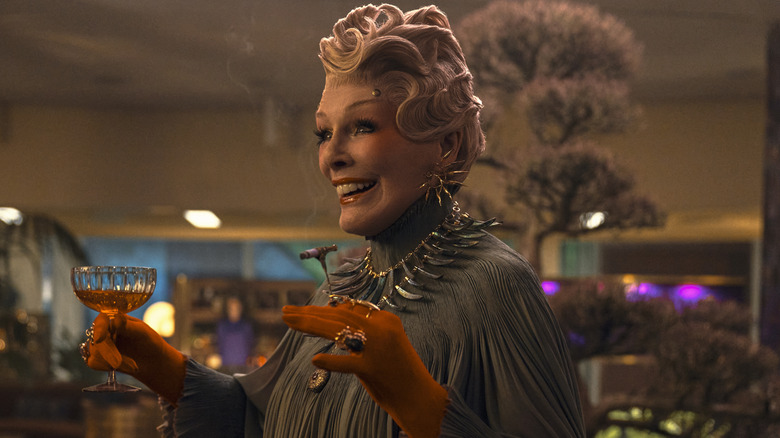
If you're well-versed in Hunger Games lore, you know that exceptionally obvious and near-disfiguring plastic surgery is all the rage in the wealthy Capitol, the area that controls all of the districts and never has to send any of its children into the Games. (By way of example, there's a character named Tigris, who we see in "The Ballad of Songbirds and Snakes" as played by Hunter Schafer, who reappears in the book version of "Mockingjay" and has plastic surgery that turns her into a human-tiger hybrid.) When the audience is introduced to Drusilla Sickle — the Capitol's assigned District 12 chaperone played on-screen by Glenn Close — she's sporting plenty of evidence of exaggerated, bizarre surgeries. As Haymitch says in the book, she's a "plastic-faced woman who escorts our tributes to the Hunger Games each year."
Close's prosthetics and makeup are truly incredible to behold, but the movie adds in another interesting detail: she's wheeled into the proceedings on a sort of upright gurney before she's unstrapped and allowed to make announcements about the tributes. While the gurney is never explained, it stands to reason that a recent surgical procedure left her at least partially immobile, showing just how far the residents of the Capitol will go to transform their bodies to remain en vogue.
Snow's white rose makes an appearance
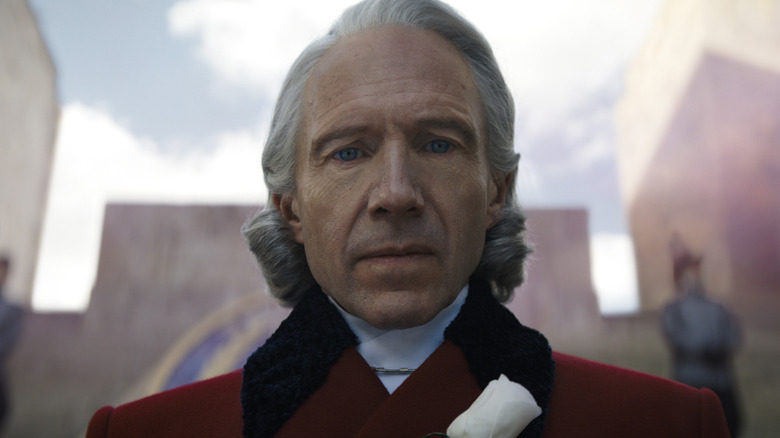
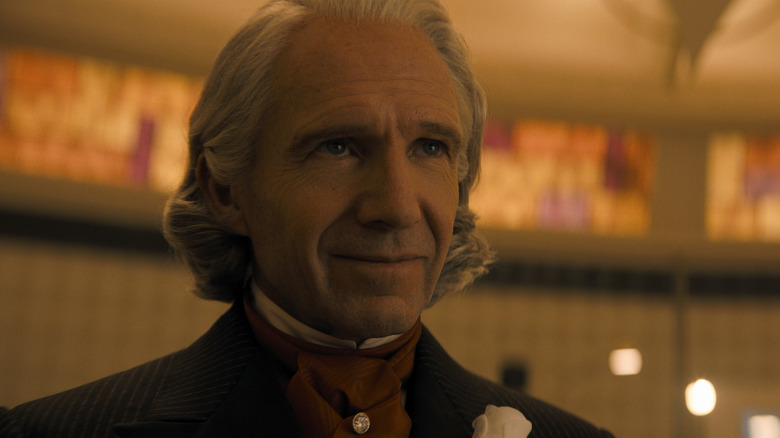
When we see President Coriolanus Snow, portrayed by Ralph Fiennes (bridging the gap between Tom Blyth in "The Ballad of Songbirds and Snakes" and the late Donald Sutherland in the original films), in "Sunrise on the Reaping," his lapel is always adorned with a white rose; we also see him get sick during a secret meeting with a confused Haymitch. This is the first time we properly see Snow with his signature white rose, which has a sinister meaning despite its weirdly sweet origins.
As we learn in "The Ballad of Songbirds and Snakes," Coriolanus Snow's late mother loved roses, and the family grew them on the roof of their home. As Snow ages and begins assassinating enemies, though, he uses the roses for a different purpose: their perfume. We actively see Snow reacting to the effects of poison during "Sunrise on the Reaping" (when he's physically ill), and famously, Snow conditions himself to endure poison so he can trick said enemies into eating or drinking the same thing as him. As Katniss says in the text of "Mockingjay," this becomes a pattern:
"People dropping dead at a feast or slowly, inexplicably declining into shadows over a period of months. Blamed on bad shellfish, elusive viruses, or an overlooked weakness in the aorta. Snow drinking from the poisoned cup himself to deflect suspicion. But antidotes don't always work. They say that's why he wears the roses that reek of perfume. They say it's to cover the scent of blood from the mouth sores that will never heal. They say, they say, they say . . . Snow has a list and no one knows who will be next."
The Covey girls haunt President Snow
Remember Lucy Gray Baird? If you don't, here's a refresher. In "The Ballad of Songbirds and Snakes," a young Coriolanus Snow is tasked with mentoring Lucy Gray Baird, a tribute in the 10th Hunger Games from the Covey that everyone assumes will be killed almost immediately (the mere fact that he's stuck with District 12 is regarded as a straight-up punishment). Before the Games properly begin, though, Lucy's talent for singing charms people throughout the Capitol and earns her gifts from sponsors; Coriolanus also interferes and cheats on her behalf multiple times. (Not only does he give her his late mother's compact as her in-arena "token" and fill it with poison, but he also lets snake muttations smell her handkerchief, which ends up keeping her safe from their attacks when they're tossed into the arena.) Ultimately, his interference guarantees Lucy Gray's victory.
Throughout that story, Coriolanus finds himself drawn to Lucy Gray again and again, even requesting that he be sent to District 12 when he's forced to become a Peacekeeper in retribution for his cheating. When they finally decide to run away together, though, Lucy grows suspicious of Coriolanus — and she's correct — and his true motives and makes a run for it, leaving him alone. This resentment towards District 12 girls and Covey ones in particular makes a major appearance in "Sunrise on the Reaping" when the older Snow asks Haymitch about an inscription on his own token, a flint striker disguised as a necklace that's engraved with her initials. Not only that, but Snow directly tells Haymitch about Lucy Gray and her perceived betrayal, warning that he'll face the same fate with Lenore Dove.
Lou Lou's love for flowers

We already mentioned that there are four, not two, tributes who head into the arena during the 50th Hunger Games to represent District 12 (including Haymitch). One of them, however, is not the original child who was chosen during the reaping. When Haymitch's childhood playground "sweetheart" Louella McCoy is chosen, he's quietly devastated, but then tragedy strikes during the opening ceremonies in the Capitol. As Haymitch, Maysilee, Wyatt, and Louella board their chariots for the traditional parade that officially begins the "festivities" of the games, onlookers start setting off colorful fireworks, spooking the horses ... and in the ensuing chariot crash, Louella is killed.
This leads to one of the most disturbing things in the entire history of the Hunger Games franchise: the Capitol doesn't publicly reveal Louella's death and simply replaces her with a brainwashed District 11 captive who looks sort of like her. This new girl, dubbed Lou Lou by Haymitch and played in the film by Iona Bell, has no idea where she is or what's going on, but when Haymitch first meets her during that private meeting with President Snow, the first thing she does is take a great big sniff of a nearby floral arrangement.
Lou Lou's love for flowers is exactly what kills her in the arena. When Haymitch finds her in this particularly devious arena — in which every animal, plant, and piece of fruit is alluring and beautiful but deadly — he's able to protect her for a little while, but when she smells a pretty flower, she's overcome with poison and dies in his arms. It's notable, then, that her introduction plants this seed (to so speak.)
The tech in The Hunger Games: Sunrise on the Reaping is more primitive than in future stories
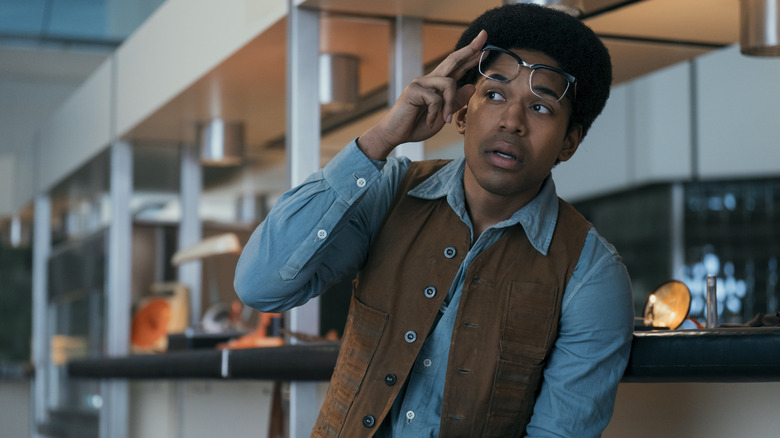
One of the coolest things about the Hunger Games universe constantly expanding is that we get to see completely different eras of Panem. In "The Ballad of Songbirds and Snakes," the games are only on their 10th go-around, and even though things are fairly technologically advanced by our standards, it's primitive by Panem's standards for sure (the arena, for example, is little more than a fighting pit). In the original trilogy, the technology is robust and complicated outside of the impoverished Districts, which Katniss and her fellow tribute Peeta Mellark (Josh Hutcherson in the films) discover as they take the train to the Capitol.
So what of "Sunrise on the Reaping?" Well, it bridges the gap perfectly. Notably, you can see where developments were made by the time Katniss competes in the games; while she and her fellow tributes are shot into the arena in a series of tubes, Haymitch and his other tributes are sort of strapped to an upright gurney (not unlike the one that carries Drusilla around) which then acts as an elevator into the arena. When Haymitch's mentor Beetee Latier (Kelvin Harrison Jr.) —± a former District 3 victor played by Jeffrey Wright in the original films whose son Ampert (Percy Daggs IV) is chosen as a tribute to punish him for insolence — convinces Haymitch to blow up a water tank underneath the arena and destroy it, the explosive they use isn't exactly advanced. It's interesting, across the board, to see how much things change by the time Haymitch becomes a successful mentor to Katniss and Peeta.
Plutarch's future becomes clear
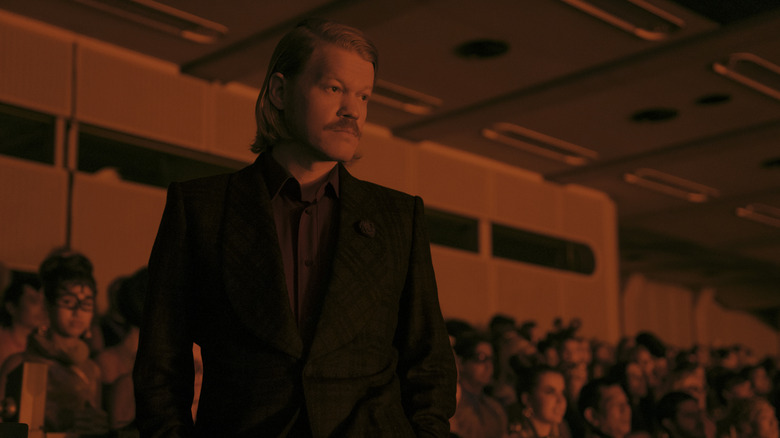
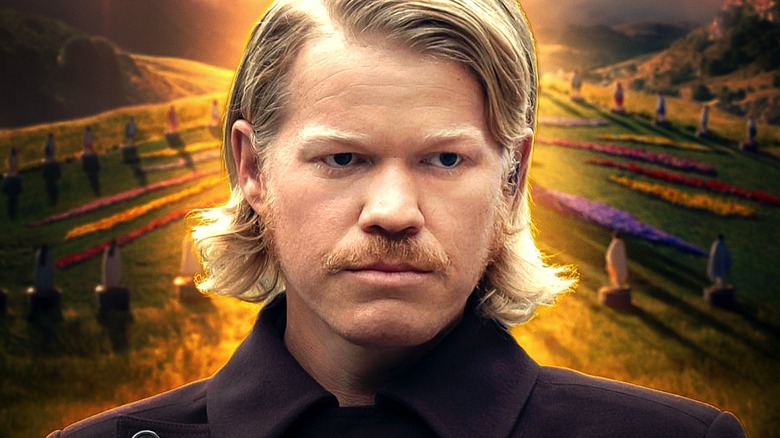
If you're unfamiliar with Plutarch Heavensbee, you might want to brush up on your Hunger Games characters ... but here's a crash course anyway. After meeting Plutarch's ancestor Hilarius Heavensbee in "The Ballad of Songbirds and Snakes," who's portrayed by Florian Burgkart in the film adaptation, Plutarch is the most important Heavensbee to the overall narrative; in "Sunrise on the Reaping," he's portrayed by Jesse Plemons. We know Haymitch's future — more on that in a second — when we see him tangle with Haymitch before and after the 50th Games, but now we know how he got his start: as a Capitol cameraman with an eye for drama and a keen ability to manipulate circumstances.
Plutarch is also, surprisingly, a rebel. Not only is he in on Beetee's plan to blow up the water tank, but he's also the one to confront Haymitch after the Games are done and Haymitch's family and Lenore have all been killed so that he can urge the young victor to carry on and keep fighting. This makes it all the more interesting that, in the movie version of "Sunrise on the Reaping," Snow finds out about Plutarch's plotting and has him briefly tortured before declaring that Plutarch might want to consider becoming a Gamemaker, considering him cleared of wrongdoing eventually. Gamemaker is a prestigious Capitol job where you literally design the Games, but it also comes with a high risk — when Wes Bentley's Seneca Crane "botches" Katniss's first time in the arena, Snow ultimately has him killed — and Plutarch does become a Gamemaker by the time Katniss competes in the 75th Games. Played by Philip Seymour Hoffman in the original films, Plutarch is still a rebel ... and he's ultimately instrumental in taking down the Capitol from the inside.
Burdock Everdeen's gift of song
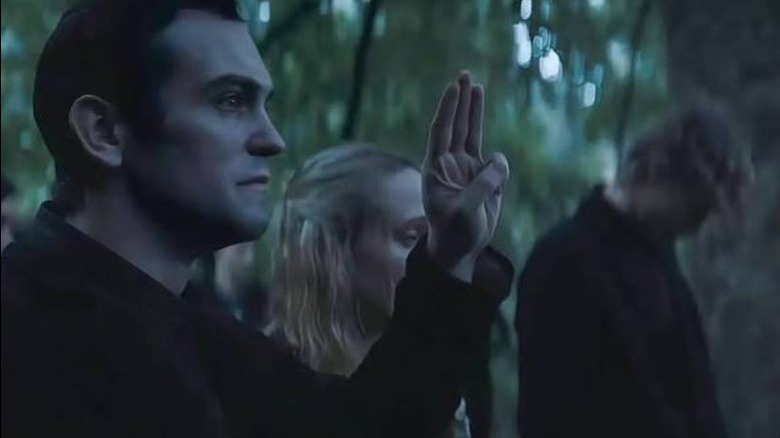
"Sunrise on the Reaping" is the first time we properly meet Burdock Everdeen, father of Katniss, on-screen or on the page; he dies in a mining accident when Katniss is young and well before she ever enters the Games for the first time. In the movie version of "Sunrise on the Reaping," he's played by Scot Greenan and appears in several District 12 scenes. Most importantly, though? He sings.
We learn, through Katniss in the first book in the series — simply titled "The Hunger Games" — that her father was a gifted singer. As she recalls:
"My father was particularly fond of mockingjays. When we went hunting, he would whistle or sing complicated songs to them and, after a polite pause, they'd always sing back. Not everyone is treated with such respect. But whenever my father sang, all the birds in the area would fall silent and listen. His voice was that beautiful, high and clear and so filled with life it made you want to laugh and cry at the same time. I could never bring myself to continue the practice after he was gone."
Then, in "Sunrise on the Reaping," we get to watch as Burdock sings a song at Maysilee Donner's funeral in an attempt to comfort her twin sister Merrilee (also McKenna Grace), the Donner family, and Haymitch. It's a perfect way to exhibit Burdock's musical talents, and brings something from the first book to life for the very first time.
"The Hunger Games: Sunrise on the Reaping" is in theaters now.