

5 Classic '50s Western Movies That Still Hold Up Today
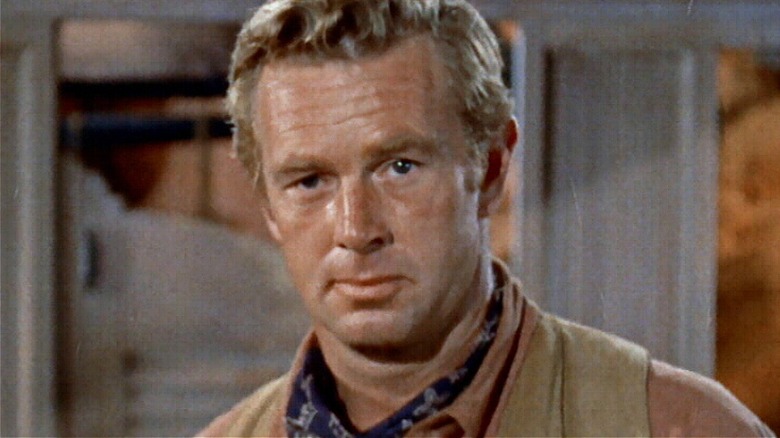
Since 1903's "The Great Train Robbery," Westerns have played a towering role in motion pictures. By the 1950s, the Western movie was inescapable at movie theaters. The genre was a reliable moneymaker and a prime way of delivering spectacle to audiences and showcasing the rapidly developing cinematography of the era. Thus, Western titles anchored by Gary Cooper, John Wayne, and Randolph Scott (among many other famous faces) were everywhere that decade. It was a peak era for American Westerns.
However, not all 1950s Westerns are created equal. What captivated audiences in 1953 may not be equally engrossing to moviegoers in the 2020s. Certain Western movies from this era have aged about as well as milk left out in the sizzling hot desert. By the same token, there are also several 1950s Westerns that have stood the test of time with aplomb. Five perfect examples of '50s Western movies that still hold up today are shining beacons of the timeless entertainment the best Western motion pictures can deliver. All kinds of elements in these five features have proven enduringly relevant, whether it's their social commentary or unforgettable performances.
Given the sheer volume of Western movies that populated the big screen in the 1950s, these five particular movies stand out as extraordinary and well worth remembering.
Bad Day at Black Rock
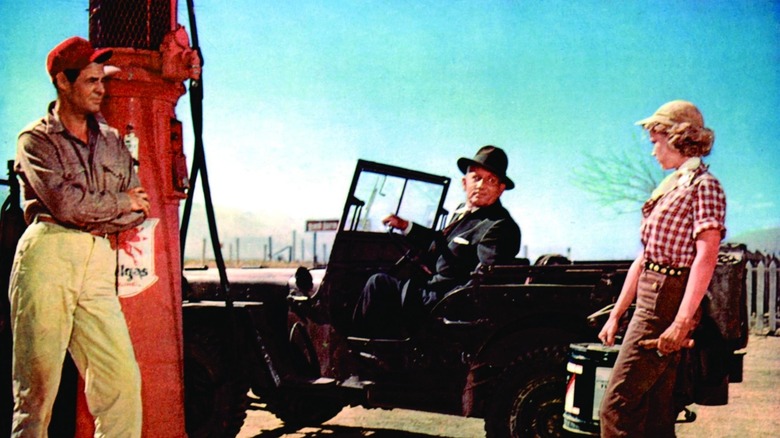
Many Westerns inevitably fall into the trap of offering cozy, colonizer-sympathizing portraits of America's past. The brutality and moral complexities of yesteryear are brushed away in classical Westerns offering one-dimensional portraits of "brave" white men "taming" the West. "Bad Day at Black Rock," a 1955 Spencer Tracy vehicle, goes in a far more interesting direction. Not only is this film conscious of real-world prejudices, but it is set in the then-modern world. Specifically, it takes place in 1945, just after the end of World War II. The production follows John Macreedy (Tracy) coming to the super small town of Black Rock.
All the local denizens immediately look at this newcomer as a problem. Their contempt grows even more intense when they realize Macreedy is here to find Kokomo, a Japanese American whose son died fighting for America. Kokomo, though, has been killed in a hate crime by Black Rock's populace, who find Macreedy's investigation far more troublesome than their racist behavior. Immense tension drips off of every inch of "Bad Day at Black Rock." Director John Sturges is remarkable in realizing the unspoken but intense hostilities directed at Macreedy, while the ensemble cast (which also includes Walter Brennan and Ernest Borgnine, among many others) is incredible.
It'd be lovely to say this central story didn't feel aching pertinent. Unfortunately, both its tale of prejudice and its eternally impressive filmmaking make "Bad Day at Black Rock" a movie potently relevant decades after its release. This is a sublime model for making Westerns brilliantly rooted in the here and now.
Johnny Guitar
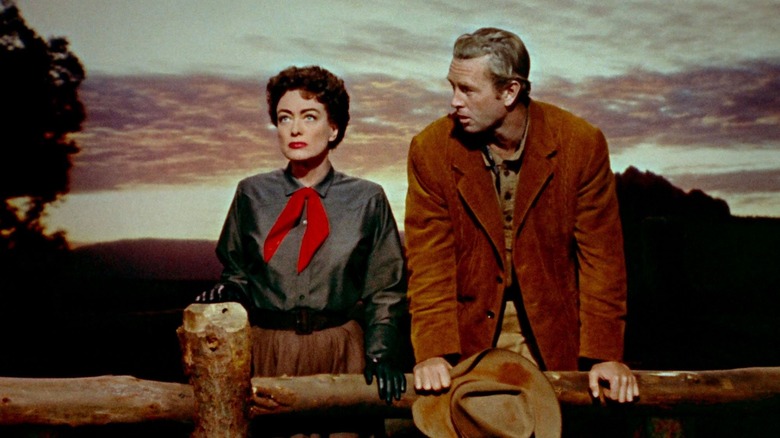
Few movies in cinema history have looked as gorgeous as "Johnny Guitar." There's a beauty and majesty to monochromatic Westerns, but by the same token, the luscious reds, yellows, and greens dominating so many frames of "Johnny Guitar" are also extraordinary to witness. One of the best woman-led Western movies ever, "Johnny Guitar" follows Vienna (Joan Crawford), whose status as a lady owning a saloon has made her a pariah and hated figure amongst the local townsfolk. Those same people soon accuse her of heinous crimes like murder, leaving Vienna scrambling to survive.
Director Nicholas Ray was always gifted at telling stories about societal outsiders, as seen in masterpieces like "Rebel Without a Cause." That talent is apparent in "Johnny Guitar," which doesn't just have a rich color palette to lend it a specific identity. It also has one of Joan Crawford's greatest performances as the lightning rod Vienna. Every time she appears on-screen, Crawford commands every inch of your attention. She's accompanied by similarly sublime supporting turns by performers like Sterling Hayden (playing the titular Johnny Guitar) as well as outstanding costume and production design.
1954's "Johnny Guitar" is one of those divine motion pictures where every artist assembled was firing on all cylinders and then some. When you're talking about the best Western movies of all time, you simply have to include the rousing "Johnny Guitar" in the conversation.
The Naked Spur
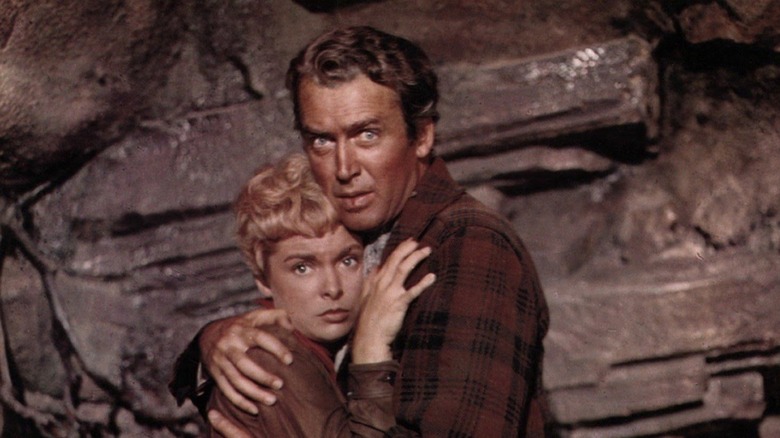
The five best Jimmy Stewart Western movies epitomize the immensely important artistic contributions this man made to the Western genre. Among those greatest Westerns is the 1953 Anthony Mann directorial effort "The Naked Spur," whose tone is one of gritty realism rather than a more palatable, cozy Western from the same era. "The Naked Spur" follows Stewart's bounty hunter Howard Kemp, who's bringing wanted criminal Ben Vandergroat (Robert Ryan) in for a reward. He soon has two unexpected companions: Roy (Ralph Meeker) and Jesse (Millard Mitchell), who helped bring Vandergroat down and want some of that reward moolah.
This leads to a contentious narrative following a quartet of morally complex men (plus Vandergroat's partner, Janet Leigh's Lina Patch) stewing in their distrust of each other. This whole enterprise is tremendously involving, but it's especially transfixing when Mann displays enough confidence to lean on sparseness. When only sound effects and striking shot compositions fill the screen, the raw anxiety and interior paranoia of these characters become extra potent. Contrasting a vividly colorful feature with the pervasive misery gripping the film's characters also makes for a fascinating experience.
Anchoring the cast is Stewart, who proves a fine fit playing a grizzled man reluctantly working with others. His work establishes a level of artistry that the other actors live up to. It's impossible to complain about the cast being kept this small when all the performances are so strong. "The Naked Spur" is excellent enough to easily stand out in Stewart's crowded catalogue of Western features.
3:10 to Yuma
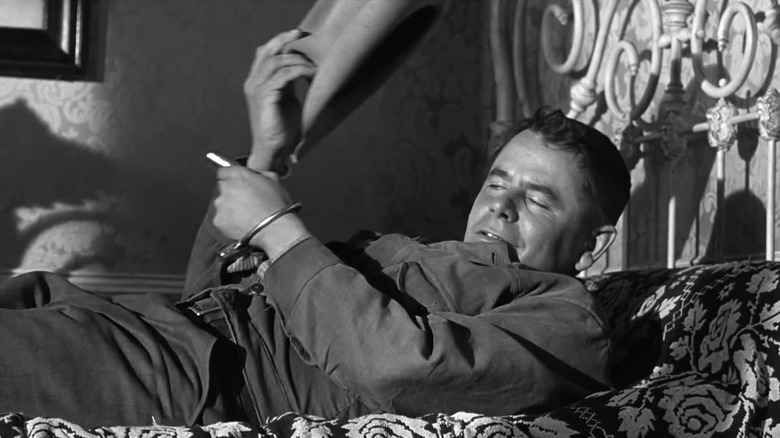
Many of the films on this list star some of the most prolific actors of the mid-20th century. Spencer Tracy. Jimmy Stewart. Joan Crawford. "3:10 to Yuma," though, stars two names that might not be household names today. Glenn Ford and Van Heflin are the headliners of this movie, and though they aren't the most famous mid-20th-century stars, they are perfect for this motion picture. One of the best Elmore Leonard movie adaptations out there, "3:10 to Yuma" follows everyday farmer Dan Evans (Heflin), who's hired to take the famous criminal Ben Wade (Ford) on a train. Wade, though, has got a whole deluge of loyal followers ready to bust him out and take down Evans.
What's especially impressive about "3:10 to Yuma" is its fantastically involving imagery, making great use of confined spaces and depth of field. There are so many great shot compositions in this title that make use of precise character geography. Meanwhile, the relatively confined scope lets the cast sink their teeth into these characters. Glenn Ford especially excels at playing the chained-up but tangibly dangerous Ben Wade. Adding an extra level of astonishing artistry to the proceedings is how short "3:10 to Yuma" is.
This 1957 title is only 92 minutes long, yet director Delmer Daves and company cram so much tension, character, and excitement into that compact package. Brevity is the soul of wit, and that approach clearly ensured this incarnation of "3:10 to Yuma" was eternally impressive.
High Noon
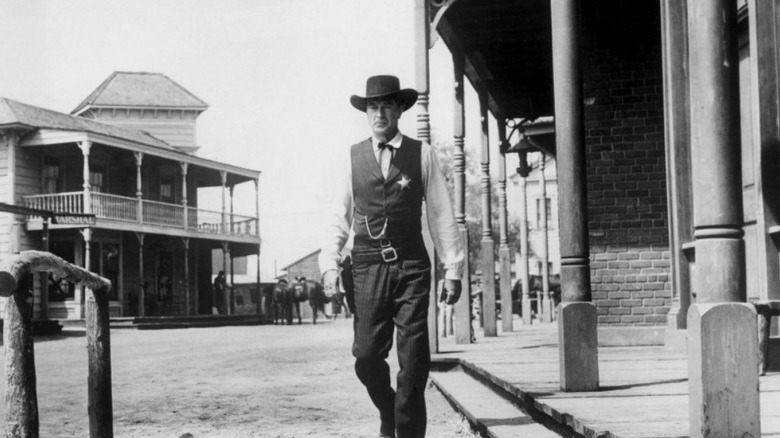
"High Noon" is the very definition of a movie speaking to the times in which it was made. This Gary Cooper vehicle came out during the height of the Red Scare and served as a commentary on McCarthyism, specifically the loneliness of being the one person who'll stand up against indomitable forces. People will talk bad about matters like McCarthyism, but where are they when it's time to actually confront them? These realities underpinning the age of HUAC (in which Hollywood artists were investigated by the U.S. government for suspected communist ties, which often led to being blacklisted by studios) informed the story of "High Noon." The film follows Marshal Will Kane (Gary Cooper) vowing to confront a gaggle of violent galoots despite everyone around him (even his new bride) telling him not to even think about such behavior.
Will Kane finds no support or comrades to stand by him whilst he dedicates himself to stopping oppressive forces at a "high noon" showdown. One of the best Gary Cooper Western movies out there, "High Noon" provides an engrossing allegorical look at surviving during McCarthyism. However, though this 1952 Fred Zinnemann directorial effort is firmly rooted in the mid-20th century, the themes it explores are pertinent to any era of history. To boot, its storytelling, suspenseful atmosphere (it's truly the ultimate underdog story), and memorable performances (particularly Cooper's lead turn) ensure it stands toe-to-toe with the 10 best movies of the 1950s.
In other words, "High Noon" is a masterclass in yesteryear specificity informing a Western movie that's entrancing no matter what era it's watched in.