

5 Best James Stewart Western Movies, Ranked
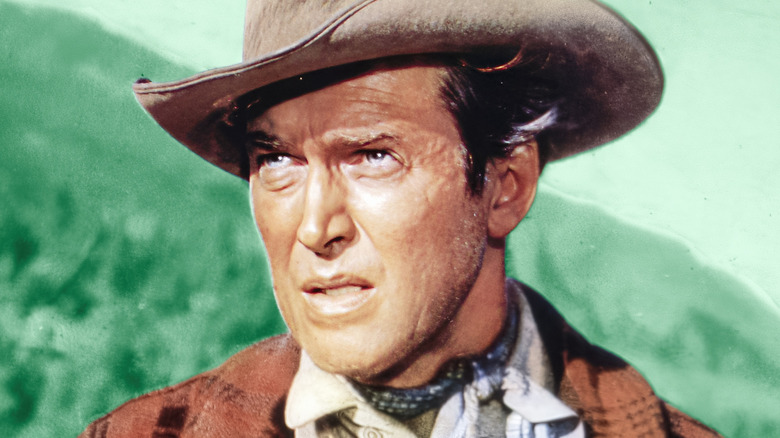
For many, James "Jimmy" Stewart isn't just an actor, but the face of American cinema as an institution. That's unsurprising given how many famous films he's anchored, including movies that proved crucial to some of the greatest years in film history. After you deliver unforgettable work in titles like "It's a Wonderful Life," "Vertigo," and "The Philadelphia Story," among countless others, Stewart's more than earned his staggering reputation. Also contributing to his immense fanbase and legacy are his iconic forays into a genre that utterly dominated pre-1965 American filmmaking.
James Stewart and Westerns are a tight-knit duo, with the actor constantly starring in this genre throughout his career (particularly from 1950 onward). Though some of his most famous roles are playing normal men in then-contemporary dramas and comedies (like "Harvey" or "Mr. Smith Goes to Washington"), Westerns let Stewart cut loose and play a whole bevy of different archetypes. Though his forays into Westerns cover many different features, five of them in particular have emerged as the most beloved of all time.
These five features don't just endure as shining examples of Stewart's acting talents. They're also among the highest peaks of artistry in the Western genre itself. Stewart headlined a slew of Westerns that didn't just bring out the best in him, but also let a slew of gifted artists excel in their respective crafts. Let's giddyap into the five best James Stewart Westerns (ranked below from "lowest" to highest average Letterboxd rating) and explore this icon's most rootin-tooin' exploits.
5. The Naked Spur
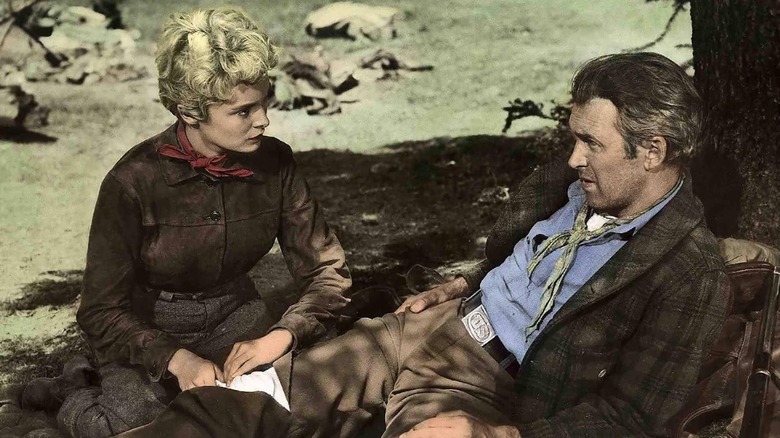
Part of why the Western may have proved appealing to James Stewart in the 1950s (beyond the genre's pervasiveness providing him with steady paychecks) is that the often grimier nature of these productions, shot in tactile dirt and often involving shootouts, gave him a chance to reinforce his versatility as a performer. Some of the most revered titles among James Stewart's 65 best movies find him portraying his classical everyman persona, an archetype Stewart sold and infused with more believability than 99% of other actors out there. However, in a decade that brought "It's a Wonderful Life," he was still also doing darker features like "Rope."
Stewart was always capable of anything as an actor and, as he grew older, '50s Westerns let him play characters who were a tad surlier and maybe not what people immediately thought of as a Jimmy Stewart character. Case in point: 1953's "The Naked Spur," an Anthony Mann directorial effort that saw Stewart playing aloof bounty hunter Howard Kemp, whose mission to retrieve a murderer and collect the reward on his head is complicated when additional people join his operation.
Stewart is fantastic here as he plays both the paranoia and grimness that are gripping Kemp beautifully. There's a tangible weariness radiating off him in every scene that is transfixing. "The Naked Spur" is great on its own merits, but it especially excels as a showcase for Stewart's acting dexterity.
4. The Man from Laramie
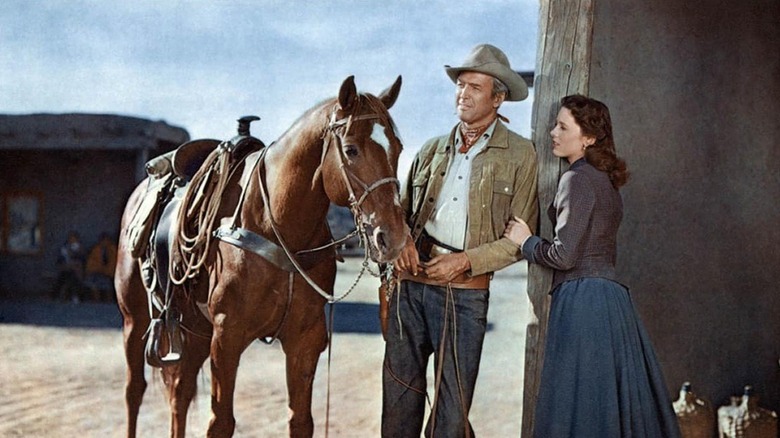
Will Lockhart (James Stewart) wants answers. While riding his horse on a seemingly routine supply operation, the titular protagonist of "The Man from Laramie" witnesses the aftermath of a calvary getting obliterated by high-powered guns. He quickly believes a local indigenous tribe are responsible, but Lockhart wants to find out who sold them the guns. His quest for the truth brings him into immense conflict with many people in the town of Coronado, including hot-headed Dave Waggoman (Alex Nicol) and his protector Vic (Arthur Kennedy).
The widely acclaimed "The Man from Laramie" has procured its reputation honestly. The film is an intriguing exploration of dueling loyalties, familial betrayal, and drama, generated by people expressing hostility toward an honest man who wants to challenge problems rather than the problems themselves. Stewart, playing a character intentionally written as terse and hard to define, is still magnificent. Audiences don't need to know every inch of his backstory or what's exactly transpiring in his mind to be riveted by his actions. His complex rapport with Arthur Kennedy (who gives a deeply tragic and compelling performance) is also quite engaging, as the two actors seem to dish out a fresh dynamic with each new scene they share.
As a cherry on top, "The Man from Laramie" (which also hailed from "The Naked Spur" director Anthony Mann) features an extended scene involving lots of adorable cows and calves being herded. Combine that with another exquisite Stewart performance and you've got can't-miss cinema.
3. Destry Rides Again
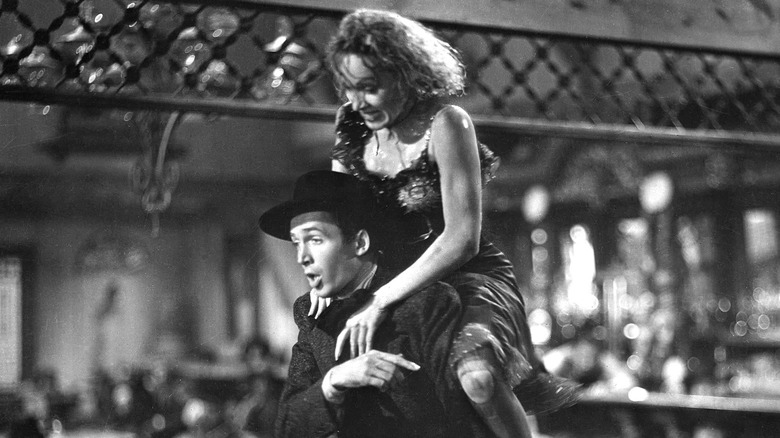
By far the oldest movie on this list (and the only released before 1950) is 1939's "Destry Rides Again," a George Marshall directorial effort that arrived at a frenetic time for James Stewart. Just a year earlier, he had headlined (along with the incredible Jean Arthur, one of the 13 best actresses of all time) the Oscar winner for best picture, "You Can't Take It with You." The same year as "Destry," Stewart secured his first ever Oscar nod for best actor, thanks to his work in "Mr. Smith Goes to Washington," while also starring in a string of other films, including the musical "The Ice Follies of 1939." To say Jimmy Stewart was a busy guy was a gross understatement.
Yet he still found time to appear in "Destry Rides Again," a Western where Stewart plays peaceful Tom Destry, who ends up stuck in a town called Bottleneck that's run by nefarious saloon owner Kent (Brian Donlevy). Marlene Dietrich is also around as Kent's lover, who causes plenty of problems for Destry as he tries to confront Kent and his minions. Running a tight 94 minutes, "Destry Rides Again" crams a lot of laughs, atmosphere, and personality-rich performances into every frame.
A young Stewart is absolutely perfect to play Tom Destry, thanks to his unwavering commitment as a conviction-riddled man devoid of any irony. His rapport with Dietrich is also tremendously memorable. Considering all these artistic virtues, it's no wonder "Destry Rides Again" is a hit with Letterboxd users and general moviegoers alike.
2. Winchester '73
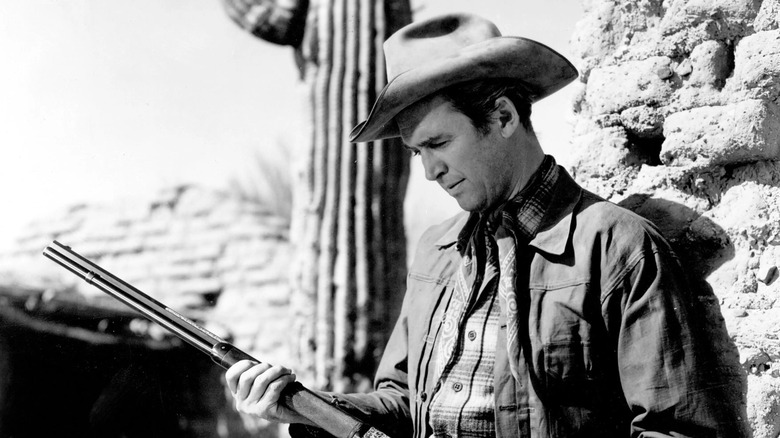
The best movies of the 1950s didn't just vanish from public conciousness once everyone's calendars turned over to 1960. Among the films from that decade still leaving an impression on viewers is "Winchester '73," a 1950 collaboration between James Stewart and director Anthony Mann. On websites like Letterboxd (where the film has a 3.9 average rating), "Winchester '73" is held in high esteem, and with good reason.
Part of its enduring appeal may come from its accessible nature, with critics suggesting that it's the most traditional Western that Anthony Mann ever directed. The film follows Lin McAdam (Stewart), who secures the highly sought-after titular rifle and then goes to great lengths to get it back once it's stolen. Stewart's work has been hailed as some of his finest, especially given how effortlessly he tackled more morally complex material than he'd ever been handed before on the big screen.
Mann, meanwhile, was nearly a decade into his directing career by this point, which ensured that (despite this being one of his first Westerns) "Winchester '73" was crafted with real care and precision. Over 70 years since it first premiered, "Winchester '73" is still hitting a bullseye with moviegoers of all stripes.
1. The Man Who Shot Liberty Valance
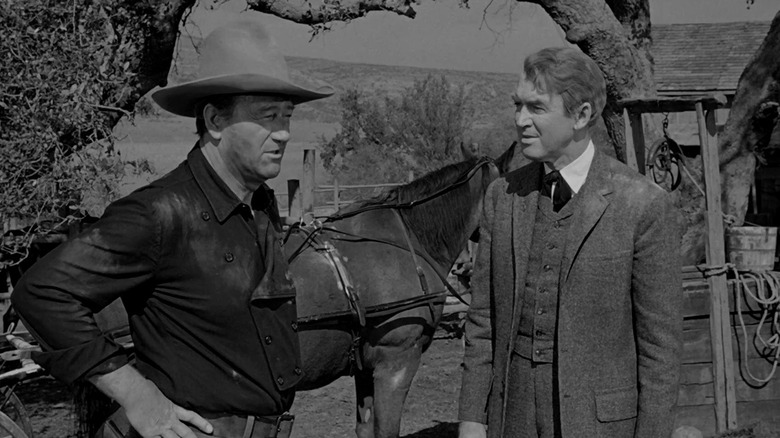
With 1962's "The Man Who Shot Liberty Valance," two classic movie icons finally shared the screen together. James Stewart and John Wayne were finally paired up here, a union that simultaneously made a lot of sense (they were both Western movie veterans, after all) and also resonated as baffling (given their radically different silver screen personas). Despite the potential pitfalls in uniting the pair, something clearly clicked with "Liberty Valance." It's now considered one of John Wayne's five best Westerns as well as a famous example of a Western that Roger Ebert gave a perfect rating.
This esteemed reputation is thanks to many attributes, but especially potent is its agonizing sense of woe. A prologue establishes an older Ransom "Ranse" Stoddard (Stewart) returning to the decaying town of Shinbone. Dust has gathered over this locale, buildings are crumbling, and everywhere Stoddard and the audience looks, there are reminders of time's ceaseless march. After this evocative opening, director John Ford brings audiences back 25 years to discover how Stoddard and Tom Doniphon (John Wayne) became friends.
The ensuing narrative is a gripping one, intimately chronicling Stoddard and Doniphon's differing approaches to "justice" against the nefarious Liberty Valance (Lee Marvin). "The Man Who Shot Liberty Valance" lived up to the potential of its lead duo and then some.