

Every Major House & Faction In Dune Explained

Denis Villeneuve's "Dune" films make plenty of changes to Frank Herbert's books. One is necessarily limiting screen time for several of the major houses and factions within the story. We hear about a few key groups, like House Harkonnen and House Atreides. There's also the House of Corrino, which holds the Padishah Emperor Shaddam IV and Princess Irulan (played by Christopher Walken and Florence Pugh, respectively, in "Dune: Part Two"). While they're technically there in the adaptation, though, the importance of these literal powerhouses is often out of sight.
There are plenty of other important geopolitical groups and factions involved in the books, too. Some of these, like the Spacing Guild, have minor appearances in the movies. Others, like the blue-eyed Fremen, are front and center. And still others are such a big deal that they've gotten their own spin-off series (like the mysterious order of the Bene Gesserit in HBO's "Dune: Prophecy."
If you're confused with all these moving pieces, so are we. That's why we sat down and tried to make heads or tails of the whole affair. If you're trying to remember who's who before you see "Dune: Part Three," never fear. We've dug into the backstory of each of the major houses and factions of the "Dune" universe to give you a quick but thorough background on each one. Ready? Let's dive in.
House Atreides is the most recognizable of Dune's noble families
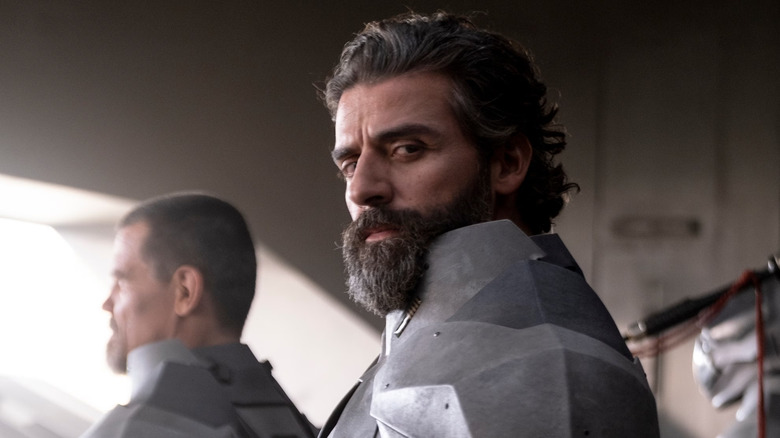
"Dune" centers on House Atreides. When the story starts, the family is led by Duke Leto I Atreides (Oscar Isaac), although he's bumped off pretty quick. From there, Paul Atreides (Timothée Chalamet) takes over leadership of the family in exile. He will be followed by his extremely long-lived son, Leto II Atreides (thanks to a disturbing crossover with the sandworms of Arrakis).
The backstory of the Atreides family goes back to our own history. This Great House claims descent from the legendary Atreus from Greek mythology. (He's the father of kings Agamemnon and Menelaus, both of whom figure prominently in Christopher Nolan's "The Odyssey.")
By the time of "Dune," the family has established itself as a powerful force in the Imperium, partly thanks to a blood connection to the Padishah Emperor Shaddam IV. The Atreides rule from the family's watery homeworld of Caladan. There, its patriarchal Dukes rule over millennia.
In a lot of ways, House Atreides is the Utopian portion of the "Dune" story. It isn't perfect, but before the whole mess following the move to Arrakis (where "Dune: Part One" starts), House Atreides oversees a prosperous, peaceful, and happy people. They balance wise leadership with a well-organized and trained military. Of course, all of this goes up in flames when Duke Leto I is lured into a spicy political trap on Arrakis to kick off the drama of "Dune: Part One," but up until that point, the fortunes of House Atreides are substantial, impressive, and quite literally rooted in the stuff of myth.
House Harkonnen's evils balance out the good of House Atreides
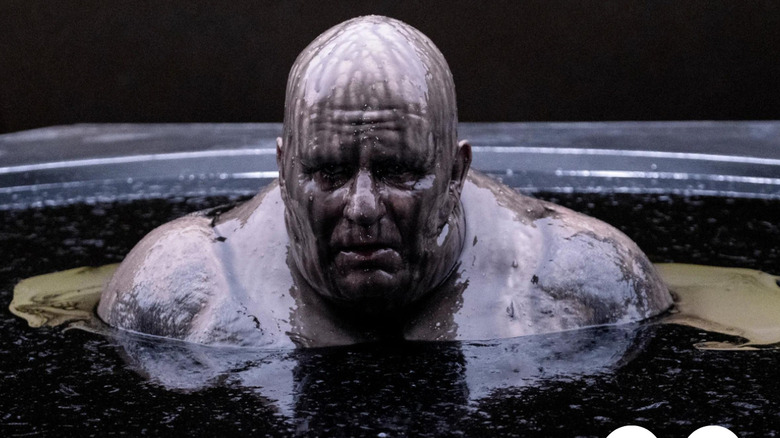
While House Atreides is the poster child for a healthy aristocratic government (for the most part — at least before we get to "Dune: Part Three"), House Harkonnen is the opposite. The family's homeworld of Giedi Prime is an industrial menace to the other houses — and its rulers are no better. The Harkonnens are infamous for their greed, violence, and brutality. They rule through fear and are known for their ability to hold a grudge — for a seriously long time.
The Harkonnens have less clear links to famous family trees in Earth history (or mythology). But the family connections are old, and they're believed to connect back to Scandinavian origins. The Harkonnen family remains a minor power for a long time, but through its relentless pursuit of economic wealth, it gains attention in the Landsraad (an important government body).
The angst between House Atreides and House Harkonnen that we see in the movies is more than a natural struggle for power. The two groups' hatred goes back thousands of years, to an important space encounter called the Battle of Corrin, where an Atreides family member accused a Harkonnen counterpart of cowardice. The event (and the banishment that follows) leads to a multi-millennia, galaxy-spanning feud between the two families that makes the infamous spat between the Hatfields and McCoys feel downright tame.
As a major House, the Harkonnens eventually gain control over Arrakis — and the spice mining operation it holds — in the decades leading up to "Dune." Right through the demise of their leader, Baron Vladimir Harkonnen (Stellan Skarsgård), they maintain ambitious hopes of gaining their revenge on the Atreides and eventually ruling their own empire.
House Corrino is a quiet but critical presence in the main Dune story

The Battle of Corrin wasn't just important. It marked a major defeat for a faction of thinking machines shortly after the end of the Butlerian Jihad (a long-running war against artificial intelligence long before the main "Dune" story timeline begins). Humans emerged from that struggle as victors. Their success marks the rise of House Corrino, a family that rules the Imperium for over 10,000 years. And if you saw the connection, it isn't a coincidence. The family gets its name from the Battle of Corrin, which itself is named after the planet where the fight takes place.
House Corrino is an interesting group in the "Dune" universe, compared to the other major and minor Houses. This is because it's already the top dog by the time the main "Dune" books start. From their position on top of the political pyramid, the leaders of House Corrino maintain peace and order across the Imperium via ruthless political and military tactics.
The most recognizable element keeping the Corrino Padishah emperors ruling from the Golden Lion Throne (named for the Corrino house's symbolic animal) are the brute force of the Sardaukar. This elite fighting force remains a powerful branch of the Emperor's military right into the "Dune" story, even if, in the end, they're no match for another faction: the Fremen.
The Fremen go from innocent bystanders to the engine of the Imperium
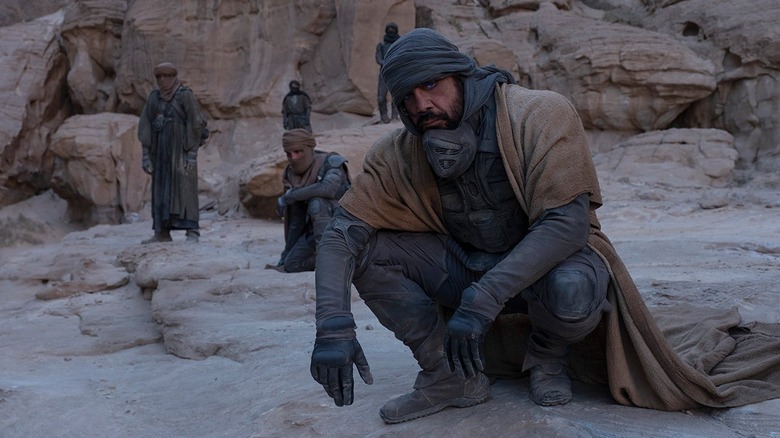
It's believed in the "Dune" universe that the backstory of the Fremen people starts with the Zensunni Wanderers. This persecuted religious group (which combines Islam with Zen Buddhism) moves from planet to planet seeking relief. Eventually, it's assumed that some of them ended up on Arrakis, planting the seeds of the Fremen culture that follows. While the Zensunni are ancient history by the time of "Dune," the Fremen culture is very much alive, despite — and often because of — the arid desert climate that they call home.
Once on Arrakis, Fremen culture understandably obsesses over survival. The group wears stillsuits to capture every drop of water and recycle it back into their bodies. Its people live in tribe-like enclaves scattered across the planet's surface, where they secretly collect water. They learn to thrive in their desert environment and even come to ride on the sandworms that threaten their very existence at every step.
On the surface, there isn't any obvious reason that the Fremen should get caught up in the galactic struggle between the Great Houses, the Emperor, and the Bene Gesserit. Or at least, that would be true if their home planet wasn't an important source of the spice melange. But that spice changes everything. It extends life, heightens awareness, and even unlocks prescience in certain people. Above all else, it's a money-maker. The unique byproduct of sandworms enables the Great Houses to engage in interstellar travel and is even used to buy parts of entire planets at certain points in the "Dune" story. The Fremen grow up in a world of spice (and bleak mysticism), and in the end, that's what brings Paul Atreides into their midst, becoming the conquerer foretold.
The Bene Gesserit are a force to be reckoned with

The Houses of Dune are complicated enough on their own. But this testosterone-driven part of the Imperium is quietly counterbalanced by yet another complex faction in the "Dune" universe: the Bene Gesserit. This female-led group maintains a powerful network of agents, primarily women, who move heaven and earth in the background of the much louder male-driven "Dune" universe.
The backstory of the Bene Gesserit is mysterious. There are hints that their roots may go back to ancient Mesopotamian cults, but their legacy becomes more clear in the wake of the Butlerian Jihad. As humanity adjusts to a universe without thinking machines, the members of the Sisterhood also extend their power, infiltrating the Great Houses and manipulating them from the shadows. From the early moments of "Dune," their influence is clear — and more than a little terrifying. The covert group is heavily involved everywhere. They mess with political power both directly and through their breeding program. They establish religious systems that can manipulate cultures and societies.
The Bene Gesserit maintain an aura of intimidation partly through the impeccable training of their members. The exclusive group is made up of a fierce Sisterhood with impressive power over their bodies and minds. They are led by strict Reverend Mothers, who guide the group with the fanaticism and intensity of a religious order. (It's no surprise that the term Bene Gesserit comes from Latin words meaning "she will have conducted herself well.") From selection to training, belief to behavior, this group operates like many of the most effective (and ruthless) shadow organizations in human history.
The Tleilaxu will be important in Dune: Part Three
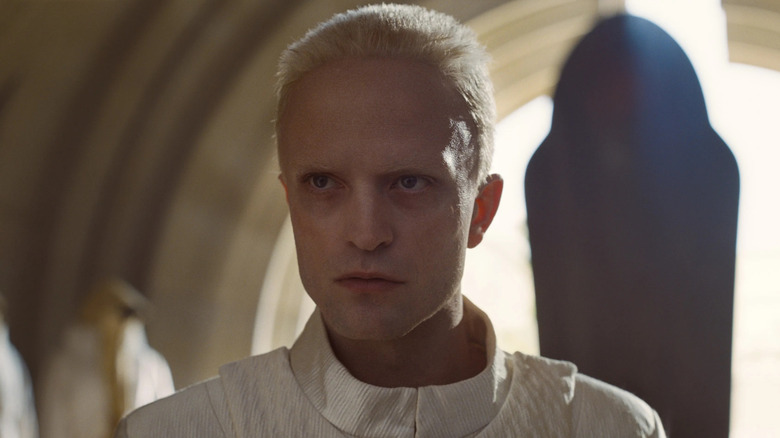
The disturbing Tleilaxu, or Bene Tleilax, are an isolationist group in the "Dune" universe. They aren't present in "Dune: Part One" or "Dune: Part Two," but they'll play a key role in "Dune: Part Three" through Hayt (Jason Momoa's new character). Hayt is a ghola, which author Frank Herbert described as "a being reconstructed from the dead flesh of the original." That's a gross description of cloning.
While gholas are unsettling on their own, their makers, the Tleilaxu, are worse. The Bene Tleilax love to manipulate genetics. Some of the Tleilaxu people are even called Face Dancers due to their genetic alterations, allowing them to mimic the appearance of others.
The money the Tleilax make through biological engineering gives them a huge degree of influence as a "necessary evil" amongst the Great Houses jockeying for power. This helps them to rise to a powerful position in the Imperium. While they rule multiple worlds, their homeworld is Tleilax. Their history also connects to Zensunni origins, like the Fremen.
However, by the time of "Dune," the group has a sinister reputation not for its religious beliefs but for its achievements in genetics. This creates a negative reputation for their entire people that is only reinforced by the trust that the Harkonnens put in them. While the Tleilaxu are side characters for much of the story (unless you dive deep into the post-Frank Herbert books), that doesn't mean they lack ambition. Along with the wealth they generate from recreating versions of dead people, they also harbor ambitions to rise up and dominate the universe.
There are many other Houses — and the Landsraad, too

The Atreides, Harkonnen, and Corrino family members tend to suck the air out of the room in "Dune." But there's a lot of space in the universe, and there are plenty of other smaller, comparatively less notable houses with plenty of power, wealth, and influence on the edges of the story. For instance, the members of House Fenring fill important roles across the Imperial court. Just to add to the confusion, this family isn't led by a Duke or a Baron. Their patriarch is a Count. They don't have a permanent homeworld, but they're closely connected to the Corrinos and their imperial power.
Then there's House Ginaz of the planet by the same name. They're friends of the Atreides, gifted swordmasters, and specifically allies with Duke Leto I. It's where swordmaster Duncan Idaho is trained (played in "Dune: Part One" by Jason Momoa — who will kind of come back in "Dune: Part Three").
House Moritani flexes its power from their homeworld of Grumman, where they scheme with the Emperors of Corrino and jockey for position with House Ginaz. House Richese provides much of the technology used across the Imperium. The list goes on. And these are the major Houses. There are plenty of minor Houses, too, and fortunately the films keep it trimmed.
Collectively, these factions create a counterweight to the influence of the Padishah Emperor through a political entity called the Landsraad. This ancient group is where trade agreements, negotiations, alliances, and other major deals take place on an interplanetary and intergalactic scale. The Landsraad becomes a critical guiding force in the Imperium, especially in the lead-up to "Dune" as the power of House Corrino becomes more fragile.
Economic factions are also a major factor in Dune
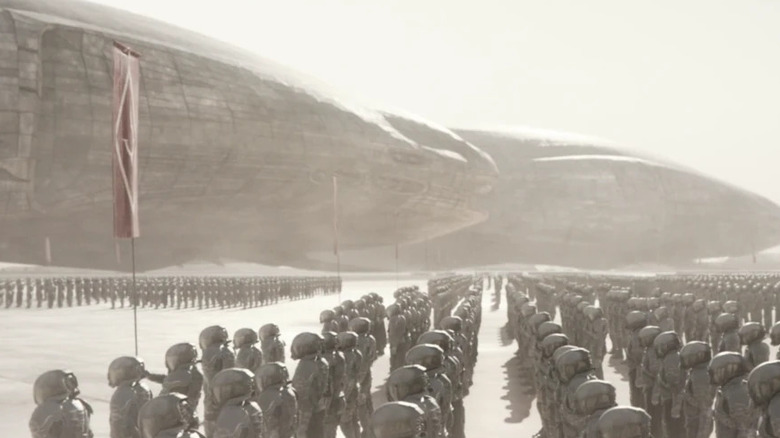
Finally, while not a specific House or group, there are multiple major organizations in "Dune" that have an outsized influence on the story — even if they couldn't get much screentime in Denis Villeneuve's movies. For instance, there's the Spacing Guild. This is a business conglomerate focused on shipping trade goods across the Corrino Empire. The need for a group capable of interstellar travel is essential after the removal of the more advanced thinking machines.
As a result, the Spacing Guild creates a secretive enclave of interstellar Guild Navigators capable of using the spice to gain advanced cognitive capabilities. This helps them find interplanetary paths of "folded space" without the need for AI-powered navigational computers. Naturally, this gives the guild a stranglehold on the economic flow of goods. That gives them a seat at the same table as the Great Houses and the Padishah Emperor himself.
Then, there's Combine Honnete Ober Advancer Mercantiles — "CHOAM" for short. The clunky acronym represents a terrifying economic superpower that has a monopoly on commerce across the Imperium. CHOAM is managed by a combination of the Emperor and the Landsraad, with both the Bene Gesserit and Spacing Guild wielding a degree of influence, as well. The sheer amount of wealth that travels through the organization automatically makes it a major player in the Imperium. The fact that it involves so many of the Great Houses and other groups puts it front and center throughout much of the story, even if that isn't obvious in the adaptation. Read the books for more, but don't be surprised if you have to take notes.