

The Complete History Of Dune's Sandworms Explained
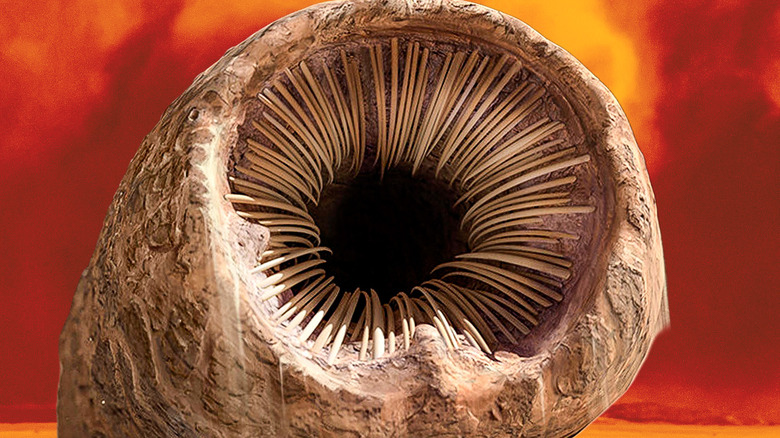
Denis Villeneuve's "Dune" movies are full of spectacle: There's political drama. There's futuristic choreographed fighting. There's plenty of trippy spice-induced behavior. There's full-on war. And then there are worms — really big worms — who haunt the sandy dunes of the planet Arrakis.
These are the biggest reveal of the movies. The slithering sand creatures don't show up in a significant way until the fading moments of the first film, but after a quick glimpse or two, they're unveiled in their full glory in the sequel.
While the sandworms of "Dune" play a critical role throughout Villeneuve's films and Frank Herbert's books, piecing together all of the details about them can be confusing. Where did these mammoth desert monsters come from? Why are they on Arrakis in the first place? How long do they live, and how do they repopulate and continue to impact the "Dune" universe over time? Let's look at the full backstory and future of the sandworms before, during, and after Paul Atreides uses them to rise to the heights of interstellar imperium.
Where do Dune's sandworms come from?

The ultimate origin of the sandworms is never made clear in the "Dune" books. Arrakis is their home world when we first meet them, but they aren't native to the planet. At some point, far in the past, the worms are brought to the planet, where they quickly start to thrive — and change — on their new home world, while altering the planet as well.
When sandworms initially arrive on Arrakis, they find a world with a lot more water (which is poisonous to them). However, due to their reproductive cycle, which we'll look at in a minute, the planet terraforms into an arid desert. This allows the sandworm population to take root and grow quickly. The worms establish themselves in huge quantities across the planet's surface, growing to enormous lengths (again, more on that in a minute) and becoming the defining biological life form that we meet in the first "Dune" book and film.
It's a disappointingly unclear origin story, but in the grand scheme of things, the lack of information about how they came to Arrakis or where they originated from only helps to shroud Shai-Hulud in even more mystery. It also sets up the other origin point worth discussing: the ongoing (and disturbing) reproductive cycle of the worms themselves.
Sandworm reproduction is a wild (and weird) process
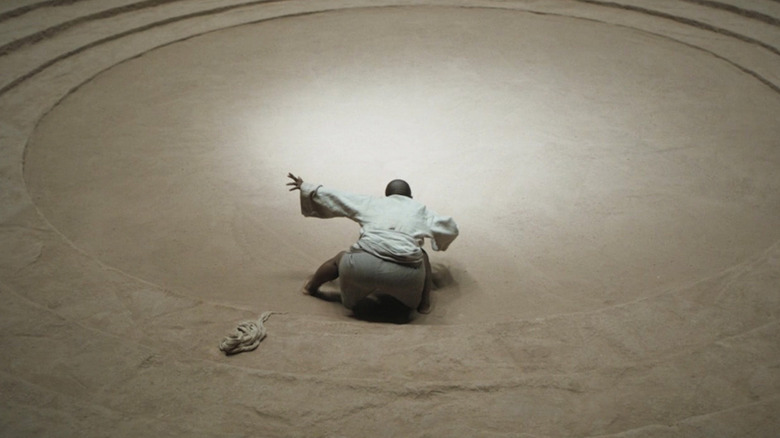
The "Dune" books have some strange and disturbing concepts. Everywhere you turn in the books, weird stuff is happening. One human even becomes a sandworm at one point — as we'll see. But throughout the "Dune" universe, there are few processes as strange and discomforting as the sandworm reproductive cycle.
First, it's important to realize that "sandworm" is the term for the adult version of the species. The huge, sand-swimming beings are full-grown versions of a process that starts with creatures smaller than a human hand. This progression begins with something called sand plankton. Over time, as they feed off traces of spice in the desert, these tiny beings develop into small creatures called sandtrout.
These are leathery and diamond-shaped, and unlike their larger companions, sandtrout are attracted to water. Of course, on Arrakis, water comes at a premium. That means they need to burrow for water far below the desert sands, and when they find it, they enclose the water in a cyst-like encasement. The sandtrout can link together, too, creating larger pockets of water in the process. (This is how Arrakis is turned from a more lush planet into a particularly barren desert over millennia before the "Dune" story begins.)
In the book "Children of Dune," Leto Atreides II points out that this encapsulation of water is literally a survival technique, saying, "Sandtrout encysted the available free water, made this a desert planet ... and they did it to survive. In a planet sufficiently dry, they could move to their sandworm phase."
Let's look at sandworm anatomy and features
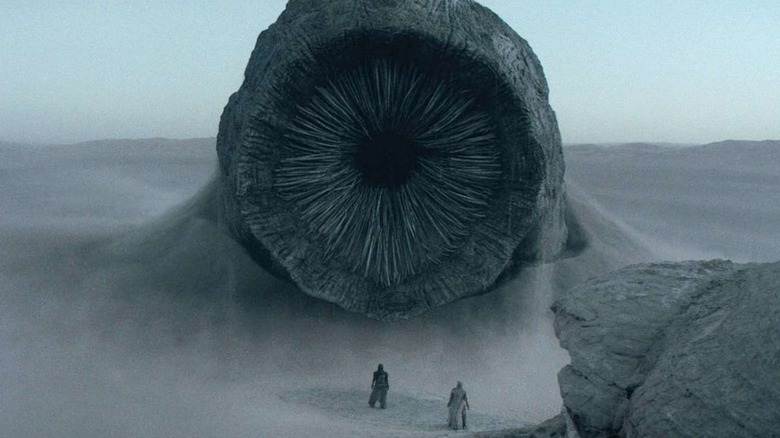
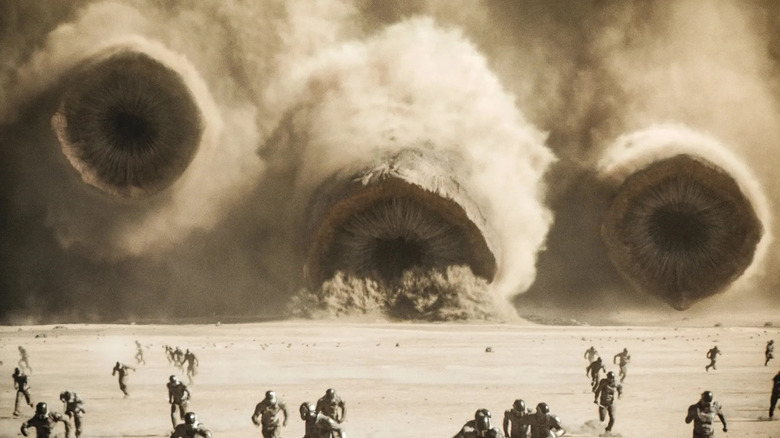
Before charting the later stages of sandworm history, let's run through a few facts about the adult version of the species that make them so unique in science fiction, starting with the most obvious one: size. Sandworms are absolutely gargantuan. They can get up to nearly 500 yards in length, and there are hints at even bigger specimens deeper in the unknown areas of the Arrakis desert.
While there isn't a ton of information about how and what they eat, it's clear that sandworms take in huge quantities of sand as they travel through the desert. Their actual nourishment comes from nutrient-rich foods like sand plankton (before it becomes a sandtrout), which is filtered from the masses of minerals. Think: a Blue Whale filtering the seawater to trap and digest tiny aquatic prey.
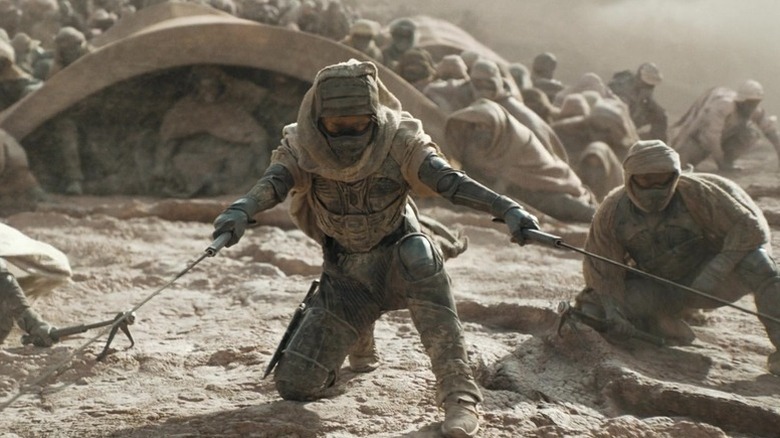
Sandworm moodiness is also infamously well-known. They can detect impressively small vibrations and rhythmic behavior from miles away, including footsteps, the activity of spice harvesting equipment, and the rumble of another worm. When that happens, their fiercely territorial nature takes over. They quickly investigate, often annihilating whatever it is that is in their personal desert bubble.
As for age, sandworms can live for a very long time. They don't have a known predator to curb their population and control of the planet. While they don't have a definitive lifespan, it's clear that they can live for hundreds and perhaps even thousands of years. This led to one of the most unnatural and extreme extensions of human life in science fiction (but again, more on that in a minute).
What is the sandworm connection to spice?

There isn't much to love about sandworms on the surface. They're moody, aggressive, and they destroy water sources, creating barren living environments. But they also are the source of one of the most precious commodities in the universe: melange. The spice can do a lot of different things. It shapes cultures, extends lifespans, gives visions of the future, and helps with space travel. Oh, and it can literally add flavor to food, too.
Here's the thing. Spice isn't easy to find. In fact, the only place you can get it (apart from a synthetic version of it that is eventually developed in the "Dune" books) is through the sandworms' reproductive cycle. Here's what that looks like.
Remember how the sandtrout are attracted to pockets of water under the desert surface? When that water combines with their own secretions, it creates a fungoid mass. It also releases gases, which eventually add up and explode into the upper desert surface. When the pre-spice mass reaches the sun and air, it transforms into melange, leaving deposits of spice on the desert surface.
This is what brings profit-hungry humans to Arrakis thousands of years before "Dune" starts: to harvest melange and use it to run the intergalactic economy. It also adds a much deeper sense of meaning behind the sandworms in the "Dune" story. Along with putting the spice itself in the spotlight, this changes the sandworms from a strange, grumpy phenomenon on a distant desert planet to a central source of imperial power. It also thrusts the people who occupy the land above the Old Man of the Desert into the political spotlight.
How the sandworms are positioned in Fremen culture
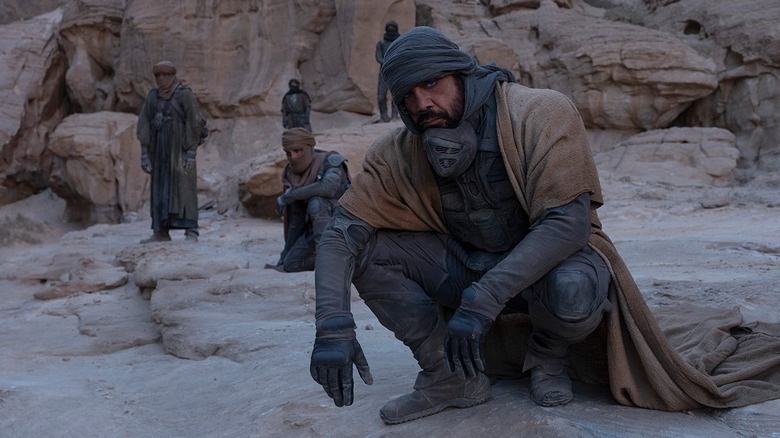
The Fremen are the native peoples of Arrakis. The backstory of the Fremen comes from real-world inspiration, drawn from a number of indigenous cultures on Earth. The Fremen in Frank Herbert's world live in pockets or enclaves across Arrakis. They are a deeply religious people, which is where their connection to the sandworms — or as the Fremen call them, Shai-Hulud — comes into play.
The Fremen see the sandworms as the "Great Maker." They are talked about as instruments of God, and many of their rituals revolve around worm-related concepts. For example, they give the sandworms names, like "Old Father Eternity" and "Grandfather of the Desert," indicating their deep reverence and respect for the organic beings that share the desert with their people.
The Fremen fixation on water mirrors the sandworms' aversion to it, as well as the sandtrouts' obsession with it. The Fremen are also deeply impacted by the spice produced by sandworms, right down to their eye color. They turn sandworm teeth into ceremonial knives, called crysknives, and riding sandworms is a profoundly meaningful and earned right within their communities. When Paul Atreides arrives on Arrakis and uses their warriors, riding on the backs of Shai-Hulud, to take over the planet, it ushers in an era of conquest — one that is deeply rooted in religion and ritual that centers on melange and its Maker.
The Fremen-powered war leads to the intergalactic rise of the sandworm
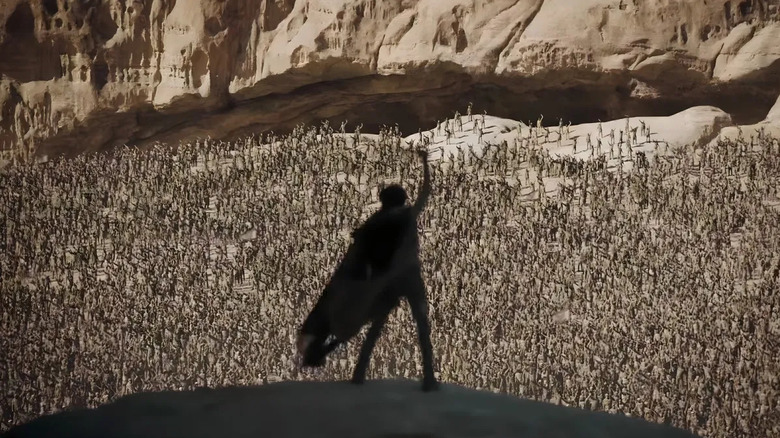
In the first "Dune" book (and the first and second films), Paul "Muad'Dib" Atreides turns out not to be the hero you think he is. While the story continues to largely be told through the perspective of Paul and his family, the rising leader quickly uses his Fremen-backed, spice-infused power base to spark a war of conquest. Muad'Dib's jihad lasts for a dozen years and is over by the time the book "Dune: Messiah" begins — although based on the trailers, "Dune: Part Three" will focus more heavily on this plot point, which took place between the first two books.
In that conflict, Paul's forces spread from planet to planet. Led by the Fremen, they kill tens of billions of people, sterilizing planets and wiping out resistance to the new religiously-laced power structure of Paul's imperial ambitions. And what is at the heart of that religious political movement? The sandworm and its spice.
The symbolism of the giant worms of Arrakis pushes them even further into the political spotlight. The creatures that were already economically critical become ideologically indispensable. They remain at the heart of the story throughout the second book and will doubtless be involved in the third film, even if it isn't in the same war-elephant capacity as "Dune: Part Two." But even when that part of the story wraps up, their biggest and most disturbing presence in the story is still yet to come.
The weirdest moment in sandworm history comes later in the series

It's no secret that Paul Atreides eventually dies in the "Dune" books (kind of), although that story is something we'll let Denis Villeneuve start to explain in "Dune: Part Three." While Paul is the figurehead for the rise of the sandworm in the "Dune" universe, it is he and Chani's son, Leto Atreides II, who is at the center of the most famous (and disturbing) episode in the history of sandworms.
In "Children of Dune," Leto II melds his body with sandtrout. His skin merges with the forming body of a sandworm, allowing him to make the horrific transformation from a prescient, spice-saturated human to the superpowered God Emperor of the universe. As a part-human, part-sandworm being, Leto II develops and grows over centuries, then millennia.
In the end, he rules in this grotesque, worm-like form for a staggering 3,500 years, as chronicled in the book "God Emperor of Dune." Leto II also lives through a time when Arrakis is being actively terraformed back to its lush, watery past. This was part of Paul's vision for the planet, and Leto II oversees the transition. But as the planet becomes greener, it threatens the worms' natural desert habitat. Leto himself even has to keep a desert reserved for his own arid requirements. He's eventually killed, but the event doesn't end the sandworms.
The sandworms' home habitat returns to its arid glory
While there is a lot of story we're skipping over here, we're focusing on sandworm history. After Leto II dies, his body comes in contact with water. It decomposes into sandtrout again, which doesn't end the sandworm species, but reboots it. The sandtrout begin the reproductive cycle again — and they start to reverse the terraforming that has made their ancient home world so hostile.
The result (in Frank Herbert's fifth book, "Heretics of Dune") is another 1,500 years of survival and, eventually, renewed prosperity for sandworms. The species returns Arrakis (which is called Rakis later in the series) to its bone-dry conditions. This gives them an ideal space to once again thrive, creating spice for centuries on end. As humanity spreads out from Arrakis again, the planet itself starts to look like it did at the beginning of "Dune."
However, thousands of years after Paul Atreides' rise, the conditions around Arrakis have changed. This far in the future, humanity doesn't need spice in the same way. Arrakis spice is no longer the sole way to navigate space travel, and the role of melange in the universal economy has lapsed. In the end, a group called the Honored Matres attack the ancient center of the spice's economic and political power.
The sandworm ending is tragic — but there's still hope for the species
When the Honored Matres attack Arrakis, they use a weapon from space to wipe out all biological life forms below. The result is so horrifyingly spectacular that entire portions of Arrakis are literally fused into glass. The blow is fatal to the sandworms and their habitat — with one exception.
A group of the famous Bene Gesserit, including a ghola (a being reconstructed from the dead flesh of an original person) of Paul's long-deceased mentor Duncan Idaho, escape the destruction with a great prize: a single surviving sandworm.
The group brings that adult worm to their home base planet, Chapterhouse. Once there, they successfully transplant the species into a new home. In the last "Dune" novel Frank Herbert wrote before his death, "Chapterhouse: Dune," the title planet begins the slow transformation into a desert world, reviving hope that the spice supply will continue and more planets may successfully be able to terraform into new Arrakis-like planets in the process.
So while known sandworm history wraps up with their home planet destroyed and the race all but extinguished, the species is actually poised for a potential comeback, which could leave it stronger and more expansive than ever before.