

5 Western Movies That Received A Perfect Rating From Roger Ebert
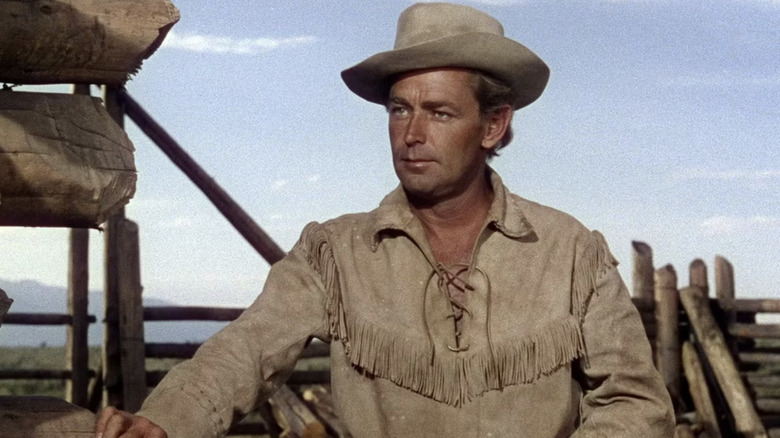
There are few names in film criticism as widely respected as Roger Ebert. The Chicago Sun-Times critic championed the movies for nearly five decades between 1967 and 2013 and often found himself enthralled (as we are) by the Western genre. Having reviewed over 100 different Westerns in his day, not every cowboy adventure earned a four-star rating (the highest on his scale) from the well-established motion picture connoisseur. However, those that did definitely deserve the spotlight — and we've decided to shine it in Ebert's honor.
From John Wayne classics and Clint Eastwood shoot-em-ups to lesser-known features and capable remakes, Ebert noted them all in his time analyzing film. Although Roger Ebert's official website catalogs over two dozen Westerns that Ebert awarded the coveted "perfect" rating to, we've selected only a handful to highlight here based on cultural importance and how beloved they are by this author. Of course, given the wealth of Western movies Ebert offered a 4/4 score to, it would be a shame if we didn't highlight some of the best runners-up.
The critic also held in high esteem: John Ford's "The Man Who Shot Liberty Valance" and "Stagecoach," Nicholas Ray's "Johnny Guitar," Sam Peckinpah's "The Wild Bunch," Howard Hawks' "Red River," Kevin Costner's "Dances with Wolves," and, upon a second assessment, Sergio Leone's "The Good, the Bad and the Ugly." So, with those fine pictures out of the way, here are five of the best Westerns that Ebert couldn't get enough of.
3:10 to Yuma
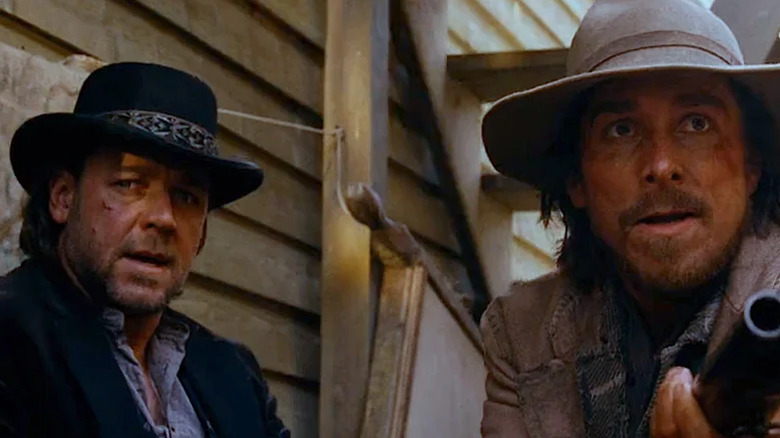
Remakes are hard, and those who love the original will likely struggle to see the merits in the do-over. While there are plenty of Western remakes that surpass the original, this was not often the case in Roger Ebert's eyes. Case in point, though he gave the original "True Grit" four stars, he couldn't do the same for the Coen Brothers' version decades later. However, when it came to James Mangold's re-imagining of "3:10 to Yuma," the Windy City critic was over the moon.
In Ebert's review, he praised the picture for the way it "restores the wounded heart of the Western and rescues it from the morass of pointless violence." Rather than lean into all the blood-and-guts as many Revisionist Westerns do, "3:10 to Yuma" is a battle of morals between rancher Dan Evans (Christian Bale) and outlaw Ben Wade (Russell Crowe). Indeed, the critic asserts that the reason Mangold's take exceeds the 1957 original is due to the performances of these leading men, who "play this dialogue so precisely that it never reveals itself for what it really is, a testing of mutual insight."
Of course, Ebert isn't the only one who adores "3:10 to Yuma." The film has been widely celebrated by audiences and other critics alike, and is ofter considered among the best Western remakes for good reason. A breathtaking morality play in the spirit of the classic Westerns of the '50s and '60s, this action-packed Old West romp is a notable picture indeed, and certainly among the best Westerns of the 21st century.
Rio Bravo
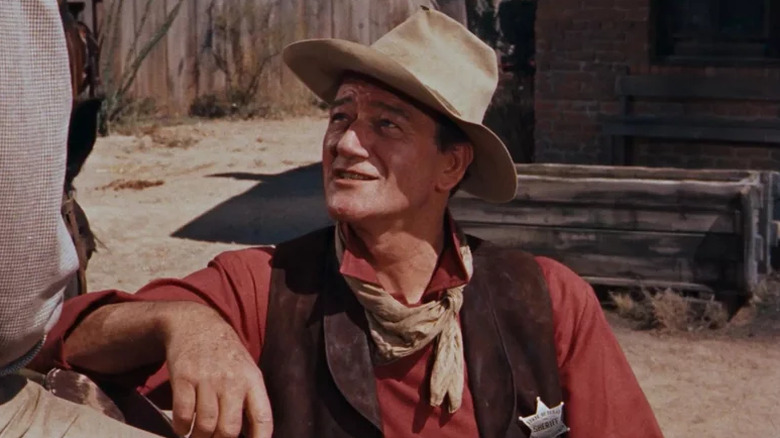
As one of the most important directors in 20th century filmmaking, it doesn't come as a surprise that Roger Ebert would award Howard Hawks a perfect score for a picture like "Rio Bravo." For one thing, this John Wayne Western is impeccable. The pair made the film because neither of them liked "High Noon" and its parable of Hollywood blacklisting, and they wanted to tell a similar story that pushed their more traditional view of the mythic American West. Ebert didn't care for "High Noon" either, and so it's no surprise he adored "Rio Bravo."
"To watch 'Rio Bravo' is to see a master craftsman at work," Ebert recalled in his 2009 review. "The film is seamless. There is not a shot that is wrong. It is uncommonly absorbing, and the 141-minute running time flows past like running water." He's right, of course. Between the performances of Dean Martin, Ricky Nelson, Walter Brennan, Angie Dickinson, and the Duke himself, "Rio Bravo" simply flies by. It's a phenomenal Western that perfectly captures the independent and self-reliant spirit of the "American Way" the way only Hawks and Wayne knew how.
Penned by the screenwriting duo of Jules Furthman and Leigh Brackett, who worked frequently with Hawks (most notably on "The Big Sleep"), "Rio Bravo" boasts a handful of truly dynamic characters who carry the film to its natural (and explosive) conclusion. Wayne, in particular, is a knockout, delivering one of his most important performances on camera. It's easily one of the most rewatchable Westerns out there.
Shane
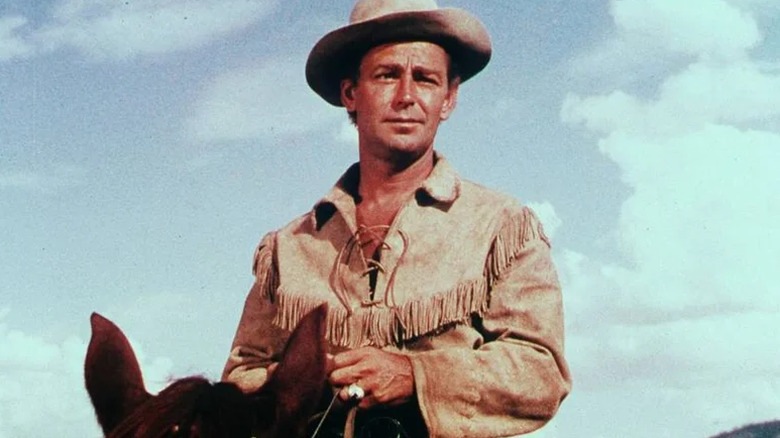
Although many younger audiences no doubt recognize "Shane" due to its appearance (and importance) in James Mangold's "Logan," the classic Western has been considered the quintessential horse opera for some time. It comes as no surprise, then, that Roger Ebert's 2000 review of the film confirms this as the critic unravels layers of narrative depth that many have likely glossed over. Alan Ladd's titular gunfighter is not just a traditional Western hero; he's a complicated individual who wrestles with his own wants and desires.
According to Ebert, Shane is a man who is best understood as not simply a lone rider wandering into a Johnson County War-style conflict, but as a repressed man wrestling with his own sins, namely his desire for the married Marion Starrett (Jean Arthur). Of course, our Western hero doesn't fall prey to his impulses, which is part of why we're so magnetically drawn to him. "It's not that a greater truth lurks in the depths of George Stevens' 'Shane'," Ebert asserts. "It's that all of these levels coexist, making the movie more complex than a simple morality play."
"Shane" is a delight that concludes with a powerful Western-flavored shootout. The result is that Shane cannot remain in the Wyoming Territory — though not only for the reason you think. As Ebert puts it, "He can't stay, not simply because he has been 'branded' by a killing, but because there is no acceptable resolution for his feelings for Marion." Thus, "Shane" is counted among the most important Westerns ever made — it's no wonder Clint Eastwood's soft remake, "Pale Rider," would also be so beloved by Ebert.
Unforgiven
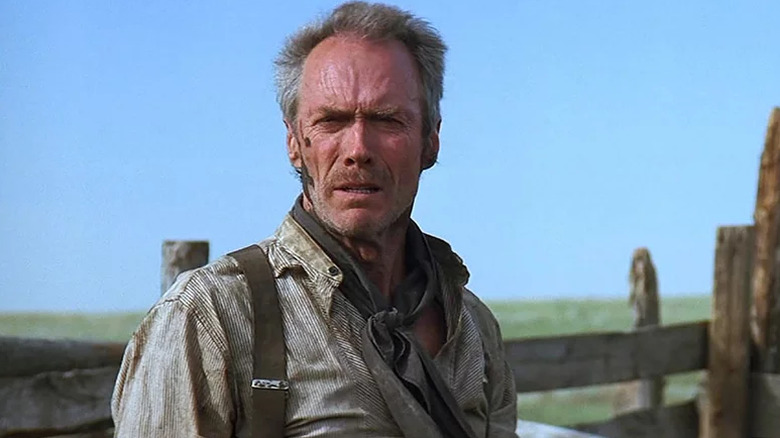
Speaking of Clint Eastwood, Roger Ebert was, like many of us, also quite impressed with his Western send-off picture "Unforgiven." Although one might debate which flick ought to be counted the most important or influential of Eastwood's Old West escapades (many would likely cite "The Good, the Bad and the Ugly"), "Unforgiven" is one of only a small handful of Westerns to ever win Best Picture at the Oscars, and that's got to count for something. According to Ebert, the honor was well-deserved.
In his 2002 review, Ebert sings the praises of Eastwood's exceptional work here. Not just in his performance as former outlaw William Munny, a man who returns to his gun as a means to provide for his young children, but in the way he, as a filmmaker, eulogizes the genre as a means of honoring the directors who made his career: Sergio Leone and Don Siegel. "The film reflects a passing era even in its visual style," the critic rightly notes upon reflecting on Eastwood's choice of the 1880s setting.
Of course, Ebert deduces the film's ultimate appeal. In his view, "Unforgiven" offers "that implacable moral balance, in which good eventually silences evil, [that] is at the heart of the Western, and Eastwood is not shy about saying so." As arguably the biggest Clint Eastwood movie of them all, "Unforgiven" was not only the actor-director's farewell to the genre, but a perfect cap on the 20th century Western canon.
The Searchers
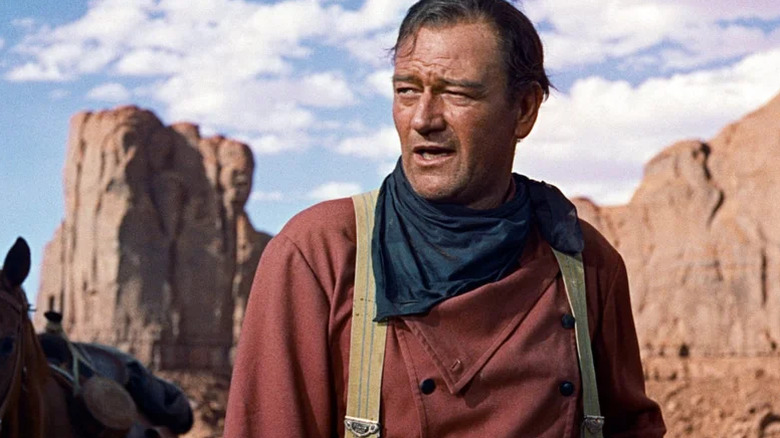
There is perhaps no Western as important or grand as "The Searchers." Though Roger Ebert would award a handful of John Ford pictures that coveted four-star rating — including "Stagecoach," "My Darling Clementine," and "The Man Who Shot Liberty Valance" — it's this 1956 film that stands tallest over all. The Duke is at his absolute best here as Ethan Edward, a grizzled Civil War vet who searches obsessively for his missing niece, stolen by Comanches. It's a powerhouse of a Western, one that doesn't pull its punches and maintains Ford's trademark Old Hollywood style firmly intact.
Yet, although Ford leans into those more traditional genre sensibilities, we see strands of revisionism beginning to form as the old Western myths are infused with a more complicated subtext. "We can see Ford, Wayne and the Western itself, awkwardly learning that a man who hates Indians can no longer be an uncomplicated hero," Ebert observed in his 2001 review. Still, "The Searchers" helped reinvent the genre, and has since been included on AFI's list of Top 10 Westerns. One need only revisit the picture to understand why.
"John Ford's 'The Searchers' contains scenes of magnificence, and one of John Wayne's best performances," Ebert notes. "There are shots that are astonishingly beautiful." The undeniably breathtaking film, masterfully painted with sprawling wide shots of Monument Valley, may boast a complicated (and somewhat mysterious) stance on racial prejudice, but that ambiguity only speaks to the myth of the Old West. "The Searchers" is simply astonishing, and Ebert was right on the money with his rating.