

5 Best War Movies Of The 21st Century, Ranked

The war movie is a bizarre cinematic realm. On its face, this genre helps audiences process global conflicts that tragically litter every corner of history. In execution, though, many take a surface-level approach to their real world events, more interested in hagiography, shallow action movie impulses, and regurgitating what audiences have already seen. However, not all war movies are destined to become derivative and politically icky.
Throughout history, motion pictures, especially ones hailing from international communities, have taken the war movie mold, twisted it around, and delivered harrowing films like "Come and See," "The Burmese Harp," and work of Miklós Jancsó. These are the pinnacle of the war movie, a bar many modern features have struggled to reach. However, that doesn't mean all 21st century war movies fail to escape the shadows of these projects. The five best war movies of the 21st century (ranked below from "least best" to best) demonstrate the array of styles and thematic ambitions this cinematic space can house. Not every modern war movie need be as empty as Michael Bay's "Pearl Harbor."
These war movies provide a glimpse into the grueling corners of history that should never be forgotten. That's yet another of the countless exceptional facets that reflect how war movies, despite the many artistic misfires in this space, can be phenomenal.
5. Palestine 36
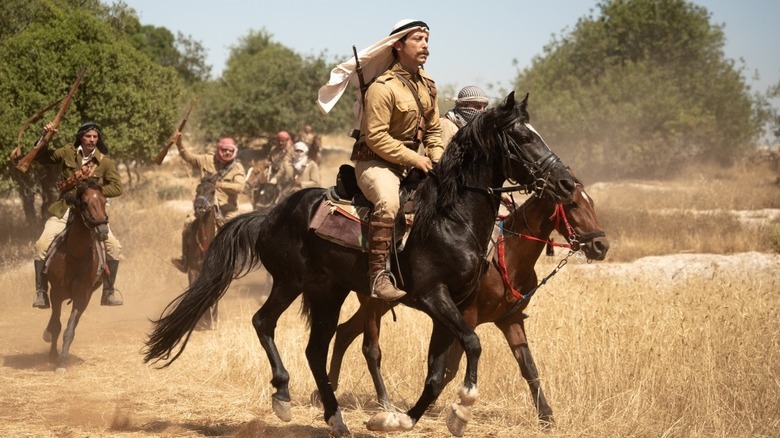
The year is 1936. British colonists rule over Palestinian territory. As the British rulers begin ramping up already brutal treatment of the land's indigenous population, a multi-year revolt unfolds between Palestinians and the Brits trying to maintain their grip on the territory. Among those fighting against the colonizers is Yusuf Bassawi (Karim Daoud Anaya), an everyday citizen who becomes a loyal rebel by the end. Also factoring into the film's ensemble are Father Boulous (Jalal Altawil), Khuloud Atef (Yasmine Al Massri), and an especially striking turn from Yafa Bakri as Rabab.
"Palestine 36" is an ensemble feature eschewing a solitary perspective on the 1936-1939 Great Palestinian Revolt. War doesn't just affect one person. It has an enormous ripple effect stretching across countless communities and even factions of history. Thus, writer/director Annemarie Jacir applies an expansive scope to "Palestine 36" that taps into this unavoidable reality. This storytelling approach also allows for a bevy of great performances to materialize. Furthermore, Jacir does strong work establishing the tremendous power of British colonizers that the various forms of Palestinian rebellion in "Palestine 36," from soldiers fighting with guns to women occupying office.
The dire costs and stakes of colonialism are palpable throughout "Palestine 36." That distinct urgency and verve propels this movie to a unique place amongst 21st century war movies.
4. Letters from Iwo Jima
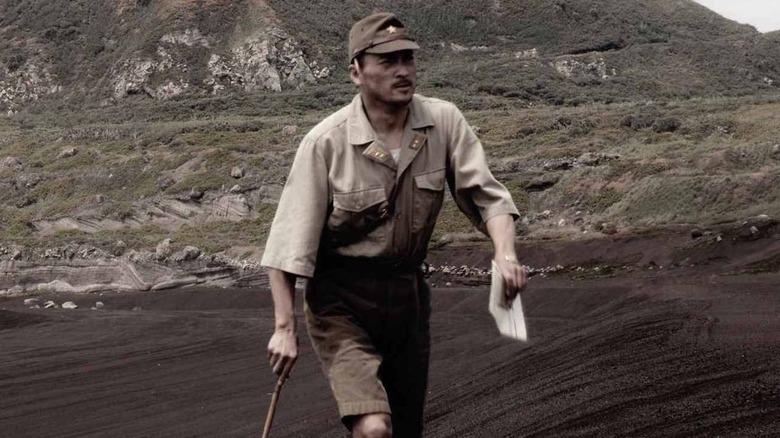
Nobody watching the best Clint Eastwood Westerns during their initial releases could've ever imagined he'd eventually direct anything as shattering as the most haunting sequence in 2006's "Letters from Iwo Jima." This feature, which follows Japanese soldiers during 1945's Battle of Iwo Jima, includes a sequence where a group of soldiers, standing around a wounded American soldier they've taken in, read a letter that the "enemy fighter" treasured. It's a letter from his mom, which includes lines like "Remember what I said to you: always do what's right because it is right."
In this quiet sequence, the Japanese fighters see themselves in this American man. He was also a person with family, vulnerabilities, and a life beyond the battlefield. It's an aching and shatteringly realized sequence reflecting the intimate humanity defining "Letters from Iwo Jima." Rather than reducing figures like General Tadamichi Kuribayashi (Ken Watanabe) to caricatures, Eastwood and co-writer Iris Yamashita render them as complex human beings. Figures like Private First Class Saigo (Kazunari Ninomiya) are just trying to survive one minute to the next rather than transform into "legends."
A flashback showing Saigo forcibly torn away from his family when he's conscripted into the war epitomizes the film's aching tragedy. Who could these men have been if not for this war? Who knew Clint Eastwood had such a contemplative movie in him?
3. A Hidden Life
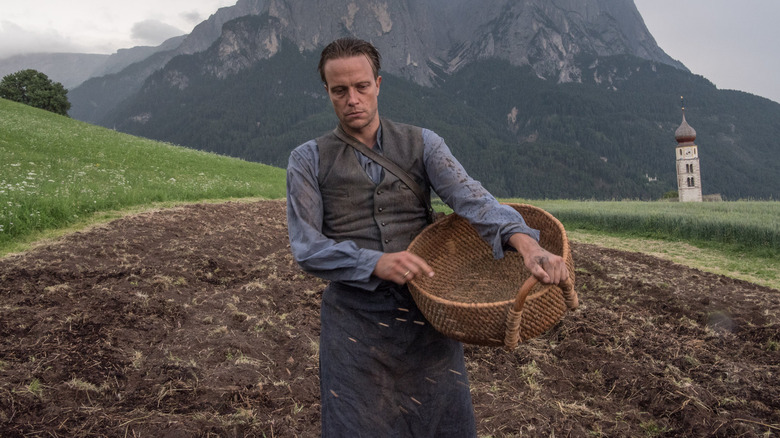
The Nazis' sole focus was destruction. These fascists dedicated themselves to an ideology focused on slaughtering Jewish people, communists, LGBTQIA+ souls, trade unionists, Romani individuals, and countless other marginalized communities. They also saw the natural world as something to be conquered for disturbing Aryan means. Terrence Malick's majestic filmmaking provides a perfect counterpoint to these dehumanizing, genocidal, and conquest-oriented mindsets. In 2019's "A Hidden Life," specifically, beautiful grasslands, towering mountains, and glorious clouds are rendered with love.
These luscious images service Malick's telling of the true story of Franz Jägerstätter (August Diehl), an Austrian farmer who refuses to fight and ally himself with Adolf Hitler. The sequences typically making up war movies are miles away from "A Hidden Life." Instead, Malick chronicles a man at war with the larger world imploring him to succumb to fascism. Malick and cinematographer Jörg Widmer imbue the proceedings with a cavalcade of expansive, beautiful imagery emphasizing the larger natural world. Meanwhile, the depiction of Jägerstätter constantly refusing to compromise his values achingly captures how rebellion can materialize in the quietest terms.
In an era of genocide and dehumanization, "A Hidden Life" follows one ordinary soul who clung to humanity. Terrence Malick movies famously take forever to make. In the case of "A Hidden Life," though, all that time was well worth it.
2. Inglourious Basterds
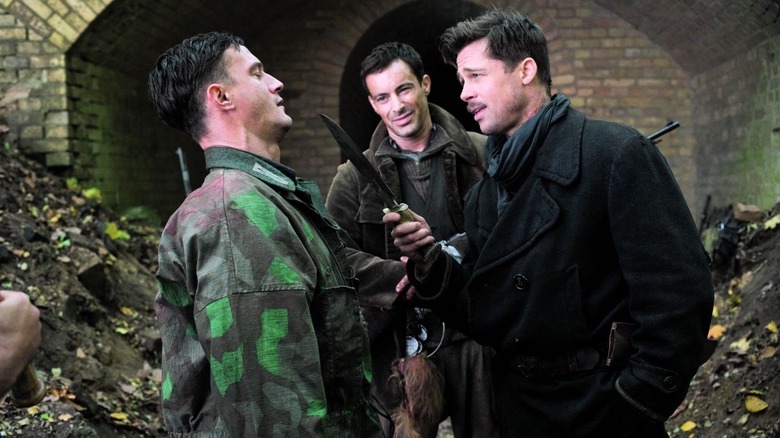
"You haven't seen war until you've seen it through the eyes of Quentin Tarantino." So proclaimed the first teaser trailer for "Inglourious Basterds." This piece of marketing implied that Tarantino's penchant for extreme violence would produce a war movie grislier than anything audiences had seen before. While "Inglourious Basterds" certainly had some gnarly imagery, Tarantino's distinctive approach manifests in more creative ways throughout the final film, from his many tense extended sequences to his juggling of various lead character perspectives.
All of these unique qualities informed a truly extraordinary project. Mélanie Laurent's incredible performance as Shosanna Dreyfus alone would be enough to ensure "Inglourious Basterds" a place on this list. However, "Basterds" somehow offers up even more. Tarantino's command of tone, for one thing, is impressive, as he deftly balances hysterical jokes involving Lt. Aldo Raine's (Brad Pitt) heightened Southern accent mangling Italian without ever diluting the horrors of the Nazis. Furthermore, editor Sally Menke (in her final collaboration with Tarantino) delivers career-best work through "Basterds" handling the transitions between the assorted storylines.
Plus, "Basterds" sends audiences home with one of the most satisfying movie endings ever. When ranking either war movies or Quentin Tarantino films from worst to best, it's impossible not to put "Inglourious Basterds" in a lofty position.
1. Quo Vadis, Aida?
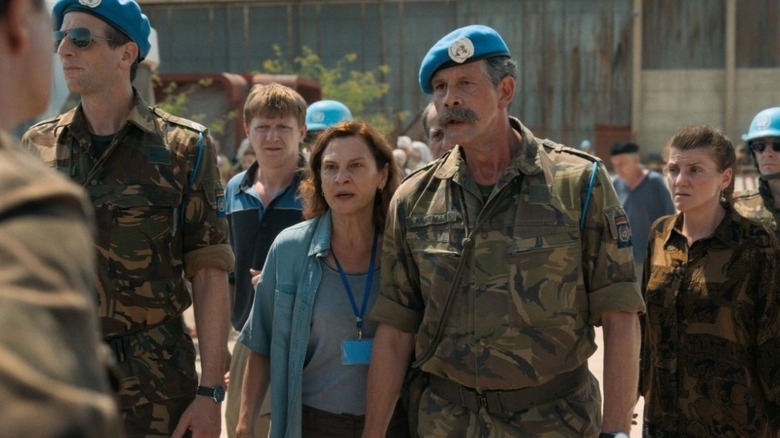
The Bosnian War isn't often touched upon in American textbooks. This is despite it encompassing key historical events like the July 1995 Srebrenica massacre, which had a death total of 8,000+ men. While many live in ignorance of the event happening, countless individuals whose lives were impacted and loved ones slain during this genocide cannot escape the realities of the Srebrenica massacre. Bosnian writer/director Jasmila Žbanić created a cinematic witness to these unspeakable atrocities with her 2020 feature "Quo Vadis, Aida?," which followed United Nation translator Aida Selmanagić (Jasna Đuričić) trying to save her husband and sons from impending enemy slaughter.
Žbanić and cinematographer Christine A. Maier don't fill up every inch of "Quo Vadis, Aida?" with Srebrenican bodies writhing in pain. Nor do they fill it with the explosive imagery most associate with war movies. The focus is instead on people scrambling to safety as enemy forces approach. Žbanić's intimate scope forces audiences to contend with the vivid humanity and desire to live from people that genocidal forces tried wiping out. These visual priorities inform a captivating production rich with filmmaking accomplishments and anchored by Jasna Đuričić's outstandingly haunting performance as Aida.
Her work should become synonymous with movie performances that are practically flawless. It's absolutely no wonder "Quo Vadis, Aida?" is considered one of the best movies of the 2020s so far on Metacritic. It's an extraordinary achievement, regardless of genre.