

5 Most Rewatchable Netflix Original Movies, Ranked
Netflix has released tons of data about the number of views its movies and series get, and the hours subscribers have clocked watching them. However, the streaming service plays coy when it comes revealing which titles have been rewatched the most, meaning nerds like us have to read the tea leaves through the data. "Red Notice" is the second most-streamed movie on the platform, with 230.9 million views; but with 454.2 million hours watched despite a two-hour runtime, an alarming number of people must have turned it off midway through. The third place "Carry-On" has a surprisingly even 172.1 million views and 344.1 million hours logged, which appears to signal that viewers happily sat through the 119-minute movie in its entirety.
But it's a little more complicated than that, as Netflix has only recently begun to drip-feed more expansive streaming data for older titles, which was previously limited to the first 91 days of release. This means that, even when assessing the disparity between the two figures, choosing the films for this ranking still mostly comes down to measuring their enduring cultural impact (which we're counting as the number of user ratings on Letterboxd, IMDb, and Rotten Tomatoes, and whether they are still getting high daily logs or reviews). After deducing those five titles, then it's a simple case of ranking and determining which is the film which rewards the most repeat streams from that crop.
The following films aren't the five most streamed Netflix originals of all time, but the five which the slim available data we have (which drastically varies based on release date) suggests viewers had already begun revisiting within their original release window. Until we're given more thorough stats, then these are what we believe have been the five most rewatchable Netflix original movies based on their success straight out of the gate, ranked worst to best.
5. Don't Look Up
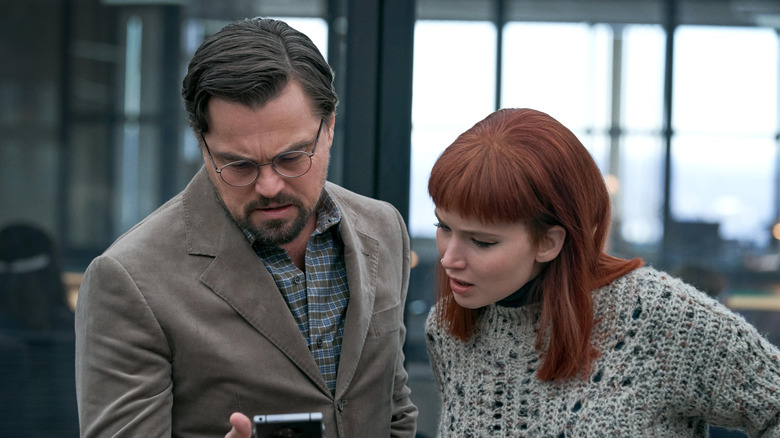
Netflix has had several movies nominated for Best Picture at the Academy Awards, with widespread acclaim for the likes of "The Irishman," "Marriage Story," and "Roma." The only one that managed to bag both the major nomination and forge a place for itself in their all-time most viewed charts is also, unfortunately, only the second film with a "Rotten" rating on Rotten Tomatoes in 50 years that still somehow managed to win over Oscar voters in that big category. Director Adam McKay's dark comic political satire "Don't Look Up" captured attention for its nihilistic climate change allegory, with a bleak disaster movie finale that refused to play things safe despite the mega-budget and one of the most A-list ensembles ever assembled. Unfortunately, despite the urgency and relevancy of the political commentary — which is addressed with a boldness generally lacking in other major studio fare — it leaves a sour taste due to the condescending approach it takes tackling it, smugly looking down at an audience it considers itself smarter than.
With broad comic performances from a variety of major stars and apocalyptic stakes which resemble the cracked mirror image of a Roland Emmerich action movie, it's easy to understand why such an unpleasant dark comedy has remained so rewatchable. Released during the Omicron wave of the COVID pandemic, it also struck a chord for satirizing the denial of science that jeopardized the vaccine rollout, a theme that has sadly remained relevant in the five years since. With that in mind, it's no surprise that fans have returned to it; if you're on its political wavelength, no other big budget, star-driven Hollywood production has dared to address its topical themes this starkly.
4. Bird Box
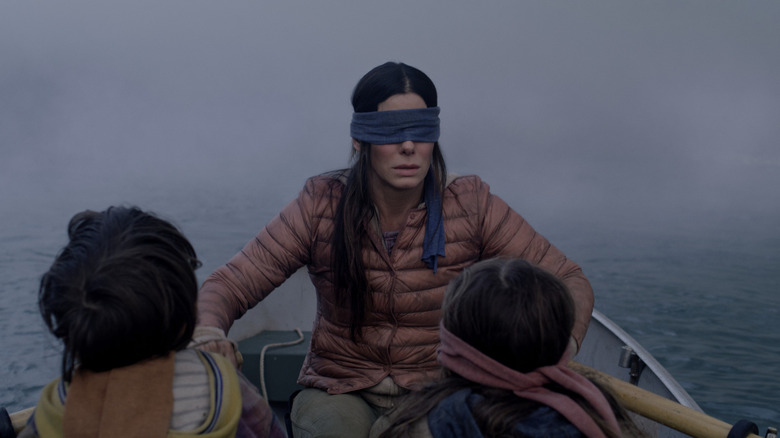
During its first few years of film production, Netflix was more fixated with chasing Oscars than making its own blockbusters. However, it was a prestige genre movie that misfired with critics which wound up capturing the zeitgeist more than any of its widely acclaimed award hopefuls. The dystopian horror "Bird Box" arrived at the tail end of a year where "A Quiet Place" became an original box office success, and its premise — people must remain blindfolded to survive, due to an invasion of aliens that makes them kill themselves if they look at it — appeared like producers had cynically swapped one sense out for another, even though it was based on a novel that predated John Krasinski's film. Instead, largely thanks to the star power of Sandra Bullock, this bleak, supernatural scare-fest became the streamer's most successful movie of all time over the 2018 festive period, even inspiring a viral social media challenge where people took part in increasingly dangerous challenges while blindfolded. Nothing says success quite like Netflix having to intervene because people kept going to hospital after taking part.
The film's simple premise and mainstream-friendly scares are likely what have made it so rewatchable for more casual horror fans looking for something dark, but not too dark. For us, it never quite finds the right tone that could get under our skin, with devastating set pieces sitting awkwardly next to ones that lean towards supernatural silliness. However, with its simple, easily digestible premise and huge A-list lead, it's easy to see why "Bird Box" became such an unprecedented water cooler movie for Netflix. Hopefully, it acted as a gateway to even darker horror for the casual audiences who stumbled upon it.
3. Leave the World Behind
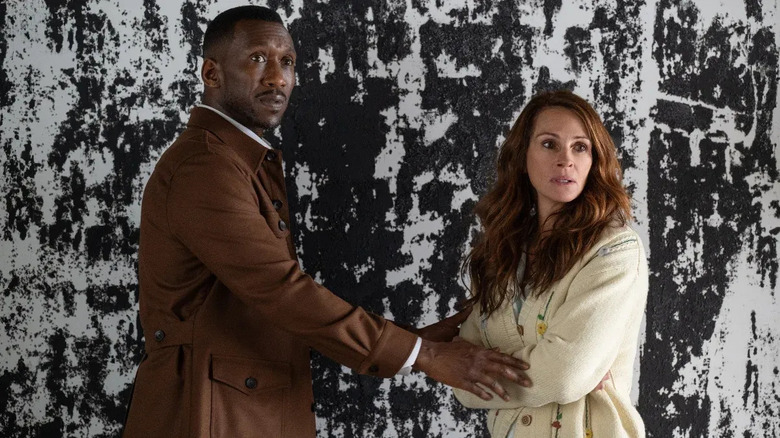
Intense survival movies, particularly those set in a post-apocalypse, are catnip for Netflix viewers, which is largely why this surreal tale of societal breakdown from "Mr. Robot" creator Sam Esmail has one of the platform's highest rewatch rates. 143.4 million people have viewed the movie, but 339.3 million hours have been clocked overall, which — even with the 138-minute runtime factored in — still points to a surprisingly healthy number of repeat visits for a movie that generally wasn't warmly received. "Leave the World Behind" is an odd, offbeat tale of a family adjusting to a technology blackout, a cousin to M. Night Shyamalan's "The Happening" that even its stellar cast (led by Julia Roberts, Mahershala Ali, and Ethan Hawke) couldn't find the plausible emotion in.
With that being said, it's the kind of challenging, divisive success that's far easier to get behind than the two previous films on this list; a streaming movie that actually wants to provoke conversation (and succeeded) rather than settle for being background noise. This explains why it simultaneously has a disproportionately high hours watched count — the passionate cult who were intrigued by its mystery wanted repeat viewings to dig deeper — and a stinky 36% audience score on Rotten Tomatoes. It begins with destructive action set pieces to hook an audience in but never neatly answers all of the questions it poses, even likely to irritate most viewers with the dumb joke it ends on. However, even if it's not to everybody's tastes, it's hard to dismiss a movie of this size that's such a big swing, refusing to play it safe as it avoids disaster movie conventions like the plague. A movie this bold getting an audience this big is something to cheer about.
2. KPop Demon Hunters
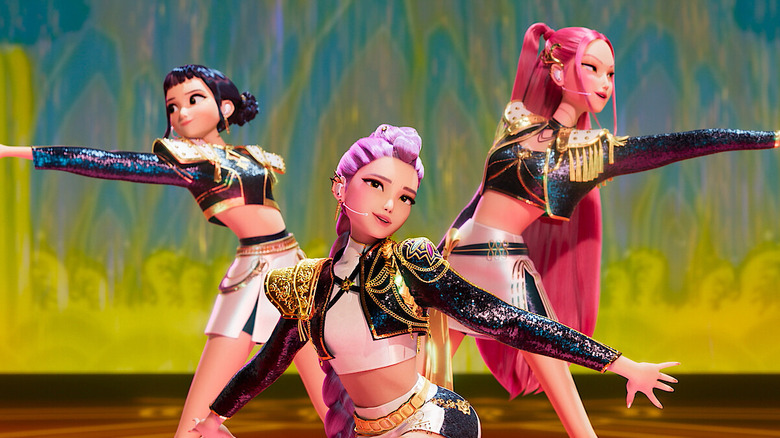
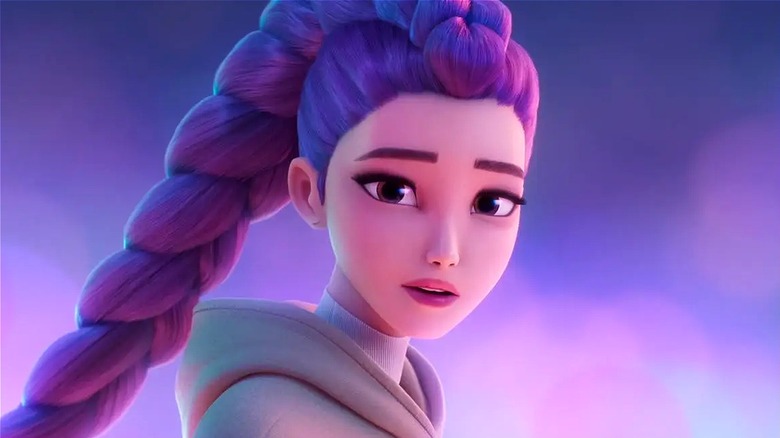
You don't even need the facts and figures to be reminded of how much of a sensation "KPop Demon Hunters" has been, but we'll tell you anyway. Viewers have spent 541.8 million hours total watching it, which is nearly 100 million more than its closest rival ("Red Notice" with 454.2 million). It is also still in the weekly top 10 a full year after release. Released with no fanfare in June 2025, the fantasy-musical became an organic word-of-mouth sensation that ended the summer with a theatrical release thanks to overwhelming fan demand. It even topped the box office despite being available at home. It's not difficult to understand why young audiences were so enamored with it. Thanks to richly detailed 3D animation which combines the influences of "Spider-Verse" with expressive 2D anime and music videos, an infectiously catchy soundtrack, and a string of inventive action sequences, "KPop Demon Hunters" is more vibrant and colorful than many recent theatrical family films.
For older audiences, it has had just as much staying power, riding a similar wave all the way to the Oscars, where it took home the Best Animated Feature and Best Original Song prizes. This wasn't just due to the intergenerational fascination with K-Pop as a genre; as similar to the surprise wide appeal of "Frozen," it struck a chord as it told an empowering story of a princess (in this case, a pop princess, not a literal one) finding strength in her own imperfections, inviting audiences to find themselves in an impossibly glamorous and otherworldly archetype. Like the best Disney movies, it is unashamedly corny and sentimental, and we mean that as a positive. That is exactly why it has resonated across continents and age groups, proving there's no need to water down quirks and specificities of characters for universal appeal.
1. Glass Onion: A Knives Out Mystery
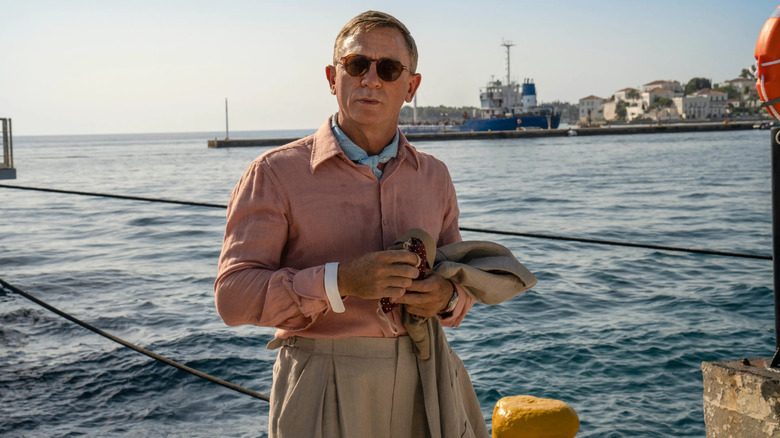
The only film not in the top 10 most watched Netflix films of all time by views that has made it into the top 10 based on hours watched, Rian Johnson's "Knives Out" sequel is the funniest of his murder mystery trilogy, with the joke-dense screenplay and tightly constructed plot rewarding multiple sittings. "Glass Onion" is also aided by being the one movie in the series to position Daniel Craig's eccentric Benoit Blanc as its audience surrogate character, with the gentleman detective repositioned as a fish out of water around a tech billionaire (Edward Norton's Miles Bron) and his inner circle who despise him. Arriving around the same time that a wave of satirical "eat the rich" comedies (such as "The Menu" and "Triangle of Sadness") landed in theaters, "Glass Onion" had the strongest cultural afterlife as it most directly flipped a middle finger at the likes of Elon Musk through Norton's dislikable dimwit, parodying his brand of brainless tech bro a couple of years before he was making headlines for his destructive political operations.
With the first "Knives Out" being a box office hit, the two sequels (which Netflix bought the rights to for approximately $400 million) were always going to be major events, but this second whodunnit arrived at the perfect time to meet the cultural moment. Musk's purchase of Twitter was still imminent as it premiered, which helped a film set during the first COVID lockdown feel more relevant than it had any right to, poking fun at the stupidity of tech "disruptors" who have made us all wish we could log off forever. A lot has changed politically in a few short years, but the jokes haven't aged at all; "Glass Onion" still perfectly captures the stupidity of our current moment.