

Small Details You Missed In Christopher Nolan's The Odyssey
Contains spoilers for "The Odyssey"
Christopher Nolan's latest epic is finally here, and three years after his Oscar-winning historical drama "Oppenheimer" became a box office juggernaut and delighted critics audiences around the world, he's turning his attention to an equally ambitious story. Yes, we're here to talk about "The Odyssey," Nolan's long-awaited take on the ancient epic Greek poem attributed to Homer that chronicles the long, arduous journey of Odysseus, played by Matt Damon in Nolan's film, as he traverses dangerous seas and clears seemingly impossible challenges to return to his home in Ithaca ... and his wife Penelope (Anne Hathaway) and son Telemachus (Tom Holland).
With a murderer's row of phenomenal actors — including Benny Safdie as Agamemnon, Lupita Nyong'o in a dual role as Helen of Troy and her twin sister Clytemnestra, John Leguizamo as Odysseus's loyal swineherd Eumaeus, Himesh Patel as Odysseus' right-hand man Eurylochus, Charlize Theron as the nymph Calypso, and Robert Pattinson as one of Penelope's suitors Antinous, just to name a few — and Oscar-winning collaborators Hoyte van Hoytema and Ludwig Göransson handling cinematography and score, respectively, Nolan's version of "The Odyssey" is pretty spectacular. So what details did you miss? This film is a rich text which itself is derived from a rich text, so there's bound to be something that you missed on a first viewing. Here are some of the small details we found hidden within Christopher Nolan's adaptation of "The Odyssey."
The language in this take on The Odyssey is modernized
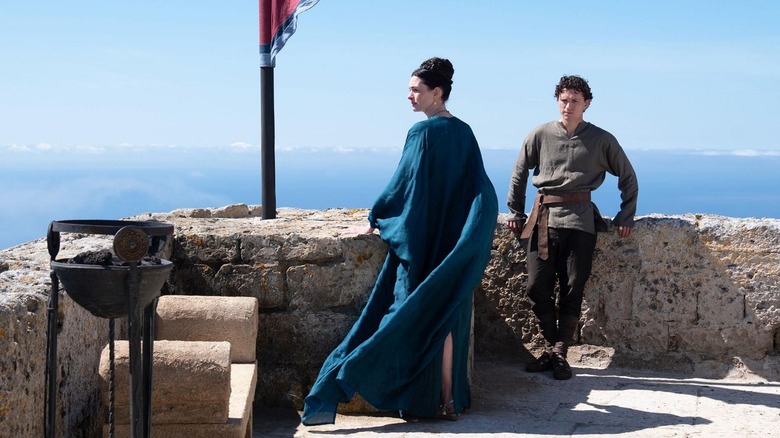
Calling the modernized language in Christopher Nolan's take on "The Odyssey" a "small detail" isn't meant to be some sort of joke; it's arguably a pretty big detail. Telemachus, notably, refers to his parents as "Mom" and "Dad," and other modern words are sprinkled through the script. (Don't worry — it's not too modern. Nobody says "dude" or anything like that.) Still, it's a surprising touch for a story that's so famously based on an epic poem, and it's sure to divide viewers. Some might consider it a "dumbing-down" of Homer's work, while others might view it as an apt modernization of poetry; after all, works like this were meant to be performed in Homer's era, and they were meant to be accessible to all audiences.
Nolan, for his part, has an explanation of sorts about the language tweaks. Speaking to the Los Angeles Times, Nolan said he wanted the dialogue in "The Odyssey" to be "language that has emotional not intellectual meaning to people," and that he's only a little bit worried about the reception. "I was maybe being naïve, it might bite me on the a**, but I wanted an earthy narrative. To me it was a no-brainer," Nolan told the outlet. He might be right about that, but the movie is finished — with bits of modern dialogue scattered throughout.
Odysseus's dog Argos speaks to his character
If you've read any of the translations of "The Odyssey," you might have wondered, ahead of Christopher Nolan's adaptation, whether Odysseus' loyal hunting hound Argos would be included in the film. He is, and his very existence speaks to Odysseus' honorable nature.
In an early scene, Eumaeus and Odysseus are on a hilltop in Ithaca together looking at a litter of puppies; Eumaeus carelessly tosses one off a cliff in a moment that's sure to enrage dog lovers everywhere. Quickly, though, Odysseus stops his friend and picks up a puppy, who immediately starts giving him kisses, and he raises that dog as Argos, a loyal and devoted hunting dog who will only truly listen to Odysseus (or, in a pinch, Eumaeus). In Odysseus' long absence, the dog ages greatly and is abused by Penelope's suitors at court ... and in one of the film's most touching moments, Odysseus finally reunites with his dear dog and tells Argos he can pass peacefully. He does, but the entire relationship clarifies that, despite his mistakes, Odysseus is a good-hearted man who tries to do what's right whenever possible.
'The belly of the beast'
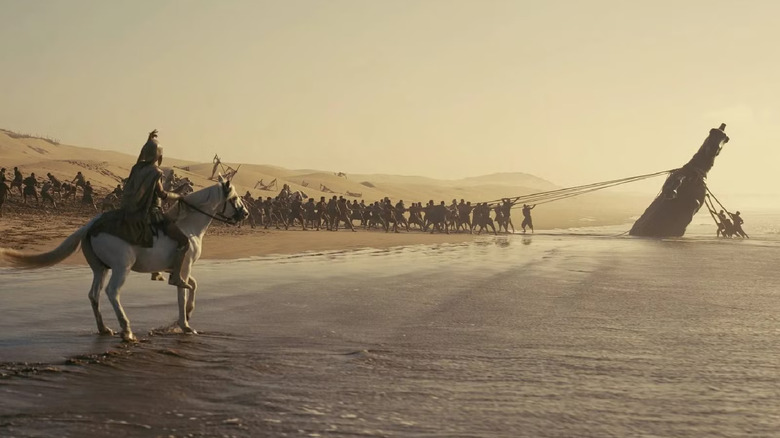
We'll talk about the legendary Trojan horse a few times — which makes sense, as it's already become one of the film's most recognizable pieces of iconography — but let's go over the basics. After lying to one of his most loyal soldiers, Sinon (an excellent deployed Elliot Page, reuniting with Christopher Nolan after the two worked together on "Inception"), Odysseus crams a whole host of his men, including the king of Sparta Menelaus (Jon Bernthal), into a giant horse to trick the Trojans by telling them that it's a gift to honor Athena. Once the Trojans drag the horse inside, you know the rest; Odysseus and his soldiers brutally attack and open the city's gates, allowing Agamemnon to finish the job with his army.
In Nolan's interpretation of this classic tale, pay special attention to where the men exit the horse. After it's brought into Troy by cheering cityfolk, it's left alone at night ... and as he begins the battle, Odysseus drops out of the horse's stomach silently and begins to slaughter guards with his men as backup. Ever heard the saying "in the belly of the beast?" Very clever, Mr. Nolan.
Keep an eye on Odysseus when he exits the Trojan Horse
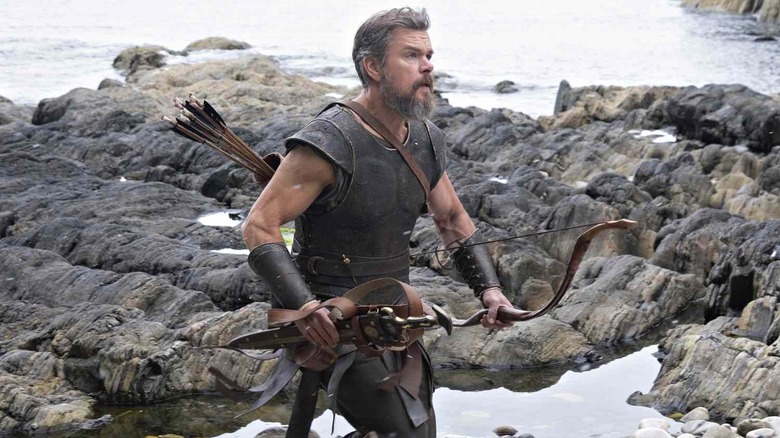
Now that we've covered the nice little ode to "being in the belly of the beast," let's talk about how Christopher Nolan and Hoyte de Hoytema shoot the disgusting, disturbing, and deadly conditions inside of the Trojan horse. Bodily fluids are, unfortunately, flowing, and when the water rises before the Trojans begin to move the structure, Menelaus, telling Telemachus about the gambit, recalls that they watched men drown before their very eyes.
When they finally leave the horrifying horse, watch Odysseus specifically. As of this writing, we don't know if Nolan instructed Matt Damon to do this or if Damon came up with the character flourish on his own, but Odysseus is obviously limping. He still fights bravely alongside of his men despite being clearly injured, but it shows exactly how harrowing it was inside of the horse for Odysseus and all of his men, some of whom didn't even make it out alive.
Why are Helen and Clytemnestra so furious?
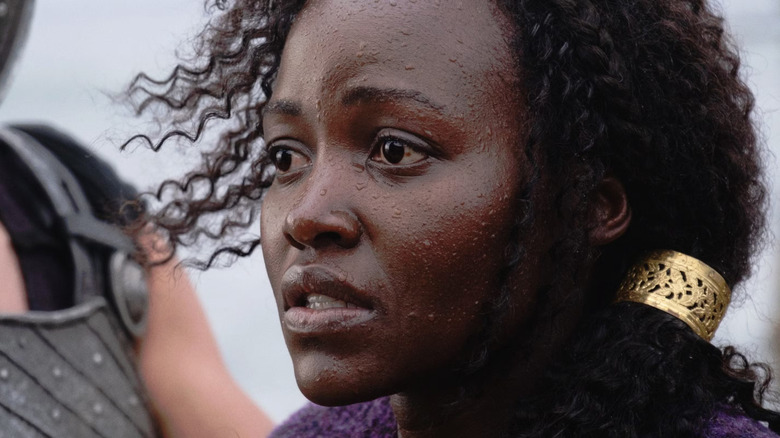
There was a fuss, initially, when Oscar winner and modern scream queen Lupita Nyong'o was announced as Christopher Nolan's Helen of Troy for "The Odyssey," which unfortunately intensified when it was also revealed that she'd play dual roles as Helen and her twin sister Clytemnestra. Let's set the record straight. Nyong'o is an incredibly talented actor who could probably play a sentient seashell if you asked her to, and she's a great choice for these roles. Furthermore, Helen and Clytemnestra's stories largely take place before the narrative of "The Odyssey" begins, so they don't get a ton of screen time. So why, when we see both of them, are they angry at their respective husbands Menelaus (married to Helen) and Agamemnon, whose wife is Clytemnestra?
It's easy enough to explain. Half of Helen's famously beautiful face is heavily scarred, and Menelaus strongly indicates to Telemachus that it's revenge for her relationship with Paris of Troy that caused the war in the first place. As for Clytemnestra, we learn, from Odysseus himself, that Agamemnon sacrified their young daughter for good fortunes in the war ... so when he returns victorious, Clytemestra murders her husband in retribution.
Athena's 'eyes' are invoked throughout The Odyssey
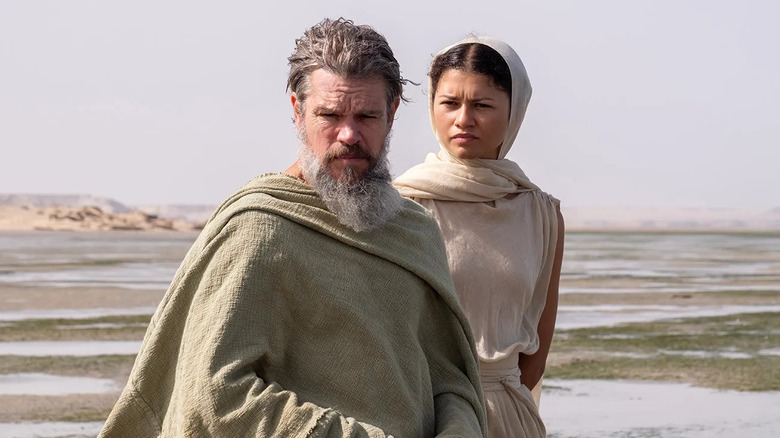
Something that Telemachus, in particular, says to characters like Odysseus in "The Odyssey" is that they have Athena's eyes ... and no, that's not Christopher Nolan adding some sort of cheeky reference to Tom Holland and Zendaya's real-life relationship. Because this version of "The Odyssey" seriously tones down the outright magic performed by gods throughout the poem, Athena, portrayed beautifully by Zendaya, appears to Odysseus throughout the narrative, seemingly when he's at an emotional impasse and needs her counsel the most.
So what's the reason for these appearances? Most likely, it's twofold. Something that does get referenced by multiple characters in "The Odyssey" is that gods are capable of disguising themselves as mere mortals to walk through society undetected, and when Telemachus notes that someone has "Athena's eyes," he might be trying to suss out a secret god in his midst. The other facet here is that Athena is, famously, the Greek goddess of wisdom; the other meaning here, then, is that learned and experienced men like Odysseus possess wisdom from years of battle, politics, and intrigue.
Circe bought a zoo (sort of)
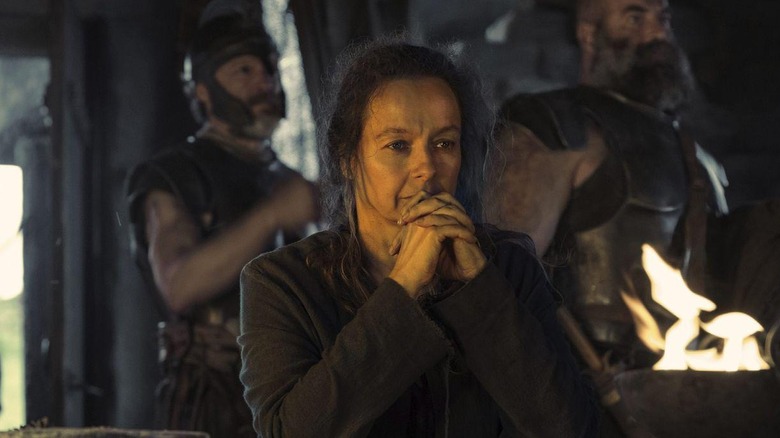
One of the scariest sequences in Christopher Nolan's adaptation of "The Odyssey" is, unquestionably, the interlude with Odysseus, his men, and Circe (outstanding pinch hitter Samantha Morton), a witch who lives on an isolated hilltop on a dangerous island. Angry at Odysseus for his repeated attempts to get them home, all of which have ended in abject disaster, his men go on to explore Circe's small cabin by themselves. As they make their way up the hill, they're shocked to discover apex predators like lions, tigers, panthers, and leopards, none of which attack them, which is ... definitely strange. Once the men make their way inside, Circe feeds them her special stew and transforms them all into pigs, a process upon which Nolan really lingers for maximum horror.
Odysseus, rightfully suspicious after shooting a deer that turns back into a man when the arrow strikes, makes his own way to Circe's and declines an offer of her stew, pointing out that rings belonging to his soldiers are in her home. Begrudgingly, Circe tells the pigs to shed their "disguises" — her argument is that transforming them simply proved their true nature — and allows them to continue on. Those animals on the pathway, though? They were a big hint ... because they're other travelers or people that Circe has transformed, something we know because her sister is currently living her life as a caged bird in Circe's hut.
The siren sequence evokes another major Christopher Nolan movie
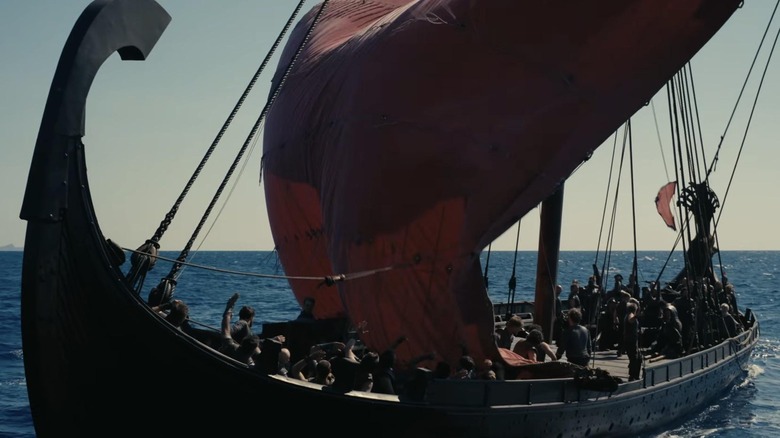
One of the most famous obstacles faced by Odysseus and his men during "The Odyssey" is the lure of the sirens, who live on a rocky island and habitually lure sailors to their untimely deaths with a song so tempting that they can't resist running their ships aground. To combat this, Odysseus orders his men to stuff their ears with wax and asks that he be tied to the boat's mast, desperate to become the only man who survives the tantalizing song of the sirens. Here's the really cool thing about this scene, though: Christopher Nolan puts you in the shoes of the soldiers whose ears remain blocked, and so you don't hear the siren song; instead, you watch one soldier rip the wax from his ears and swim to his certain demise, and Odysseus struggle against the binds tying him to the mast.
What this brings to mind, for fans of Nolan's body of work, is "Oppenheimer" — or, most specifically, the unbelievably stunning bomb test sequence in "Oppenheimer." As Cillian Murphy's J. Robert Oppenheimer and his scientific colleagues perform a test in the desert, Nolan brilliantly cuts the sound, a touch that left entire movie theaters in staggering silence as they watched a depiction of a weapon that can destroy entire civilizations. Nolan has, obviously, picked up a number of amazing filmmaking flourishes throughout his storied career, and smartly playing with sound — or lack thereof — during moments like this is incredibly impactful.
There's one indisputable way to figure out Odysseus's identity
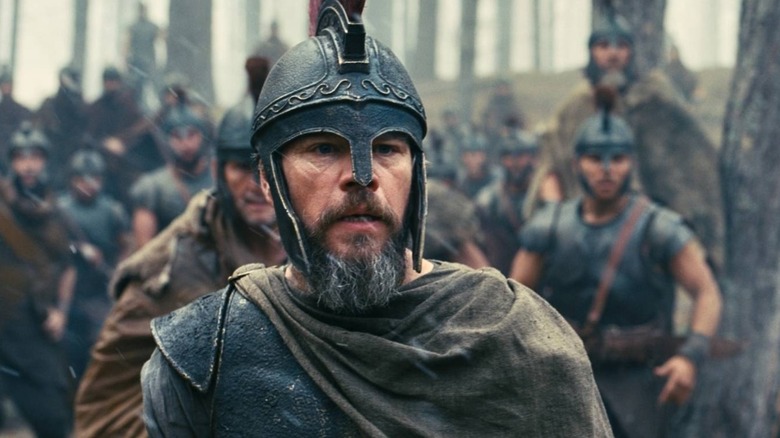
While Eumaeus is telling Telemachus about his long-lost father, he explains that Odysseus never hunted without Argos by his side, and as we see this happen in flashback, we learn that Argos and Odysseus once had a small hunting accident involving a boar that results in a frankly enormous ankle wound. As a servant women carefully stitches up Odysseus' ankle, he takes the pain bravely, even telling Eumaeus that he put himself at a disadvantage by plucking the string of his hunting bow to get the boar's attention, hoping for a "fair" fight.
Years later, when Odysseus returns to Ithaca disguised as a simple beggar before he wages war against Penelope's slovenly suitors and wins his throne back, Penelope kindly welcomes him into her palace and asks that same woman to wash his feet. Odysseus declines, but when Penelope says that her husband wanted to welcome all visitors fairly, he accepts ... and the servant immediately realizes that her long-lost master has returned because she sees the obvious battle scar on his ankle. For the entire run time of "The Odyssey," Odysseus carries around a pin gifted to him by his wife to prove that he's truly who he says he is, but that gigantic ankle scar probably would have done the trick too.
The bard in The Odyssey is played by a famous rapper
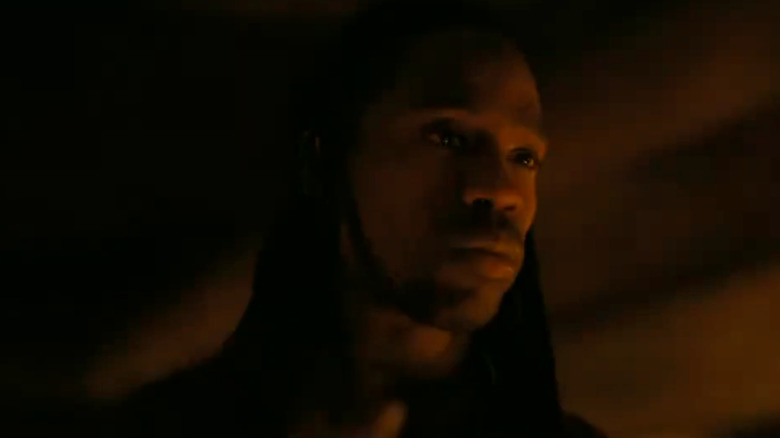
A performance by a bard essentially bookends Christopher Nolan's version of "The Odyssey" — he opens the entire film, and he also performs at the fateful banquet where Odysseus finally fights Penelope's suitors and truly returns home — and to cast said unnamed bard, Nolan decided to bring Grammy nominee Travis Scott on board. "I cast him because I wanted to nod towards the idea that this story has been handed down as oral poetry, which is analogous to rap," Nolan told Time in a wide-ranging interview about the film.
This is a genuinely interesting approach to a bard, who — as Nolan correctly points out — was responsible for spreading stories and mythology in ancient Greece. Scott, known for albums like "Astroworld," is pretty new to acting, unlike contemporaries like Kid Cudi and Donald Glover, both of whom have proven themselves as double (or even triple) threats. Now? Maybe Scott will find his way into more feature films. Also, not for nothing? After Heath Ledger absolutely blew audiences away as the Joker in "The Dark Knight" and quieted naysayers, maybe we can give Nolan the benefit of the doubt regarding his casting decisions for the rest of time.