

5 Best Western TV Shows Of The 1960s, Ranked
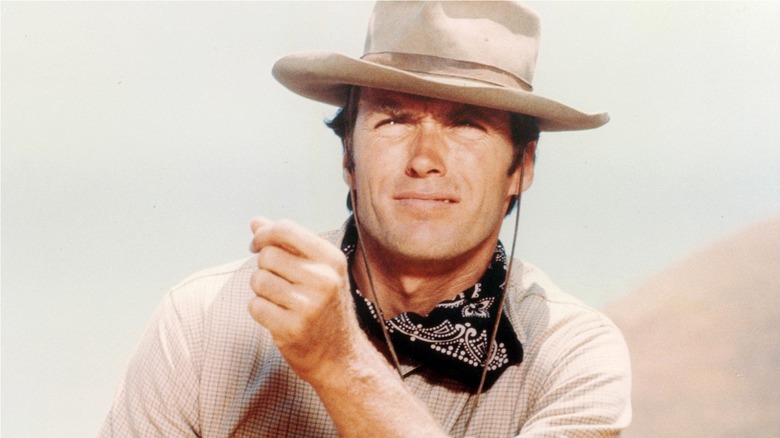
As popular as the Western is on the big screen, it has always been a television staple. Nowadays, modern TV Western shows like "Yellowstone," "Deadwood," and "Justified" are still commonly found on traditional television and streaming outlets, but back in the genre's heyday, audiences were blessed with a bevy of iconic TV horse operas that continue to make waves even now. Although the genre erupted on the airwaves in the '50s, the 1960s were home to some of the best TV Westerns imaginable — one of which even starred Clint Eastwood.
With both black-and-white and color offerings, the Big Three networks (NBC, ABC, and CBS) each boasted several Western programs for viewers still pining for the days of the Old West. A century after the American Civil War, the myths that made the wild frontier were still going strong, and Hollywood capitalized on that interest by producing more than 100 individual Western shows between 1949 and the rural purge in the early '70s. But it was during the '60s that these programs were at their peak, with Western shows featuring lawmen, drifters, and frontiersmen alike.
If you're in search of the best of these golden age programs, look no further than the five shows on this list. But before we dive in, we'd be remiss not to mention a few runners up, including "The Virginian," "Maverick," "The Rifleman," "Wanted: Dead or Alive," and "Death Valley Days." With that out of the way, here are the five '60s Western TV shows that deserve the highest praise.
5. Wagon Train
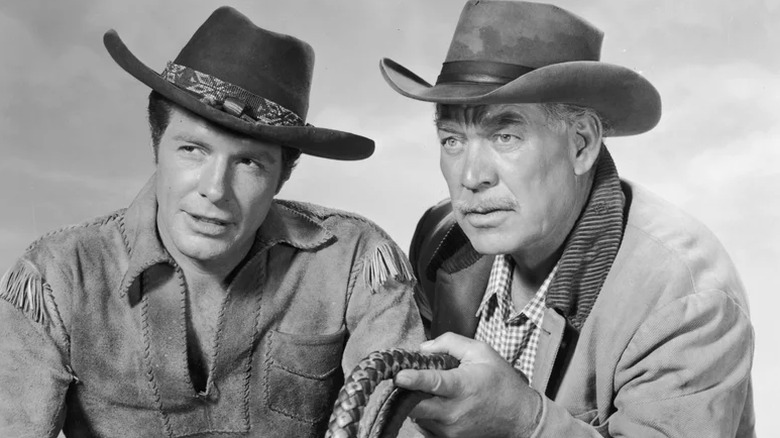
Western shows often lived up to their branding, and "Wagon Train" did just that. Although the NBC series featured a regular cast, initially Ward Bond as wagon master Major Seth Adams and Robert Horton as scout Flint McCullough, it followed an almost anthology-like format as each episode centered around a different character of the titular wagon train. Inspired by the John Ford film "Wagon Master," the series blazed the trail long before Taylor Sheridan's "1883."
While "Wagon Train" began its run on NBC, the series hit its fair share of difficulties throughout its run. Syndicated originally as "Major Adams, Trailmaster," the program shifted gears during its fourth season when Ward Bond suddenly died. He would be replaced by John McIntire as Christopher Hale, who carried the bulk of the series as the hour-long program jumped from NBC to ABC. There, it extended to 90-minute episodes for a time (later episodes were later syndicated as simply "Trailmaster"). But no matter who was leading the titular endeavor, this Western was always a delight.
All these years later, "Wagon Train" deserves a second chance for its compelling character work and solid guest cast. "The Colter Craven Story," in particular, featured John Wayne in a cameo role and was directed by John Ford himself. With eight seasons total, "Wagon Train" ran for 284-episodes from 1957 until 1965, with the entirety of its penultimate seventh season being filmed and released in color.
4. Rawhide
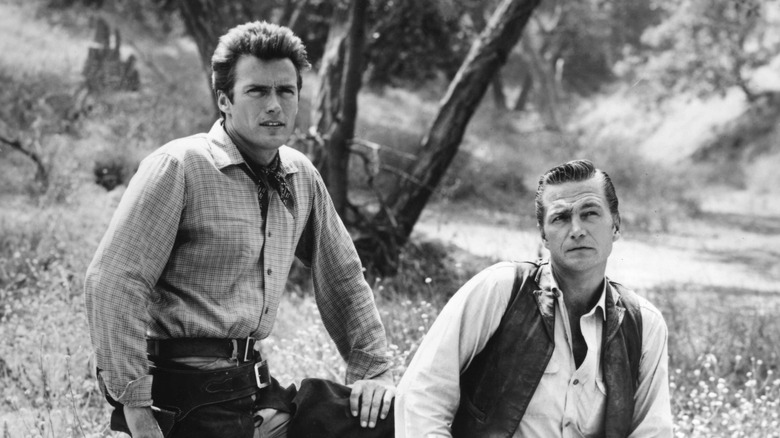
Created by Charles Marquis Warren, "Rawhide" is significant for several reasons. For one thing, it joins many of the programs on this list as being one of the longest running TV Westerns to ever air. But it was also the series that launched the career of Clint Eastwood, who played ramrod Rowdy Yates for the entirety of its eight-season run. Eric Fleming led the charge as trailboss Gil Favor, running each cattle drive with particular enthusiasm and made-for-TV strength.
Each season of "Rawhide" thrust Favor, Yates, and the rest of the cowboy crew onto the open trail for whatever new conflict they'd encounter. Be it wild animals, frontier diseases, rogue bandits, or local trouble, the cast dealt with every new challenge thrown at them. Although he didn't invent the trope, Eastwood helped popularize the singing cowboy on television in the '60s, even launching a music career as a result.
Near the declining years of this CBS Western, Eastwood moved past his boyish role as Rowdy and took on the "Man With No Name" persona, beginning with "A Fistful of Dollars." However, it was those 217 episodes of "Rawhide, released between 1959 and 1965, that first put him in the public eye. Even all these years later, some prefer Eastwood as a TV cowboy.
3. Have Gun – Will Travel
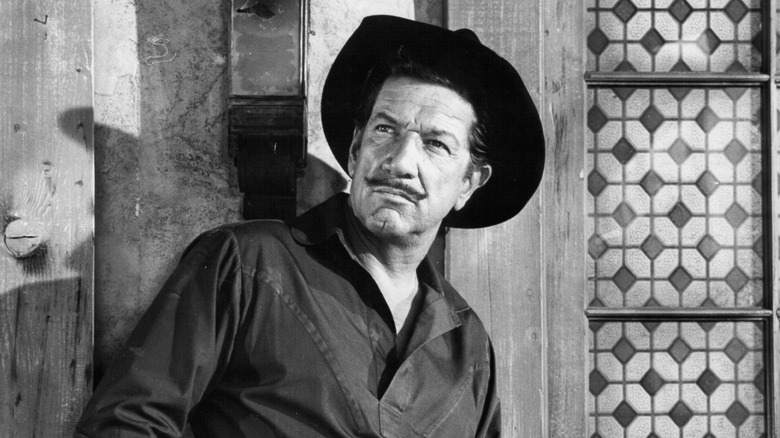
The only half-hour program on this list that remained so for the entirety of its run, "Have Gun — Will Travel" is hands-down one of the best Western TV shows ever made. The simple premise — gun-for-hire Paladin (Richard Boone) travels the American West on a new job each week solving conflicts with not just his guns but his wits — made this CBS series an instant classic. Though he had expensive tastes and lived out of the Hotel Carlton in San Francisco, the "man in black" could be as rough as they come.
"Have Gun" was so popular from the get-go that it was one of the few Western television programs to spawn a radio show rather than spawn from one. The format itself was part of the draw. In under 25 minutes, Paladin would travel as a "knight without armor in a savage land," resolving new problems and protecting the innocent, and only using his gun when absolutely necessary. He was the sort of Western hero that just about anyone could get behind, and he had a killer theme song to accompany each new adventure.
Spanning six seasons and 225 episodes between 1957 and 1963, "Have Gun — Will Travel" is a masterclass in telling succinct Western stories on the small screen. Though the show — created by Sam Rolfe and Herb Meadow — only ran a few years into the '60s, its influence is considerable and remains a cult favorite for many. No wonder it's one of the most rewatchable Western shows. Fun fact: Gene Roddenberry penned 24 episodes across all six seasons prior to creating "Star Trek."
2. Bonanza
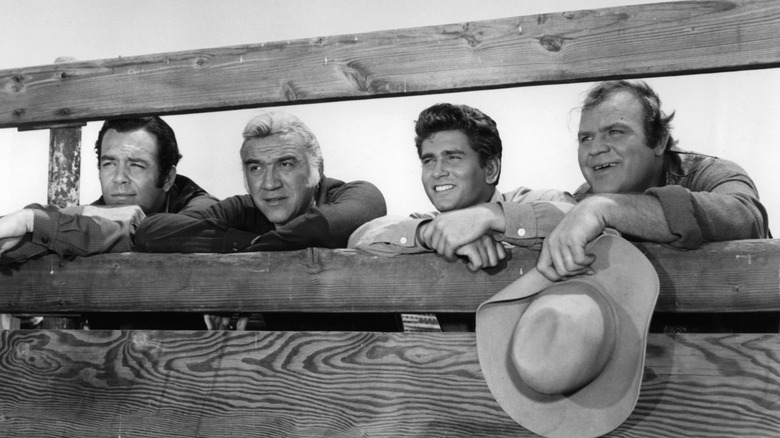
Among the longest-running Western shows to hit the airwaves, "Bonanza" was one of the most popular programs of its day. Created by David Dortort, the NBC drama initially followed the four Cartwright men — patriarch Ben (Lorne Greene) and his three sons Adam (Pernell Roberts), Hoss (Dan Blocker), and "Little" Joe (Michael Landon) — as they settled just outside of Nevada City near Lake Tahoe. Like all television shows at the time, "Bonanza" was largely episodic.
While running the Ponderosa Ranch, the Cartwrights often find themselves in heaps of trouble, dealing with the social issues of the day with more grace than most programs of the time. "Bonanza" (retitled "Ponderosa" on syndication) benefited from its leading foursome, each of whom carried their own distinct personalities. Adam was the cool-headed older brother, Hoss was the off-beat middle brother, and Joe was the youngest who wanted to be seen as an equal.
"Bonanza" ran for an impressive 14 seasons between 1959 and 1973, being one of only a small few television horse operas to span the entire decade. With 431 episodes, this hour-long series is no quick binge, but it's certainly worth the endeavor for the Cartwrights. Though Roberts left the series after the sixth season and Blocker died just before Season 14, Greene and Landon stuck with and carried the show through its entirety — and that alone is old-fashioned Western commitment.
1. Gunsmoke
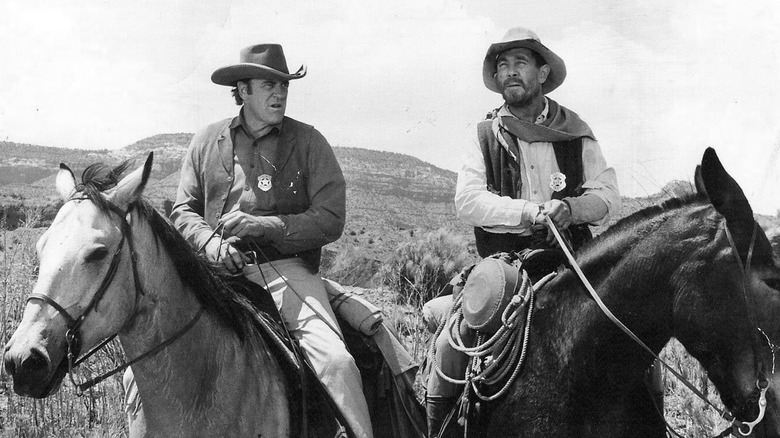
There was never a Western television program more popular than the longest-running horse opera on television, and that's "Gunsmoke." Based on the radio series of the same name by John Meston, Norman Macdonnell reworked the material for CBS as a television show — and it far outlived its source material. Set in Dodge City, Kansas, "Gunsmoke" primarily followed Marshal Matt Dillon (James Arness) as he patrolled the Old West with his badge and gun, dealing with cheats, outlaws, angry cowboys, and other problems that only he could tackle. It was one of the first "adult Westerns" ever made.
Joined by Amanda Blake's Miss Kitty Russell, Milburn Stone's Galen "Doc" Adams, Dennis Weaver's Chester B. Goode, and Ken Curtis' Festus Haggen (among many others who came and went over the years), Marshal Dillon proudly defended Dodge with everything in him. After producing some of the finest half-hours of black-and-white Western television, "Gunsmoke" eventually transitioned to an hour-long format and then to color midway through the decade. The show knew how to adjust to the times without losing what made it special in the first place, even as it shifted to a more anthological format in its final years.
"Gunsmoke" remains as popular as ever, though it was at its peak in its early years. Syndicated as "Marshal Dillon," the program ran from 1955 to 1975, spanning an impressive 20 seasons and 635 episodes (and that's before the five post-series TV movies). From that first episode introduced by John Wayne to an impromptu series finale, "Gunsmoke" was a staple on weekly television. No wonder it was the primetime series with the most episodes until "The Simpsons." You just can't keep Marshal Matt Dillon down.