

How The Lord Of The Rings Author J.R.R. Tolkien Felt About Dune

For some, science fiction and fantasy are two sides of the same coin. For others, the genres couldn't be further apart. In this vein, many of the stark differences between the supposedly unfilmable "Dune" and "The Lord of the Rings" immediately jump out to fans, including "Rings" author J.R.R. Tolkien.
Tolkien first published "The Hobbit" in 1937, followed by the first installment in his sprawling, high-fantasy epic "The Lord of the Rings" in 1954. 11 years after Tolkien's saga was fully published, author Frank Herbert found literary success with "Dune" in 1965. That same year, Tolkien was gifted a copy of the ambitious sci-fi novel by author/editor Sterling E. Lanier, who himself had championed Herbert's work toward publication. However, it wasn't until the following year that Tolkien made his feelings on the novel known in a letter to a fan published by scholar Oronzo Cilli in "Tolkien's Library: An Annotated Checklist."
"It is impossible for an author still writing to be fair to another author working along the same lines," Tolkien wrote. "In fact, I dislike 'Dune' with some intensity, and in that unfortunate case it is much the best and the fairest to another author to keep silent and refuse to comment." While the professor doesn't reveal much here, it's clear that "Dune" was not his cup of tea. Considering what we know about them, this doesn't come as a surprise.
The Lord of the Rings and Dune contain opposing philosophies
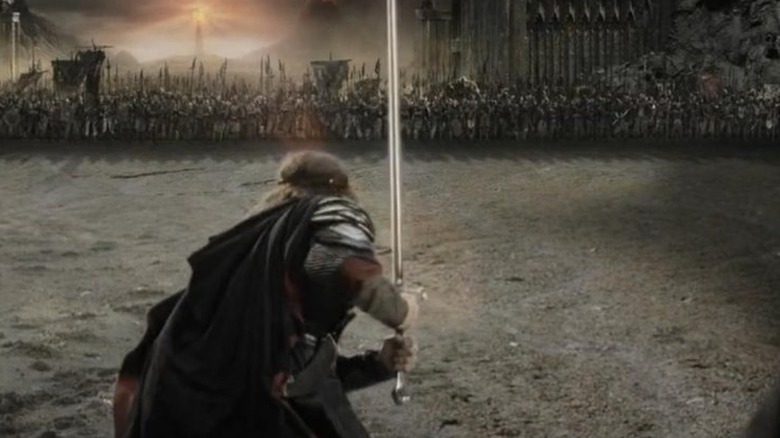
Despite his penchant for sci-fi and fantasy novels, J.R.R. Tolkien was famous for his general distaste for modern literature. "I seldom find any modern books that hold my attention," he once wrote (via "The Letters of J.R.R. Tolkien"). Given his preference for "fairy-stories," it's likely "Dune" wasn't the sort of story that Tolkien could invest in.
On the other hand, it's clear from reading "The Lord of the Rings" that Tolkien and Frank Herbert came from starkly different perspectives. Tolkien's masterwork is hopeful, optimistic, and contains a clear moral framework. Sauron is the Dark Lord that represents all evil, while the Fellowship stands valiantly against it. "Dune" is far more ambiguous morally speaking, dealing with complicated, flawed characters who use politics, marriage, and religion to further their goals.
That last point may have been the most damning for Tolkien. While Herbert was raised Catholic, he ultimately rejected the faith later in life, and "Dune" reflects that perspective. Tolkien, however, was deeply Christian, and his cosmology included room for a divine creator. "'The Lord of the Rings' is, of course, a fundamentally religious and Catholic work," he once wrote. "Unconsciously so at first, but consciously in the revision." While Herbert's six "Dune" novels use religion as a tool for power, "The Lord of the Rings" was built on a religious foundation, with distinct Christian themes woven throughout.