

5 Addictive '80s Crime Shows You Won't Be Able To Stop Watching
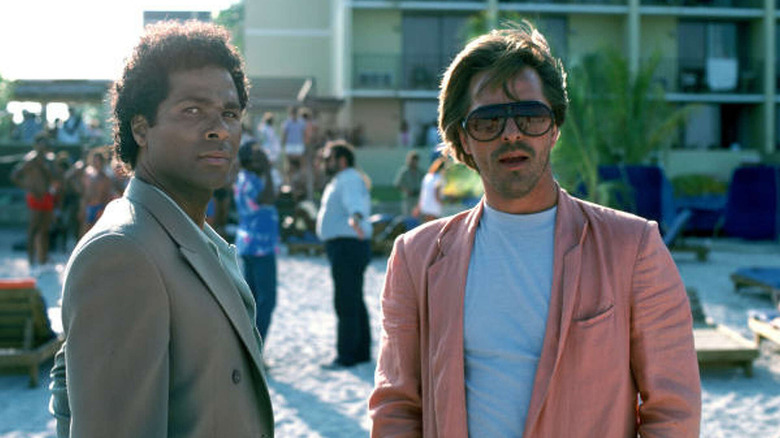
There are few TV genres as addictive as crime shows. Whether they're true crime or dramatizations, the best are endlessly watchable because they allow us to live vicariously through their characters, experiencing thrills and excitement we could never imagine in our daily routines. Who among us wouldn't like to be heroes, even if just for one day? Much as we'd hate to admit it, just as many of us would like to get away with being criminals, if only for small stuff like shoplifting. Rather than act as a petty thief in real life, we can get our kicks watching actors do that (and sometimes worse) on primetime TV. There's something equally satisfying about knowing that no matter how difficult the crime is to solve, the cops and detectives will figure it out by the end of the hour. It's for this reason — and many others — that we tune in night after night to whatever the latest crime TV show is.
Crime TV hit a creative apex in the 1980s, as the greed and excess of the Reagan era found its way onto primetime. Yet that seediness was matched by a sense of nostalgia and optimism, a feeling that no matter how bad things got, they'd somehow get better. These two warring factions led to some of the greatest crime shows of all time, many of which are enjoyed on streaming and reruns to this day. Here are five addictive '80s crime shows you won't be able to stop watching.
The Equalizer
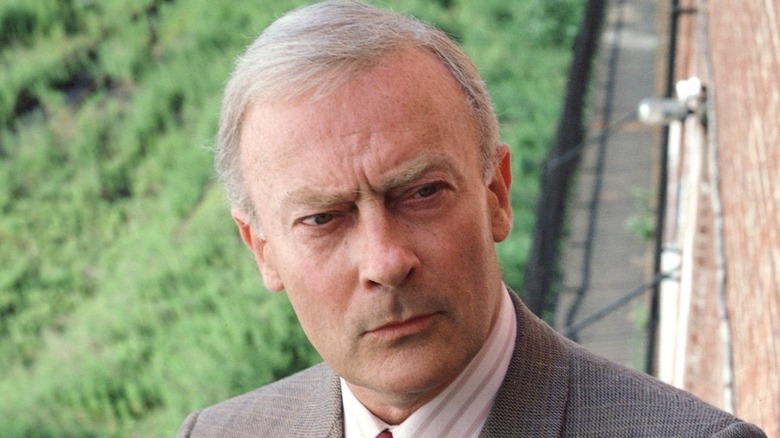
Anyone who has seen "The Wolf of Wall Street" remembers the scene where Jordan Beflort's (Leonardo DiCaprio) father, Max (the late, great Rob Reiner), becomes enraged when someone has the gall to call his house on a Tuesday night ... right when "The Equalizer" is airing. Like most Americans who were watching TV between 1985 and 1989, Max couldn't wait for a new episode of the CBS crime series, which has since been reimagined as a movie trilogy with Denzel Washington and a reboot with Queen Latifah. Like those remakes, the original revolved around a retired intelligence agent, here named Robert McCall (Edward Woodward), who uses his skills to enact justice on behalf of innocent people trapped in dangerous situations. While on his missions, McCall is often confronted with dark secrets from his past, including nefarious characters with old scores to settle.
Throughout its four seasons, "The Equalizer" earned seven Emmy nominations, five of which went to Woodward in best drama actor. (Although he never won an Emmy, Woodward did win the Golden Globe in 1987.) It featured an incredible array of guest stars, but the show succeeded in large part thanks to its leading man, as evidenced by his consistent awards recognition. Robert McCall remains one of the most fascinating characters on television, a man with seemingly no family or friends who nevertheless risks his life on behalf of people he doesn't know. Although "The Equalizer" is almost impossible to watch today on streaming, it's worth seeking out.
Hill Street Blues
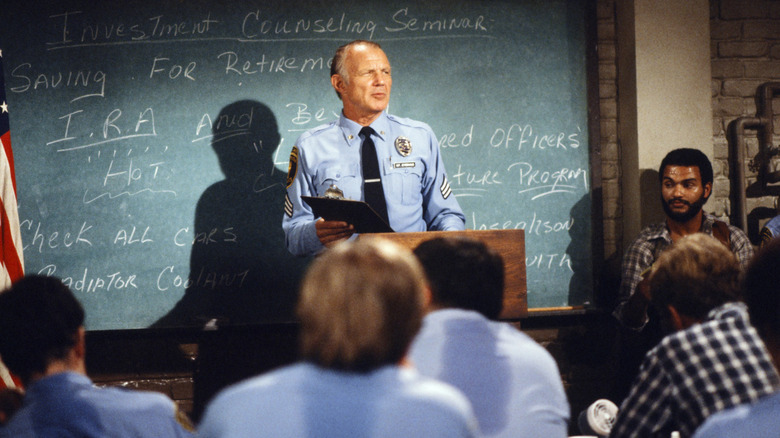
It's safe to say that "Hill Street Blues" changed the game for police dramas. One of the best cop shows of all time, its fingerprint are all over everything from "The Shield" to "The Wire," as it proved the genre could be more than just a crime-of-the-week chronicle. Instead, the Steven Bochco and Michael Kozoll-created series placed its emphasis on the police officers risking their lives day to day. Set at a police station in an unnamed American city, "Hill Street Blues" featured a large ensemble of characters, dramatizing their personal and professional lives with unflinching honesty. From Capt. Frank Furillo (Daniel J. Travantini) to Sgt. Phil Esterhaus (Michael Conrad) to Sgt. Lucy Bates (Betty Thomas), these were fully formed, three-dimensional people, rather than just anonymous grunts wearing a blue uniform.
What made "Hill Street Blues" revolutionary wasn't just its characters, but its storytelling. Whereas most TV shows from the era treated each episode as an individual starting point for new viewers, "Hill Street Blues" employed serialized storytelling, with narratives stretching out over multiple weeks. In that way, it influenced not just cop shows, but modern prestige TV, which trusts viewers to engage with complex stories rather than simply throwing something on in the background. It's hard to imagine some of the best TV shows of all time without "Hill Street Blues" paving the way. The show won 26 Emmys throughout its seven seasons, including a staggering eight prizes for its debut year.
Miami Vice
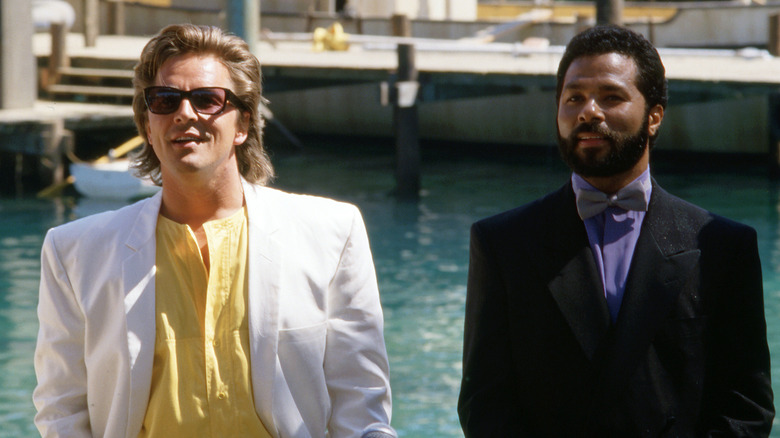
From the very first episode, it was clear "Miami Vice" wasn't going to be your typical cop show. That's because Detectives James "Sonny" Crockett (Don Johnson) and Ricardo "Rico" Tubbs (Philip Michael Thomas) weren't your typical TV cops. These were "MTV cops," so named for their hip, colorful clothing and smooth style. Yet it wasn't just the police officers that distinguished this from other cop dramas. It was the whole aesthetic, which consisted of quick cuts, a fast pace, and a propulsive energy, all set to an ultra-hip '80s soundtrack of pop and rock hits from the era. Audiences didn't tune in week after week just to watch a pair of undercover cops solve crimes in Miami: They wanted to see all the sports cars, speed boats, and Armani suits that came with it.
Although "Miami Vice" was created by Anthony Yerkovich, the show's main creative force was executive producer Michael Mann, who later adapted it into a 2006 film starring Jamie Foxx and Colin Farrell. Best known for directing "Heat" and "Collateral," Mann brought a cinematic quality to the small screen, encouraging the creative team to push past the artistic limitations of the medium. Yet the show wasn't simply style over substance. Indeed, there was a great deal of attention paid to the supporting cast, including Edward James Olmos as Cockett and Tubbs' taciturn boss, Lieutenant Marty Castillo. "Miami Vice" won four Emmys throughout its five-season run, including a best drama supporting actor prize for Olmos.
Magnum, P.I.
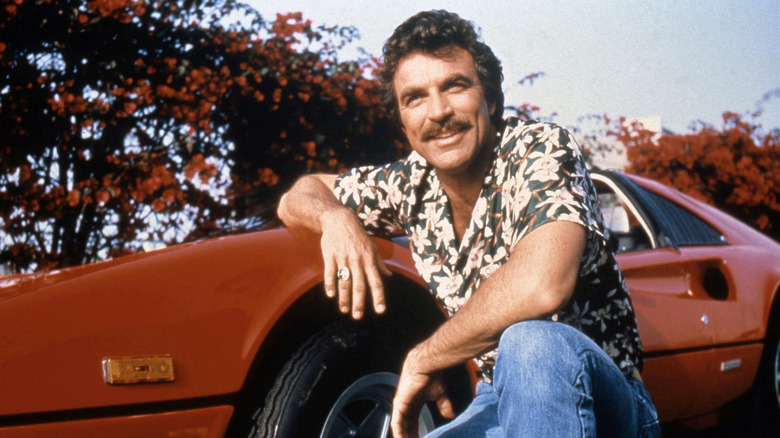
"Magnum, P.I." might've cost Tom Selleck the role of Indiana Jones in Steven Spielberg's "Raiders of the Lost Ark," but he at least got a long-running TV series out of it. He also got the most iconic role of his lifetime, one that allowed him to have a successful career in both movies and TV. When we first meet private investigator Thomas Magnum, he's called to the lavish home of Robin Masters, a mysterious individual who might've previously hired him for a job. In exchange for his services, Magnum is given a guest house on the property, appropriately named Robin's Nest and located on a beautiful Hawaiian island. While enjoying his life of luxury, Magnum takes on the occasional investigative job whenever it fits into his schedule.
Part of the charm of "Magnum, P.I." is the relationship between Magnum and Jonathan Quayle Higgins III (John Hillerman), an ex-British Army major who serves as the caretaker at Robin's Nest. Although at first cool to the easy-going Magnum, Higgins is eventually won over by him, and a mutual respect grows between the two. Both Selleck and Hillerman won Emmys in the lead and supporting drama acting categories, a testament to how well both actors played off each other. "Magnum, P.I." proved a popular hit with audiences throughout its eight-season run, which ended in 1988. Although a reboot aired between 2018 and 2024, there's no competing with the original, which has just the right amount of cheesy '80s fun.
Wiseguy
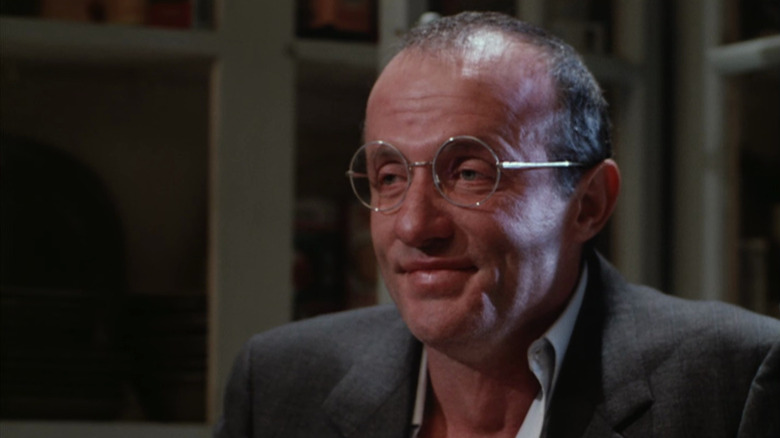
Before he was Mike Ehrmantraut on "Breaking Bad," Jonathan Banks became famous for his role in a very different kind of crime drama, "Wiseguy." Airing for four seasons between 1987 and 1990, the series portrayed the day-to-day lives of undercover FBI agents infiltrating organized crime groups. The first three seasons focused on Vinnie Terranova (Ken Wahl), a Brooklyn native who infiltrates the Atlantic City Mafia when his training agent is murdered by mob boss Dave Steelgrave (Gianni Russo). Vinnie works closely with his handler, FBI senior agent Frank McPike (Banks), and information operative Daniel Burroughs (Jim Byrnes), aka "Lifeguard." When Wahl left after season three, he was replaced by Steven Bauer as disbarred United States Attorney-turned-undercover agent Michael Santana, with Cecil Hoffman playing his love interest, Hillary Stein.
"Wiseguy" earned seven Emmy nominations throughout its run, including best drama series and lead and supporting acting bids for Wahl and Banks. Although it's not as well known as other '80s crime TV shows, it's among the most respected. In 1997, TV Guide listed the first season episode "Blood Dance" as one of the 100 greatest episodes of all time, a testament to how much its legacy had grown. Its use of serialized narratives and multi-episode character arcs, which was considered radical for network television at the time, has now become the standard for prestige TV. If nothing else, it can take credit for introducing viewers to Jonathan Banks, who's become the most unlikely of household names thanks to "Breaking Bad" and "Better Call Saul."