

5 Smart '90s Sci-Fi Thrillers That Still Hold Up Today
Audiences have flocked to sci-fi movies since the earliest days of cinema, reveling in tales of space travel, alien invasions, and dystopian futures. Like horror and fantasy, science fiction is an extremely malleable genre, and many of the best sci-fi movies of all time span a wide variety of styles, themes, and techniques. Among the most popular subgenres is the sci-fi thriller, perhaps because there has always been a degree of anxiety about the future. The sci-fi thriller lets our imaginations run wild, examining the terrors, pitfalls, and hazards of a more technologically advanced world overrun by pollution, disease, and artificial intelligence.
There was perhaps no better time for the sci-fi thriller than the 1990s, the last decade of the 20th century. As the world barreled full-speed into the 21st century, fears of Y2K fueled stories of futuristic chaos. As computers grew more savvy and climate change became more apparent, humanity braced for uncertainty, and that unease found its way into movies. Although many predictions of '90s sci-fi cinema have failed to come true, many have turned out to be disturbingly prescient. Global pandemics, virtual reality, and the rise of artificial intelligence were all depicted cinematically throughout the decade, making one wonder if these directors had some sort of crystal ball.
Here are five smart sci-fi thrillers that still hold up today. Like the best sci-fi, these films have something to say about the world we live in today while predicting what the world may one day look like, all while entertaining us.
Terminator 2: Judgment Day
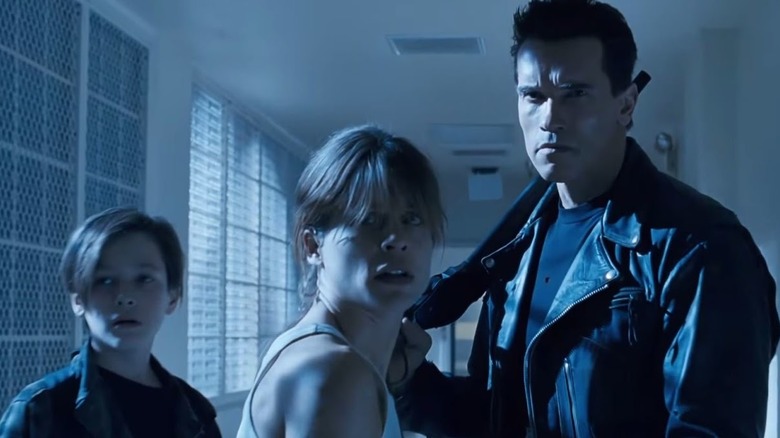
11 years after defeating a Terminator sent from the future to kill her, Sarah Connor (Linda Hamilton) is confined to a mental institution and her son, John (Edward Furlong), is living with foster parents. Sarah's prophecies about impending nuclear annihilation are interpreted as mental illness by her doctors, and the teenage John dismisses the notion that he's the future savior of humanity. He starts to believe her when a shape-shifting T-1000 (Robert Patrick) shows up and tries to kill him, but luckily for John, a revamped T-800 (Arnold Schwarzenegger) has been sent from the future to save him. After breaking Sarah out of the hospital, the Connors and the Terminator work to prevent Skynet from gaining sentience, all while evading the T-1000.
By the time he made "Terminator 2: Judgment Day," James Cameron had firmly established himself as the king of sci-fi, thanks to "Aliens," "The Abyss," and the original "Terminator," with the Avatar franchise soon to come. Released in 1991, "T2" is one of James Cameron's best movies, a dazzling action spectacular that's also surprisingly poignant in its depiction of a surrogate father-son relationship between the Terminator and John. The highest grossing film of its year, "T2" earned six Oscar nominations and won four: best film editing, best sound, best sound effects editing, and best visual effects. More than 30 years later, it remains the best of all the Terminator films and shows, and stands heads and shoulders above the vast majority of '90s sci-fi action movies.
Strange Days
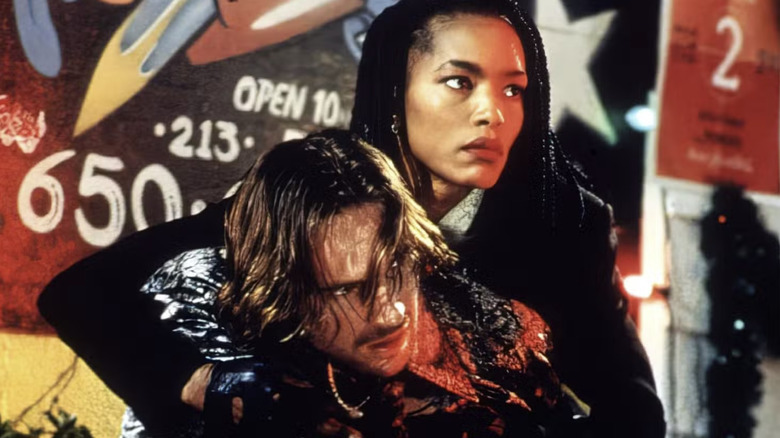
Los Angeles is overrun with chaos in the final days of 1999 as it prepares for New Years Eve. Former LAPD officer Lenny Nero (Ralph Fiennes) has left law enforcement behind for a lucrative gig as a black marketeer. His trade: selling SQUID tapes, an illegal form of virtual reality that records memories of intimacy, violence, and mayhem which are later sold to customers wishing to experience all the thrills without any of the consequences.
Lenny routinely views SQUID recordings of his ex, Faith Justin (Juliette Lewis), a rocker who's now dating shady music mogul Philo Grant (Michael Wincott). When Lenny comes into possession of a SQUID tape of a murder, he enlists his friend, Mace (Angela Bassett), to track down the killer, but the criminal conspiracy runs deeper than either can imagine.
Before she was widely recognized as one of the best directors of all time, Kathryn Bigelow was a highly respected genre filmmaker, known for blending action and artistry in films like "Near Dark," "Blue Steel," and "Point Blank." Her career was nearly derailed by "Strange Days," an expensive and ambitious sci-fi flick that earned critical raves but flopped hard at the box office. More than three decades later, it's now considered one of her masterpieces, a work of futuristic cyberpunk art that proved shockingly prescient in its depiction of virtual realty supplanting real-life experiences. Co-written by Bigelow's ex-husband, James Cameron, "Strange Days" is a dazzling blend of sci-fi action, lore, and thrills.
12 Monkeys
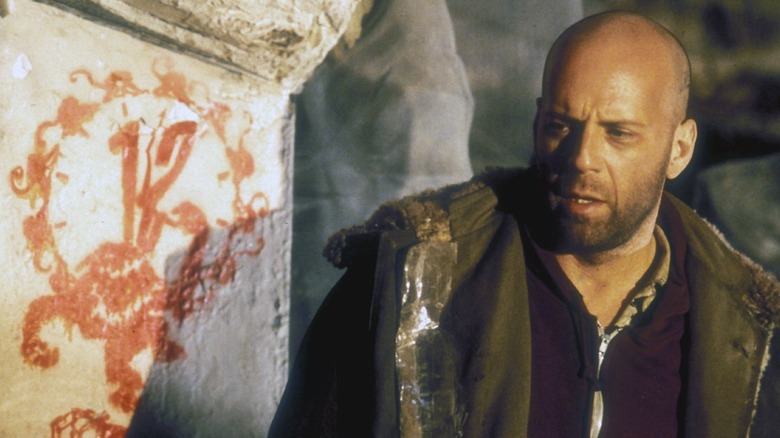
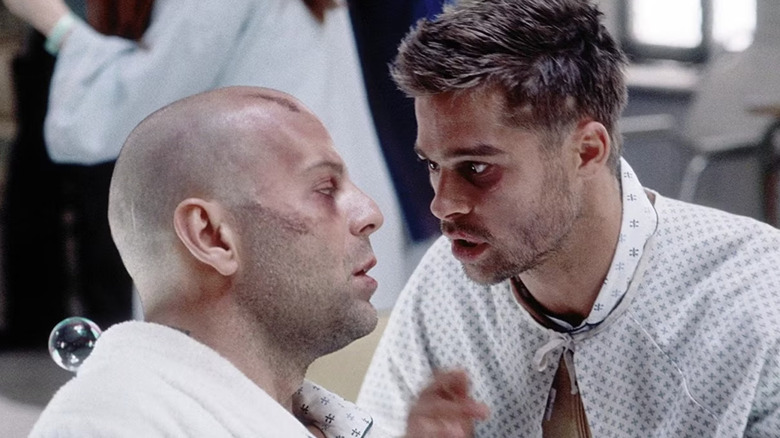
In the future, society has been forced underground by a pandemic that kills 99% of humanity in the year 1996. Prison inmate James Cole (Bruce Willis in one of his best movies) is granted an opportunity to reduce his sentence by agreeing to travel back in time and gather information about the virus before it can spread. Unfortunately, Cole gets sent back to 1995 — a full year before the virus breaks out. His warnings of a future pandemic land him in a mental institution, where he meets manic patient Jeffrey Goines (Brad Pitt), who rants and raves about consumerism.
As Cole is sent back and forth through time, a sympathetic psychiatrist, Dr. Kathryn Railly (Madeleine Stowe), starts to take his claims seriously. Meanwhile, Jeffrey's relationship with his prominent father, Dr. Leland Goines (Christopher Plummer), may hold the answer to what caused the 12 Monkeys virus.
Released in 1995, "12 Monkeys" was one of the few unqualified successes in Terry Gilliam's career, earning critical raves and raking in massive box office returns. What's remarkable is that even with the presence of superstars Bruce Willis and Brad Pitt, Gilliam doesn't compromise his unique vision. Adapted from the short film "La Jetée," "12 Monkeys" is just as weird, esoteric, and eccentric as Gilliam's "Brazil," "The Fisher King," and "Time Bandits," while still appealing to a mass audience. The film received Oscar nominations for best costume design and best supporting actor for Pitt, who won the Golden Globe for his high-wire act of a performance.
Gattaca
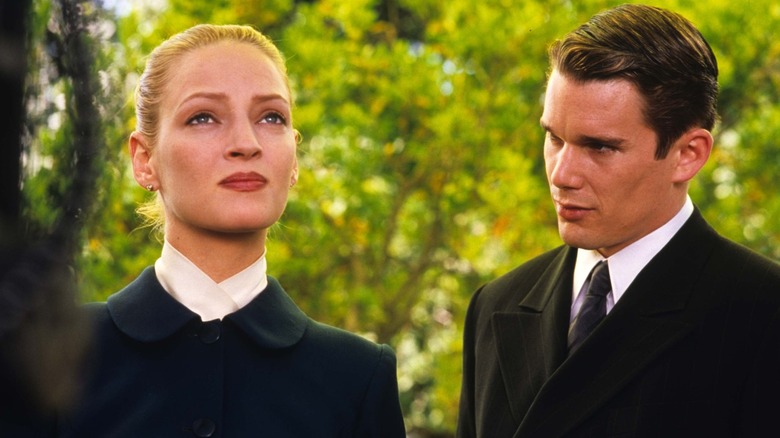
In the near future, eugenics has become commonplace, and those who are naturally born are looked down upon as "in-valids." One such in-valid, Vincent Freeman (Ethan Hawke), is beset with genetic disorders that set his life expectancy at 30. Wishing to experience space travel while he still can, he decides to pose as a "valid" by borrowing the DNA of Jerome Eugene Morrow (Jude Law), a once-great swimming champion now confined to a wheelchair after a car accident.
Using Jerome's genetic makeup, Vincent is able to join the Gattaca space program, and is assigned a trip to Saturn's moon. As he continuously sheds his own DNA to keep up the ruse, Vincent finds love with a co-worker, Irene Cassini (Uma Thurman). When a Gattaca administrator is murdered ahead of the mission, Vincent finds himself in the crosshairs — literally, since one of his eyelashes is found at the scene.
A year before earning an Oscar nomination for writing "The Truman Show," Andrew Niccol released his directorial debut, 1997's "Gattaca." Whereas "The Truman Show" was radically transformed from a dark sci-fi thriller into something more comedic and optimistic, "Gattaca" is as bleak and unrelenting as science fiction gets. It's also brimming with ideas, using the sci-fi genre to explore how racial and class discrimination could evolve with the advent of biological technology. The film earned an Oscar nomination for its stunning production design, which imagines a future that's just as pristine and sterile as the genetic perfection the Gattaca space program demands.
eXistenZ
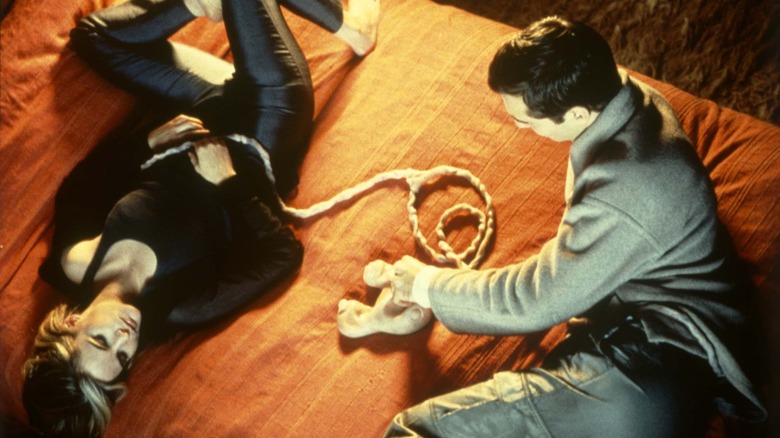
In the not-so-distant future, video game designer Allegra Marshall (Jennifer Jason Leigh) has developed a new form of virtual reality employing biotechnological "game pods" that connect directly to the player's body. Her latest game, "eXistenZ," allows the user to "live" the game by tapping it directly into their spinal cord via a "bio-port." During a focus group demonstration, a crazed fan tries to kill her with an organic pistol, forcing Allegra to go on the run with her publicist, Ted Pikul (Jude Law). Since Ted is now acting as her security guard, Allegra implants the damaged "eXistenZ" game into his bio-port, hoping to make repairs later. As they test the game, Allegra and Ted go on a series of bizarre adventures that force them to question what is reality and what is fiction.
Few directors have done more to blend sci-fi with scares than David Cronenberg, who pioneered the body horror genre with such gorefests as "Scanners," "Videodrome," and "The Fly" (one of the best horror movie remakes of all time). All of these films depict the horrors that could result from blending technology with biology, which is certainly the case with "eXistenZ." The 1999 film predicts how video games might evolve to encompass virtual reality, and how the need to create increasingly immersive experiences could one day lead to our turning into computer-human hybrids. Hitting theaters the same year as "The Matrix," "eXistenZ" asks similar questions about the safety of allowing technology to take an even greater role in our consciousness.