

2006 Sci-Fi Movies That Were Way Ahead Of Their Time
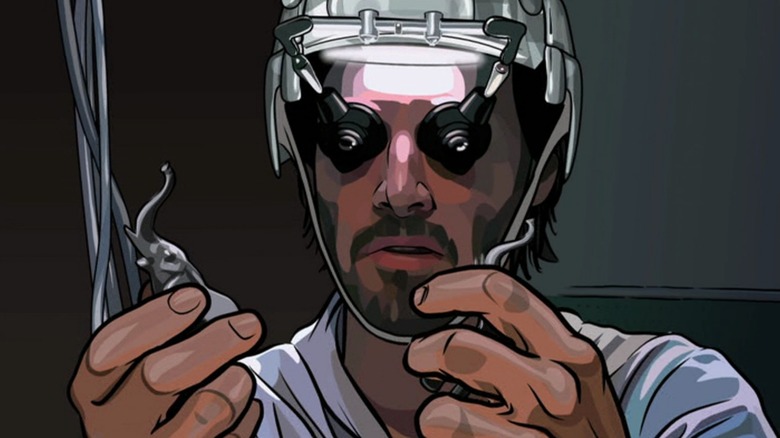
Part of what makes science fiction so exciting is that, every once in a while, the genre legitimately predicts the future. Isaac Asimov, the author of the likes of "I, Robot" and "Foundation," wrote about the Three Laws of Robotics long before machine learning became a commonplace reality. Of course, there's no shortage of sci-fi movies that don't make any sense, but that's all part of the fun. The genre has the capability of telling utterly wild, borderline fantastical stories, but it can also hew incredibly close to reality when it needs to.
The best sci-fi movies of all time find themselves somewhere in the middle, using real-world science concepts to tell stories that go so far beyond reality they're almost unrecognizable. 2006 gave us a sampling of every variety of sci-fi story. Films like "Black Sheep" played fast and loose with scientific concepts for comedic effect, and others like "The Fountain" mixed and matched so many strange ideas that audiences could hardly follow what was really happening, but a handful of sci-fi movies from 2006 seem incredibly prescient today, and it's a little unnerving just how ahead of their time they were.
The Host
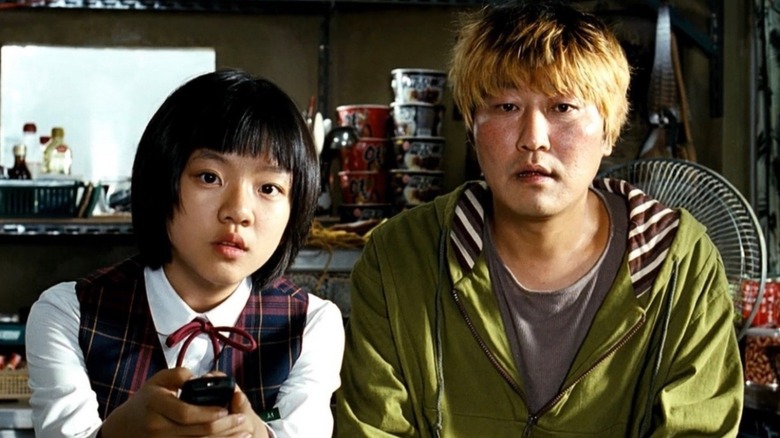
More than a decade before winning an Oscar for "Parasite," South Korean filmmaker Bong Joon Ho made a movie that eerily predicted some aspects of the COVID-19 pandemic era. "The Host" follows Park Gang-du (Song Kang-ho), whose daughter, Hyun-seo (Go Ah-sung), gets kidnapped by a giant amphibious monster that attacks Seoul. Gang-du knows that his daughter is alive in the sewers beneath the city, but the South Korean government orders everyone into quarantine because the monster allegedly carries a deadly virus with it.
"The Host" shockingly anticipated so many of the anxieties the entire world experienced during the COVID-19 pandemic. The movie uses quarantine as an excellent plot device, but it also plays with the idea of citizens mistrusting their governments. Gang-du needs to break out of quarantine to save his daughter, but other characters in the movie push back against the quarantine because they believe the virus is a government hoax. In the end, "The Host" is more of a monster flick than a quarantine story, but its virus plotline hits a lot harder nowadays. It may not be Bong Joon Ho's best movie, though it's definitely worth your time if you like creature feature sci-fi.
Ghost in the Shell: Stand Alone Complex - Solid State Society

In the mid-2000s, the dystopia craze was just beginning to really take off. One sci-fi movie anticipated the trend and created a dystopian vision that still feels incredibly relevant — and frightening — today. The somewhat cumbersomely named "Ghost in the Shell: Stand Alone Complex – Solid State Society" is technically a follow-up to the "Stand Alone Complex" TV series, which itself was a sequel to the original "Ghost in the Shell," one of the best anime movies of all time and one of three classic anime films that inspired "The Matrix." Despite that complicated lineage, "Solid State Society" tells a standalone story about viral epidemics and the dangers of artificial intelligence.
The movie follows members of Public Security Section 9, a team created to pursue highly classified missions. Section 9 is investigating the assassination of a public figure, and they soon uncover a connection between the murder and a plot to use children to distribute a devastating virus. The virus is debilitating for people with cybernetic technology grafted onto their bodies — which, in this version of 2034 Japan, is just about everyone. Section 9 needs to track down a hacker called the Puppeteer in order to prevent the virus from spreading across the globe. 20 years after "Solid State Society" debuted, the movie feels perfect for a post-COVID-19 world that's grappling with all the potential ramifications of integrated AI.
Origin: Spirits of the Past

"Origin: Spirits of the Past" is a 2006 anime with all the environmental anxiety of the 2020s. The film imagines a future where traditional ecology has collapsed and most of human civilization is in ruins. It's not just climate change that has transformed the world of "Origin," however. Genetic modification somehow led to the creation of a sentient race of trees, and now the Forest rules over the world, manipulating other parts of nature to its whims. When a young human boy named Agito (Ryō Katsuji) discovers a mysterious machine from before the age of the Forest, he begins unlocking the secrets of how his post-apocalyptic society came to be.
"Origin" was ahead of its time in multiple ways. Climate change is an even more urgent issue today than it was in the 2000s, and, since the movie's debut, there's been a lot of studies examining the risks and potential benefits of genetic modification. Aside from the plot elements, the movie's overall tone also anticipated a major shift in the sci-fi genre. Solar punk is a sci-fi subgenre that describes sci-fi stories that take an optimistic view of a future dealing with environmental change. The world of "Origin" looks very different from our own, but ultimately the movie imagines humans and nature finding a way to peacefully coexist together — it was solar punk before the subgenre really existed.
A Scanner Darkly
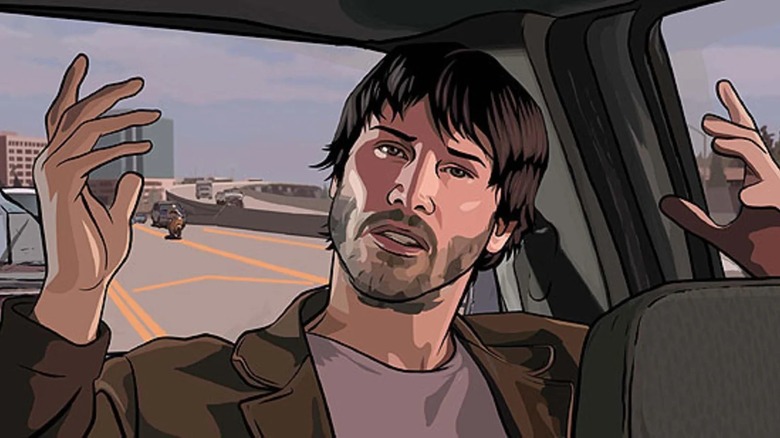
Richard Linklater wrote and directed a 2006 animated adaptation of the celebrated 1977 sci-fi novel "A Scanner Darkly." Despite a star-studded cast including Keanu Reeves, Robert Downey Jr., and Woody Harrelson, the movie flopped, in part because of its jarring rotoscopic animation style. Thanks to the popularity of unconventionally animated films like "Spider-Man: Into the Spider-Verse," Linklater's sci-fi adaptation might have performed better if it was released today.
That's not the only way in which "A Scanner Darkly" was ahead of its time. The story is set in an alternate future reality where the United States lost the war on drugs and a fifth of the population is addicted to a hallucinogen called Substance D. To help maintain control, the government has instituted a mass surveillance program using the kind of tech that would have seemed very far fetched in the '70s.
Today, many experts agree that the war on drugs was a demonstrable failure. Mass surveillance is essentially a built-in part of existing online, and famous whistleblowers like Edward Snowden have revealed that governments keep themselves plenty busy by spying on their citizens. "A Scanner Darkly" is one of several Philip K. Dick movies everyone needs to watch, and anyone who sees it today will be amazed by just how prophetic it turned out to be.