

5 Philip K. Dick Sci-Fi Movies Everyone Needs To Watch At Least Once
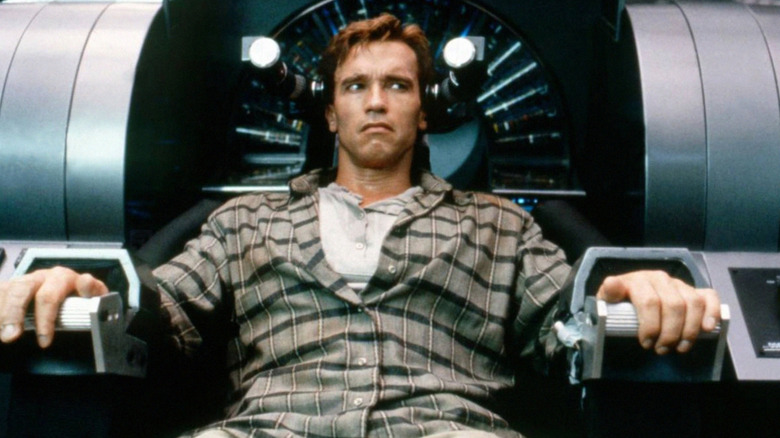
When it comes to discussing the greatest science-fiction authors of all time, the conversation isn't complete without bringing up Philip K. Dick. Previous writers developed far-out, futuristic cities or pondered what would happen if man could reach the cosmos. They were fantastical stories, but Dick brought sci-fi back down to earth. Not only that, but he looked at the rot that would occur within the human soul and psyche if incredible technology was readily at our disposal and, by proxy, became boring.
With works like "VALIS" and "Ubik," you're not left wondering how cool it would be to have a robot companion. Instead, you're questioning the very nature and stability of reality and whether something else could exist beyond the veil cloaked over our eyes. Dick also wasn't so much interested in cool heroes, like warriors and astronauts. His protagonists are working-class individuals, like Rick Deckard in "Do Androids Dream of Electric Sheep?" They're relatable, which makes their paranoia all the more terrifying, as it feels like something that could afflict any of us.
It should be no surprise that many of Dick's works have been adapted into films, and some of the best sci-fi movies of all time hail from Dick's mind. If you want a sample of Dick's philosophy and a primer on what to expect when you pick up one of his books, these are the movies to check out first.
Blade Runner
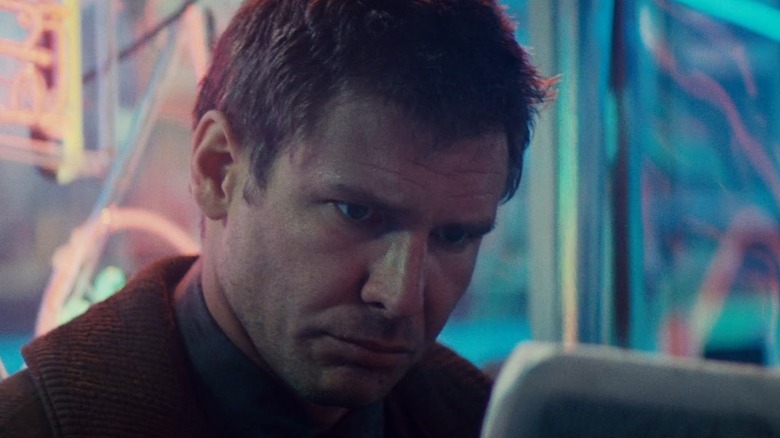
Some refer to "Blade Runner" as the best science-fiction movie of all time, and it's hard to argue with that statement. It influenced so much of sci-fi in the ensuing decades, from its dirty yet futuristic landscape to the nature of android's identities. The film is adapted from Philip K. Dick's "Do Androids Dream of Electric Sheep?" It removes several prominent components from the book, such as the concept of Mercerism, a virtual reality religion, and Rick Deckard's (Harrison Ford) desire to own a living pet. This is in favor of a more focused sci-fi noir that questions whether androids can achieve a level of intelligence that makes them indistinguishable from humans.
Rick's a blade runner, which is basically a detective whose job is to track down replicants (read: androids) who are too human for their own good. The film raises questions as to humanity's true nature, and one could even view the film with Rick being the villain. After all, he comes across as more cold and unfeeling than the androids, who often have all the hallmarks of humanity. Rachael (Sean Young) has memories and is initially unaware of her true nature, while Roy Batty (Rutger Hauer) is aware of his own mortality, with replicants having shorter lifespans than humans.
Despite coming out in 1982, "Blade Runner" still looks incredible. And in a world where AI is frequently on the tip of everyone's tongue, examining artificial intelligence's place in the world continues to be a noteworthy theme. If you consider yourself a sci-fi enthusiast in any capacity, there's no getting around the film's impact.
Minority Report
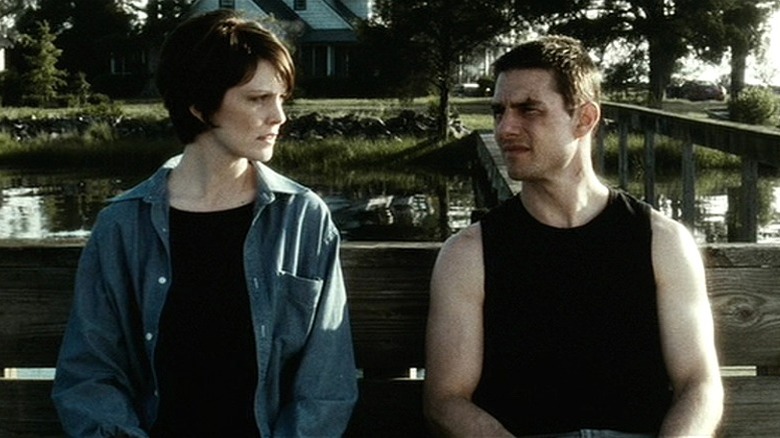
Philip K. Dick's novelette, "The Minority Report," envisions a future where all crime is predicted by three individuals known as precogs. Police can then intervene and prevent the crime before it occurs, which calls into question the nature of free will. It's a gripping story that Steven Spielberg adapted into a chilling vision of the future with his 2002 film "Minority Report," which sees Tom Cruise's John Anderton go on the run when the precogs see that he'll commit a murder in the near future.
"Minority Report" isn't just noteworthy for its complex discussions on the nature of determinism: Are we truly in charge of our fates, or have our paths already been laid out in front of us? But "Minority Report" is also amazing because it's one of a few sci-fi movies that predicted real technology. There's a scene where John's walking and is bombarded with a slew of advertisements. It's not something that had occurred in the real world yet, but it's like Spielberg brought the internet to life. And certain AI technologies are being developed in such a way that they could try to predict crime before it occurs, which means the world may face the same philosophical quandary John Anderton does.
"Minority Report" is far more action-y than Dick's novelette. That tends to be the case with many Dick adaptations, as the author was usually more interested in moral quandaries than explosions. But Dick's philosophy combined with Spielberg's visual flair is a match made in heaven and proof-positive that these dense stories can make for excellent movies in the right hands.
Total Recall (1990)
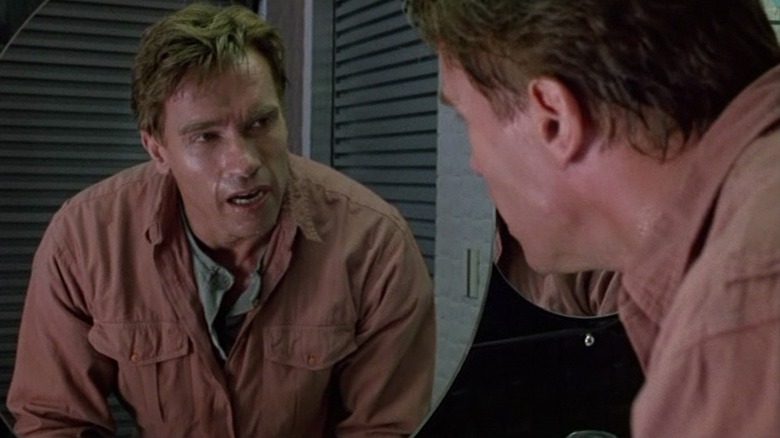
Incorporating paranoia, alternate realities, and chronic hallucinations, Philip K. Dick's works can often be described as mind-bending. That's certainly the case for his novelette "We Can Remember It for You Wholesale," which was adapted into the 1990 film "Total Recall." There's also a 2012 remake, but you can skip that one. The good "Total Recall" involves construction worker Douglas Quaid (Arnold Schwarzenegger), who suffers from false memories of time on Mars. He goes to Rekall, a company that can implant false memories, but during the procedure, Douglas lashes out, believing he's on a top secret mission.
Directed by Paul Verhoeven of "RoboCop" fame, "Total Recall" has all of the filmmaker's signature over-the-top violence and satire. And watching "Total Recall" now may feel eerily prescient, as Rekall itself specializes in manufactured experiences rather than allowing people to do anything "real." Many people today are content living life through their phones, watching other people do fun stuff rather than seeking it out themselves.
It's a bit of a cop-out when a movie ends with the idea that everything you saw might've just been a dream. But the ending of "Total Recall" tackles this in one of the best manners we've ever seen. The ideas presented in the finale aren't just there to confuse you; they play into the larger themes surrounding memory. Like "Blade Runner," there's the idea that our memories, whether they're real or fake, are fundamentally what make us human.
A Scanner Darkly
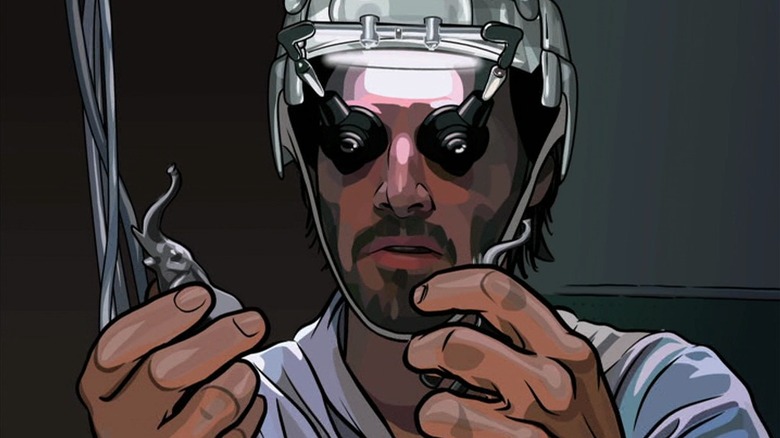
Through the use of rotoscoping, 2006's "A Scanner Darkly" is the Philip K. Dick adaptation that feels the most like it was plucked straight from the author's scrambled mind. Based on Dick's 1977 novel of the same name, both stories hone in on characters engaging in extensive drug use. An undercover agent, Bob Arctor (Keanu Reeves), infiltrates a drug den, but in the process, he becomes addicted to Substance D himself, thereby experiencing intense hallucinations.
Rotoscoping is a technique in which live-action footage is filmed and then traced over by an animator. The result is something that looks somewhat real but just slightly off. It's utilized to perfection when Bob's wearing a scramble suit, which in this world is used by undercover agents to conceal their identities when they're at the station so that no one can identify anyone else. It's a surreal state that puts the viewer into the mindset of one of the Substance D users; you constantly feel as though everything is vibrating and begin questioning your own grip on the film's reality.
In case you can't tell by this point, Dick was very much into the idea of paranoia and characters losing their sense of what's real. Even though "A Scanner Darkly" doesn't get into future sci-fi tech as much as other Dick stories, the idea of losing your humanity is still at the forefront. And if nothing else, you should watch it because it's one of Reeves' favorite movies that he's ever done.
The Adjustment Bureau
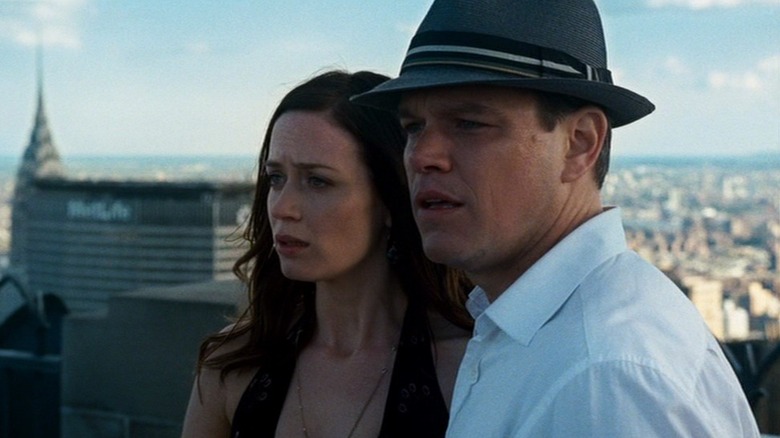
Philip K. Dick's short story, "Adjustment Team," opens with a talking dog, and honestly, the biggest knock against the 2011 film, "The Adjustment Bureau," is that it doesn't include said dog. However, the same themes of determinism are at play. The movie involves congressman David Norris (Matt Damon) meeting a beautiful woman, Elise (Emily Blunt). However, as he tries to learn more about her, he discovers there's an omnipresent organization known as the Adjustment Bureau that aims to ensure everyone follows their own plan. They aim to maintain the illusion of free will that David and Elise seek to escape.
Despite the bizarre Dickian premise, "The Adjustment Bureau" works as well as it does thanks to the central chemistry between Damon and Blunt. The two almost give the film an Alfred Hitchcock-like pathos that grounds the story. Amid all the talk of predetermination, there's a beautiful love story at the core, so even if you don't consider yourself a sci-fi fanatic, there's something to enjoy there.
"The Adjustment Bureau," along with the other four films on this list, provide the best look at Dick's philosophy and the types of stories he wanted to tell. There are commonalities across these stories that will alter the way you think about the world, and if you're feeling daring enough, you can explore the rest of Dick's bibliography. It won't take long until you realize that some filmmaker needs to have the resolve to finally adapt "Ubik" for the big screen.