

5 Most Overpowered Weapons In The Star Trek Universe, Ranked
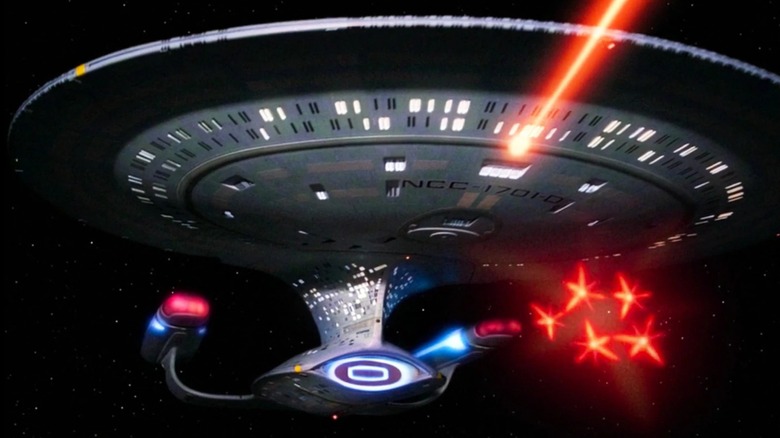
Ever since "Star Trek" first graced the small screen in 1966, the franchise has featured some interesting and powerful weapons. Initially, the series started out with phasers and photon torpedoes playing a big part in space combat. As the series evolved, the weapons grew from something you might use in smaller, ship-to-ship skirmishes to devices capable of incredible damage on a cosmic scale.
These are the weapons that are truly devastating, and "Star Trek" has featured plenty of them. Throughout the "Star Trek" franchise's many TV series and movies, some great stories that needed to be told hinged on a weapon of some kind. These are the episodes and films that draw in viewers, as the stakes are often significant. A good example of this is how a particular weapon threatened an entire solar system in "Star Trek: Generations" (1994), and there are plenty other types of devastation that weapons in the "Star Trek" franchise can bring.
One aspect that mirrors the real world is that not all weapons in "Star Trek" are actually intended to be used as such. Many were developed as tools that have the potential for causing destruction on a large scale. The Genesis Device from "Star Trek: The Wrath of Khan" (1982) is one of the best instances of this, as it has the capability to completely destroy and rebuild the biosphere of a planet. Still, there are far more dangerous devices in "Star Trek," and these five are among the most overpowered, ranked by their potential devastation on a cosmic scale.
5. Red Matter
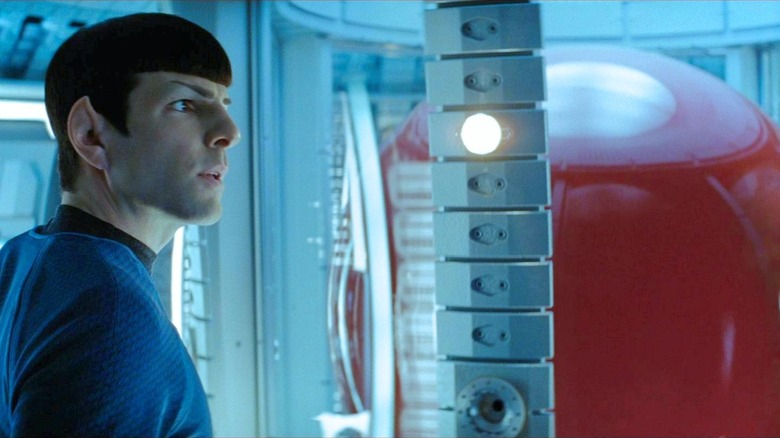
When the "Star Trek" reboot film arrived in 2009, it relaunched the cinematic franchise in what became known as the Kelvin Timeline. The crux of the new take on "Trek" revolves around a temporal event where Ambassador Spock (Leonard Nimoy) and a Romulan vessel inadvertently travel back in time, resulting in the destruction of the USS Kelvin. Years later, it's explained that Spock attempted to use a substance called Red Matter to divert the shockwave from a supernova to save Romulus but failed, resulting in the formation of a temporal rift.
Red Matter isn't well defined in "Star Trek", but what's known about it suggests that it's one of the most powerful substances in existence. A single drop is more than enough to collapse a planet into a singularity. It's unclear how this functions, but the demonstration in the film is clear when Nero (Eric Bana) uses his drill to place a droplet of Red Matter in the core of Vulcan, causing the entire planet to collapse in on itself, killing everyone on the surface while destroying the homeworld of an entire species.
Red Matter is revealed in the "Star Trek: Countdown" comic book miniseries to be an artificial substance created by the Vulcan Science Academy. It functions best when exposed to intense heat and pressure, which is why Nero drills into the planet to deploy the substance on Vulcan. Given the scope of its destructive capability, it's likely that Red Matter could significantly damage or even collapse a star, though this is conjecture based on available data from the associated comics.
4. The Doomsday Machine
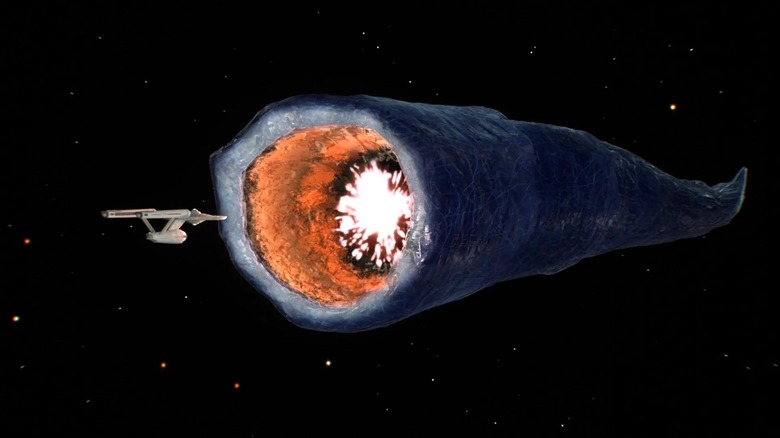
In Season 2, Episode 6 of the original "Star Trek," the USS Enterprise follows a trail of destroyed star systems to find a massive machine, stretching several miles long. It's determined to be entirely automated, using beams of antiprotons to rip planets to shreds and consuming the rubble for fuel. The episode's title, "The Doomsday Machine," aptly describes this device, which Captain Kirk (William Shatner) surmises was created as a weapon of last resort.
It is now on an unstoppable killing streak across the galaxy, while its creators are long since dead. This is a weapon that's more than capable of destroying any planet it comes across, and it's done so for an indeterminate amount of time, leaving widespread destruction in its wake. It's far more efficient at what it does than Red Matter, and it's all but unstoppable. What makes the franchise's OG planet killer so fascinating is that it's one of "Star Trek's" biggest mysteries, as there's no indication of who made the Doomsday Machine or why.
Decades after the episode aired in 1967, some light was shed on its possible origin. A non-canon tie-in novel to "Star Trek: The Next Generation," "Vendetta," written by Peter David and published in 1991, suggests it was created long ago by a race intent on fighting the Borg. Regardless, the Doomsday Machine posed a significant problem for Kirk, who was able to destroy its power systems by flying the USS Constellation into its massive maw and detonating it, leaving it dead in space.
3. A Trilithium Missile
The Nexus in "Star Trek: Generations is revealed to be an energy ribbon that transports anyone caught inside it to a world that's not unlike an afterlife. It sits outside of time and offers infinite joy to anyone within. However, getting into the Nexus is dangerous, as any starship that crosses its path is destroyed. Returning to the energy ribbon is the driving force of Soran (Malcolm McDowell), an El-Aurian scientist who has worked for nearly a century to direct the Nexus to a planet to ensure his readmittance.
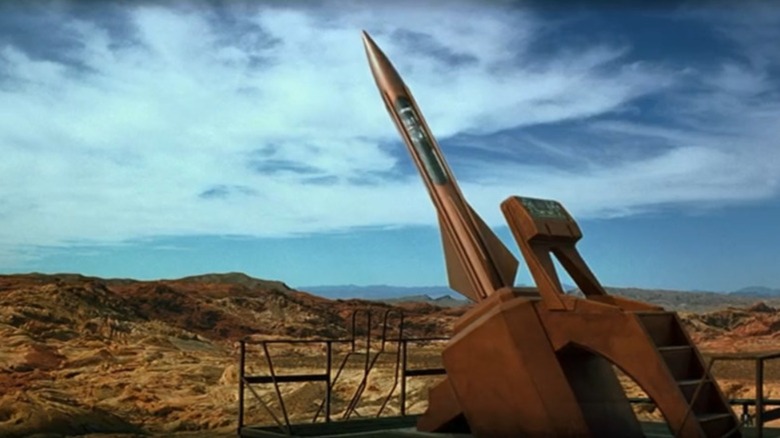
Unfortunately, his method in doing so requires a trilithium device, which he fashions into a missile. In this way, the weapon can stop all nuclear fusion within a star, causing it to instantly achieve supernova. The intended result, which Soran uses to devastating effect, is the creation of a stellar shockwave that directs the Nexus to the planet Veridian III. There, Soran is engulfed by the energy ribbon. In destroying the star (which happens to be the second one he's annihilated in this manner), Soran also destroys all of its nearby planets.
It's one thing to destroy one planet or even a few here or there; Soran instead destroyed multiple solar systems, causing widespread gravitational changes throughout the galaxy. The resulting destruction was incredible, and he did it with little more than a single missile launched from the surface of a planet. It takes almost no time to reach its target, and the effect is nearly instantaneous, making the trilithium missile one of the deadliest weapons in the "Star Trek" universe.
2. Annorax's Temporal Beam Weapon
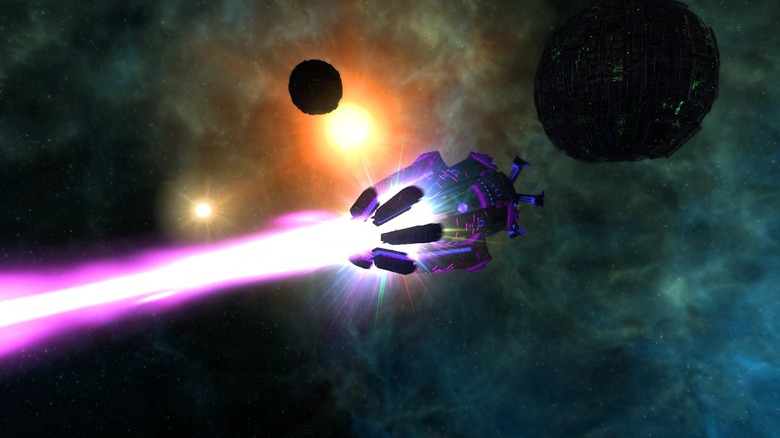
One of the more interesting weapons in the franchise isn't a weapon in the traditional sense. In "Star Trek: Voyager's" two-part episode "Year of Hell," the Federation starship meets a low-tech species that suddenly becomes superior and belligerent in a number of ways, putting the ship's crew through agonizing trials. This is due to one man named Annorax (Kurtwood Smith), a Krenim scientist who built a special ship and weapon that functions outside of spacetime, making it undetectable and untouchable under normal conditions.
When Annorax fires his temporal weapon on a target world, he erases the planet's entire species from history, potentially wiping out trillions of lives in the process while impacting multiple star systems. The weapon is the reason that the Krenim Imperium rises to power, and Annorax's goal for using it is to save 50 million Krenim lives and recover his lost family, who died in the destruction of the species' colony on Kyana Prime accidentally caused by Annorax himself. As he continues to alter history over the course of the two-parter, the Krenim destroys one civilization after another, failing to achieve his goals.
In one of Captain Janeway's (Kate Mulgrew) fiercest moments, she and the crew stop Annorax, inadvertently achieving his goals. The weapon worked by pushing its target outside of the spacetime continuum, erasing them from history. Precise calculations were made to ensure the best results, but each change branched in unseen ways. This made Annorax's temporal beam weapon incredibly powerful, but also one of the most dangerous devices to use, as its results could be unpredictable.
1. The Omega Molecule
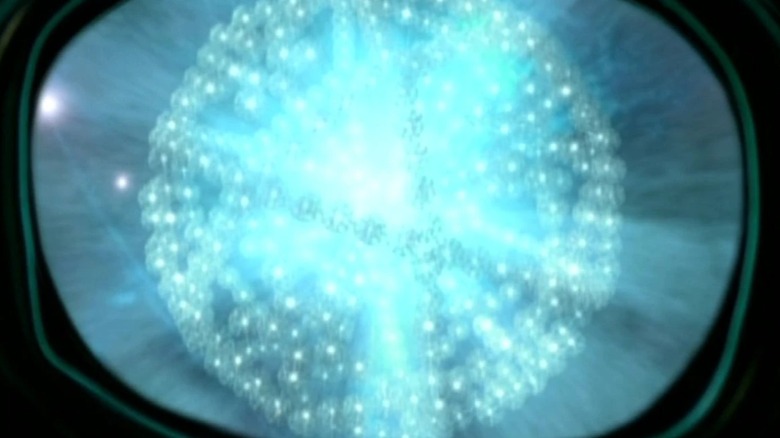
In "Star Trek: Voyager's" Season 4, Episode 21, "The Omega Directive," it's revealed that Starfleet captains have a rule they must follow if an Omega molecule is ever detected. The rule is so paramount that it's one of the only ways that a Starfleet captain can violate the Prime Directive. The Omega molecule is something that the Federation has determined to be too dangerous to be allowed to exist, so if anyone ever detects even a single trace of the substance, all else becomes secondary; its destruction comes first, no matter what.
That said, the Omega molecule isn't a weapon — at least not in the traditional sense. Instead, it's a substance of such potentially destructive power that the Federation will not allow it to exist in any capacity because it can easily be weaponized. There are no known ways to contain an Omega molecule, hence the need to destroy them, and it's possible to synthesize it with boronite ore. Once the molecule inevitably destabilizes, the resulting destruction it causes to subspace renders warp travel impossible across several light-years.
Starfleet learned this lesson the hard way when an Omega-related disaster destroyed subspace in the Lantaru sector during experiments to unlock its potential as a power source. As a result, the Omega Directive became law in the Federation. When the USS Voyager detects the molecule, Captain Janeway jumps into action. It's clear from her reaction that she's not playing around; she makes it clear that studying Omega is simply too dangerous, opting instead to destroy the substance instead of using the opportunity to learn more about it.