

The Hardest Stephen King Character To Get Right In Mike Flanagan's Dark Tower Series Isn't Who You Think
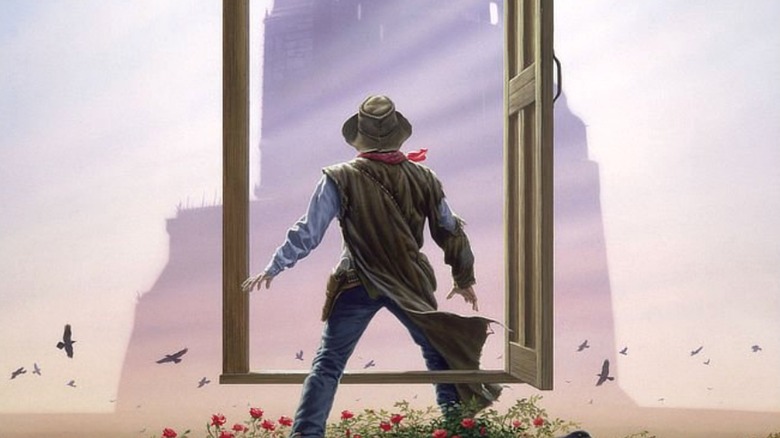
Stephen King's "The Dark Tower" is an epic, told across decades, discovered by the author as it was composed. It spans thousands of pages, hundreds of thousands of words, and features so much lore that we still haven't reached the end of its secrets. To call it "complex" is an understatement.
And that complexity extends to the characters in King's multi-book saga. In the world of "The Dark Tower," because of the lengthy timeline and depth of characterization, even the most straightforward figures are hiding layers of depth that slowly bubble to the surface over the course of the story. That means every character is hard to adapt, but some will inevitably be trickier to nail than others, and when it comes to the hardest character to get right in the entire series, it's probably not who you think.
Yes, Eddie Dean is a recovering heroin addict with a very dark past, and Susannah Dean is a newly formed personality built out of the two disparate figures who once shared her body, but it's not either of them who is the toughest to get right. Even Roland Deschain, who has to carry the weight of the world beneath a stony exterior, isn't truly the trickiest character. That honor goes to a boy named Jake Chambers, and he may well be the linchpin holding the entirety of Mike Flanagan's upcoming "Dark Tower" series together. If, that is, the show gets him right.
Jake Chambers is an impossible boy
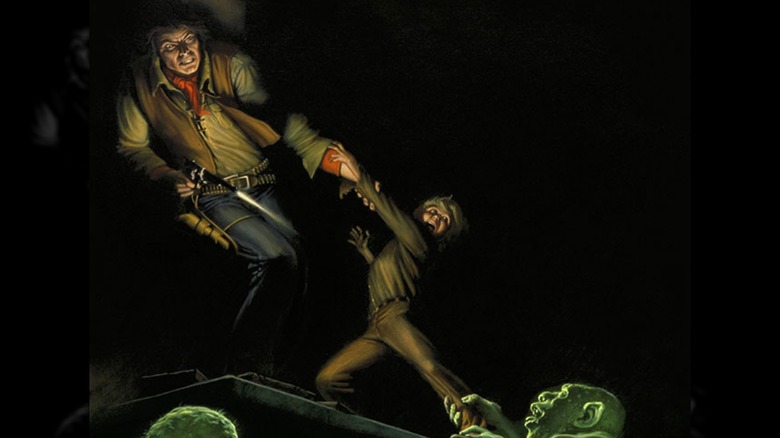
The first book in "The Dark Tower" series, "The Dark Tower: The Gunslinger," is a very sparse novel. It's short, features very few principal characters, and a big chunk of it is devoted to flashbacks. The plot doesn't advance all that far, but we do learn about several of the emotional chains binding Roland, which is where we meet Jake.
He is the first major character to join Roland in the "present" day of the main story, and like Roland himself, he arrives as something seemingly simple. He's a lost boy, crouched in an old way station in the middle of a desert, with no idea where he is or how he came to be there. For Roland he's a burden, an obstacle. For the audience he's a source of instant empathy that will inform how we view Roland in a host of remarkable ways.
By the end of the book, Jake is seemingly dead, a strange bump in Roland's road — but he's also somehow become Roland's surrogate son. Stephen King's handling of this seemingly discordant set of emotions is the first major narrative hurdle in the book, not just because it makes us conflicted about Roland, but because it sets up a seven-book arc for two different characters — and he nails it. It's a tightrope, but in a very short book it's carried out with grace and style, and getting that feeling from the page to the screen is key. Of course, that's not the end of the hurdles. Jake's death is just the beginning of his story, adding to the weight of his arc as an impossible boy who dramatically changes Roland's quest.
Jake Chambers has to carry one of the strangest Dark Tower stories
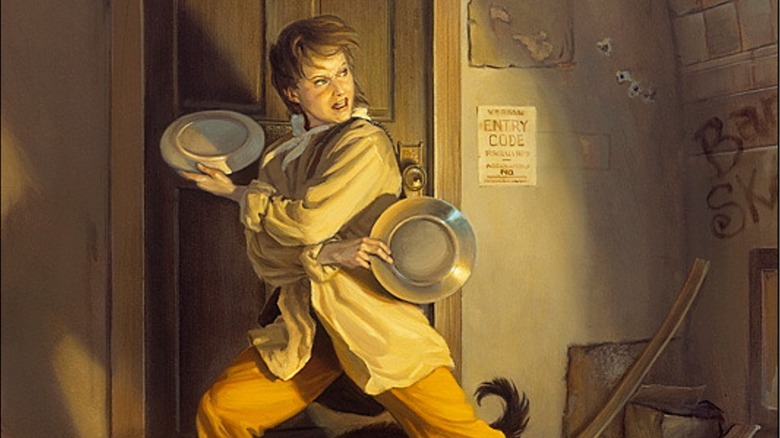
After his apparent death, Jake returns near the end of the next novel in the series, "The Dark Tower II: The Drawing of the Three." In this story, set in 1977 New York City, Jake is stalked by Jack Mort, a serial killer who loves staging apparently accidental deaths for his victims. His destiny seems to be to push Jake into traffic and kill him, which would send Jake into Roland's universe in the first book, but Roland's presence in Jake's New York changes this. Suddenly, Jake is alive in one timeline and dead in the other, and only Roland and Jake himself remember this paradox. Jake's already-heightened emotional life as a young man in a cold household is suddenly thrown into madness as he ponders the memory of his own death, which both did and did not happen.
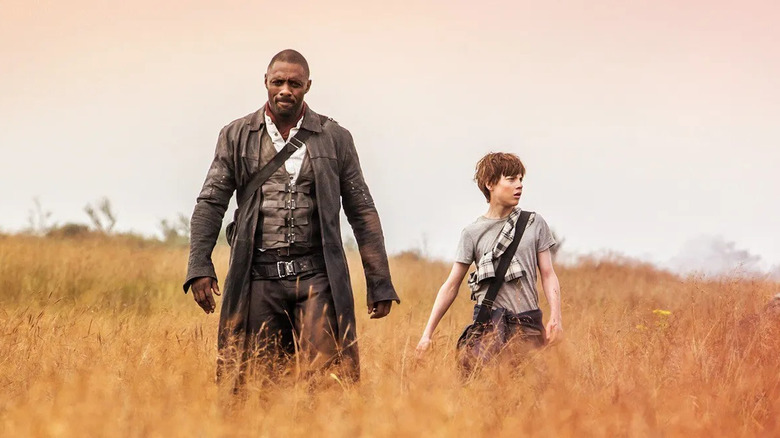
This makes Jake an even more complex character, and adds to the sense of contradiction surrounding him. He has to be youthful and ancient, tormented and naive at the same time. It's a difficult thing to get right on the page, which means it'll be just as difficult to adapt to the screen and find the right young actor to embody Jake's stranger qualities. Of all the main characters, he has to take the biggest emotional leaps, and that makes him uniquely challenging. In the first "Dark Tower" film adaptation he was smoothed down into an artificial Chosen One, but there's much more to Jake than that.
Jake's story has to carry the entire series
Contains spoilers for "The Dark Tower VII: The Dark Tower"
The protagonist of "The Dark Tower" is Roland Deschain, a man hellbent on completing his quest to reach the nexus of the universe, even as that universe takes everything from him along the way. Roland's destiny is to be alone, and he knows this because every key point in his life has reinforced it, leaving him the last of his kind. Time and time again we see Roland lose people, including at the very end of his quest. And this is where Jake — not the protagonist, but arguably the most important supporting character — comes in.
Jake is our first encounter in the story's present with Roland facing loss, the way he pushes the emotions away for the sake of his quest yet simmers with angst each time. And then, at the end, he is Roland's last encounter with loss, at least in this incarnation. Jake, who has become Roland's son in basically every way by the end, has to die in order to preserve the quest for the Tower. Roland is so close to his goal, the thing to which he's given everything, that it seems he'll do almost anything to get there. So he does the unspeakable, and allows Jake to die one last time. That Jake dies saving a fictionalized version of Stephen King himself only adds to the emotional impact.
It is a moment of dizzying complexity, and it pays off years of storytelling between two characters in a heartbreaking, unforgettable way. Getting it right is crucial, and to do that, you have to get Jake right from the beginning. Fortunately, the story is in very good hands.
Mike Flanagan will do right by Jake Chambers
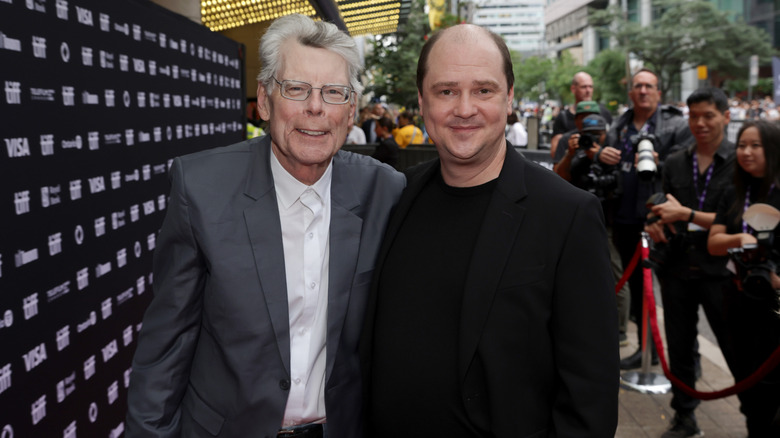
There are many, many reasons to have confidence in Mike Flanagan, who reveres Stephen King in ways few other filmmakers ever have, as he approaches "The Dark Tower." If we're thinking in terms of Jake Chambers, though, perhaps the best reason to be confident is Flanagan's long history of working with young actors in emotionally demanding performances.
It starts in his second feature film, "Oculus," and continues through "Before I Wake," "The Haunting of Hill House," "Doctor Sleep," and much, much more. Throughout his career Flanagan has been able to center the narratives of young people in his films in a way that's neither condescending nor garish. His kids feel like fully formed people with their own perspectives, not just objects to be placed in random peril for the sake of moving a story along. He understands King and he understands children, which means he has a head start in understanding how Jake fits into this story, and what getting him right can do for the rest of the tale.