

Tragic Details About The Office Star Rainn Wilson
The following article mentions addiction, mental health issues, and suicide.
The world of sitcoms is riddled with quirky characters that should be downright unlikeable — and yet, they're beloved by the masses. This is all thanks to the actors behind these difficult personalities, who boast an innate talent for making them comedic rather than irritating. An absolute pro in this area is Rainn Wilson, who, over the course of nine seasons of "The Office," established Dwight Schrute as everyone's favorite beet-farming assistant to the regional manager, despite his eccentricities.
For many, Dwight is a comfort character. From sick days to breakups, a quick "The Office" binge to see him endure the pranks of Jim Halpert (John Krasinski) and conduct martial arts demonstrations is the ultimate medicine. However, while crafting those iconic antics (and Dwight's occasionally genuine one-liners) that bring happiness to fans, Wilson didn't feel much joy. In fact, he's proof that sometimes, those with the funniest personalities on screen overcame the biggest hurdles in real life.
Wilson's earliest memories are of hurt and neglect due to his mother abandoning him as a toddler. This gravely impacted him as an adult, with anxiety, depression, and addiction threatening to halt his pursuit of an acting career. Even in sobriety and as part of a top network sitcom, he struggled to find purpose. These days, Wilson is candid about the tragedies of his life in hopes that his story will make a positive impact on those experiencing something similar.
He had a traumatic childhood
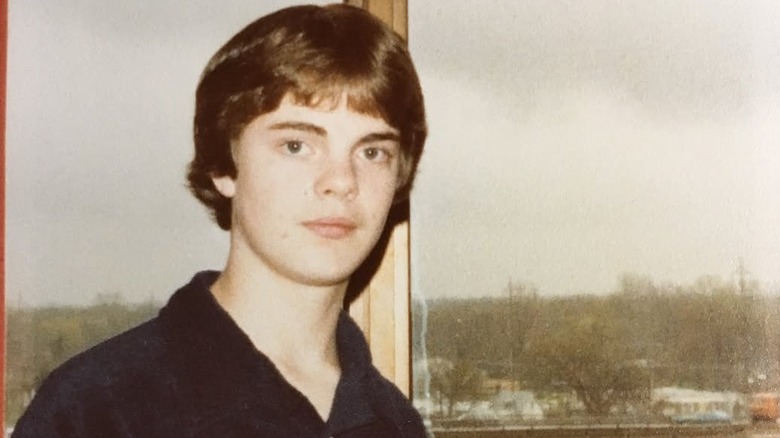
From an outsider's perspective, the upbringing of Rainn Wilson might have appeared normal — home cooked meals, clean house, strong faith. Yet behind closed doors, it was anything but. After his mother abandoned Wilson as a toddler, his father joined the Baháʼí faith and moved them to the Nicaraguan jungles for a brief stint before returning to the U.S. and remarrying. Although Wilson's dad was married to his stepmom for over 15 years, the relationship turned loveless only six months in — a dynamic that had a huge impact on Wilson.
On "The Diary of a CEO" podcast, Wilson reflected on how, just moments before hosting a Baháʼí gathering, the couple had a massive fight. Fed up with his father's narcissism, Wilson's stepmother raged and broke dishes. But once the guests started arriving, they pushed that aside to read beautiful prayers and meditations: "There was never any kind of acknowledging what had just happened. And so, for an 8-year-old, 9-year-old, 10-year-old being in that milieu, you're like, 'What the hell is going on? Is this how people act? We have all these emotions, but we don't talk about them, and then we go and we pray together?'"
Wilson's father and stepmom were not emotionally present for him in a way that a child and young adult requires. All he knew was anger and forced happiness, when all he truly craved was a simple hug. He said on the "Mighty Pursuit" podcast, "What I really wanted was just an embrace of, 'Rainn, you're beautiful and special and we adore you, and you're doing great.'"
He had anxiety and depression
Following a childhood that was fraught with tension, Rainn Wilson's mid-20s and early 30s saw him experience waves of intense anxiety, depression, and suicidal ideations as he questioned the meaning of life. Fresh out of drama school and attempting to make it as an actor in New York while living in an abandoned, rat-infested beer brewery, Wilson's panic attacks were so intense and debilitating, he often thought he was having a medical emergency.
He said on "The Diary of a CEO" podcast, "I remember getting these anxiety attacks that would leave me literally shaking on the floor and sweating, and I thought I was dying. I was about to call 9-1-1 five different times. Heart palpitations, sweating. I talked to a doctor at NYU about them and they said, 'Oh, these are just anxiety attacks.' So, I knew that's what they were, but I didn't really know anything about them."
Since this was the '90s, mental health wasn't a widely discussed topic, and neither was therapy. Therefore, whenever anxiety reared its ugly head, Wilson didn't have a support system equipped to properly help. On the "Chase Jarvis LIVE Show," he recalled punching a mirror out of frustration. With his hand dripping blood and unsure where else to turn, Wilson went to his dad, who took him to a teriyaki restaurant: "He didn't know how to comfort someone or how to interact with someone who was being emotional. He was from that really old school way of being and he didn't know what to do."
He used drugs and alcohol to feel less anxious
Eventually, Rainn Wilson's anxiety, depression, and panic attacks became too much for him to live with daily. Since he had yet to discover the benefits of therapy and had limited people in his life who could empathize with his experiences, Wilson turned to drugs and alcohol as a coping mechanism. He desperately sought an escape from his own mind, and substances did the trick ... for a little while.
"When I was using and drinking, I was just medicating anxiety. I just didn't want to deal with myself and my feelings, so anything to escape, medicate, soothe. And then it became a problem. It became a crutch. I couldn't get through the day without medicating myself," he told the Palm Beach Recovery Center.
Wilson realized on his own that his vices were becoming problematic and, one day, simply decided to quit. But soon after, he felt that old feeling of anxiety creeping back in. Instead of returning to drugs and alcohol, he attempted to soothe himself with other addictions ranging from excessive working to pornography. It wasn't until he attended therapy for the first time at the age of 40 while living in Los Angeles that he began to have some revelations — the main one being the negative impact of his childhood, which was filled with neglect and emotional suppression.
It took a long time to find his big break in acting
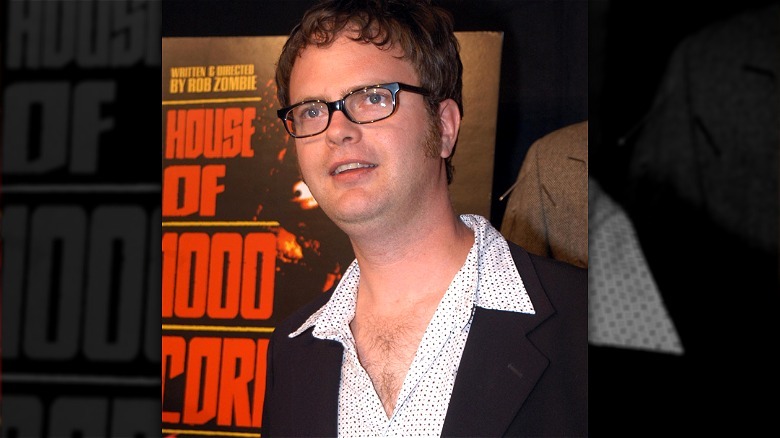
Nothing about Rainn Wilson's early days in acting was easy. On top of his anxiety, depression, crippling panic attacks, and bleak living conditions in New York, Wilson's big break — and steady on-screen work — was slow to arrive. Throughout the first decade of his career while living in the Big Apple, Wilson landed a number of small roles. Wilson landed on-episode gigs on "CSI: Crime Scene Investigation" and "Law & Order: Special Victims Unit." All the while, he honed his knack for bringing eccentric, slightly unorthodox personalities to life. Although the early 2000s saw him snag the recurring role of Arthur Martin on "Six Feet Under" and die a particularly gruesome death in the cult classic horror flick "House of 1000 Corpses," none of this was enough to make him a household name ... or pay the bills.
"I calculated it. For those 10 years, I never made more than $17,000 in a year doing acting," Wilson said on "The Skinny Confidential" podcast. "I would wait tables and cater, and I would drive a moving van. That was another one of my big jobs, side hustles. It wasn't until I came to LA that doors started opening for me because I had this ability to create weird, interesting characters. Hence, eventually, Dwight Schrute. But I played a lot of other characters before and after Dwight."
He oftentimes wasn't happy on The Office
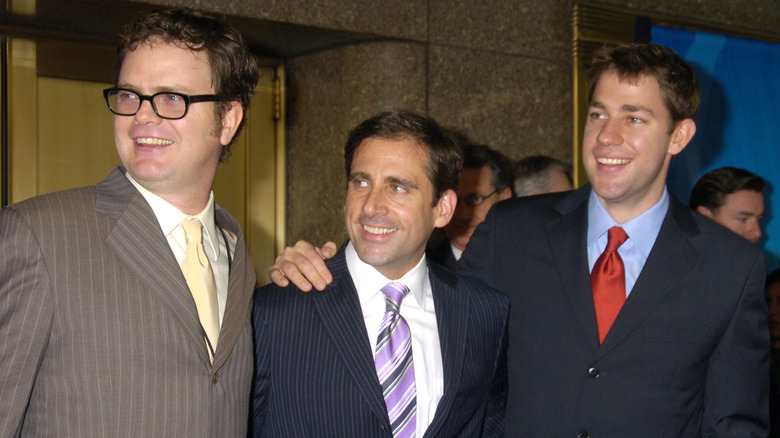
After a decade of roughing it in New York, Rainn Wilson finally made it with the dawn of "The Office." For the first time, he had it all — financial security, critical acclaim with three consecutive Emmy nominations, comedic geniuses as coworkers, and the ability to bring an iconic fan-favorite character to life. He should've been over the moon, right? As Dwight Schrute would say, false.
"There were times on 'The Office' that I really struggled because I really wasn't happy. It wasn't enough," Wilson said on "The Diary of a CEO" podcast. He went on to explain, "I was like, 'How come I can't get more movies? Why did my movie I did bomb? Why won't they make a deal with me? I just want to have this. I want an office in Warner Bros.' I spent a lot of unnecessary time, angst, and anguish in that anxious discontent at a time when I should have just been like, 'It doesn't get better than this. Just enjoy it. Drink it in and be a part of this incredible artistic experience.'"
While Wilson didn't enjoy making "The Office," the discontent he felt wasn't from ungratefulness. Rather, it stemmed from a lifetime spent disassociating and numbing himself from the present moment, whether it was his stepmom smashing dishes or a panic attack. And that doesn't change overnight, even when things are going amazingly well. It wasn't until Wilson reconnected with his spirituality and discovered the magic of gratitude that he was able to appreciate the good.
The Office was difficult to film after Steve Carell's departure
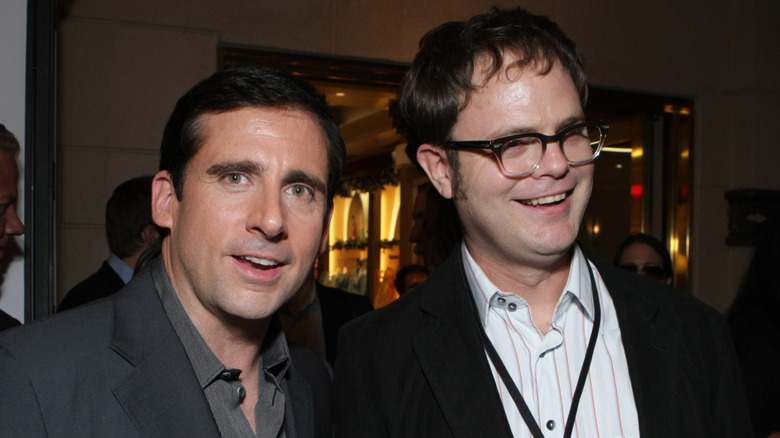
Many fans of "The Office" are vocal about how much they loathe the final two seasons. After Steve Carell parted ways with the show in Season 7, a Michael Scott-less Dunder Mifflin had a different energy to it ... for both audiences and cast members. "It was a little bit chaotic trying to figure out the tone of the show, who's the lead, and how are we telling these stories without the comic engine of the show, which is Michael Scott, and without one of the greatest comic actors in American history at the center of our show," Rainn Wilson said on the "Good Guys" podcast.
Not only did Carell's departure impact the show's tone, it left Wilson missing a colleague and friend with whom he shared some of the best moments on "The Office" as Michael and Dwight. In an interview with "All Things Comedy," Wilson hailed Carell as one of the greatest actors of all time. Even in the midst of his struggles to find gratitude, Wilson formed an appreciation for Carell's impeccable craft: "You could never throw Steve. You'd be in the middle of a scene and you could start honking like a goose, and he would just take it completely in stride ... It was absolutely astonishing to watch."
He was emotional when The Office ended
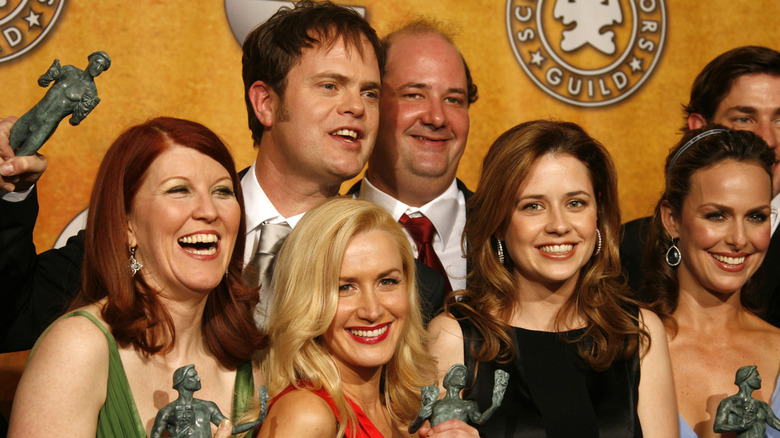
Rainn Wilson may have spent his prime years on "The Office" looking for bigger and better opportunities, but when it all came to an end in 2013, he couldn't stop the waterworks. While Wilson agreed to end "The Office" after nine seasons, he was extremely emotional on the last day of filming, which was expertly scripted so that the entire cast was part of the final scene.
"I just remember Rainn Wilson crying," co-star Ellie Kemper told Business Insider. "He looked stricken and I'd never seen him like that. I was so moved. It was such a powerful experience." On an episode of "Watch What Happens Live with Andy Cohen," Angela Kinsey echoed Kemper's statement: "Rainn Wilson broke down."
The finale of "The Office" is a tear-inducing one. Although the employees of Dunder Mifflin are all at different points in life, especially following the airing of their documentary, that office — where countless pranks and a few love stories unfolded — forever remains a part of them. And for Wilson, that sentiment holds true for Dwight and himself. In a 10-year anniversary post on Facebook, he wrote, "I'm forever blessed by my association with a show that has withstood the test of time and brought so much joy to so many over the years."
A Dwight Schrute spinoff was axed
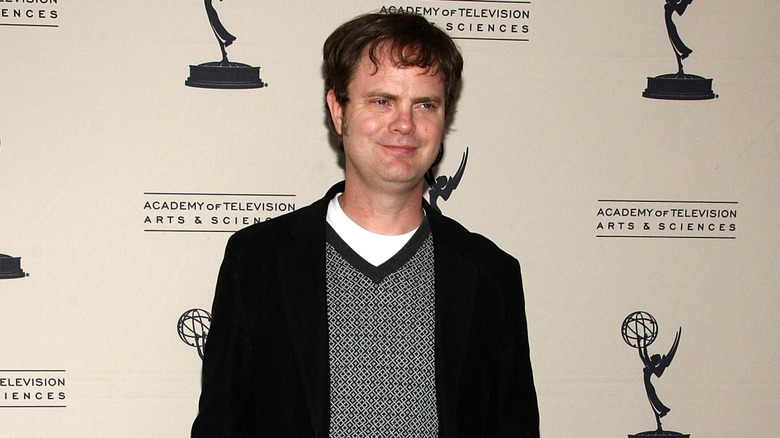
"The Office" fans likely noticed that Season 9, Episode 17 ("The Farm") has a slightly different tone than other episodes. Dwight Schrute briefly steps away from Dunder Mifflin to travel home, where he reunites with his equally eccentric family members for an aunt's funeral. Originally, NBC intended for the episode to serve as a backdoor pilot to a Dwight-centered spinoff, rightfully titled "The Farm." However, that project never expanded past "The Office."
"Had [NBC] taken 'The Farm,' they'd probably have another billion dollars in the bank,' Rainn Wilson said on "The Last Laugh" podcast. "Even now, all the people that have seen 'The Office' 20 times, they're going to watch 'The Farm' at least once or twice. Would it have been as good as 'The Office'? No. No way. Not even close ... Would it have been a good, solid comedy? Yeah, it would have, and we would've done some really cool stuff. And I think they really missed out."
According to Wilson, the network didn't fully comprehend how beloved "The Office" was until the dawn of streaming, which saw audiences bingeing the show several years post-finale. If NBC recognized its global popularity sooner, televisions may have been graced with a season or two of Schrute family antics. Still, Wilson admitted he was relieved to take a break from Dwight after "The Office."
He grieved the death of his father
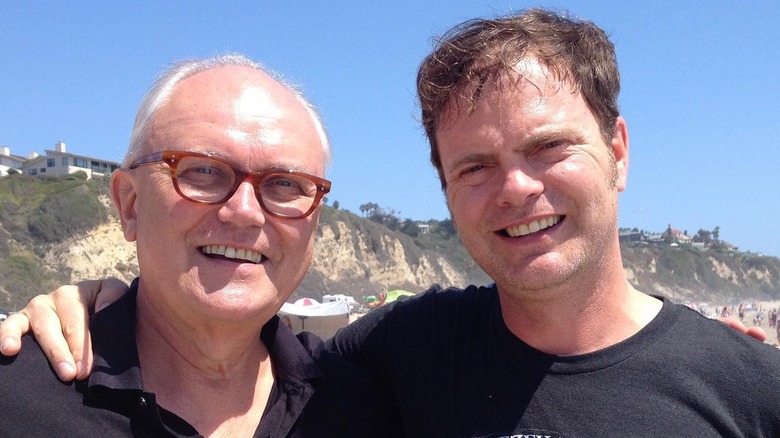
Rainn Wilson may be candid about his difficult upbringing and how he often wished his father, Robert Wilson, provided stronger emotional support. But this doesn't mean there wasn't love between them. When Robert died in 2020 from heart disease and complications during a quadruple bypass surgery, Rainn took the loss extremely hard — especially because he and his stepmom had to make the devastating decision to take him off life support.
"He was going to be dead within an hour. We were sobbing," he said on "The Diary of a CEO" podcast. "I looked at his gray body there on the table and I saw all these aspects of my dad that I loved — the one eyebrow hair kind of poking out, the mole on his arm, the way his hands are, his hair kind of messy — and was filled with such love and such heartbreak. At the same time, at seeing his lifeless body, I was like, 'Um, this isn't him. This isn't my dad. This is the vessel that carried my dad, Robert Wilson, and his beautiful heart and spirit, his dynamism, his creativity, his light.'"
During this time, Rainn leaned on his spirituality, taking comfort in the idea that his dad wasn't just "snuffed out like a candle" but had passed on to someplace better. He continues to honor Robert on social media. One Facebook post from 2021 read, "I miss him every day. And still I feel his presence."
He was slammed on social media for his religious commentary
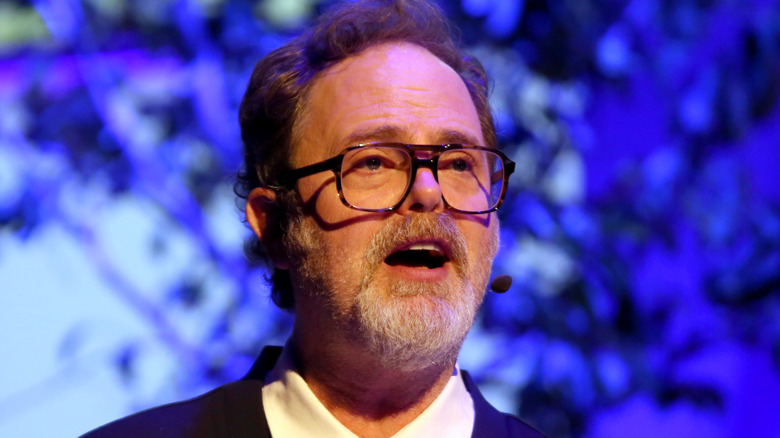
After distancing himself from religion for some time, Rainn Wilson reconnected with his spirituality and the Baháʼí faith of his childhood in his 20s. The basis of Baháʼí is simple — a belief that all religions are just different iterations of the same source. While Wilson isn't a Christian, his faith teaches him to see them as brothers and sisters. So, when "The Last of Us" Season 1 portrayed David (Scott Shepherd) as a corrupt Christian preacher who turns to cannibalism and holds Ellie (Bella Ramsey) hostage, Wilson took issue.
"I do think there is an anti-Christian bias in Hollywood," he posted on X (via Business Insider). "As soon as the David character in 'The Last of Us' started reading from the Bible, I knew that he was going to be a horrific villain. Could there be a Bible-reading preacher on a show who is actually loving and kind?" His post garnered some backlash, with many arguing that he posted prematurely before fully understanding David's character in "The Last of Us," who is not actually Christian. Although David reads from the Bible and has followers believing in his preachings, he's a villainous false prophet who uses religion for power. But Wilson buckled down, adding, "Most Christians that I know are kind, accepting, and loving and seeking to make the world a better place. They should also be honored in the media."
He still struggles with the 'shadow' of his addiction
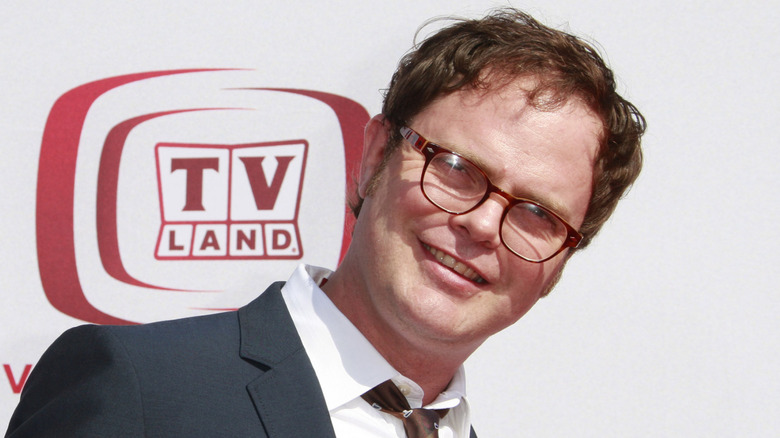
Rainn Wilson is a different man from that 20-something who punched a mirror and got teriyaki with his dad while sporting a bloody hand. He's gone to therapy. He's reconnected with his spirituality. Yet, he still knows that he's far from perfect and that there's always work to do. The effects of his childhood linger, with Wilson still learning how to be a compassionate husband, father, and friend after not experiencing that for most of his early life. Those years spent numbing his anxiety with drugs and alcohol also linger.
"I still have a big ego. I'm still narcissistic and I still want ego satisfaction. It's always there. They always say in addiction that your addict is in the basement doing push-ups," Wilson said on "The Diary of a CEO" podcast. He added, "[Carl] Jung talks about the 'shadow' side and it's so important. Part of the therapeutic process is to get to know and embrace and accept and love one's shadow. I have a dark shadow. It's an addict shadow. It's a miserable shadow, and it's self-important and righteous and entitled. This is part of who Rainn Wilson is and I'm not going to get rid of those aspects of myself by keeping that shadow at arm's length or locked in a closet."
Wilson's journey is an inspirational one. Decades ago, his mental health and addiction threatened to completely take over. Now, he can candidly acknowledge his tragic past and coexist with the darkness rather than let it consume him.
If you or anyone you know needs help with addiction issues, mental health or is in crisis, help is available:
- Visit the Substance Abuse and Mental Health Services Administration website or contact SAMHSA's National Helpline at 1-800-662-HELP (4357).
- Please contact the Crisis Text Line by texting HOME to 741741, call the National Alliance on Mental Illness helpline at 1-800-950-NAMI (6264), or visit the National Institute of Mental Health website.
- Call or text 988 or chat 988lifeline.org.