

10 Biggest Box Office Flops Of The 2020s (So Far)

The 2020s have been a strange time for cinema. High quality movies have been plentiful, especially when one expands their gaze to the indie and global film scenes. However, theatrical moviegoing has constantly been under scrutiny in a world rocked by COVID-19 and where increasingly prolific streaming services have further added doom and gloom to the theatrical movie space. Not helping matters are the assortment of mighty box office flops that have rocked the cinema world.
Whether it's the biggest box office bombs of 2024 or another collection of the biggest flops of summer 2025, there are countless examples of motion pictures that lost oodles of money. These same box office duds also tend to send people into a panic over the long-term viability of theatrical exhibition. The movies that really crystallize the fraught nature of 2020s cinema, though, are the 10 biggest box office flops of the decade so far.
There is no one template for what a massive money-loser in the 2020s can look like. This collection of movies range wildly in genre and tone. Some are grounded dramas or comedies that tried luring grown-ups back to theaters. Others were superhero movies that performed closer to "Jonah Hex" than "The Avengers." However, what binds all these disparate titles is that they all occupy the same, unpredictable decade. Their box office hauls were miserable, making them poster children for 2020s cinema woes. One note before going forward: Titles that received simultaneous streaming releases like "Luca" and "The Matrix Resurrections" are exempted from this list.
Moonfall

For decades, Roland Emmerich's big-budget disaster movies were as reliable moneymakers as you could find in Hollywood. "Independence Day" was famously a gargantuan smash, but "The Day After Tomorrow" and "2012" each grossed more than $166 million domestically; the latter film even procured more than $750 million worldwide. But the good times didn't last forever: 2016's "Independence Day: Resurgence" was a major underperformer, proving that this mode of popcorn entertainment had become old hat.
However, the former blockbuster king truly became a box office pauper with 2022's "Moonfall," which saw Emmerich chronicling a handful of humans stopping the Moon from colliding with Earth. Hailing from indie distributor Lionsgate rather than the major studios handling his prior disaster films, "Moonfall" also opened over the first weekend of February 2022 rather than a prime summertime or November launchpad like "Independence Day" or "2012."
To boot, the premise of "Moonfall" was less dramatically engaging than past Emmerich disaster movies. "Independence Day" and "2012" played on widespread fears related to the existence of aliens or an ancient Mayan prophecy. "Moonfall," meanwhile, got lost in Moon-based outer space lore and sequences of generic CG cities collapsing. Inevitably, "Moonfall" only grossed $59 million worldwide, only $19 million of which came from domestic audiences, on a $150 million budget. External problems like its Canadian theatrical release getting canned due to box office closures amid the omicron variant of COVID-19 could only excuse so much of this one's failure. The immense box office losses on "Moonfall" truly cemented how Emmerich no longer belongs in this new blockbuster cinema world.
Strange World
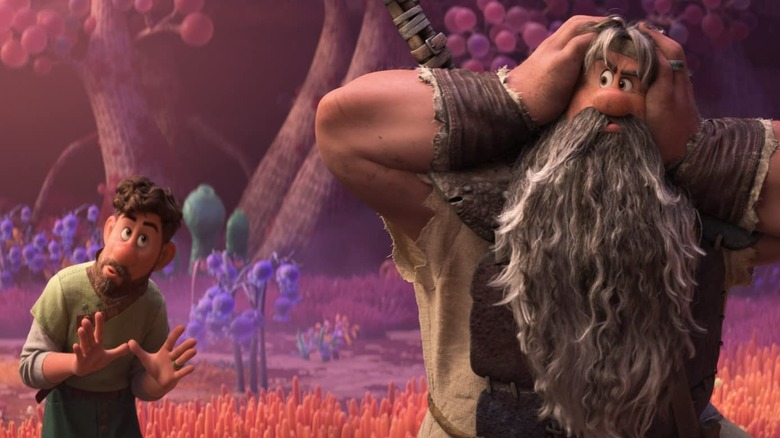
Nearly all cinematic genres or spaces can produce hits. Musicals are supposedly "dead" — until a hit like "Chicago" comes along and revives the genre. Same for Westerns, which were modern box office poison before "True Grit" and "Django Unchained" proved that theory wrong. If it's a good story with compelling characters and visuals, people will show up to the theater. Still, there are a handful of incredibly specific subgenres that moviegoers seem to be adverse to. One of these is animated sci-fi action films aimed at families hailing from Walt Disney Animation Studios.
"Atlantis: The Lost Empire" and "Treasure Planet" were a pair of early 2000s box office underperformers that reaffirmed this demographic just isn't interesting to Disney fans. 20 years after "Treasure Planet," Disney Animation tried this genre again with "Strange World," an homage to old-school adventure movies. Once more, though, audiences greeted the prospect of the "Zootopia" studio making its own "Sky Captain and the World of Tomorrow" with a shrug.
On a massive $180 million budget, "Strange World" only grossed $74.74 million worldwide, with just over $39 million coming from North American audiences. A dismal haul ranking among the lowest grossing post-1990 Disney Animation Studios projects worldwide, "Strange World" handily became the biggest money-loser among all 2022 movies. Its failure reflected not only the consequences of sending so many new animated Disney films to streaming platforms in 2020 and 2021, but also how explosion-heavy sci-fi is a hard sell for family moviegoers.
Amsterdam

Before 2015, only one of David O. Russell's directorial efforts ("Joy") had cost more than $48 million to produce. That changed radically with "Amsterdam," a 2022 motion picture starring Christian Bale, John David Washington, and Margot Robbie that cost a staggering $80 million. Despite assembling so many big stars (including Robert De Niro, Rami Malek, Anya Taylor-Joy, and Taylor Swift, among many others) during the height of the COVID-19 pandemic, this wasn't necessarily what sent the budget skyrocketing.
Instead, choices like shooting "Amsterdam" in Los Angeles rather than Boston ensured that this project cost a pretty penny despite being a largely low-key affair with no explosions or CG characters. Neither the massive cast nor any residual goodwill from previous Russell features like "The Fighter" could save "Amsterdam" from an embarrassing financial fate. This movie only grossed $14.9 million domestically and $29.4 million worldwide.
Among 2022 theatrical releases, "Amsterdam" made less domestically than titles like "Father Stu," "Prey for the Devil," and "Barbarian." It was also one of Bale's lowest-grossing post-"Batman Begins" wide releases, even earning less than "Hostiles" and "Vice." He and the other "Amsterdam" stars couldn't save this disaster, while dismal reviews and confusing marketing kept adult moviegoers away in droves. As a result, "Amsterdam" ended up losing an estimated $108 million for its financiers. There's a reason earlier David O. Russell films cost considerably less than this boondoggle.
The Marvels

After grossing $1.1 billion worldwide, 2019's "Captain Marvel" seemed to herald the arrival of Carol Danvers/Captain Marvel (Brie Larson) as a major big screen star. Inevitably, a sequel was greenlit, and this time, Captain Marvel wouldn't be the only superhero on-screen. Monica Rambeau and Kamala Khan/Ms. Marvel would join her to fight off new Kree baddies and save the galaxy. On paper, it sounded like a natural evolution for "Captain Marvel" and an easy recipe for another billion-dollar-plus global success.
However, a lot changed for the Marvel Cinematic Universe in the nearly five years between "Captain Marvel" and its sequel. In the 2010s, MCU titles often made $800 million or more worldwide without breaking a sweat. In the 2020s, though, projects like "Ant-Man and the Wasp: Quantumania" couldn't even reach $480 million globally. As enthusiasm for these films (and specifically their intent on intertwining too many movies and streaming shows together) dwindled, so too did interest in another solo "Captain Marvel" adventure.
Thus, "The Marvels" cratered in November 2023 with only a $206 million worldwide gross. That included just $84.5 million domestically, making this the only MCU feature film to gross under $100 million in North America. "The Marvels" lost a little over $900 million from "Captain Marvel's" global haul, representing a colossal dip. Worse yet, this tremendously costly blockbuster ended up losing more than $200 million for Disney and Marvel Studios. What would have been a surefire sequel from the perspective of March 2019 turned into a historic box office failure just a few years later.
Chaos Walking

Clearly, Lionsgate initially had major confidence in the book adaptation "Chaos Walking" given the immense cast this Doug Liman directorial effort assembled. Daisy Ridley and Tom Holland were the stars of this project, while Mads Mikkelsen, Nick Jonas, Cynthia Erivo, David Oyelowo, and Demián Bichir (among others) were all performers here. Lionsgate executives must've thought that bringing all these souls together for one project would inevitably produce a moneymaker that would resonate strongly with viewers.
Long before its proper theatrical debut, though, "Chaos Walking" was plagued by immense trouble. The real reason we almost never got to see "Chaos Walking" was that the feature experienced tremendous reshoots directed by Fede Álvarez. After that, the COVID-19 pandemic shutting down theaters in March 2020 further postponed when moviegoers would finally get to see this adaptation of the Patrick Ness novel "The Knife of Never Letting Go." Finally, over March 2021's first weekend, "Chaos Walking" hit theaters.
Any of the initial confidence permeating the cast of "Chaos Walking" had long evaporated by then, with Lionsgate scheduling this feature to hit multiplexes a few weeks before New York City and Los Angeles movie theaters reopened. With these constrictions placed on its theatrical run, "Chaos Walking" only grossed $27 million worldwide. This included a pitiful $13.28 million in North America. Crashing and burning like this was an anemic end to such a tortured, belabored production. A star-studded cast wasn't enough to save "Chaos Walking" from a grisly box office fate.
Indiana Jones and the Dial of Destiny

A core problem "Indiana Jones and the Dial of Destiny" never overcame was that it rehashed a project audiences had already seen. The entire marketing campaign and purpose of this feature centered on providing Harrison Ford's iconic character with a legacy sequel send-off paying homage to an older era of action cinema. The problem, though, was that "Indiana Jones and the Kingdom of the Crystal Skull" already delivered such a nostalgia-fueled movie, focusing as it did on an older Indy navigating a world beyond World War II.
Thus, "Dial of Destiny" just felt like a retread of "Crystal Skull," as none of its story elements or promotional materials sold unique qualities to separate it from that 2008 film. With audiences already taken care of in regard to this kind of "Indiana Jones" movie, "Dial of Destiny" was a mighty big flop when it debuted in June 2023. Costing more than $400 million to make, this James Mangold directorial effort only made $383.9 million worldwide.
That's less than half of what "Kingdom of the Crystal Skull" made globally back in 2008, when the concept of a new, older Indiana Jones gracing movie theater screens had some allure. 15 years later, though, audiences weren't craving another variation on that same plot, especially with director Steven Spielberg no longer behind the camera. While Disney executives may have loved the idea of releasing a new "Indiana Jones" movie, "Dial of Destiny" just ended up being a redundant artistic exercise that cratered spectacularly.
Lightyear

The biggest Pixar movies of all time vividly emphasize how the Pixar brand name has often been associated with both beloved and lucrative family features. While many studios perceive revenue and artistic success as different elements, Pixar has repeatedly proven that they can go hand-in-hand. Unfortunately, in recent years, Pixar has encountered more than a few hurdles in getting its motion pictures to tremendous box office success. That includes 2022's "Lightyear," which attempted to give Buzz Lightyear his own solo movie.
The two 21st century "Toy Story" movies each cleared $1+ billion worldwide, and all four of these "Toy Story" outings were massive box office successes. That should've been a sign that anything in this franchise could make money hand over fist. However, "Lightyear" shattered that perception with a comparatively paltry $118.3 million domestic gross, a haul well beneath the North American opening weekend of "Toy Story 4." International moviegoers didn't rescue Buzz Lightyear here, either; worldwide, it only amassed $218.87 million, a disaster given its $200 million price tag.
Turns out, audiences weren't interested in a movie where Buzz Lightyear wasn't interacting with Woody and Jesse. Abandoning so many hallmarks of the "Toy Story" saga led to "Lightyear" losing $106 million for Disney, a once unthinkable outcome for a Pixar feature. To quote a song penned by Randy Newman (who famously composed songs for the "Toy Story" franchise), "strange things" seem to be happening these days for Pixar titles.
Joker: Folie à Deux

Calamity. There's really no other word to describe what happened with "Joker: Folie à Deux" at the box office. In 2019, the first "Joker" obliterated all concepts of how big an R-rated movie could go financially with a worldwide haul that reached $1.078 billion. That's the kind of gross that inevitably spawns a sequel, which emerged five years later with "Joker: Folie à Deux." Once this project reached multiplexes, it immediately became apparent that a rerun of "Joker's" box office success was not in the cards.
Instead, "Joker: Folie à Deux," which cost $190 million to make, fizzled out with just $58.3 million domestically. Putting so much more cash into another "Joker" adventure (though this time with awkward "musical numbers" and Lady Gaga as a very toned-down version of Harley Quinn) didn't inspire even a fraction of that first movie's box office. Globally, it only brought in $207.5 million. What had captivated audiences in 2019 with its grim anarchy was now widely ignored and lambasted.
Worse yet, Warner Bros. ended up losing money on "Folie à Deux" rather than raking in piles of cash like they did on the first "Joker." It was eventually estimated that this misguided sequel cost the studio $144.25 million, a massive sum more than two-and-a-half times the original "Joker's" budget. This particular DC Comics movie just wasn't something people wanted to see extended into multiple films, especially when they're as poorly done as "Joker: Folie à Deux."
The Flash

It's overwhelming to consider how long it took Barry Allen/The Flash, one of the most prolific DC Comics superheroes, to get his own solo live-action movie. Across Marvel and DC's roster of crime-fighters, Howard the Duck, Ghost Rider, Jonah Hex, Morbius, Black Adam, and The Losers all got their own solo silver screen vehicles before The Flash, a character that's existed in some form since January 1940.
After so long, though, "The Flash" reached theaters in June 2023. Ezra Miller played various iterations of the titular superhero in this multiverse project, which also starred Michael Keaton and Sasha Calle. Unfortunately, all that waiting didn't exactly inspire a movie that set the world on fire in a good way. Artistically, "The Flash's" most confusing moments dominated the discourse rather than discussions about it being any good. Then there was the fact that "The Flash" bombed at the box office, thanks to a worldwide haul of only $271.46 million.
With only $108.16 million in ticket sales coming from North America, "The Flash" made less than prior DC bombs like "Green Lantern" and "Aquaman & the Lost Kingdom" in this critical territory. Costing $200 million to make, "The Flash" was estimated to have resulted in a $155 million loss for Warner Bros. Bringing The Flash to the big screen for the first time and giving him numerous other DC Comics icons to interact with didn't guarantee box office success. Unfortunately for Flash fans, all that waiting just led to one of the most towering superhero movie flops ever.
Tron: Ares

Even in the 2010s, Disney's modern approach of spending money wildly on any and all tentpoles wasn't a foolproof strategy. The various Marvel Cinematic Universe titles in this era did super well on $150+ million budgets, but there were also costly flops like "The BFG," "The Lone Ranger," and "The Nutcracker and the Four Realms." Price tags that were perfect for "Star Wars: The Force Awakens" weren't ideal for duds like "Dumbo." Live by the big-budget tentpoles, die by the big-budget tentpoles.
In the 2020s, the Mouse House has seen these kinds of projects become even riskier thanks to the international market's demand for superhero movies and American tentpoles shrinking. A microcosm of how this cinema strategy is becoming more and more of a hazard is October 2025's "Tron: Ares." This Jared Leto star vehicle had a budget of $220 million, a massive amount for a motion picture that didn't have a brand name as powerful as "Star Wars" to fall back on.
"Tron: Ares" only grossed $142.2 million worldwide, an abysmal haul that was roughly half of what infamous Disney flop "John Carter" made globally back in 2012. That was also way below "Tron: Legacy's" worldwide box office gross from 2010. It was quickly projected that "Ares" would lose around $132 million for Disney, a tremendous loss that instantly killed any further momentum for the "Tron" franchise. If Disney had abandoned its default lavish budgets practice for "Tron: Ares," perhaps the losses on this feature could've been less embarrassing.