

How To Watch The Arrowverse's Crisis On Infinite Earths Crossover In Order
When the Arrowverse officially launched with "Arrow" in 2012, nobody expected it to spark an entire franchise full of DC Comics-inspired shows, much less a full-on adaptation of "Crisis on Infinite Earths." The original comic book crossover of the same name was published in 1985 and has since inspired a wave of sequels, spin-offs, and adaptations, though perhaps none as eventful as what the Arrowverse was able to achieve. The first (and thus far only) live-action attempt at the ambitious multiversal tale, "Crisis on Infinite Earths" is a CW-sized feast that pays off years of set up with enough cameos to make your head spin. The problem, of course, is knowing how to watch it.
Like any multi-series crossover, "Crisis on Infinite Earths" — which aired across four nights between December 2019 and January 2020 — requires the viewer to watch each installment sequentially. After all, common sense dictates that you probably shouldn't start the story at the end. But that can be confusing when you consider that the crossover is spread across five different shows. If you aren't sure which one to start with, you'll be even more lost than our heroes.
If you want to jump into the crossover without going back and rewatching every season of the five shows in question, follow this order when diving into "Crisis on Infinite Earths":
- "Crisis on Infinite Earths: Part One" ("Supergirl" Season 5, Episode 9)
- "Crisis on Infinite Earths: Part Two" ("Batwoman" Season 1, Episode 9)
- "Crisis on Infinite Earths: Part Three" ("The Flash" Season 6, Episode 9)
- "Crisis on Infinite Earths: Part Four" ("Arrow" Season 8, Episode 8)
- "Crisis on Infinite Earths: Part Five" ("DC's Legends of Tomorrow" Season 5, Special Episode)
Crisis on Infinite Earths requires a chronological viewing
Ideally, anyone hoping to dive into the five-part "Crisis on Infinite Earths" crossover ought to have seen the buildup from previous seasons of each of the Arrowverse shows. "The Flash" Season 6 and "Arrow" Season 8 (and the previous year's "Elseworlds" crossover) specifically build toward this event. While you don't have to watch every episode of those shows — or "Legends of Tomorrow," "Supergirl," and "Batwoman" — to understand what's happening, the payoff is certainly better if you have. The same, of course, goes for many of the other unrelated DC projects that factor into the crossover, especially "Black Lightning" and the original '90s "The Flash" series. Additionally, shows like "Smallville," "Constantine," and "Birds of Prey", and movies like "Superman Returns" and "Justice League", feature characters that cross over into the story as well. But all that is preamble leading to the main event.
After reading everything you need to know about "Crisis on Infinite Earths," you can jump in with the first part of the epic event with the ninth episode of "Supergirl" Season 5. From there, the narrative continues with the ninth episodes of "Batwoman" Season 1 and "The Flash" Season 6 respectively before the crossover took a month break on air. For the final two installments, the eighth episode of "Arrow" Season 8 (the show's final season) is next, followed by a special episode of "Legends of Tomorrow" Season 5 to wrap things up. Sometimes that installment is labeled as the first episode of the season, but since Season 5 hadn't officially begun yet (and wouldn't until a week later with "Meet the Legends"), the final chapter of the "Crisis on Infinite Earths" crossover ought to be considered a "special episode" one-off.
Part One (Supergirl)
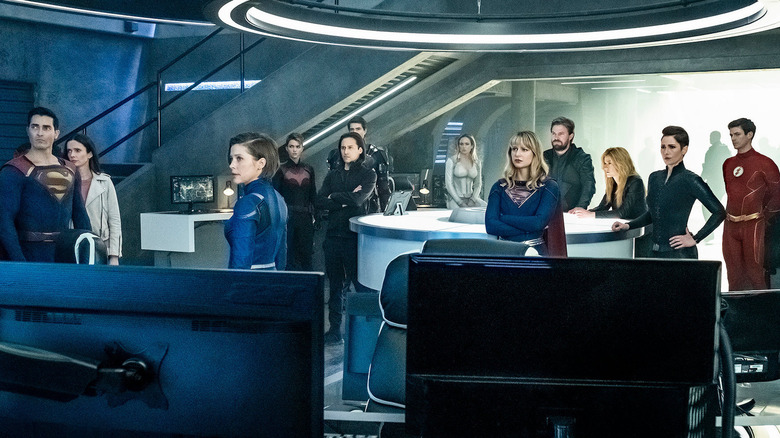
"Crisis on Infinite Earths" begins on "Supergirl," and if you want to experience the full crossover as intended, there's really no other jumping on point. With the arrival of an anti-matter wave that destroys Argo — and nearly takes out Superman (Tyler Hoechlin), Lois Lane (Elizabeth Tulloch), and their newborn son — the end is nigh and the Arrowverse won't let you forget it.
As worlds end, Lyla Michaels/Harbinger (Audrey Marie Anderson) brings our heroes — including Oliver Queen/Green Arrow (Stephen Amell), Barry Allen/The Flash (Grant Gustin), Kara Danvers/Supergirl (Melissa Benoist), Sara Lance/White Canary (Caity Lotz), Kate Kane/Batwoman (Ruby Rose), and Ray Palmer/The Atom (Brandon Routh) — together to inform them about the impending threat that is the Anti-Monitor (LaMonica Garrett). This leads them to try and evacuate Earth-38, only to face a horde of shadow demons sent by the Anti-Monitor, leading to Oliver's shocking death as he stays behind to defend his friends and allies.
With several nods to other DC properties — including the series "Titans," the original 1989 "Batman" flick, and the '60s "Batman" TV series, which brings Burt Ward back as the original Dick Grayson/Robin just in time to see the sky go red — "Part One" is a heck of a way to begin such a momentous event. We even see Russell Tovey return as Ray Terrill / The Ray from his previous Arrowverse appearance in the "Crisis on Earth-X" crossover and "Freedom Fighters: The Ray" animated series.
Part Two (Batwoman)
The second part of the crossover picks up on "Batwoman" after Harbinger brings the Earth-74 version of Mick Rory/Heat Wave (Dominic Purcell) and his ship, the Waverider, to give the heroes a base of operation outside of space and time. After "Part One" set the stage for the threat of the Anti-Monitor, "Part Two" dives head-first into what everyone was hoping "Crisis on Infinite Earths" would be — a quest to save the multiverse as we revisit the other DC heroes who made it great.
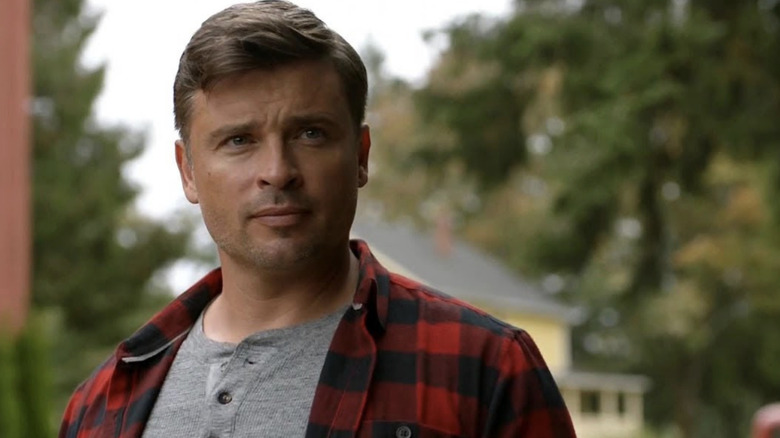
When the Monitor (also played by LaMonica Garrett) discovers that the key to defeating his antimatter counterpart lies in seven Paragons, he sends the surviving heroes on a quest throughout the different worlds to find them. This is where we are reunited with Tom Welling's Clark Kent and Erica Durance's Lois Lane. Here we learn that following the end of "Smallville," Clark and Lois settled back on the farm and started a family after the former retired as Superman. On the darker side of the multiverse, we also meet an older, angrier Bruce Wayne, played by none other than "Batman: The Animated Series" legend Kevin Conroy himself, who has let the darkness of Batman seep into his soul.
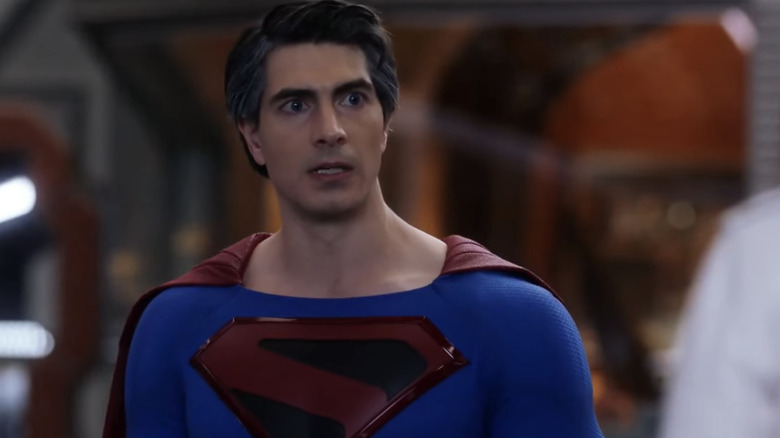
But while our heroes are able to find a Superman to their liking in the return of Brandon Routh's Man of Steel from "Superman Returns," Sara, Barry, Oliver's future daughter Mia Smoak (Katherine McNamara), and John Constantine (Matt Ryan) attempt to bring Oliver back to life via Lazarus Pit. While it doesn't exactly work, it leads to the unexpected return of Jonah Hex (Johnathon Schaech).
Part Three (The Flash)
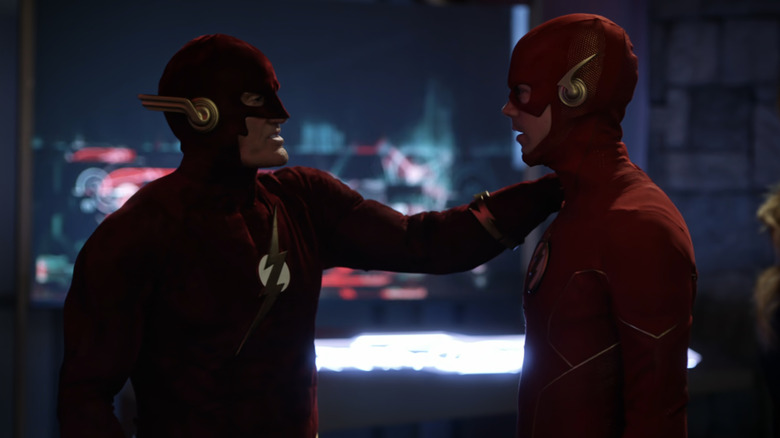
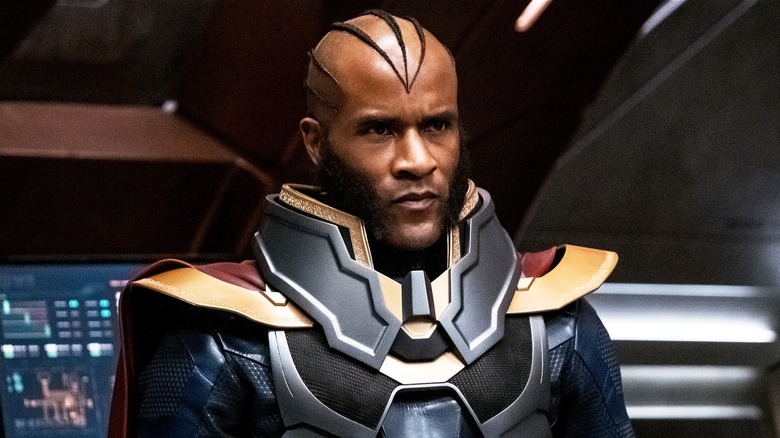
With the third part of "Crisis on Infinite Earths," the crossover begins to feel a bit more like the show that it's set on. This hour is very heavy on Barry Allen, and considering it's an episode of "The Flash," we can't argue. After Ray finishes up a "Paragon Detector" that labels J'onn J'onzz/Martian Manhunter (David Harewood), scientist Ryan Choi (Osric Chau), and Barry as the final paragons in question, Team Flash discovers the Anti-Monitor's anti-matter canon — a device powered by John Wesley Shipp's Barry Allen/The Flash from the '90s "Flash" series. It's certainly one of the best parts of this entire crossover.
If Shipp hadn't already passed the torch from one Fastest Man Alive to another, "Part Three" makes it official, and anyone who has read the original "Crisis on Infinite Earths" comic book knows how this ends. Meanwhile, Sara, Mia, Constantine, and John Diggle (David Ramsey) visit Earth-666, home of the Fox series "Lucifer," to visit the titular Devil regarding Oliver's soul, which is stuck in Purgatory. As we catch up with Oliver, we discover that he is to be the next human host of the Angel of Vengeance known as the Spectre. But when Lex Luthor (Jon Cryer) finally plays his hand, he uses the Book of Destiny to rewrite reality so that he, not Brandon Routh's Superman, is the final paragon.
"Part Three" also includes cameos from Helena Kyle/Huntress (Ashley Scott of "Birds of Prey") and heavily features Cress Williams' Jefferson Pierce/Black Lightning, pulled into the story by Pariah (Tom Cavanagh) to aid the Flashes. This chapter ends with a major cliffhanger that kept fans anxious for a month at the time it aired, However, in our age of streaming, finding the next part isn't a challenge.
Part Four (Arrow)
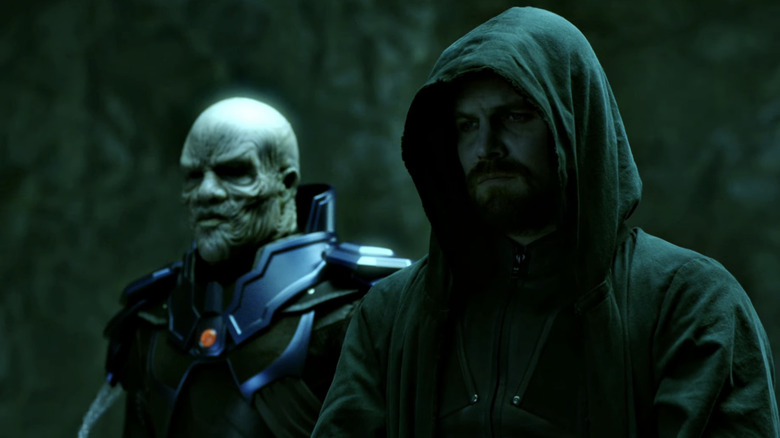
Just as "The Flash" hour of the crossover was heavily focused on Barry Allen and his friends, the "Arrow" installment heavily features Oliver Queen, who is no longer Green Arrow but the ethereal Spectre. After a flashback to how the Monitor mistakenly unleashed the Anti-Monitor in the first place, the episode picks up with our heroes aboard the Waverider, now stuck in the Vanishing Point at the dawn of time. As Oliver is guided by Jim Corrigan (Stephen Lobo) in learning to use his newfound supernatural abilities, he increases Barry's power and gives the Paragons — Barry, Sara, Kate, J'onn, Kara, Ryan Choi, and Lex Luthor — an edge they need against their foe.
"Part Four" is very much the climax of "Crisis on Infinite Earths." Everything leads up to this, and it's here that the final push against the Anti-Monitor takes place. As the now-supercharged heroes battle the shadow demons, Oliver uses his newfound abilities to reboot the universe, restoring (and rewriting) reality. Unsurprisingly, he succeeds; the cost is, once again, his own life. While there would still be two episodes of "Arrow" to serve as an epilogue to Oliver's sacrifice, the hero who first launched the Arrowverse dies here upon remaking it.
For fans who hoped that the Arrowverse would crossover with the DC Extended Universe at the time, "Part Four" gave us hope when Barry encountered his DCEU self played by Ezra Miller. But even cooler is the fact that this is the one installment of the five-part saga co-written by original "Crisis on Infinite Earths" comic writer Marv Wolfman, though it wouldn't be his only contribution to the tale.
Part Five (Legends of Tomorrow)
Awaking in a brave new multiverse, "Part Five" brings everything to a close as the Paragons wake up to realize that they are the only ones who remember the pre-Crisis world, though J'onn uses his telepathic abilities to restore the memories of their allies. As it turns out, the Anti-Monitor is still prowling around, hoping to destroy the cosmos once more. So, our heroes band together for one final attack on the villain to ensure that Oliver didn't sacrifice himself in vain. As they do, we discover that the Arrowverse has been changed forever.
Now, Earth-1 ("Arrow," "The Flash," "Legends of Tomorrow," "Batwoman"), Earth-38 ("Supergirl"), and the world of "Black Lightning" have been merged into one singular Earth-Prime. But the multiverse is still intact, with other universes like Earth-2 ("Stargirl"), Earth-9 ("Titans"), Earth-12 ("Green Lantern"), Earth-19 ("Swamp Thing"), Earth-21 ("Doom Patrol"), and Earth-96 ("Superman Returns") all confirmed to be reborn as well. Seemingly, this means that basically every world is restored; they may just have new designations. Oh, and Marv Wolfman has a cameo here too.
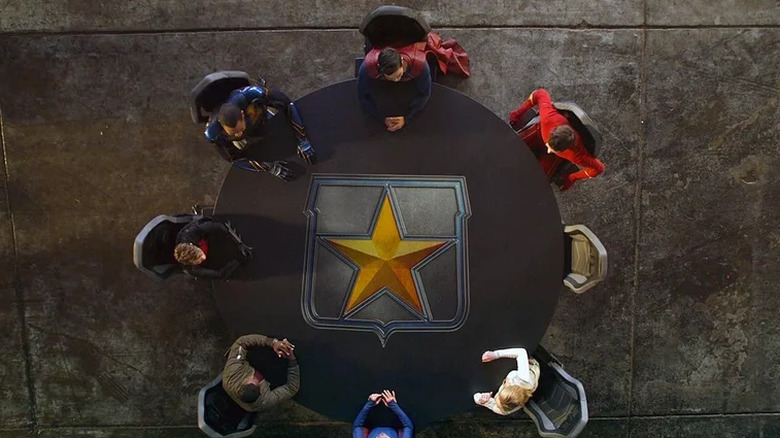
The crossover ends with Supergirl, Flash, White Canary, Black Lightning, Batwoman, Martian Manhunter, and Superman holding a memorial for Green Arrow in an abandoned S.T.A.R. Labs hangar that resembles the Hall of Justice from the "Super Friends" cartoons. It's here that these heroes decide to form a team to protect the new world and multiverse from similar threats. While they don't straight-up call themselves the Justice League, that's the obvious implication.
There are several Arrowverse tie-ins and epilogues to the event
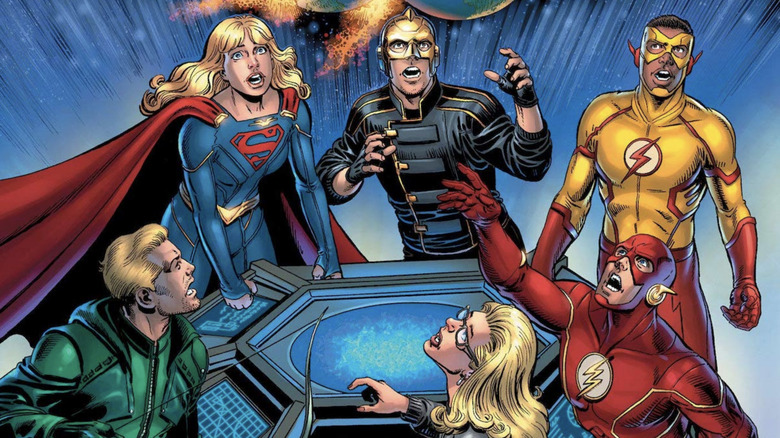
If you just can't get enough of the Arrowverse's "Crisis on Infinite Earths" epic, then we have some good news for you. To explain the absence of characters like Felicity Smoak/Overwatch and Wally West/Kid Flash, Marv Wolfman and Marc Guggenheim penned a two-part parallel story under the banner of two issues of "Crisis on Infinite Earths Giant." This comic features two new stories, "Paragons Rising" and "Infinite Luthor," that fill in some the gaps and plot holes that inevitably occur in a multi-part event. Both cameo-heavy stories take place at the beginning of "Part Two," so if you want to enjoy the whole thing chronologically, read it after you watch "Part One."
Additionally, if you feel like you may have missed something regarding Black Lightning's inclusion in the crossover, the "Black Lightning" Season 3 episode "The Book of Resistance: Chapter Four: Earth Crisis" leads right into his introduction in "Part Three." The whole episode is about how other Earths interact with the red sky madness that is the Anti-Monitor's universe-ending threat, and it's a curious parallel tale that adds something extra to the experience. While neither the comic book interludes or the "Black Lightning" episode are pivotal to one's understanding of "Crisis on Infinite Earths," they certainly add to the continuity.
Lastly, while you could continue with the rest of the respective seasons of "The Flash," "Supergirl," "Legends of Tomorrow," "Batwoman," and even "Back Lightning" to see how their new lives on Earth-Prime go for them, the best epilogue comes in the "Arrow" series finale "Fadeout." It's here we learn how much Oliver changed the world when he rebooted everything, and despite his death, he still gets somewhat of a happy ending.
Crisis on Infinite Earths was also adapted elsewhere
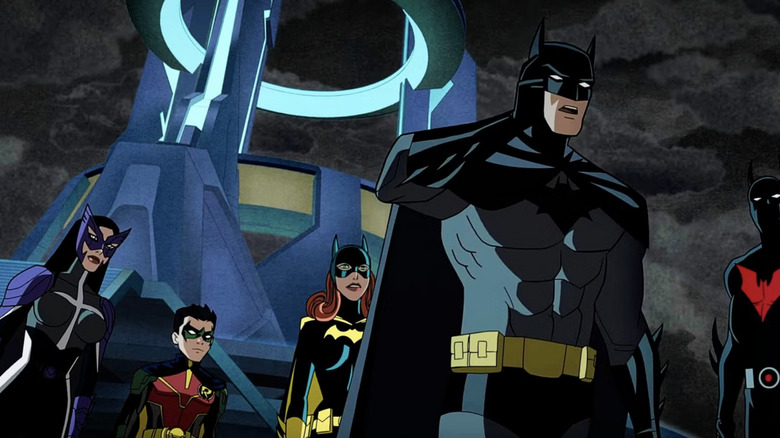
If you've still hungry for more after already watching the Arrowverse's "Crisis on Infinite Earths," exploring the subsequent tie-in and epilogue material, and even revisiting the precursory "Elseworlds" crossover, we have some good news. DC Comics' original "Crisis on Infinite Earths" has been adapted on several occasions, including just after the Arrowverse tried its hand at it in live action. If you're looking for an animated feature that does what the CW did for live-action DC media, consider the "Justice League: Crisis on Infinite Earths" animated trilogy.
In three parts, this saga revisits the epic DC event in animated form as the Tomorrowverse (the second iteration of the DC Animated Movie Universe) versions of DC's Justice League team up with their multiverse counterparts to stop the Anti-Monitor's familiar universe-collapsing schemes. With nods to the DC Animated Universe and even the original "Super Friends" cartoons, this trilogy is a bit closer to the original comic than the Arrowverse ended up being. It even includes Kevin Conroy's last lines as Batman in any medium, which brings an end to his tenure as the Dark Knight after 30 years. It may not be the Arrowverse, but it managed to include a few DC characters that were suspiciously missing from "Crisis on Infinite Earths."