

5 Stephen King Book Scenes So Dark They Never Made It Into The Movies
This article includes mentions of child death.
Nothing makes horror fans perk up more than the words "based on a novel by Stephen King." King has rightfully earned the title of the "Master of Horror," so when audiences see his name, they come to expect top-notch tales of terror – even if that terror can sometimes be watered down in the translation from book to screen, much to the author's chagrin at times.
Of course, one could argue that some of Stephen King's most chilling moments have never even made it to his film adaptations. At some point in the process, the filmmakers must have decided these scenes from Stephen King books were too dark for moviegoers to handle. Some were likely cut because they were too gruesome; others never made it into the movie because they were too depressing. Most of them involve children (which is often a recurring theme in many of his books). Either way, if horror fans want to appreciate these moments, they will need to crack open the source material.
Patrick killing his baby brother in IT
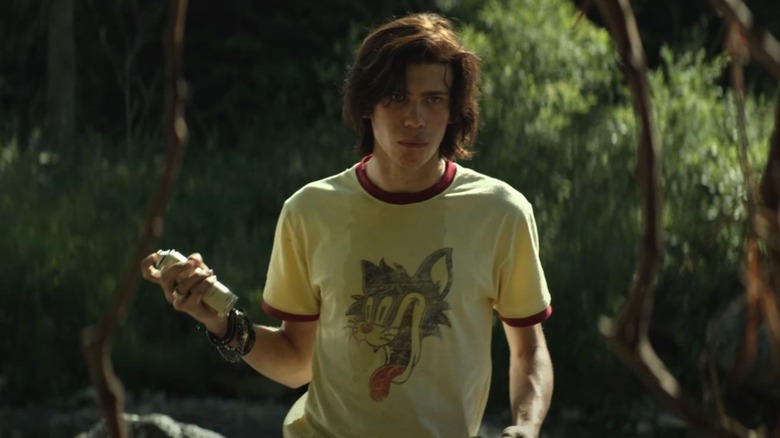
Stephen King's "IT" is more than a thousand pages long. For every scene featured on the screen, there are ten hidden gems from the book that never made it into either the film or the television adaptation. We could fill a whole article with the disturbing moments from "IT" that were cut from the movie. But right now let's look at one particular scene that was too messed-up to film.
Chapter 17 of "IT" reveals a shocking atrocity that Patrick Hockstetter committed when he was only five years old. When Patrick's parents first bring home a new baby, Patrick isn't exactly excited to be a big brother. Maybe it's sibling rivalry taken to the extreme, or maybe the new baby challenges Patrick's solipsistic worldview; whatever the reason, Patrick makes up his mind to kill his brother. When his parents aren't looking, Patrick smothers the child with a pillow and gets a twisted surge of exhilaration doing so.
This would be the beginning of an alarming pattern for Patrick, since later in the chapter he begins tormenting animals by trapping them in an abandoned refrigerator. But it's his first kill that hits the hardest; after he commits infanticide, Patrick goes to the kitchen to get milk and cookies, which only makes the moment even more chilling. No wonder both the movies and the TV series chose to pass over this scene.
The depressing ending of Cujo
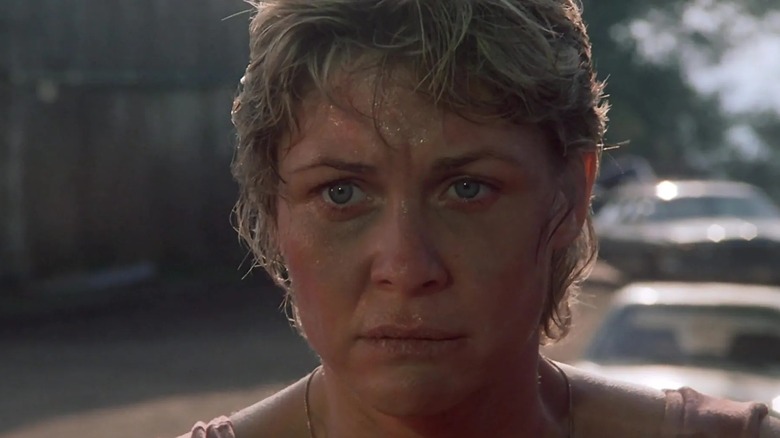
Stephen King adaptations often change the ending from the one in the original book. Like with "Cujo", sometimes this is for the best because the original is just too brutal. The novel is not an easy read. It's agony, watching a mother trapped in a hot car with her son while a vicious rabid dog named Cujo waits outside. To make matters worse, Donna's car won't start and her son may be dying of heatstroke. Donna will stop at nothing to protect her son, and at the end of the book, her husband finds her standing over Cujo's body with a bloody baseball bat. So it hits like a sledgehammer when, after everything Donna has endured, her husband takes one look at her son and says, "How long has he been dead, Donna?"
It's a powerful ending, but certainly not for the faint of heart. The movie softens the blow a little. Although Tad (Danny Pintauro) comes dangerously close to dying, he ultimately survives, and Donna (Dee Wallace) gets a hard-earned happy ending. When she signed on to film "Cujo," Wallace insisted that they change the book's depressing ending. Even Stephen King himself conceded the original ending was a bit much. According to Wallace in an interview for the podcast Still Here Hollywood, the author wrote her to say, "Thank God you didn't kill the kid at the end. I've never gotten more hate mail for anything else I've done." Hate it or love it, there's no denying Stephen King's original ending is much darker.
Vicky's death in Children of the Corn
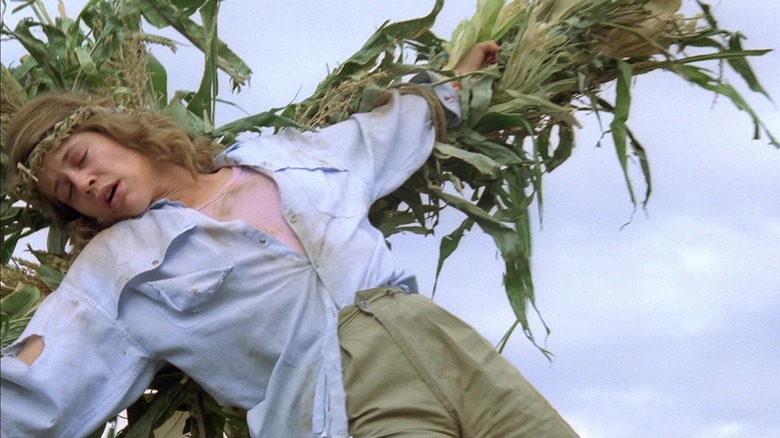
There's something inherently chilling about creepy kids, and Stephen King taps into that in "Children of the Corn." The story of a small Nebraska town claimed by a cult of murderous children is ripe with opportunity for horror. The 1984 movie adaptation has no shortage of scary scenes. Certainly, the moment when Vicky (Linda Hamilton) is mounted on a pole like a scarecrow and sees what happened to the last poor soul that shared the same fate is terrifying, but it doesn't hold a candle to the equivalent scene from the short story.
In Stephen King's original narrative, Vicky's torment happens entirely out of view of the reader. All we see is the gruesome aftermath, and it chills us to our bones. Here, Vicky has been suspended from the pole with barbed wire, making her pain all the more palpable. As if that isn't bad enough, the children have scooped out Vicky's eyes and stuffed her mouth with corn husks — and that's how her husband finds her. She's dead, of course, and but a grisly way to go! The image Stephen King leaves us with is pure nightmare fuel. Not only does the movie spare us this image, but Vicky also makes it out alive, which must have been a relief to anyone traumatized by this scene in the original story.
Jack smashing his own face with a mallet in The Shining
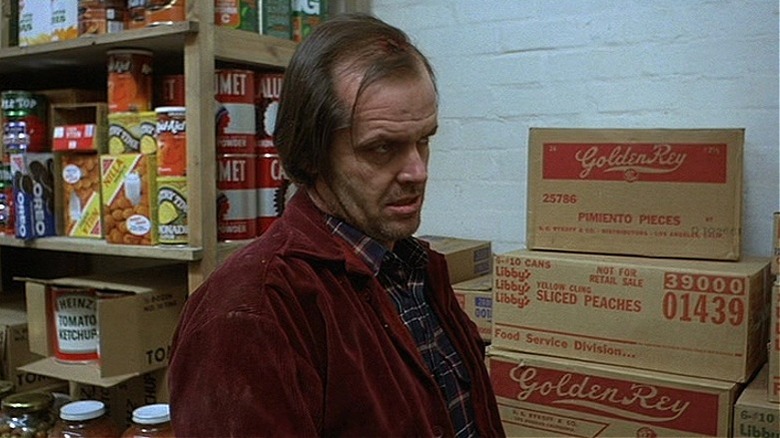
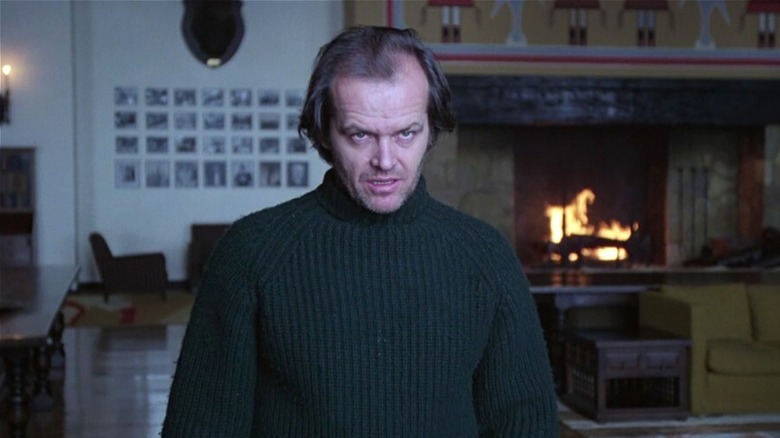
The darkest part of "The Shining" isn't the creepy hotel or the grisly murders that happened there — it's the way Stephen King holds up a mirror to reality. At the heart of King's book is a story of how addiction can transform a person you love into someone utterly recognizable. Of course, Stanley Kubrick's movie is a whole different animal. One of its many differences from Stephen King's book is the omission of this haunting scene with Jack and Danny.
When Danny's father becomes possessed by whatever malevolent spirit that inhabits the Overlook Hotel, Jack begins coming after Danny with a roque mallet (proving that Stephen King can make even a quaint piece of sports equipment seem menacing). Just when it seems like Jack is going to bash in Danny's face, however, Jack starts mutilating his own face instead, smashing it with the mallet until it is reduced to a pulpy mess.
It's enough to make anyone squirm — not just because of the graphic descriptions, but also because, over the course of the novel, we have come to care about Jack. It's disturbing for readers to see him like this, and even more so knowing that poor Danny needs to watch. The moment when Danny realizes that the thing before him is not his father anymore is so messed up that we don't blame Kubrick for leaving it out (though one could argue the movie is lesser because of it). Incidentally, the 1997 television miniseries remake of "The Shining", where Jack Torrance is played by Steven Weber, is a more faithful adaptation, preserving King's original scene.
The chocolate custard scene in Salem's Lot
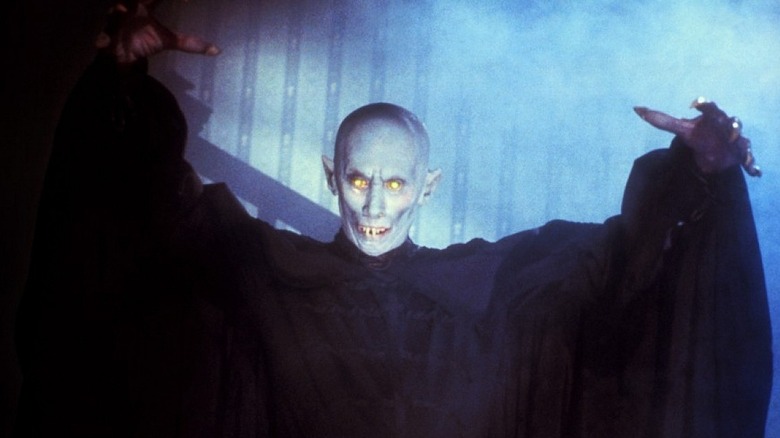
As of this writing, Stephen King's novel "Salem's Lot" has gotten three different adaptations: There have been two TV series, and most recently, a straight-to-streaming movie (which, given its troubled production history, Stephen King fans had good reason to worry about). However, one haunting moment from the book is noticeably absent from all three due to how disturbing it is.
The scene in question comes right after a vampire has crept through a bedroom window, stolen the infant Randy McDougall from his crib, and drained his blood. So far, so good; it's nothing Stephen King hasn't done before when it comes to how kids are often victims in his stories. No, the real horror comes from the mother's reaction when she finds her child. Still in denial about what is happening, Sandy tries desperately to revive her son.
She becomes convinced that her baby has only gone limp because he feels abandoned by her and is trying to provoke a reaction from her. So Sandy attempts to bring him back in the only way she knows how by attempting to feed him some Gerber's chocolate custard. As Sandy tries and fails to shove custard into the baby's lifeless mouth, a revelation slowly dawns on her, even as readers have already sensed it in their bones: Her baby is gone. That's an image that will be burned into our minds for a long time — not to mention we will never be able to eat chocolate custard again. Thanks, Stephen King!