

10 Actors Who Endured Excruciating Makeup Transformations For Iconic Roles
Makeup can make or break a character depiction on-screen. Characters like Elphaba Thropp in "Wicked" or The Joker in "The Dark Knight" are recognizable because of their iconic appearances, built from layers of makeup and sometimes prosthetics. Could tech today use CGI to make someone green or add horns to their head? Sure, but there's something to be said about using practical effects to make a character look so realistic it even fools the rest of the cast.
However, it isn't always a piece of cake to use prosthetics and special makeup to transform someone's appearance. It often requires long hours in a makeup chair, early call times, lots of layers, and additional weight that cannot only impede a performance but also make it difficult to move around. The makeup can cause concerns about skin health and, in rare cases, even cause extended issues due to continued exposure to different adhesives or removal agents. For these iconic roles, the makeup transformations were excruciating, but the results made the characters memorable for audiences.
Angelina Jolie in Maleficent
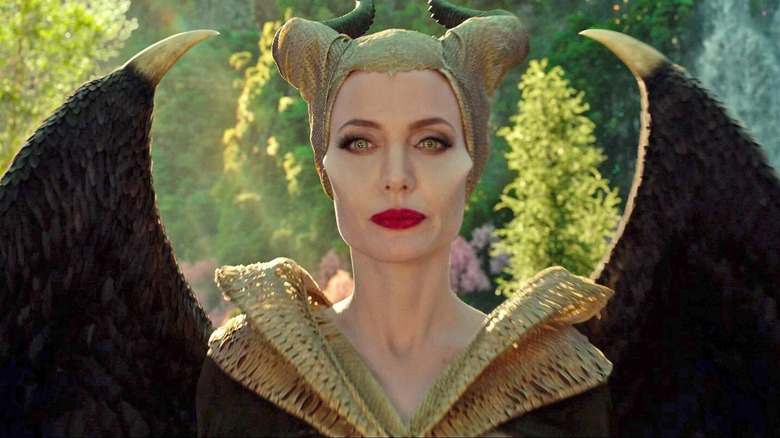
Angelina Jolie is the classic "Sleeping Beauty" antagonist Maleficent in the 2014 film of the same name. It shows the evil fairy's origin story, presenting the initial conflict between Aurora's father and Maleficent, showing her side of the story. While Elle Fanning's Aurora is soft and ethereal, Jolie's Maleficent is all harsh lines, showing her scornful nature.
Jolie encouraged the use of more prosthetics in the movie, with makeup artist Rick Baker telling Allure that "Jolie wanted to change her bone structure to play Maleficent," and pointed to Lady Gaga's "Born This Way" music video appearance as an idea for what they could do for Maleficent. The actress also wanted a strong nose, intending for the character's face to be incredibly angular. The makeup team developed "cheek prosthetics, a subtle nose piece, pointy ears, and sharp molars" to lean into the vision, according to Fashionista.
The horns were the most difficult part of the transformation, mostly because of their functionality. It took a bit of trial and error, but eventually, they found a system with magnets and a skullcap that made them easy to put on and remove. "First they were too heavy, then we got them softer, and then we found ones that snap off because I kept banging into things," Jolie told Hitfix in 2014. "It all slowly came together, and we tried different things and some things didn't work."
Jessica Chastain in The Eyes of Tammy Faye
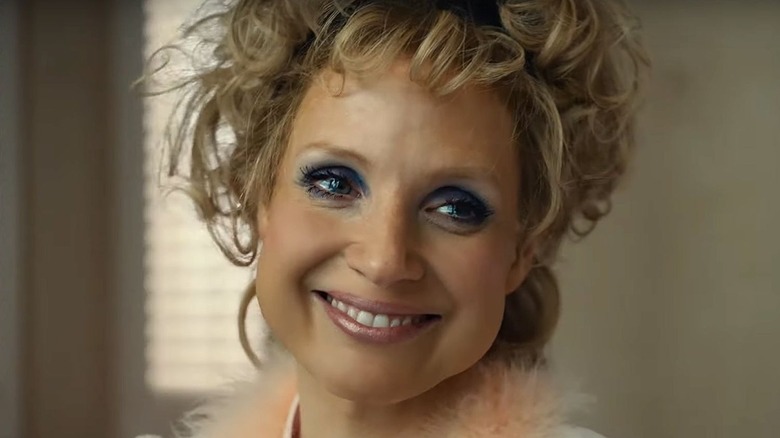
Jessica Chastain plays a famous televangelist in 2021's "The Eyes of Tammy Faye." The film shows the rise of Faye's career and the ups and downs that came with it as she and her husband Jim Bakker (Andrew Garfield) built their own TV network. In the titular role, Chastain won her first Academy Award for best actress and was almost completely unrecognizable, with prosthetics and fake teeth helping her transform into Faye.
At its longest, Chastain spent seven-and-a-half hours in the makeup chair to turn into the televangelist, and a minimum of two hours at the end of the day to remove the prosthetics. "That's the most prosthetics I've worn," the actress said in an interview with the Los Angeles Times. "Even the bronzer and the foundation are so much darker, the lashes are thicker. The makeup gets heavier as she gets older." Chastain described the makeup and prosthetics as "heavy and hot" and that she "was worried about [her] circulation." She's also positive she's "done some permanent damage to [her] skin" just because of the weight of wearing it all.
After the first makeup test, the actress was unsure of how to be Tammy Faye through the makeup, worried that facial expressions and other parts of her performance would be hidden by the prosthetics. "I was like, 'I don't know how to act like this.' People think it's easier, but it's not," Chastain continued. "You have to reach through the makeup — you can't let the makeup be the performance."
Jim Carrey in How the Grinch Stole Christmas
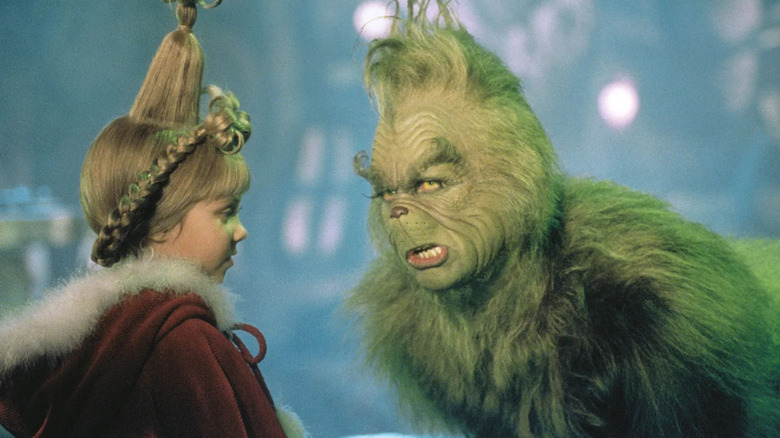
While there are several versions of the holiday classic "How the Grinch Stole Christmas," an entire generation grew up seeing Jim Carrey as the Grinch in the 2000 live-action movie. He's unrecognizable as the green guy with a heart two sizes too small, and it took quite a bit of makeup to achieve the look.
"Literally the makeup was like being buried alive every day," Carrey said on "The Graham Norton Show" in 2014. He couldn't breathe with the prosthetic nose on, found it difficult to speak with the fake teeth, and the colored contacts limited his vision. The actor also struggled with how long it took to turn into the Grinch, which clocked in at over eight hours the first time, and wanted to quit the film. However, a CIA trainer helped him handle it, encouraging him to do things like turn on the TV or punch himself in the leg to distract from how the prosthetics and makeup made him feel.
Carrey is interested in playing the Grinch again, provided they figure out a different way to do the makeover. "Oh, gosh, you know, if we could figure out the Grinch," the actor told ComicBook.com. "The thing about it is, on the day, I do that with a ton of makeup and can hardly breathe. It was an extremely excruciating process." While he did it for the young audience watching the movie, he thinks it would be possible to use motion capture technology now to achieve the same effect.
John Hurt in The Elephant Man
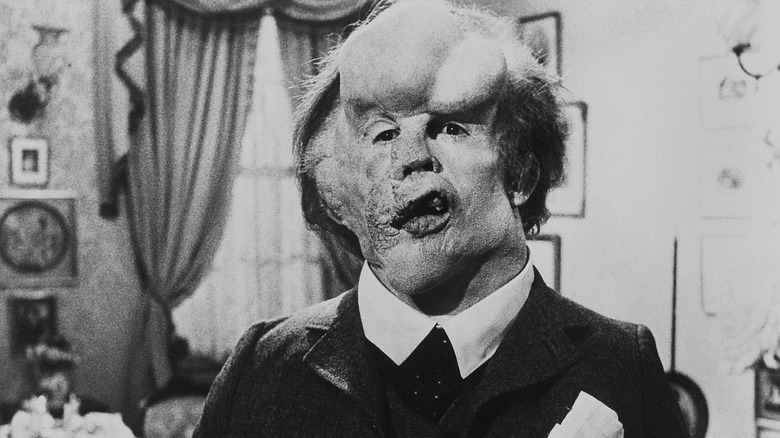
"The Elephant Man" follows the story of John Merrick, a man born with deformities, who is taken advantage of by the people around him and often used as an "attraction" in a circus. It's loosely based on a real person from the 1800s, though names are changed. John Hurt is John Merrick, requiring substantial prosthetics to achieve the look director David Lynch was going for.
Fifteen layers of prosthetics, applied over seven to eight hours, made up Merrick's face. The prosthetics were based on casts provided by the Royal London Hospital of the real individual the movie is inspired by, adding a degree of authenticity to the design. However, with that long in the makeup chair, and an additional two hours at minimum to remove it all at the end of the day, Hurt wasn't always on board, quoted at one point saying, "I think they finally managed to make me hate acting" (via Dangerous Minds).
The makeup and prosthetics in "The Elephant Man" caused the Academy of Motion Picture Arts and Sciences to add a dedicated makeup award the following year. Not because they felt it should be awarded, but because the voting base complained that reportedly there wasn't a way to honor it. Before that, two films received an honorary award for achievement in makeup: 1964's "7 Faces of Dr. Lao" and 1968's "Planet of the Apes."
John Rhys-Davies in Lord of the Rings
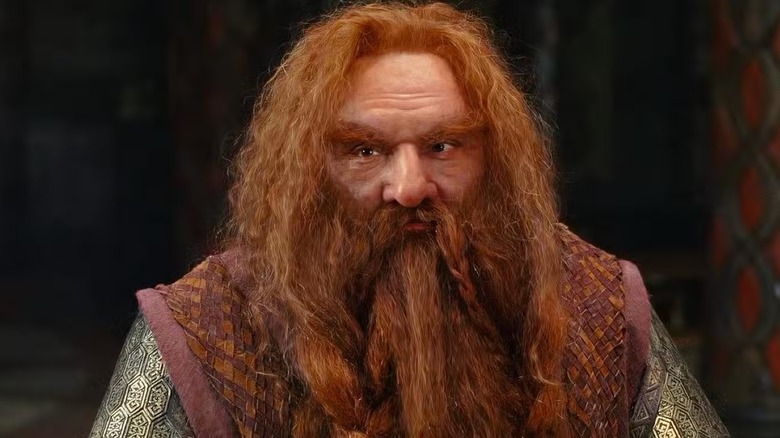
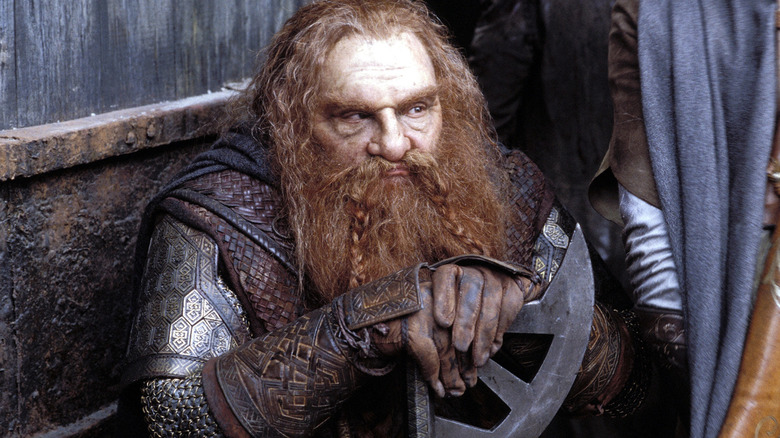
Fantasy fans know John Rhys-Davies as Gimli in the "Lord of the Rings" movies. The dwarf warrior helps Frodo Baggins on his journey, is a member of the Fellowship of the Ring, and has arguably one of the best beards of the franchise. Facial prosthetics helped create the character we see on screen, and the actor has been honest about how difficult the application and removal process was for his skin.
While it's often reported that he had an allergy to the prosthetics, which in turn impacted his filming schedule, he set the record straight at Fan Expo Boston with Collider in 2025. "We were using medical adhesive for the prosthetic, and medical adhesive is hypoallergenic. It won't give you an allergic reaction," Rhys-Davies said. "The only slant is that it's a very strong adhesive that sort of bonds to the outer cells of the skin, and it's not designed to be taken on and taken off at a daily basis."
The constant application and removal damaged the skin around his eyes, and his body reacted in the moment. "In the end, I would lose all the skin around my eyes. And then of course you'd get a histamine response as your body is pumping fluid through to repair it, so your eyes get swollen and horrid," the actor continued. "And quite simply I would walk in sometimes and they would look at my eyes and say, 'John we cannot put the prosthetic on you today. There is nothing we can stick it to.'" Rhys-Davies is open to returning to the role, but only if they were to use CGI the next time around.
Lon Chaney in The Phantom of the Opera (1925)
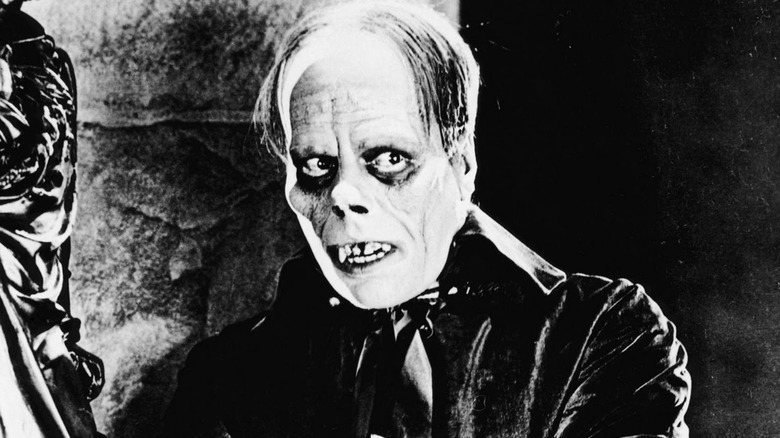
With a nickname like "The Man of a Thousand Faces," it shouldn't be a surprise that Lon Chaney is on this list. As written in his New York Times obituary, the actor is known and remembered for "his ability to make-up his face and distort his body, often pioneering new ways to portray scars and other effects." He was a star of the silent horror film age and played iconic roles like Quasimodo in 1923's "The Hunchback of Notre Dame" and the titular character of 1925's "The Phantom of the Opera."
For the latter, he manipulated his nose in a way that caused it to bleed during production, based on information from the film's cinematographer Charles Van Enger (via Mental Floss). According to History.com, it was a wire that Chaney used to pull on his nose, giving the flared effect to his nostrils. It's a character design that stuck with people, with Guillermo Del Toro telling Entertainment Weekly, "The moment Lon Chaney is revealed as the Phantom of the Opera was one of those seminal moments."
This wasn't the first time Chaney used prosthetics or techniques that resulted in injury. It's reported that the prosthetics he used on his face in "The Hunchback of Notre Dame" altered his vision, in addition to a 15-to-20-pound fake hump he wore. Historian David J. Skal wrote in his book "The Monster Show" that the actor used leather stumps to play an amputee in 1919's "The Penalty," collapsing from using them for extended periods of time.
Paul Bettany in Avengers: Age of Ultron
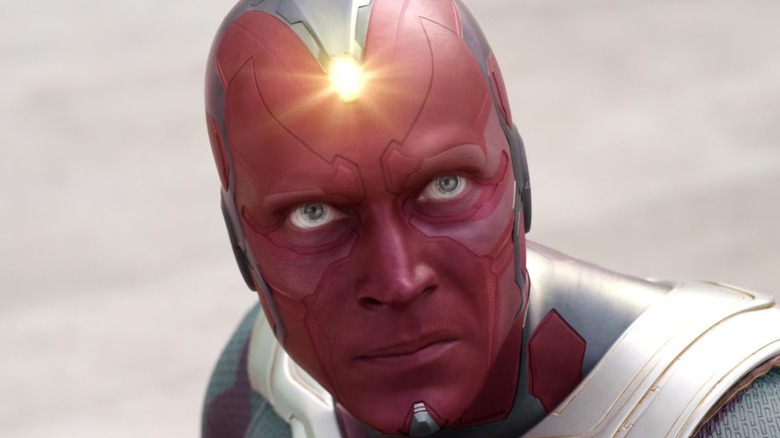
There's plenty of interesting makeup in the "Avengers" movies. Sure, many of the characters are in supersuits, but some are spending hours in the makeup chair to build their look. Paul Bettany's Vision, a sentient android that comes to life with the help of the mind stone, has a unique look, combining robot and human in a way that looks seamless and natural.
"Mainly the pain in the ass was the prosthetics and stuff that you know is as uncomfortable as getting paid a lot of money to be uncomfortable is, which is not really that uncomfortable," Bettany told Business Insider in 2015. "The makeup on my face, which, you know, they're huge prosthetic pieces that go from below my eyebrows all the way down to the mid-shoulder blade. And same thing around my neck."
The number of prosthetics made it difficult for the actor to hear, and the suit that went with it required a cooling mechanism so Bettany wouldn't overheat. Yet, he says the hardest part "was the sitting in" the makeup and prosthetics. "The first day was OK, and it wasn't even the second day really, but the third day in a row and the fourth and the fifth day was ... you had to really get kind of Zen about it."
Sofía Vergara in Griselda
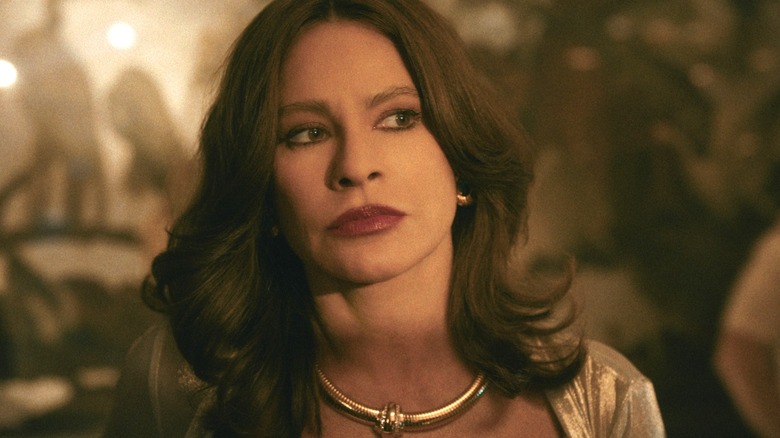
While many know Sofía Vergara for her role as Gloria Delgado-Pritchett in the sitcom "Modern Family," she showed off a different side to her talents with Netflix's "Griselda," a miniseries following a Miami crime boss. Based on a real person, the show follows her life in the business, including her time in jail and her death.
To transform into Griselda Blanco, Vergara wore a prosthetic nose, teeth, and other prosthetics to make her features look more like Griselda's. It took over four hours to apply them each day, along with wigs and other body makeup that the actress used. "I needed to disappear," Vergara told E! News. "It was in Miami in the '70s and the '80s. Getting the look correct was very important to me." She wanted people to see Griselda, not her "Modern Family" character, or who they see her as during public appearances.
"The teeth were horrific," the actress said on "CBS Sunday Morning." In addition to wearing yellowed fake teeth, pieces of plastic were applied from the tops of her eyes up to her hairline, covering her eyebrows and forehead. The team also used prosthetic eyebrows, helping Vergara look more like Griselda than herself.
Stellan Skarsgård in Dune
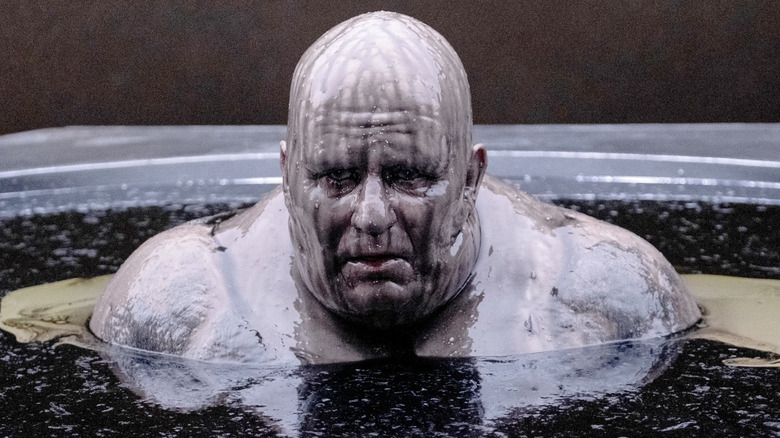
Stellan Skarsgård is Baron Vladimir Harkonnen in "Dune." He's an enemy of House Atreides, presenting a threat to Paul and his father, Leto. Vladimir is a memorable character — to say the least — remembered most for his large body and bald head sitting in a huge tub of dark water. Though he isn't on screen long, his image sticks with you, thanks to the prosthetics and makeup.
Skarsgård spent eight hours in the makeup chair to become the baron, complete with a 20-pound body suit. "It was painful, but it was worth it," the actor said to Business Insider. "We wanted him to be so well defined as an image that he made an imprint on people just by showing up on the screen."
He has long been a supporter of practical makeup over CGI. While filming "Pirates of the Caribbean," the actor was one of the few who chose prosthetics. "I was the only one on set with real prosthetics on," Skarsgård continued. "Everyone else on that ship showed up five minutes before we started shooting and had dots put on their face, and away they went. I had been there for six hours." He says that he "like[s] to see the artists paint," even if it is a long time to spend in the chair.
Zoe Saldaña in Guardians of the Galaxy
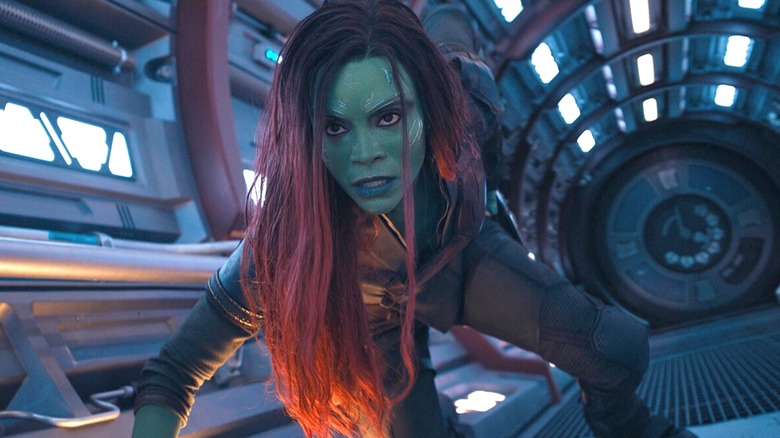
Zoe Saldaña has many iconic roles, like Neytiri in James Cameron's "Avatar" franchise and 2002's "Crossroads." While she isn't painted blue to play the Na'vi warrior, she was painted green to play the character many know her from: Gamora, daughter of Thanos, in the Marvel Cinematic Universe. She's one of the main characters of the "Guardians of the Galaxy" trilogy, and her death in "Avengers: Infinity War" is one of the most heartbreaking. While Saldaña misses playing Gamora, she doesn't miss the makeup that came with her.
"I can never say no to anything, but that green makeup? I wouldn't be upset if it didn't happen again," Saldaña said in an interview with Variety in 2022. "I miss Gamora but I don't miss 3:30 a.m. calls and five-hour makeup sessions and trips to the dermatologist afterwards." While filming "Guardians of the Galaxy 3," the actress gave behind-the-scenes looks at the process, showing the layers of prosthetics and makeup that go into the character and how long it took to apply and remove.
Spending that long in a makeup chair isn't something she'd like to do again, even if it were for another movie set in space. "I would like to just be a human in space. I don't see myself going through the three to four hours every morning of makeup," she told Vanity Fair in 2024. "I'm so concerned about just the chemicals and stuff that you're putting into your system for long periods of time, because we shoot these films in a period of five months."