

Blade Runner 2099 Officially Solves A Plot Hole From The Original Movie
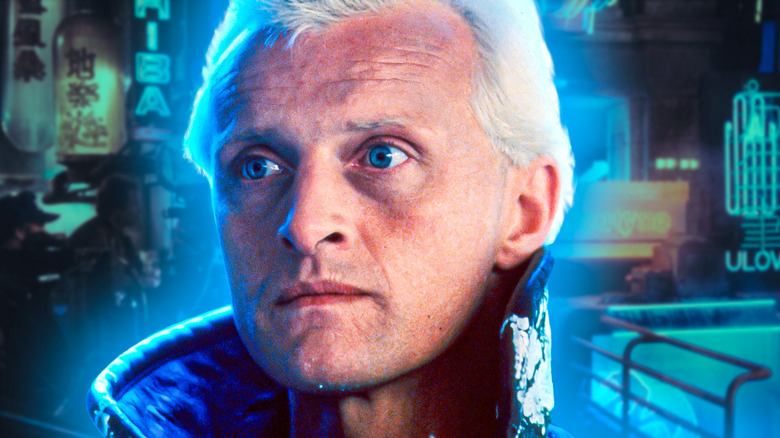
Contains spoilers for "Blade Runner 2099" Season 1, Episode 8
Although it pulls several plot threads from Philip K. Dick's "Do Androids Dream of Electric Sheep?" that have never appeared in any movie adaptation, one of the biggest Easter eggs hiding in plain sight during the "Blade Runner 2099" finale closes one of the movie's longest debated plot holes. After arriving at the Off-World launch complex to track down Julien (Tom Burke), Cora (Hunter Schafer) and Olwen (Michelle Yeoh) first encounter a replicant named Hodge (Wil Coban), one of the first models that the Nexus-1 has resurrected in his plan to overthrow humanity.
Cora and Olwen swiftly kill him before powering down almost every other rebooted replicant spoiling for a fight, but this character has greater importance to the Blade Runner universe beyond simply offering plot exposition. This might surprise even the most devoted fans, considering there's no corresponding character in Dick's groundbreaking novel, nor any trace of Hodge in the two prior movies.
But there was a major Hodge-shaped hole in Ridley Scott's original cut, where a passing reference to this absent character unintentionally gave credence to the popular fan theory that Rick Deckard (Harrison Ford) was a replicant. To explain why Hodge is a stealthily significant character, let's go back to the original movie.
Who is Hodge?
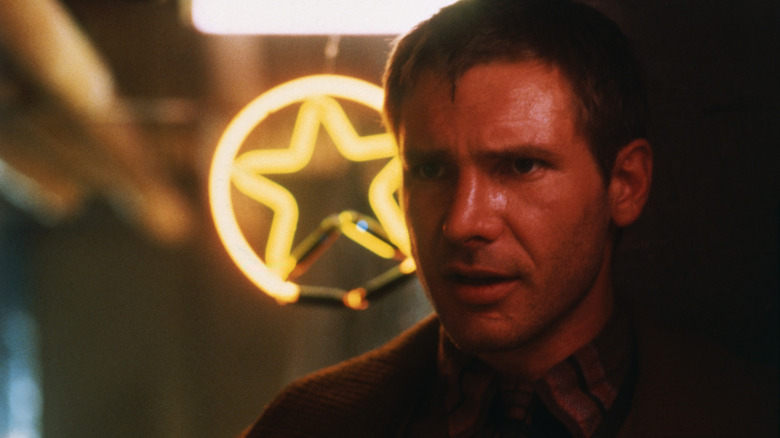
In early drafts of the "Blade Runner" screenplay, one of the first scenes would have seen the outer colony escape that Deckard has been called in to investigate. This is where six renegade replicants led by Roy Batty (Rutger Hauer) made their way to Earth from an off-world colony, killing dozens of humans during their escape, before breaking into the Tyrell Corporation. In those early drafts, the characters Mary and Roger were two of the replicants, with the latter killing two security guards before being killed entering Tyrell headquarters. In later drafts, Roger was renamed Hodge, before he was excised from the plot altogether.
No actor was ever cast -– although the other scrapped replicant, Mary, was set to have been played by Stacey Nelkin before that character was also removed entirely due to budgetary constraints. This isn't uncommon in Hollywood, but there were unintended consequences of cutting out two replicant characters, as script editors missed a throwaway line of exposition that more obsessive viewers misinterpreted as a sign that Deckard was a replicant.
In the original cut while briefing Deckard about the case, Harry Bryant (M. Emmet Walsh) says that of the six replicants wanted for the break-in, only one was killed. As Deckard was only tasked with finding four surviving replicants, many insinuated that this meant he was secretly the sixth replicant, when it was actually a reference to the scrapped character of Hodge that should have been removed.
Closing the plot hole
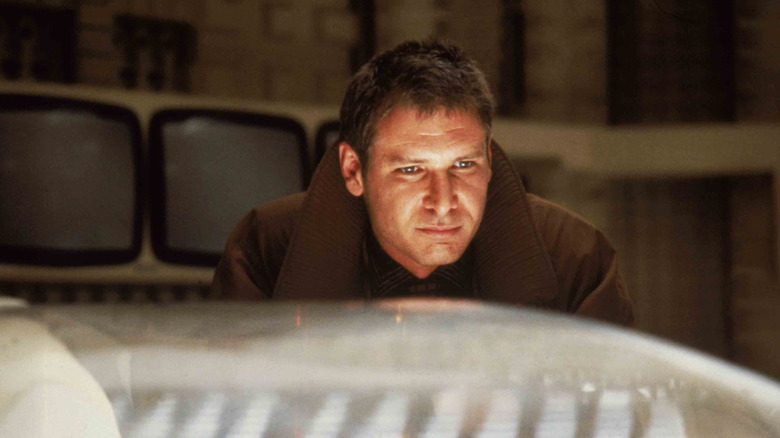
Ridley Scott's 2007 final cut of "Blade Runner" cleared this up by using alternate dialogue takes from a workprint, so it becomes unambiguous that two replicants were killed and that Deckard wasn't one of them (a mistake kept in the 1992 director's cut). Roy Batty calling Deckard by his name when they first met, despite never having previously been acquainted, lends this theory more credibility — and arguably, still holds up as evidence if you are of the persuasion (like Scott himself) that Harrison Ford's Blade Runner is a replicant.
The existence of a rogue Nexus model called Hodge in "Blade Runner 2099" helps close the plot hole in all iterations of the sci-fi masterpiece, looking far better than you'd expect from a model who was fried to death after attempting to pass an electro-magnetic security field. He doesn't get much further allying with another rogue replicant here, killed before Julien started enacting the next stages of his plan and turning his presence into something of an in-joke for the biggest nerds of the franchise.
Every iteration of this character is doomed to be one of the first casualties when the main villain's masterplan goes awry; his immediate death at the first hurdle despite his devotion to the replicant cause is as faithful to his original characterization as you can get.