

5 Best Stephen King Movies That Aren't Horror, Ranked
He's known as the King of Horror, but Stephen King has mastered far more than the art of creeping readers out. In fact, many of the best movie adaptations of his work are lifted from stories that are rooted in other genres altogether; if they're anything to go by, he's just as skilled at making us cry as he is making us cower under our bedsheets. Those are the movies we're putting under the microscope today, with any King adaptation that fits into the horror category tossed aside so we can shine a light on his best work outside of the genre.
Which isn't to say that the following movies don't share a sense of the dark and macabre; these stories just saw King channel his dark thematic preoccupations into genres as far afield as gothic melodramas, coming-of-age stories, and supernatural prison dramas. They're all considered amongst the best and most faithful King adaptations outright, and multiple picks here would be worthy of the top spot.
5. The Green Mile
It hasn't aged perfectly –- we should always be a little skeptical of a movie where a Black character's pain functions in the plot so a white character can have a profound emotional breakthrough –- but director Frank Darabont's epic adaptation of "The Green Mile" has maintained its tearjerker status for a reason. Admittedly, it's always going to be the second-best King adaptation directed by Darabont about the harrowing toll of life behind bars, although the supernatural dynamics at play make it a more recognizable King adaptation compared to the straight prison drama of "The Shawshank Redemption."
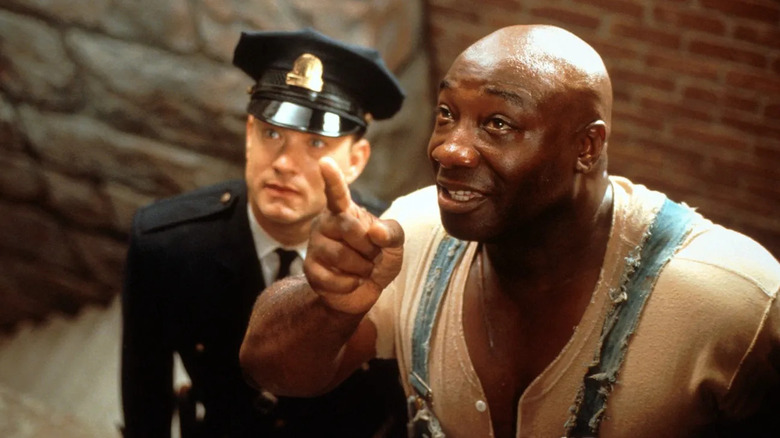
Set in 1935, Tom Hanks stars as corrections officer Paul Edgecomb, who begins to realize that the convicted child murderer he's supervising, John Coffey (Michael Clarke Duncan), may be innocent, and that his supernatural healing powers should offer reasonable doubt about his criminality. Across the three-hour plus runtime, Paul and John form something approaching a friendship, one made increasingly tragic as John's powers prove his innocence, but don't provide any physical evidence, meaning one still has to lead the other on their final journey down death row.
The movie boasts a powerful message about the prevalence of racism in the criminal justice system, although the simplistic characterization of John Coffey –- elevated somewhat by Duncan's Oscar-nominated performance -– does feed into outdated narrative stereotypes about magical Black characters with little agency of their own. It's an effective tearjerker, but far from a flawless one.
4. The Running Man
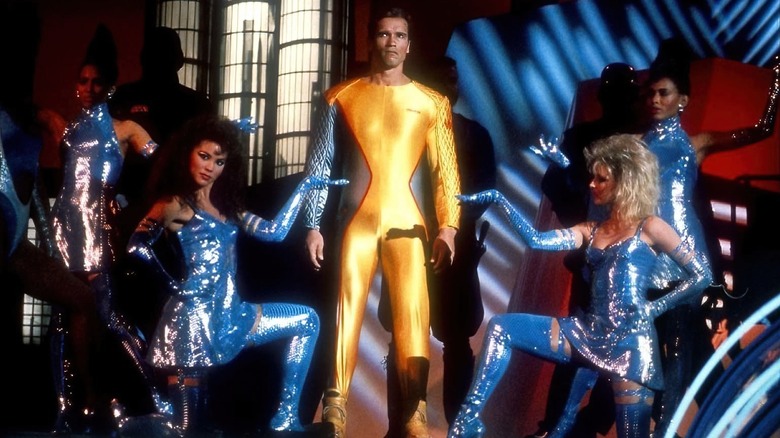
We could have placed either adaptation of the novel King wrote under his Richard Bachman pseudonym here, although Edgar Wright's more faithful 2025 adaptation falls at the final hurdle trying to avoid copying the novel's bleak ending. That wasn't a problem for director Paul Michael Glazer, as he and screenwriter Steven E. de Souza were more liberal in their adaptation, translating a thriller about a desperate man in-over-his-head into an archetypal Arnold Schwarzenegger vehicle. It's easier to buy the Austrian Oak as a wronged police captain seeking revenge against the totalitarian system that framed him for the massacre of protesting civilians than an American everyman pushed over the edge, and the transformation of the Ben Richards character is an ideal fit for the gruff action hero.
Its less shocking that this iteration of the protagonist offers an equal match to the Stalkers –- the assassins who reliably kill all contestants on the deadly game show -– considering Schwarzenegger's intimidating build. However, its pleasantly surprising that the social commentary doesn't get lost beneath the carnage, with themes ranging from economic inequality to the dehumanizing nature of reality TV making this feel more prescient today than the more recent remake. Released in the same year as the satirical sci-fi "Robocop" meant "The Running Man" initially lived in its shadow, but it holds up far better than it has any right to.
3. Dolores Claiborne
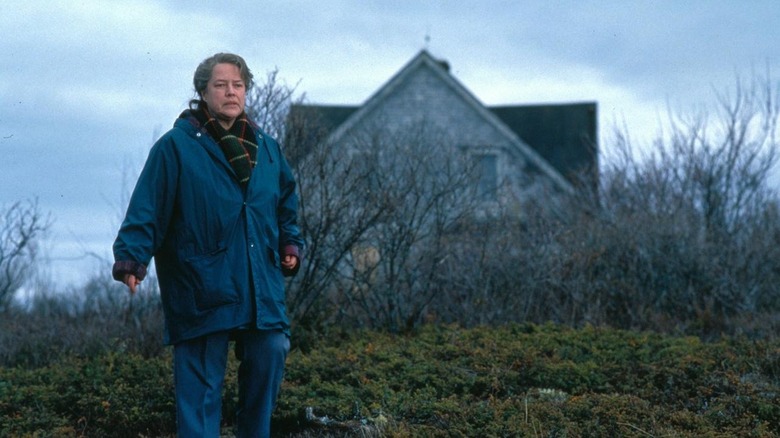
Written by Tony Gilroy, the screenwriter behind "Andor" and the original Bourne franchise, this gothic melodrama adaptation of King's 1992 novel has been a little forgotten to time. This might be because it's the second adaptation to star Kathy Bates in the lead, with nowhere near as over-the-top a showcase for her as "Misery;" that being said, the actress has repeatedly described this as her best performance.
Director Taylor Hackford's movie is a very different beast to that bloody psychodrama, a more slippery tale about a strained mother-daughter relationship decades after the death of Joe (David Strathairn), their sexually abusive husband and father. In the present, Dolores (Bates) is under suspicion for murdering the elderly woman she's a caretaker for, and her journalist daughter Selena (Jennifer Jason Leigh) returns to aid her, despite having her own nagging doubts about her innocence.
The whole town of Little Tall Island, Maine, assume Dolores was responsible for her husband's death many years earlier, with Selena's own memories of the period cloudy due to lingering trauma. "Dolores Claiborne" is, as the title suggests, less about the bigger legal picture and more about the woman at the center reconciling the damage and devastation that has forced her back under a microscope.
She's not an easily likable figure, but this makes the movie far richer as a feminist melodrama; a contemporary equivalent to the "women's pictures" of the 1940s and '50s, which makes for the adaptation furthest out of King's comfort zone.
2. The Shawshank Redemption
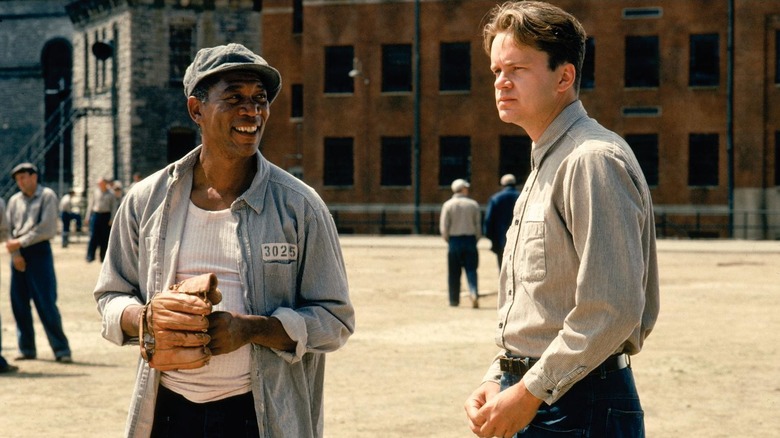
It may be the consensus pick for the greatest movie ever made according to IMDb users with its 9.4 score, but we're placing "The Shawshank Redemption" as our runner-up, because of King's non-horror efforts, one offers a more profound emotional gut punch. Which isn't to say that Frank Darabont's adaptation of King's novella "Rita Hayworth and Shawshank Redemption" has lost any of its impact: it's one of the rare movies that makes grown men weep for a reason. The movie may be unashamedly sentimental, but it doesn't shy away from the harrowing hallmarks of prison life, with the wrongly incarcerated Andy Dufresne (Tim Robbins) beaten and sexually assaulted multiple times in Shawshank.
Even as his circumstances slightly improve by helping the corrupt prison administration, the movie captures the bleak reality of passing time behind bars, underscored by the even darker reality that many inmates struggle to readjust to civilian life after their sentences are finished. But the reason the movie is fondly remembered as a crowd-pleasing sob fest -– even after initially underperforming at the box office –- is its central friendship between Andy and Red (Morgan Freeman), with the former doing all he can to find moments of hope in an unimaginably depressing situation. It makes for a final act every bit as melancholy as it is triumphant, with a touch of cynicism mixed in with the sentimental; a far more emotionally complex movie than it's typically given credit for, but still undeniably rousing.
1. Stand By Me
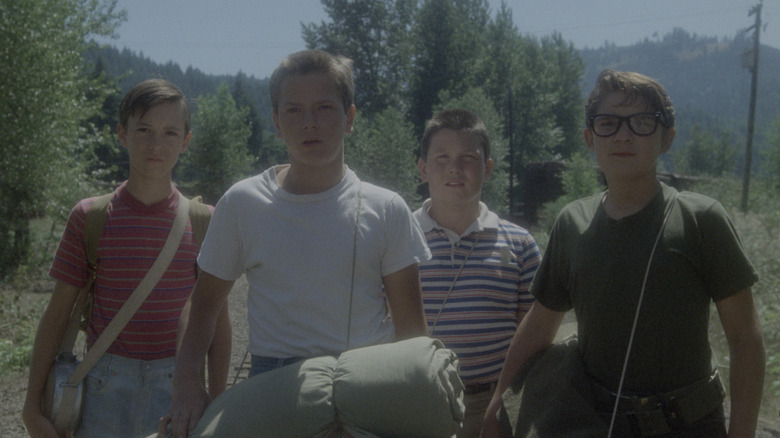
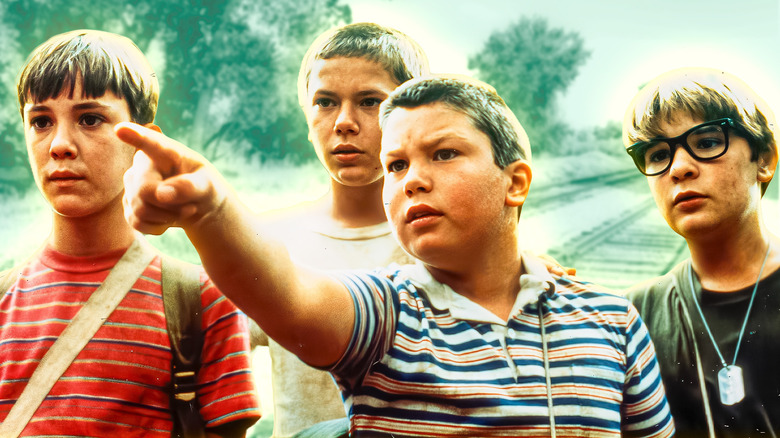
When Stephen King isn't creeping you out, chances are he's making you cry, and this definitive coming-of-age movie –- adapted from his 1982 novella "The Body" — turns us into bigger emotional wrecks than any other adaptation. Directed by Rob Reiner in the midst of his hot streak, "Stand by Me" balances the innocence of 1950s nostalgia with a melancholy examination of mortality that's rare in such a youth-oriented genre. Framed by the older Gordie LaChance (Richard Dreyfuss as an adult, Wil Wheaton as a kid) looking back to a formative Labor Day weekend, he reflects on gradually losing touch with childhood best friend Chris (River Phoenix), realizing he hasn't seen him in a decade when he receives the news of his murder.
The feature-length flashback follows the pair and their two friends Vern (Jerry O'Connell) and Teddy (Corey Feldman) as they embark on a quest to find the dead body of a local kid reported missing, believing that it'll get them recognized as heroes. Heading out on foot to a neighboring town and spending the night in the wild, the group process the cusp of a new school year that'll force them down separate paths in life that have already been pre-determined, and that this might be the last moment they all share as friends. It's the kind of story about childhood that resonates even more the older you get, and we've never been able to watch it through dry eyes.