

The Only Recap You Need Before The Hunger Games: Sunrise On The Reaping

This article contains discussions of addiction and mental health.
In 2008, author Suzanne Collins — previously best known for writing on TV shows like "Clarissa Explains it All" and her children's series "The Underland Chronicles" — majorly shook up the young adult genre by releasing "The Hunger Games," a sort of hybrid between "The Lord of the Flies" and "Battle Royale" set in a dystopian world controlled by the powerful Capitol that forces young people to compete in these horrifying titular "games." Two literary sequels, "Catching Fire" and "Mockingjay," followed, turning the original set of Hunger Games novels into a well-rounded trilogy. Movie adaptations, naturally, followed; as was the fashion at the time, "Mockingjay" got split into two films (like the final original Harry Potter movie before it).
Many, many, many attempts to imitate the Hunger Games novels and films came in the form of franchises like Divergent, Maze Runner, and the Mortal Instruments ... and despite those all being adapted from novels as well, nothing took off as well as Collins' treatise on government overreach, reality television, and control. To this day, the Hunger Games franchise has endured, and Collins has, as of this writing, released two prequels, "The Ballad of Songbirds and Snakes" and "Sunrise on the Reaping," both of which examine the world that led to the one that we see in "The Hunger Games." "The Hunger Games: Sunrise on the Reaping" is getting its own big-screen adaptation — with Joseph Zada as its protagonist Haymitch, a supporting cast that includes Mckenna Grace, Kieran Culkin, Elle Fanning, Jesse Plemons, Glenn Close, and Ralph Fiennes, and Francis Lawrence back as the director — what do you need to remember about the timeline as a whole before you see the latest film? Spoilers for everything but "Sunrise on the Reaping" ahead!
What is Panem, and what are the Hunger Games?

In the text of "The Hunger Games," we immediately meet our young heroine Katniss Everdeen — portrayed on-screen by Jennifer Lawrence — we learn about Panem, and we learn about the titular Games. Here's precisely what Katniss, who speaks in first person throughout the book, says of the mayor's speech on Reaping Day, the event that kicks off each year's Games:
He tells of the history of Panem, the country that rose up out of the ashes of a place that was once called North America. He lists the disasters, the droughts, the storms, the fires, the encroaching seas that swallowed up so much of the land, the brutal war for what little sustenance remained. The result was Panem, a shining Capitol ringed by thirteen districts, which brought peace and prosperity to its citizens. Then came the Dark Days, the uprising of the districts against the Capitol. Twelve were defeated, the thirteenth obliterated.
Katniss lives in the downtrodden coal mining district of District 12 — later in the book, she says that school taught that "the Capitol was built in a place once called the Rockies" and "District 12 was in a region known as Appalachia" — and she ultimately volunteers as the district's female tribute when her younger sister Primrose (Willow Shields in the movie) is chosen in the random lottery. So what are the Games? It's simple. Each year, one girl and one boy (between the ages of 12 and 18) are chosen from each district to fight in an arena, with only one tribute surviving. The entire thing is televised for entertainment, with the Capitol sending zero children each year and simply enjoying the carnage. That winning tribute gets an enormous cash prize, but the cost is ... significant.
Who is Haymitch Abernathy?

When Katniss first sees Haymitch Abernathy, her eventual mentor played by Woody Harrelson in the original film franchise and Joseph Zada in the prequel, he's the only living (and known) District 12 victor in its entire history. He also has ... a substance abuse issue:
"In seventy-four years, we have had exactly two. Only one is still alive. Haymitch Abernathy, a paunchy, middle-aged man, who at this moment appears hollering something unintelligible, staggers onto the stage, and falls into the third chair. He's drunk. Very."
This is our very first glimpse of Haymitch as well, and to call it unflattering is ... an understatement. Still, thanks to the novel version of "Sunrise on the Reaping," we do know some things about Haymitch that Katniss doesn't. We know that he's a victor, yes, but we ultimately also learn that he competed in the 50th Hunger Games, known as the Second Quarter Quell. The Quarter Quells happen, appropriately, every 25 years and introduce sickening and awful twists into the proceedings ... and Haymitch's games included 48 tributes instead of 24, doubling the children who die during the brutal competition. We also know, from "Sunrise on the Reaping," that he left behind loved ones when he participated in those Games that he ultimately won: his girlfriend Lenore Dove Baird, his mother Willamae, and his younger brother Sid. (These characters are played by Whitney Peak, Kara Tointon, and Smylie Bradwell in the film adaptation.) Vitally, Haymitch works as a bootlegger in District 12 to support his family by selling contraband liquor ... but he doesn't drink as a teen. We'll avoid spoilers, but suffice to say the Games are tough on him.
We meet Haymitch in the original Hunger Games book and film

Katniss sees Haymitch Abernathy drunk as a skunk at the District 12 reaping, but then she and her fellow tribute Peeta Mellark (Josh Hutcherson) clean him up after a night of drinking and meet him properly on a train to the Capitol, where they spend a few days holed up with Haymitch and their stylist Effie Trinket (Elizabeth Banks in the original films and Elle Fanning in "Sunrise on the Reaping"). When Katniss tells Haymitch that he's supposed to provide advice and support to his tributes, his only advice is "stay alive," which causes Peeta to knock Haymitch's first drink of the morning out of his hand and Katniss to drive a knifepoint between his fingers on the train's mahogany table. Haymitch is ... begrudgingly impressed.
Haymitch and Katniss spend most of the first book and film soundly butting heads — they're both incredibly stubborn and, at worst, rude, so this makes a ton of sense — but when they reach an agreement to keep the kindhearted Peeta alive, a bond grows between them. Even in the arena, when they're separated, Haymitch urges Katniss to keep up the ruse that he and Peeta devise before the Games (that they're in love) through sponsor gifts, and his words ring through her mind almost constantly. Though Katniss's initial impression of Haymitch is that he provides shoddy advice as a mentor because he doesn't care, the truth is that he grows to care for her and thinks she can actually win the Games — and he actively tries to make sure she succeeds.
By the time Katniss and Peeta manage to jointly win the games by pushing the pretend relationship, Katniss and Haymitch are firmly bonded ... and their relationship only grows in the sequels.
In The Hunger Games: Catching Fire, Haymitch becomes a confidante to Katniss

As "Catching Fire" begins, Katniss and Peeta live with their families in District 12's nearly deserted Victor's Village, a line of dilapidated and mostly empty mansions meant for Hunger Games winners to enjoy post-victory. Haymitch also lives there, and as Katniss notes, she takes daily trips into the gritty District 12 marketplace known as the Hob to fetch something for him:
"The liquor isn't for my family. It's for Haymitch, who acted as mentor for Peeta and me in the Games. He's surly, violent, and drunk most of the time. But he did his job—more than his job—because for the first time in history, two tributes were allowed to win. So no matter who Haymitch is, I owe him, too. And that's for always."
Haymitch protects Katniss when she tries to interfere as Peacekeepers savagely beat her best friend Gale Hawthorne (Liam Hemsworth in the movies), stepping between their whips and his friend and fellow victor; when Capitol president Coriolanus Snow (Donald Sutherland in the original films) wants vengeance against Katniss for her machinations with Peeta in the first game and declares that only previous victors can be Reaped for the 75th Hunger Games (the third Quarter Quell), Peeta immediately volunteers in Haymitch's place. As Katniss and Peeta learn later, though, Haymitch is working behind the scenes once again. After encouraging them to align themselves with other fellow victors like Finnick Odair and Johanna Mason (Sam Claflin and Jena Malone in the film), they realize he's been quietly working with the resistance to break them out of the arena ... but things go awry by the time "Catching Fire" comes to a close, and Peeta is captured by the Capitol while Katniss and Haymitch escape.
Haymitch joins the revolution in The Hunger Games: Mockingjay

To say the bond between Katniss and Haymitch is fractured in "Mockingjay" is an understatement; Katniss is incandescently furious at her mentor for not protecting Peeta over here and allowing him to be captured and tortured by the Capitol during an all-out war. As the two hunker down in District 13 — which does actually exist and operates as a stronghold of the resistance deep underground while evading Capitol forces — Katniss remains angry at Haymitch for what she believes was his inability to save Peeta, but he argues that she needed to be the priority because she's the one who can rally the resistance and inspire the downtrodden.
As Katniss becomes the titular Mockingjay, the symbol of the resistance, Haymitch lends whatever support he can, and things do eventually thaw between them (Katniss can be extraordinarily stubborn, and as a reader and viewer, you have to step outside of her perspective and understand that she can be just a touch pig-headed when it comes to other people's intentions). Still, there's an incredibly funny moment between them in the novel while Katniss attempts to film a convincing video as the Mockingjay. As she wraps up the shoot, Katniss narrates, "Finally, the intercom crackles and Haymitch's acerbic laugh fills the studio. He contains himself just long enough to say, 'And that, my friends, is how a revolution dies.'"
Haymitch and Katniss ultimately survive the war against the Capitol and settle down in District 12 alongside Peeta, but to say the scars remain is to undersell exactly how traumatized all of them are. Interestingly, though, Haymitch's story also connects to Suzanne Collins' first prequel "The Ballad of Songbirds and Snakes," despite it taking place years before his birth.
Decades before Haymitch's Hunger Games, President Snow tangles with District 12

District 12 plays a huge role in every existing Hunger Games book and film, whether we're meeting Katniss there on her reaping day, watching Haymitch get plucked from the crowd for his own reaping, or, in the book and film of "The Ballad of Songbirds and Snakes," an important place for a young Coriolanus Snow. (Tom Blyth portrays the young Coriolanus, who goes by "Coryo," in the 2023 film adaptation.) As a student in the Capitol Academy — and the heir of the Snow family, whose high status crumbled to the point that Coryo and his sister and grandmother live in poverty — Coryo is assigned to mentor a District 12 tribute in the 10th Hunger Games, and that tribute's name? Lucy Gray Baird, the Covey songstress portrayed on-screen by Rachel Zegler.
Being given District 12 as a responsibility is, initially, a punishment for Coryo doled out by the Academy dean Casca Highbottom (Peter Dinklage on screen), but when he meets Lucy after she makes waves at her reaping by slipping a small snake into a rival girl's dress, he realizes that her musical talents and irrepressible spark might earn her goodwill from the audience. With the 10th Hunger Games airing all around Panem — the first Games to be televised, actually — Coryo takes full advantage of Lucy's charm. As we know, his "guidance" (put a pin in that) and faith in Lucy not only helps her get sponsors and earn that aforementioned goodwill; Lucy wins the 10th Hunger Games.
Haymitch is one of only two District 12 winners before Katniss Everdeen
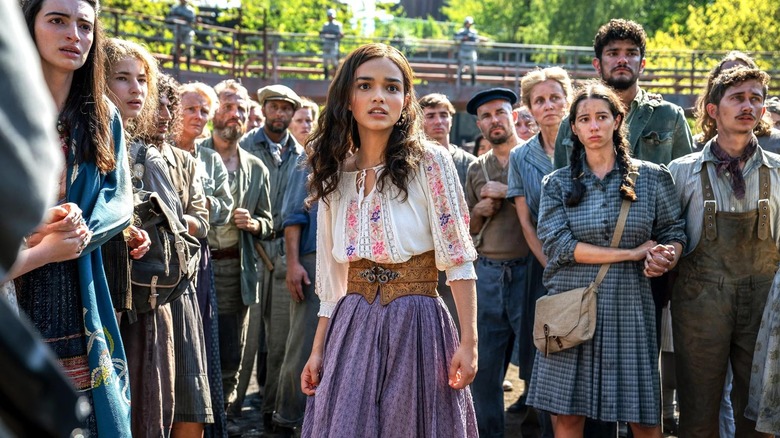
Lucy wins the games — she's the only victor to precede Haymitch— but because Coryo helps her lightly cheat with some rat poison hidden inside of her token as well as a trick where he uses a handkerchief with her scent to trick some Capitol "muttations" into avoiding her, he's punished again by Casca Highbottom and forced to become a Peacekeeper. Still, Coryo quietly arranges to be sent to District 12 to reunite with her. If you've watched or read "The Ballad of Songbirds and Snakes," you know that Lucy and Coryo's relationship doesn't exactly end well.
In fact, in District 12, Coryo's true colors start to show. Not only does he betray his best friend and fellow Hunger Games mentor Sejanus Plinth (Josh Andrés Rivera in the film) by recording him discussing a rebellion using a jabberjay — and sending said jabberjay to the Capitol's Head Gamemaker at the time, Viola Davis' evil Dr. Volumnia Gaul — but during an altercation with Lucy Gray and other District 12 denizens, a shootout occurs, and Coryo kills the mayor's daughter Mayfair Lipp (Isobel Jesper Jones) in the process. He and Lucy devise a plan to run away together, but Lucy is understandably wary of Coryo, especially after Sejanus is hanged and Coryo says something odd about killing multiple people. As she escapes his clutches, Coryo attempts to shoot her, but she gets away ... and his villain arc officially begins, as does his enduring hatred of District 12. (It's not a coincidence that an older President Snow hates the strong-willed, brown-haired District 12 tribute Katniss Everdeen.)
In the Hunger Games franchise, Haymitch is the major connective tissue

Once we learn that Haymitch wins a particularly dangerous and frightening iteration of the Hunger Games in "Catching Fire," it's easy to see how Suzanne Collins built an entire prequel around the Second Quarter Quell. (In the text of "Catching Fire," a miniature version of Haymitch's games that we see in full in "Sunrise on the Reaping" plays out as Katniss and Peeta watch the official Capitol footage of the interviews, arena carnage, and conclusion, ending with Haymitch's surprising victory.) Because of Haymitch's participation in these specific games, he's the most essential connective tissue in the entire Hunger Games universe — because he has crucial interactions with both Snow and Katniss, bridging the decades between them.
Like Katniss, Haymitch is a rebel who uses forbidden aspects of the arena — like a force field — to great effect (he wins the Games when his only surviving opponent, a "Career" tribute from District 1, throws an axe at him only for it to rebound in the force field and kill her instead). He also is given "special" attention by Snow — as Katniss is decades later as well — and he understands the danger posed by Snow and the Capitol at his command better than anyone (for reasons we won't spoil here that have to do with the ending of "Sunrise on the Reaping"). Spoilers aside, Haymitch vows to bring down the Capitol and end the Games in "Sunrise on the Reaping" — the title of which refers to him hoping another sun will never rise on Reaping Day — and thanks to Katniss, he achieves that goal decades after winning the Second Quarter Quell.
Will there be more stories in the Hunger Games universe?

After the initial release of the Hunger Games trilogy, Suzanne Collins waited a full decade to release "The Ballad of Songbirds and Snakes" and another five for "Sunrise on the Reaping," so whether or not she'll continue telling stories from different Games and parts of Panem is anyone's guess. With that said, the world that Collins has built here is vast, layered, and fascinating, and it's genuinely remarkable that both of the prequels we've gotten so far haven't felt like cheap attempts to cash in on a sensation. Instead, they're fascinating and urgent ... and only add to the wider world of Panem instead of diminishing the legacy of this genuinely excellent young adult series.
It's easy to imagine that, in the future, we'll get a prequel focused on Games won by former victors like Finnick Odair or Johanna Mason. Perhaps we could even take a look at a complex Capitol figure in the form of Plutarch Heavensbee, who's portrayed by Jesse Plemons in the prequel and who was played by the late, great Philip Seymour Hoffman in the original trilogy. In any case, we'll all be waiting to see if Collins continues her story ... and "The Hunger Games: Sunrise on the Reaping" releases on November 20, 2026.
If you or anyone you know needs help with addiction issues, help is available. Visit the Substance Abuse and Mental Health Services Administration website or contact SAMHSA's National Helpline at 1-800-662-HELP (4357).
If you or someone you know needs help with mental health, please contact the Crisis Text Line by texting HOME to 741741, call the National Alliance on Mental Illness helpline at 1-800-950-NAMI (6264), or visit the National Institute of Mental Health website.