

Street Fighter Review: A Weak Video Game Adaptation That Pulls Every Punch
- - Stellar animated sequences
- - Some cheeky hints of homoeroticism
- - Bloodless action, with every slapstick fight falling flat.
- - Gags even more outdated than the 1993 setting.
- - Doesn't even have an ending!
It doesn't come as a surprise that the latest "Street Fighter" movie follows the formula of rival beat-em-up video game adaptation "Mortal Kombat" from 2021, but it did still catch us off guard that it similarly forgot to finish the tournament fans have come to see. "Mortal Kombat" refrained from showing any of its high-stakes combat event until the superior sequel, released earlier this year, while "Street Fighter" reveals very early on that the World Warrior tournament is all a ruse to bring the world's best fighters closer to a dictator (David Dastmalchian's Bison) who wants to drain them of their powers. There are no winners, and the movie unceremoniously ends by teasing that the big boss fight won't happen until next time, setting the table for a sequel that will likely never see the light of day.
Zach Cregger's excellent "Resident Evil" movie and a series of small-screen successes have convinced many that we're entering a golden age of video game adaptations, thanks to creatives who understand how to translate the specific storytelling approach of their source to a different medium. "Street Fighter" is a movie that feels out of time next to those, and not just because it's set in a 1993 where nobody's wardrobe has changed since the mid 1980s.
Instead of faithfully capturing the experience of playing one of the original games, the screenplay by T.J Fixman and director Kitao Sakurai tries too hard to narrativize a source with very little plot to start with, their attempts at world-building clumsily getting in the way of the simple, effective action thrills.
The worst kind of live-action cartoon
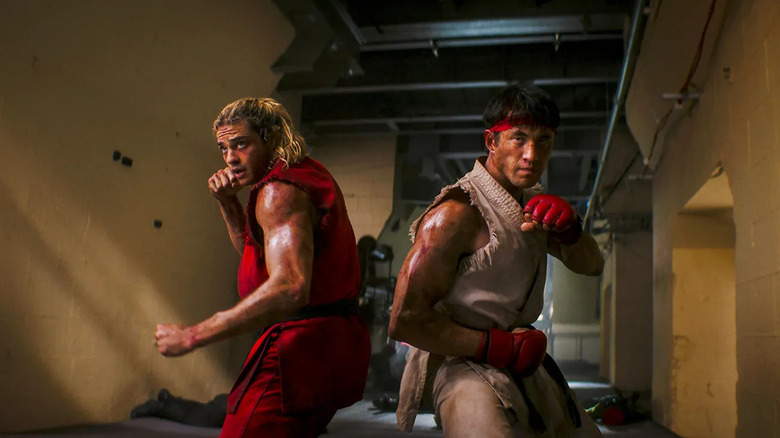
This isn't helped by a PG-13 rating which renders said action completely bloodless, with Sakurai relying on a live-action slapstick cartoon tone to work around the MPAA restrictions. It's an aesthetic I admired it attempting, but the execution is insufferable, with all but a handful of visual gags falling flat amidst poorly staged martial arts carnage.
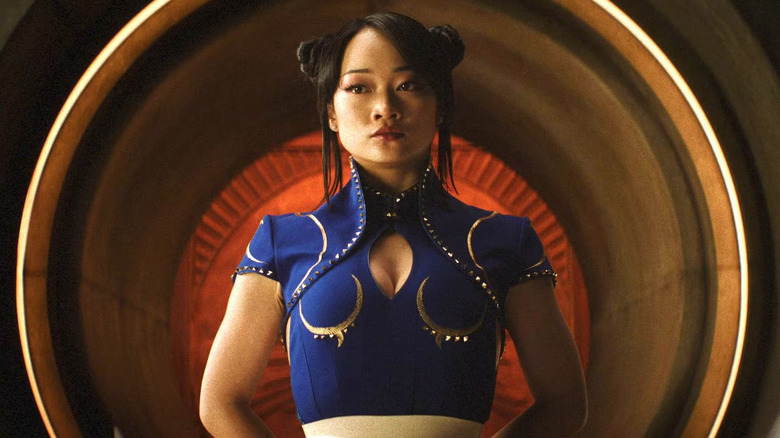
Callina Liang plays Chun-Li, an undercover Interpol agent wanting to avenge her father's death at Bison's hands, who is recruiting fighters from all over the world to appear at the dictator's tournament in Metrolao City. These include estranged adopted brothers Ryu (Andrew Koji) and Ken Masters (Noah Centineo), the former now retired from fighting, only making the journey to dissuade his sibling from entering the ring. Ken refuses, as he'll finally have a chance to prove himself out of his brother's shadow, but soon learns the truth about why the tournament is taking place under a dictator's eye.
The worldbuilding is every bit as one-dimensional as you'd expect from an adaptation of a source highly regarded for its innovative gameplay but not its story. Details of Bison's dystopian dictatorship beyond his tournament aren't filled in, with his Spirit Halloween Nazi uniform created to fill in blanks the screenplay doesn't care for, making the fight against his overarching evil plan feel devoid of any real stakes. This is a movie where even the grounded characters are cartoonish caricatures, with Fixman and Sakurai's script taking such pains to ensure audiences don't take anything seriously that it quickly winds up asking us not to care at all.
It's a popular speculation that Skydance CEO David Ellison has been trying to make more right-leaning movies under his tenure to capture the attention of certain types of audiences. Though produced and filmed under Legendary, it feels easy to connect Ellison — who would have had no actual connection to the production — to an attempt to appeal to this audience, with outdated gags about Asian food, multiple outdated gay panic one-liners to undercut the healthy dose of homoeroticism, and countless more strained sexual gags that are more vulgar than they are actually funny.
It is at least refreshing that a movie gunning for such a stereotypically male audience sexualizes its men just as much as its female characters — even the hand-drawn animated sequences linger ever so slightly too long on a character's pectoral muscles — but these all seem like distractions to deflect from just how much the movie treats the idea of queerness (or any non-conventional sexuality) as a joke.
Lost in the '90s
Yes, the joke is also on straight men, as the film offers a Michael Bay-style scene where Chun-Li gets into the shower, steam covering the lens, that then fades into the body of a sumo wrestler in a sauna. Unfortunately, this too feels like a hangover from a less empathetic era, before the body positivity movement. For that visual punchline to work, you have to rely on the audience's presumed fatphobia and heterocentricity, which makes all nods towards homoeroticism elsewhere look even more hollow. You'd find more progressive body positivity from a Grindr user with a pro-manosphere profile.
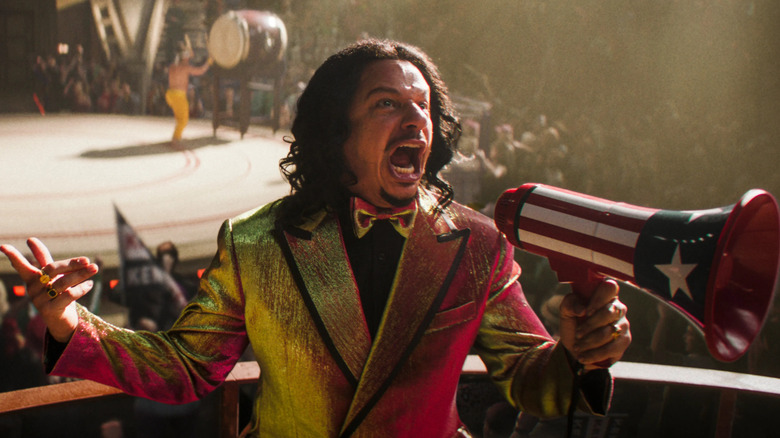
The cartoonish tone maintained throughout is likely to dull some of this criticism, although the high energy required is absent from the cast's performances. Even reliable chaos merchant Eric Andre, playing tournament MC Don Sauvage, feels like he's phoning in a performance that begins with him licking a boot. This is eventually matched by the editing of the film itself, which keeps draining the tension from fights already lacking in stakes by cutting between locations seemingly at random, with no sense of rhythm to the direction. A punchier edit would make it easier to overlook the bloodlessness of it all, but in this iteration, its aimless slapstick never lands on the right note.
Ultimately, "Street Fighter" wants to appeal to those who came of age during the movie's heyday, without offering anything that would make us nostalgic for the game itself. It's a strange decision to make a PG-13 blockbuster aimed squarely at the oldest millennials after the success of both "Backrooms" and "Buddy" has shown that Gen-Z are fascinated by those final pre-internet years, and the 21-year-old director of the latter provided a more authentic depiction of the '90s despite being born in 2005.
The emotional arc of the movie hinges directly upon Ryu's love of the 4 Non-Blondes' "What's Up," which we see him listening to before the 1987 tournament, even though the song wasn't released until 1993. It's shamelessly chasing nostalgia through pop culture references it has no connection to in the first place. It's the biggest issue with "Street Fighter" in a nutshell — it wants us to be nostalgic about its pop culture heyday without giving us a reason to care about it here and now.