

5 Best Robert Mitchum Western Movies, Ranked
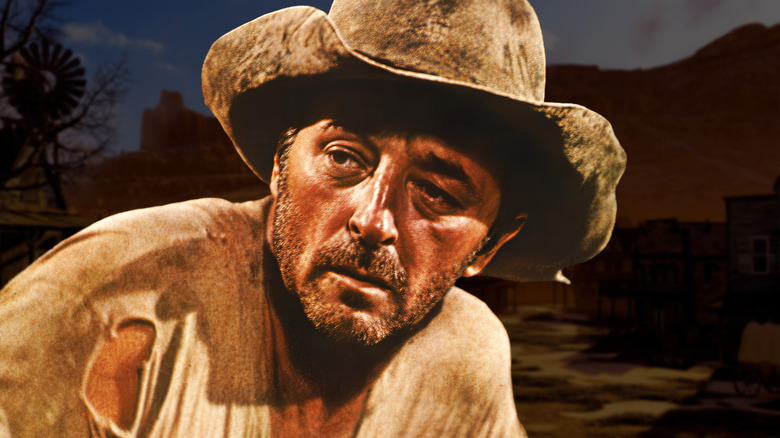
If you tried selling Robert Mitchum as a lead to modern Hollywood executives, you'd get laughed out of the room. This actor was famous for having eyes and facial expressions that immediately suggested years of wear and tear. The instant he strolled on-screen, Mitchum imbued his characters with decades of compelling experience. His gifts here as well as countless his innate charisma resulted in numerous memorable movies. His unforgettable performance as Reverend Harry Powell alone in "The Night of the Hunter," one of the best movies of all time, is enough to solidify this actor as a silver screen titan.
Impressively, though, Robert Mitchum's career went beyond having one of the greatest American cinema lead man turns ever. Among numerous other achievements, he's also famous for headlining several Western movies. This genre ensnared nearly all famous leading men of the '40s and '50s, and Mitchum was no exception. The five best Robert Mitchum Western movies (ranked from "least best" to greatest based on their average Letterboxd user ratings) exemplify why this actor is so deeply intertwined with this genre today.
These five films also show the many different characters and deeply impactful performances Mitchum delivered across his astonishing filmography. Robert Mitchum made the movies infinitely better, and these Western gems are just the tip of the iceberg.
5. Track of the Cat
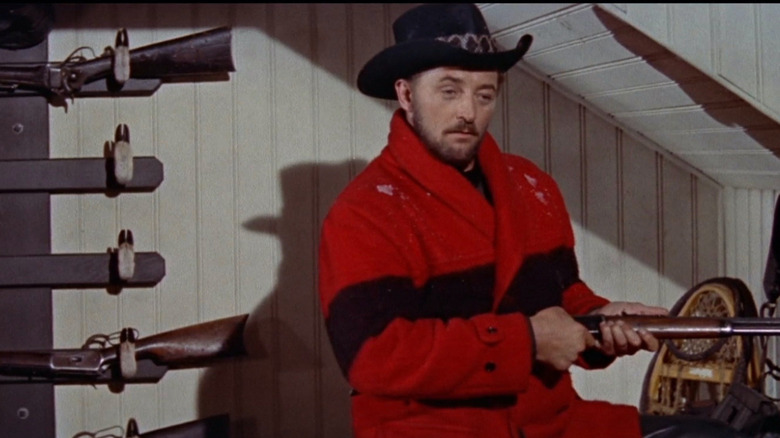
Snow makes movies extra special, and snowy Westerns are a sublime example of this phenomenon. Westerns are so often defined by dry deserts, tumbleweeds, and crumbling canyons that seeing the backdrops of these stories covered in white snow immediately captures your attention. Plus, snow imbues Westerns with an extra melancholic air. Winter has arrived. Seasons always change. Even the most legendary cowboy can't control or alter that reality. It doesn't hurt that the snow-covered Western is associated with movies like the 1954 Robert Mitchum vehicle "Track of the Cat."
In this William A. Wellman directorial effort, Curt (Mitchum) and his brother Harold (Tab Hunter) live a normal, albeit full of familial torment, life in California until the fateful day when a panther slaughters another one of Curt's brothers. Now Curt is Captain Ahab and this panther is his white whale. "Track of the Cat" has a 3.4 average rating on Letterboxd, with that rating weighed down by its racially caricatured Indigenous characters as well as some of its more bizarre plot points. However, other Letterboxd reviews praised the memorable snow-covered imagery as well as Robert Mitchum's commitment to the strange material.
If you've been craving a snowy panther revenge thriller, "Track of the Cat," though far from perfect, should satisfy your oddball cravings.
4. Blood on the Moon
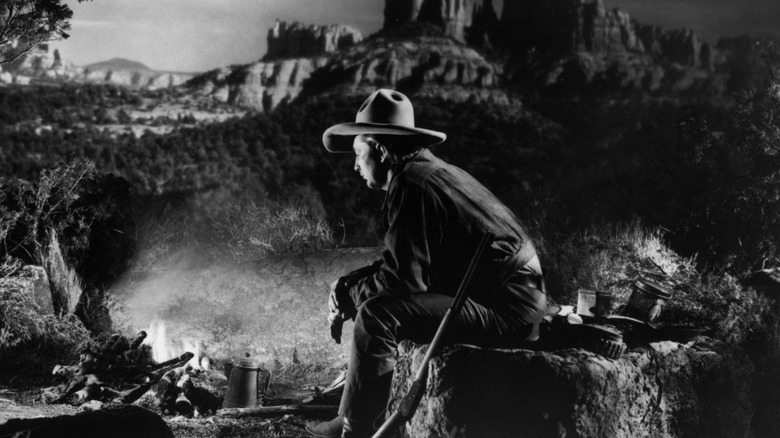
Director Robert Wise was all over the map across his career as a journeyman filmmaker that spanned from the 1940s to the 1980s. If you wanted someone who could capably deliver anything from "The Haunting" to "The Sound of Music" to "The Andromeda Strain," a '70s sci-fi movie that was way ahead of their time, Robert Wise was your guy. One of two movies he helmed in 1948 was "Blood on the Moon," which saw Mitchum playing Jim Garry. When he's asked to help sort out a cattle-oriented argument, Garry uncovers a scheme involving Tate Rilling (Robert Preston) taking money from an unwitting rancher. Will he intervene in this plot or let Rilling get away with his machinations?
The average 3.5 rating for "Blood on the Moon" on Letterboxd is informed by a bevy of reviews stating that this script won't surprise anyone who has seen even a handful of classic Westerns. However, those same reviews sing the praises of Mitchum as being absolutely perfect for these grimy proceedings. Jim Garry being forced to contend with a towering moral conflict gives Mitchum many jagged edges to realize, and the performer handles these intricate imperfections with great deftness.
Robert Mitchum's excellent star turn informs many euphoric Letterboxd reviews for "Blood on the Moon." Assured veterans like him and Robert Wise liven up a project that could've collapsed into a pile of familiar tropes.
3. Pursued
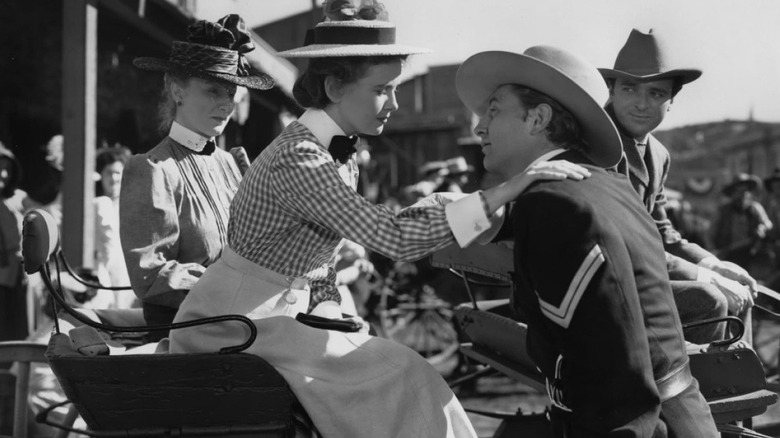
Director Raoul Walsh and screenwriter Niven Busch made no pretenses about what the 101-minute Western "Pursued" was about with the film's succinct title, a Southern saying suggesting bad guys chasing heroes. Instead, this movie is about paranoia surrounding being pursued, so the movie is simply called "Pursued." That psychological mayhem comes down to the character Jeb (Robert Mitchum), whose parents were killed when he was just a boy. Now, he lives with the Callum foster family, a household that provides Jeb plenty of happiness save for whenever he and his foster brother Adam (John Rodney) are at each other's throats.
When Jeb gets shot one day, chaos unfolds as he assumes Adam wants him dead. Turns out there's an even greater conspiracy afoot involving people "pursuing" Jeb until he's got no pulse. With an average 3.7 Letterboxd rating, "Pursued" had many feeling that trying to pull off this grim story in Hays Code-era Hollywood meant it couldn't reach its fullest potential. The externally-informed obligations to not ruffle too many feathers inevitably undercuts its tragic and bleak plot. Otherwise, though, the "Pursued" Letterboxd reviews are chock full of lauding comments, particularly towards Walsh's assured direction.
Robert Mitchum's tormented lead performance is also repeatedly praised here, especially since this is a rare project where he's being tormented by others instead of being the "Night of the Hunter-"style tormenter. Mitchum's complex range is reinforced in "Pursued," a movie with a decidedly uncomplex title.
2. El Dorado
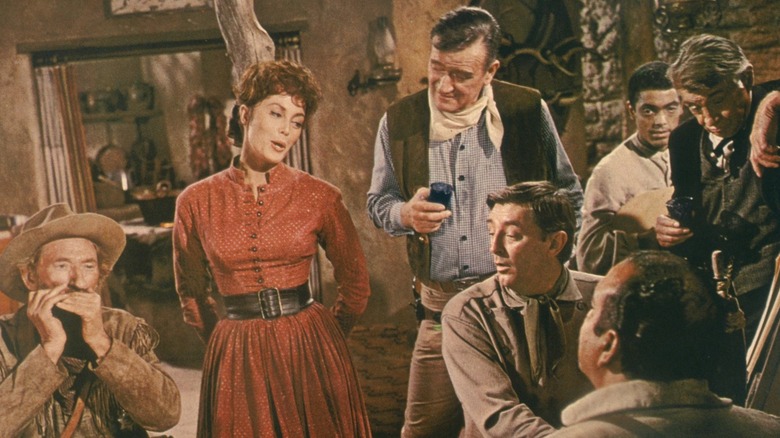
Decades before "The Road to El Dorado" lit up movie theaters, Howard Hawks helmed the Western "El Dorado," which united two notable stars of the mid-20th century Western. None other than John Wayne and Robert Mitchum were brought together for this enterprise. Wayne played Cole Thornton, who calls upon a pal from his past, Sheriff J.P. Harrah (Mitchum) to help a rancher protect his land and water from evildoers. That's a tall ask, but that's why a formidable duo like Wayne and Mitchum have been called into action.
"El Dorado," which also features Ed Asner, James Caan, and Charlene Holt (among others) in its supporting cast, has an impressive 3.8 average Letterboxd rating. One recurring feature of these reviews are Letterboxd users expressing pleasant surprise over how funny and loose "El Dorado" is. While some of Wayne's Westerns were self-serious productions, "El Dorado" wasn't afraid to cut loose with some jokes. Other users also remark that "El Dorado" is good enough to make its glaringly obvious similarities to the older Howard Hawks Western "Rio Bravo" more digestible.
Derivative? Sure. However, "El Dorado" was entertaining enough to make that facet less egregious than it otherwise would've been. The relaxed pacing, meanwhile, allows for plenty of scenes here where Mitchum nonchalantly reminds viewers why he's such a legend. Uniting Wayne and Mitchum ended up delivering a movie that lived up to the potential of that pairing.
1. The Lusty Men
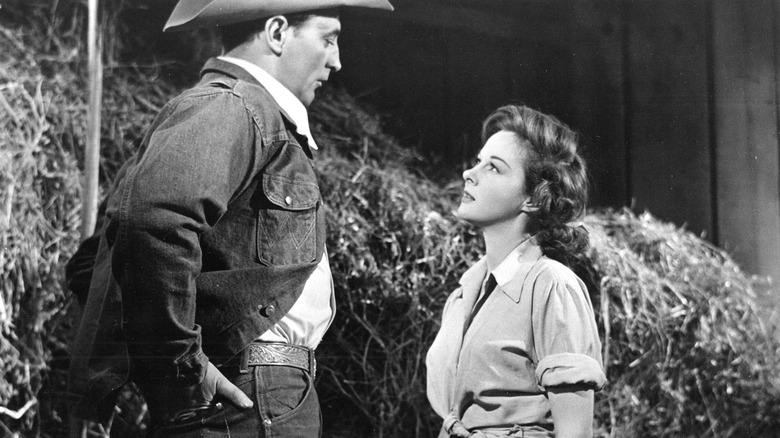
One can't talk about the best movies of the 1950s without mentioning director Nicholas Ray. The filmmaker behind "Rebel Without a Cause," "Johnny Guitar," and "In a Lonely Place" was an essential artist whose directing exploits also included working with Robert Mitchum on 1952's "The Lusty Men." Mitchum's famous and tangible on-screen weariness was well-suited to playing Jeff McCloud, whose long left the world of rodeo performances (where he used to be a legend) behind. However, when Wes Merritt (Arthur Kennedy) pleads for McCloud to train him, this tired veteran agrees.
This is despite Louise Merritt (Susan Hayward) adamantly discouraging her husband's rodeo fixation. "The Lusty Men" is a movie about being torn between opposing forces, whether it's McCloud struggling to evade or embrace his past or the Merritt couple's differing attitudes towards rodeo work. Such rich themes inform this acclaimed title's 3.9 average Letterboxd rating, with an avalanche of positive reviews waxing poetic on its countless achievements. The movie's aching tragedy and how potently Mitchum epitomizes that quality are two virtues especially lauded across Letterboxd reviews.
The effectively precise realization of the rodeo sequences similarly endure as acclaimed aspects of "The Lusty Men." Not only did Nicholas Ray deliver another knockout movie with "Lusty Men," but the Letterboxd entries for it help crystallize Robert Mitchum's specialness in the history of American leading men.