

5 Best War Movies Of All Time, According To Rotten Tomatoes
In the original song by The Tempations and its subsequent cover by Edwin Starr, a simple question is raised. "War: what is it good for?" While the answer in the song is "Absolutely nothing," that hasn't stopped some of the world's best writers, directors, cinematographers, and actors from making a ton of films about the subject. On many levels, this isn't surprising at all. Brutal and horrifying as the very concept of war might be, it's also a topic that allows artists to explore the fullest extent of the human psyche, and it's a well that creatives have been turning to for decades. Even though many of the films included on this particular list have been around for decades, lauded, award-winning directors like Christopher Nolan and Steven Spielberg have explored wars — both real and imagined — across projects like "Dunkirk," "Oppenheimer," and "The Odyssey" (Nolan) and "Munich," "War of the Worlds," and "Saving Private Ryan" (Spielberg).
So which movies are the very best? That's a matter of opinion, except when it's not — because we're ranking these films according to their Rotten Tomatoes ratings, using the review aggregator to collect the data on the most realistic, moving, and emotionally difficult war films ever made. From one of Spielberg's best-ever movies to a romance set against the backdrop of World War II to a staggering animated classic, here are the five best war movies of all time according to Rotten Tomatoes.
5. Schindler's List
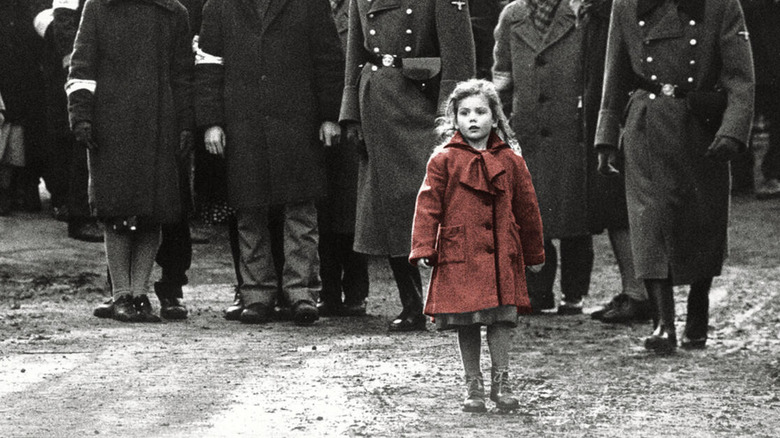
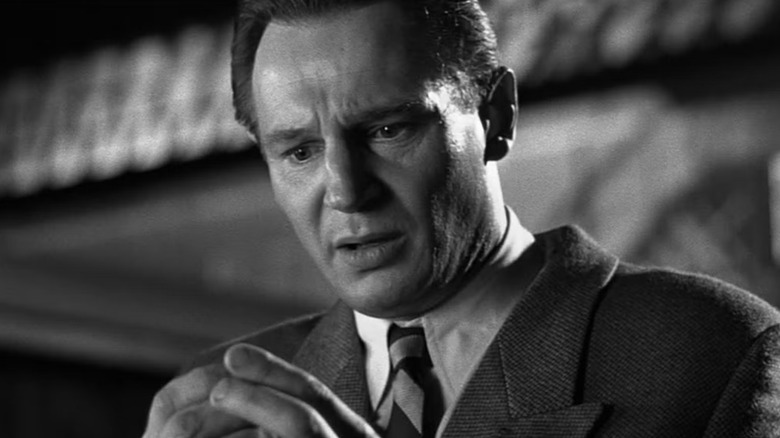
Adapted from Thomas Keneally's 1982 historical novel "Schindler's Ark" and based on true events, Steven Spielberg's 1993 film "Schindler's List" is a legitimate masterpiece ... and centers the story of Oskar Schindler, a man who risked his life time and time again to save innocent victims from Nazi forces. Portrayed by Liam Neeson (who earned an Oscar nod for lead actor), Oskar, initially a Nazi party official from the territory then known as Czechoslovakia who works as an industrialist, heads to Nazi-occupied Kraków to try and make a tidy profit by opening an enamelware factory. He has a secret plan, though. As he opens the factory, Oskar hires Itzhak Stern (Ben Kingsley), a Jewish man, to oversee operations ... and the two give Jewish members of the Kraków ghetto jobs in the factory in an attempt to prevent them from being taken to concentration camps.
To hide his true intentions even further, Oskar cozies up to the deeply evil Nazi official Amon Göth (Ralph Fiennes), who holds the title of SS-Untersturmführer (translating to "second lieutenant") and wields enormous power ... but is also perfectly happy to take endless bribes from Oskar. Through the efforts of both Oskar and Itzhak, over 1,000 Jewish people were saved from certain death, and Spielberg and Neeson show us all of the horrors he experienced in his righteous quest. It's ultimately not surprising that this deeply influential war movie, which won best picture at the Academy Awards and earned Spielberg a statue for best director, still has a 98% rating on Rotten Tomatoes.
4. The Battle of Algiers
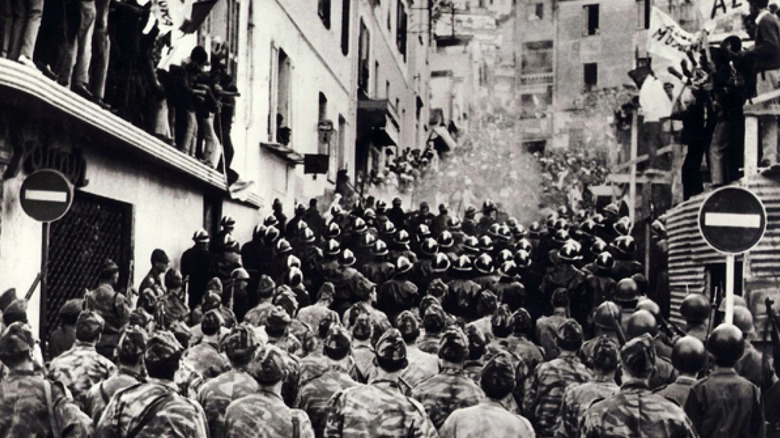
Just in case you somehow thought that the 1966 film "The Battle of Algiers," directed by Gillo Pontecorvo, isn't "relevant" anymore, here's a fun fact. In Paul Thomas Anderson's acclaimed 2025 Americana masterpiece "One Battle After Another," which won an Academy Award for best picture, Leonardo DiCaprio's former revolutionary is watching this movie at his house when he's suddenly called to action to help his daughter Willa (Chase Infiniti), proving that "The Battle of Algiers" remains a massive influence on major filmmakers.
Directed by Pontecorvo and written by Franco Solinas, "The Battle of Algiers" takes direct inspiration from a real battle in Algiers, the capital of Algeria, that occurred during the Algerian War; Pontecorvo went to great lengths to largely hire non-actors who had actually served and fought in the war, and his filming approach leans much more towards cinema verité or even a documentary rather than a traditional narrative film. All the while, the action centers around our protagonist Ali la Pointe (Brahim Hadjadj), a revolutionary fighting against the French army for Algerian independence. "The Battle of Algiers" is an extraordinary feat of filmmaking and remains one of the best and most realistic movies ever made about wartime. That's probably why it's maintained, across decades, a 99% rating on Rotten Tomatoes with a critical consensus that reads, "A documentary-like depiction of a nation's real-life efforts to expel a colonizing force, 'The Battle of Algiers' puts viewers on the front lines with gripping realism."
3. Casablanca
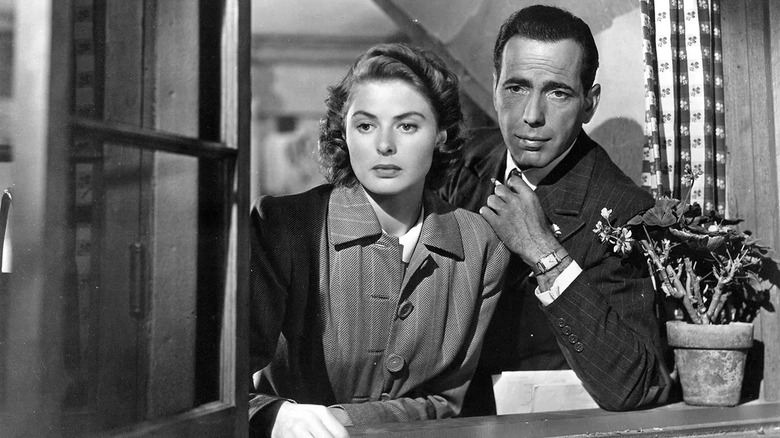
Even though the classic romantic drama "Casablanca" — directed by Michael Curtiz and written by Julius J. Epstein, Philip G. Epstein, Howard Koch, who adapted it from the stage play "Everybody Comes to Rick's" — doesn't feature any battle scenes, World War II looms over the entire narrative ... especially when it comes to the story's war-torn lovers. When we first meet Rick Blaine, he's an American ex-pat running his own bar, Rick's, in the Moroccan city of Casablanca — and to be fair, his life seems pretty good in that he owns a bar, can smoke inside and stay after hours whenever he wants, and answer to nobody. Still, Rick is shocked when his former lover Ilsa Lund (Ingrid Bergman) shows up at his bar only to be introduced to her husband Victor Laszlo (Paul Henreid), a well-known Czechoslovakian freedom fighter who was previously assumed dead.
See, while Ilsa thought Victor was dead, she carried on an affair with Rick in Paris — and when she abruptly left him without a good explanation, he closed himself off to the world. Now, in Casablanca, Ilsa and Victor need papers to allow them to freely travel away Nazi control, because Victor is wanted by the Third Reich.
Objectively, "Casablanca" features one of the all-time best performances of the French national anthem "La Marseillaise" as a group of French patriots rise up against German interlopers — and the love story between Ilsa and Rick is irresistable. "Casablanca" is one of the most sweepingly romantic films ever made, and it's also the third-best war movie ever made thanks to its 99% rating on Rotten Tomatoes.
2. A Man Escaped
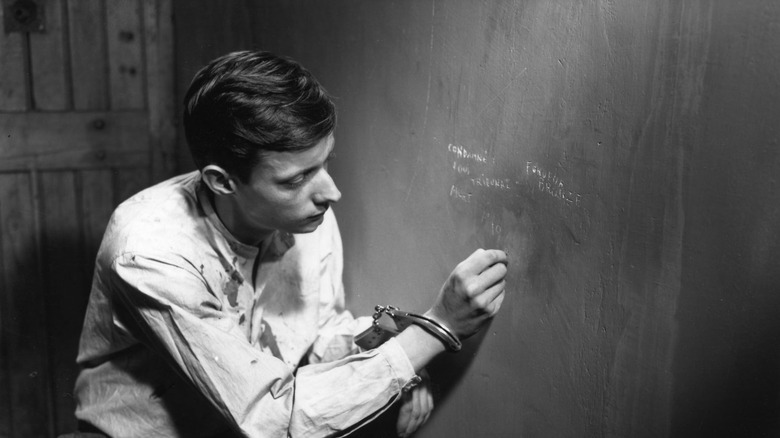
"A Man Escaped," which bears the full title "A Man Escaped or The Wind Bloweth Where It Listeth," is adapted from a memoir written by a real French Resistance hero — André Devigny, who landed himself in a cell at Montluc prison in Lyon after facing off against Germans during World War II — is, without question, one of the best war films ever made. Written and directed by Robert Bresson, "A Man Escaped" centers around a fictional version of Devigny, Lieutenant Fontaine, portrayed by François Leterrier, who also finds himself imprisoned in Montluc. By tapping on the walls between cells, Fontaine figures out how to communicate with the man next door to him and also befriends an inmate named Terry (Roger Treherne) who has yard privileges by the barred window to Fontaine's cell.
When Fontaine is moved off the ground floor and freed from his handcuffs, his desire to escape intensifies, and he links up with a few other inmates — including Maurice Beerblock's Blanchet and Charles Le Clainche's young soldier François Jost — to stage a daring, risky, and audacious jailbreak. We won't spoil how "A Man Escaped" turns out specifically (though, admittedly, the title is just a bit of a giveaway here), but the film is gripping, exciting, and a stark portrait of what it was like to endure imprisonment during World War II against Axis forces. Rotten Tomatoes agrees; it holds a perfect 100% rating on the review aggregator, and the critical consensus calls the film "a well-acted POW drama that builds with subtle, seat-gripping tension."
1. Grave of the Fireflies
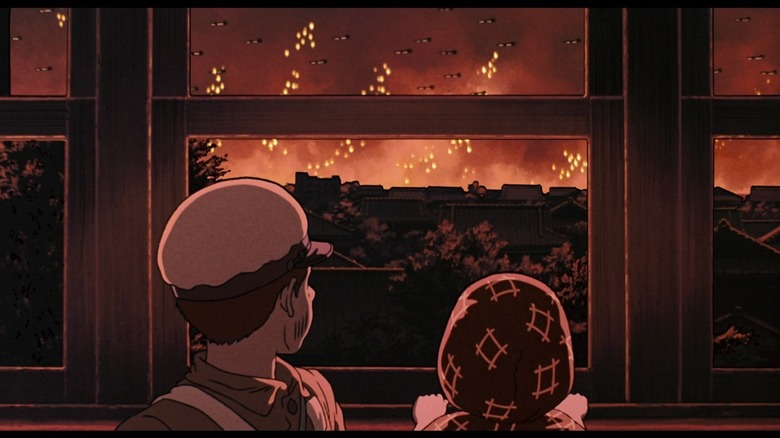
Studio Ghibli is probably best known for its animated films by Hayao Miyazaki, but the Japanese studio also gave other directors the reins plenty of times ... including its co-founder Isao Takahata, who made his first Ghibli film with 1988's "Grave of the Fireflies." Regarded as both a great war film and an anti-war film, "Grave of the Fireflies," which was also written by Takahata, takes place in the Japanese city of Kobe — and begins in the immediate aftermath of Allied bombings on the city, which were carried out by American forces. (If you want to get extremely specific, "Grave of the Fireflies" takes place during the Pacific War, which was a theater of World War II.)
Siblings Seita and Setsuko Yokokawa (voiced in the original Japanese version by Tsutomu Tatsumi and Ayano Shiraishi and in the first English language version by Robert John Spencer and Corinne Orr) survive the attack, and because their mother dies and their father is fighting in the front lines as a captain of the Imperial Navy, they're sent to live with an aunt. As the war intensifies, food and supplies become scarce, and Seita must look out for his younger sister Setsuko, who starts experiencing physical symptoms of starvation even as news breaks that the war is over.
To be honest, "Grave of the Fireflies" is not for the faint of heart; honestly, it's one of the most gut-wrenching films you could ever watch in your life. It is, however, well worth your time, and probably the most harrowing look at war you could possibly experience because it's told through the eyes of two despondent, innocent children. Like "A Man Escaped," "Grave of the Fireflies" has a perfect 100% rating on Rotten Tomatoes, which lists it as the best war movie ever made.