

Who Are The People From The Sea In Christopher Nolan's The Odyssey?
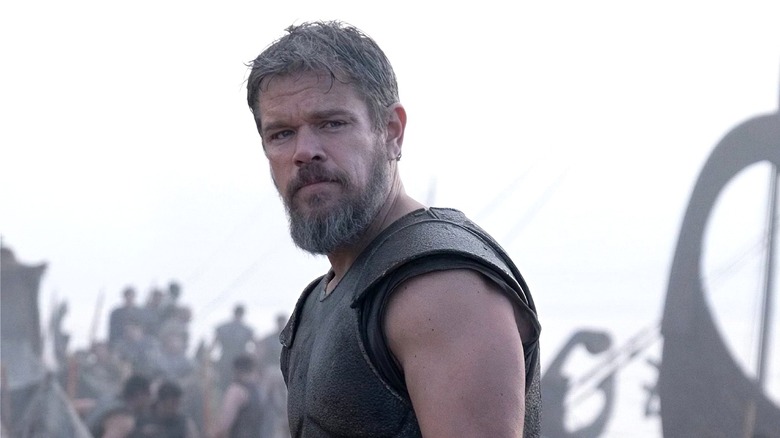
"The Odyssey" has finally found its way home (or at least into movie theaters) and is being hailed as Christopher Nolan's masterpiece. The adaptation generally follows the winding, fantastical source material well, even if Nolan's "Odyssey" does get a few things wrong about the story, too. There is also a strong sense of humanity to the director's storytelling that makes it more relatable than the original poem. One factor that really nails this is the way that Nolan's film integrates real-world historical elements, especially multiple references to the impending, off-screen threat of the "People From the Sea." Also called the Sea People, the term refers to a long-term migration of different groups sailing in often aggressive waves across the eastern Mediterranean during the Late Bronze Age.
When was the Late Bronze Age? There is a range of dates, but usually we're talking about the centuries leading up to roughly 1,000 BCE. That's a few hundred years before the author known as Homer created "The Odyssey."
The Sea People aren't actually referenced in Homer's original poem; there are mentions of a lot of local regional powers in the Mediterranean, including Troy, Crete, Egypt, and the various Achaean kingdoms scattered across Greece (including Ithaca). But Christoper Nolan's film goes further by adding multiple references to the "People from the Sea," a move that, even more than the connection to semi-mythic Troy, grounds the fantastical story in a very real period of history.
The historical impact of the Sea People
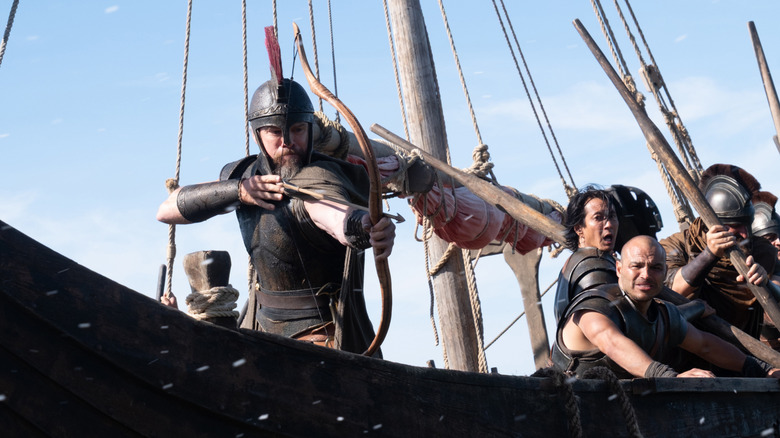
The People from the Sea are not just an off-screen boogeyman Christopher Nolan used to raise the stakes around Odysseus' quest. Instead, the director uses the intimidating rumor to subtly signal the approach of a very real, but little-understood, multi-century episode in history.
The Sea People were made up of a number of disparate groups who have various cryptic names in old Egyptian and Hittite archaeology, which we won't break down here. However, one of them is more recognizable: the Peleset — a group that is generally thought to have been the historical ancestors of the Biblical Philistines who settled in Palestine.
By referencing the People From the Sea, Nolan is quietly pointing to the very real geopolitical pressure not just around Odysseus's world but that of Homer himself. Let's take the poetic character first. Odysseus is alive during the Trojan War, which is thought to have taken place right at the end of the Bronze Age, at a time when the Sea People were actively invading, attacking, and destroying regional civilizations like the Hittites.
This period of attacks launched Greece into a Dark Age that dragged on for centuries, roughly from 1,200 to 800 BCE, which is how this connects to the author of "The Odyssey" himself. While Odysseus sits on the early side of the Greek Dark Age dates, Homer is thought to have lived around the 9th or 8th centuries BCE, right as Greece was coming out of that same Dark Age. In other words, both Odysseus in the story and Homer as he composed it could easily have been aware of this threat of "People from the Sea."
The People From the Sea set a specific tone in the movie
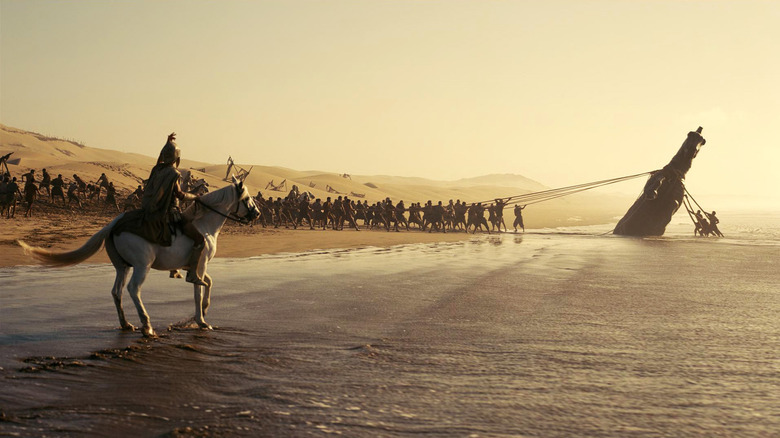
As far as Christopher Nolan's adaptation is concerned, adding the People from the Sea was a great way to ground the fantastic elements, like the cyclops and the Laestrygonians, in a very real world. And Nolan doesn't just add them in as a passing mention. They actively shape his iteration of the ancient tale.
When the story moves to Ithaca, the narrative is all about the potential of invasion, giving the multi-decade absence of a king more heft. When Telemachus (Tom Holland) visits Menelaus (Jon Bernthal), the King of Sparta moodily gripes about the impending threat while hunting with Odysseus' son. This has an effect on Telemachus, who brings it up again when he returns and speaks with his mother, Penelope (Anne Hathaway), about the need for someone, himself or a suitor, to take the throne and protect their homeland. Finally, Odysseus (Matt Damon) himself talks about the collapsing Bronze Age and the end of their era when he proposes setting sail for the "unknown west" at the end of "The Odyssey."
While the People from the Sea never feature directly in the movie, they end up being one of the most consistent and lethal threats. In a story packed to the brim with all sorts of wild and eccentric dangers, the Sea Peoples' impending arrival is a factor that stretches across time and space, influencing every area of the map and each character in the story for decades. You could almost say Nolan took Homer's epic and found a villain bigger than all of the rest put together.