

5 Best Post-Apocalyptic Movies Nobody Talks About Anymore

One of the more interesting genres of film deals with the end of the world – or, more accurately, what comes after civilization is destroyed. Like many genres, post-apocalyptic movies have been around in one form or another since the early 20th century, and the genre expanded to include all manner of reasons why society collapsed.
When survivors of the apocalypse have to find a way to continue on, that's often more fascinating than what ended civilization, and the films that fit such a description aren't as common. Movies like the original "Planet of the Apes" don't reveal themselves to be a post-apocalypse movie until the very last scene, while "Mad Max" and "Escape From L.A." explore post-apocalyptic worlds shortly after their collapse. Other movies like "The Terminator" feature a world-ending situation, but it's revealed in non-linear fashion.
Movies like "The Matrix" interweave complex narratives depicting their apocalyptic scenarios, and it and the aforementioned are all well-known. There are many others that fall within the post-apocalyptic film genre, many of which aren't talked about for a variety of reasons. Whether they've been overshadowed by bigger-budget box office successes or it's simply been decades since they came and went, each of these five post-apocalyptic movies is excellent. Few people talk about them anymore, so we will.
Logan's Run

One of the most innovative post-apocalyptic films of the 1970s is "Logan's Run," which masks its truth until well into the third act. Initially, the world presented in "Logan's Run" is a utopia, but on closer inspection, it's a cage, with hard rules to prevent overpopulation. In the film, whenever someone reaches the age of 30, they participate in a ceremony where they're killed and disintegrated. A chip in their hands blinks when the telltale day arrives, and most go willingly.
The ones who don't are called "Runners," and the people who chase them are a police force made up of "Sandmen." Logan 5 is a Sandman, but after discovering a mysterious artifact, the computer that runs the city changes his age in the system to 30, forcing him to become a runner as a kind of unwilling undercover agent. He befriends a woman named Jessica 6 (Jenny Agutter), and the two embark on a rush to escape their termination by Logan's old partner, Francis 7 (Richard Jordan), who relentlessly pursues them.
"Logan's Run" was a visually stunning film, and one of a handful of sci-fi movies that predicted real technology. It was also a box office success, earning a short-lived television series adaptation and a comic book series. Nowadays, most moviegoers aren't aware of "Logan's Run," as it's been buried beneath a mountain of later-released popular culture. While dated now compared to today's sci-fi films, it's nonetheless a fascinating story about handing over decisions to computers that use logic devoid of morality to rule.
Wizards

At first glance, most people likely see "Wizards" as a fantasy film, and while it certainly features elements of that genre, it's actually more science fiction, and a post-apocalyptic movie. It's set millions of years in the future, and the opening narration describes the story as "An illuminating history bearing on the everlasting struggle for world supremacy fought between the powers of technology and magic." It then reveals that atomic weapons destroyed the world, mutating humans into orc-like beings that thrive on radiation.
In the unspoiled lands, the beings of the old world returned: fairies, dwarves, and elves, described as "the true ancestors of man." Two children of immense power are born, one of the light who is good, and another of the dark who is evil, and they both become powerful wizards, taking sides in a global conflict for world domination. The evil sorcerer, Blackwolf (Steve Gravers), uses ancient technology scavenged from the wasteland, consisting of WWII Nazi propaganda and long-lost weapons.
Avatar (Bob Holt) leads the other side using magic and hope, leading up to a final confrontation between the two brothers that ends in an unexpected way. "Wizards" is one of director Ralph Bakshi's most celebrated animated features, but like so many films from the '70s, it isn't well known today. Still, it's one of the best fantasy movies of the 1970s. Yes, that's despite being set millions of years in the future, long after a nuclear apocalypse wiped most of humanity from the face of the Earth.
Blindness
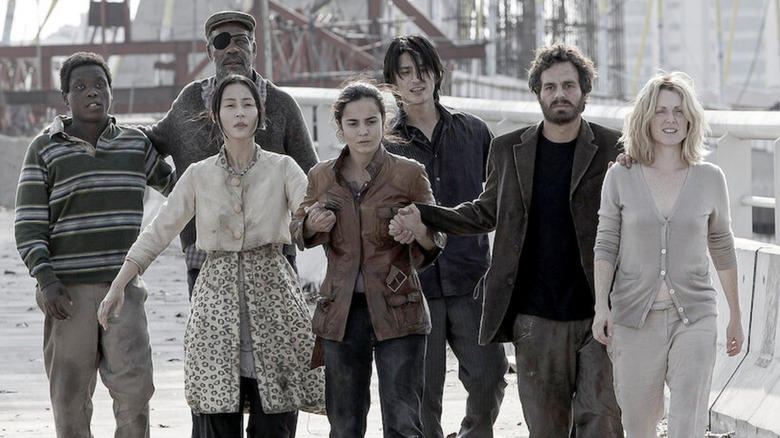
A more recent post-apocalyptic film that explores an unusual end-of-the-world scenario is 2008's "Blindness," based on José Saramago's novel of the same name. The world doesn't end in a way that's commonly seen in films, as it doesn't involve war or conflict of any sort. Instead, almost everyone on Earth is suddenly blinded by an unknown communicable disease. As more people lose their ability to see, civilization breaks down as governments quarantine the blind and refuse to offer aid.
Blinded people are rounded up and quarantined inside internment camps that are overcrowded, mirroring concentration camps from WWII. Only one person appears immune to the blindness sickness, leaving everyone else susceptible to the epidemic. Eventually, a group of survivors escapes the camp only to find that society has crumbled as the blind wander about like zombies. In the end, they find a safe harbor, and there's a twist ending that won't be spoiled here.
When it came out, "Blindness" didn't do well at the global box office, pulling in only $19.9 million on a production budget of $25 million. Still, while the film didn't do well financially, its leads, Julianne Moore and Mark Ruffalo, showed off their exceptional talent. The story adds an interesting twist to the sensory loss horror subgenre while showing how society's function is reliant on those senses, and all it can take to tear it all down is one unforeseen communicable disease for which humanity is unprepared.
A Boy and His Dog

One of the most underrated post-apocalyptic films of the 1970s is a B-movie that's actually awesome: "A Boy and His Dog." Unlike most films in the genre, this one is a comedy, centered around a young man, Vic (Don Johnson), and his dog, Blood (Tim McIntire), who communicates via telepathy. The two spend most of their time searching for food and female companionship, and they use Blood's telepathy. At first, they have a somewhat contemptuous relationship.
After a while, they realize that they need one another, and they get along as best they can in order to survive the wasteland of the former United States. When Blood captures the scent of a woman, the two track her down. Ultimately, they locate an underground society called Downunder, which has an artificial ecosystem that sustains it. It's essentially a utopia, but like any idyllic place, it hides its truth behind layers of food and luxury.
When it becomes clear that remaining wouldn't be in Vic's best interest, he leaves and saves Blood from starvation through some quick thinking and murder. The film is a product of its era, which may be one of the reasons why it's not well known or much discussed these days. It certainly breaches what's considered appropriate in polite society, which makes sense as it is a jet-black comedy. Still, "A Boy and His Dog" is an excellent B-movie that any fan of the post-apocalyptic genre should watch.
The Last Man on Earth

One of the most-adapted post-apocalyptic novels is Richard Matheson's 1954 book "I Am Legend." The novel has been made into three feature films, beginning with 1964's "The Last Man on Earth," which was followed in 1971 with "The Omega Man," and finally, in 2007, with "I Am Legend." The first adaptation is often overshadowed by its successors, which is a shame, as it's not only a brilliant take on the book, but it's also among Vincent Price's best movies.
The film's screenplay benefited from Richard Matheson's involvement, though he didn't like the final product and was credited as Logan Swanson. Regardless, the film takes his source material and dives right in with the titular last man on Earth, Dr. Robert Morgan (Price), who is living in a world populated by vampires. They're infected people who transform into vampiric creatures via a plague, and the dead are reanimated into the same monsters, making the world into a complete ruin.
Much of the plot revolves around Morgan's memories told via flashbacks, and the story is incredibly personal. It takes the monster genre and flips it into a twist few could have seen coming back then, making "The Last Man on Earth" one of the best films of the 1960s. That said, it wasn't a hit upon release, but became something of a cult classic over time, earning praise from critics. Unfortunately, that hasn't brought much attention to "The Last Man on Earth," as few know of its existence today. Skip the Will Smith version and check this one out.