

The Odyssey's Most Confusing Moments Explained
Contains spoilers for "The Odyssey"
If you haven't read "The Odyssey," the epic Greek poem attributed to a blind poet named Homer, for a long time — or at all — you should know that it's relatively famous for being a tough read. This does, of course, depend on the translation; Emily Wilson's 2017 translation is known for being slightly fresher and more modern, but versions by Robert Fagles and Robert Fitzgerald are also taught in high schools and universities across the world. This is all to say that "The Odyssey" is long, can be hard to parse, and has been told and retold countless times throughout history.
As far as Christopher Nolan's adaptation of "The Odyssey" is concerned, though, the director went for a very straightforward storytelling approach; in fact, he omitted some of the poem's more fantastical and magical elements, like gods tailing various humans and casting outright spells. Still, the movie has some moments that go largely unexplained or might be slightly confusing if you're unfamiliar with the source material. The gist, however, is this. Our war hero, Odysseus (Matt Damon), who's been missing for nearly a decade, is determined to return home to his long-lost wife Penelope (Anne Hathaway), who's fending off hapless suitors, and his son Telemachus (Tom Holland), whom he hasn't seen since he Telemachus was a small child. Unfortunately for Odysseus, his initial journey back from the Trojan War sent him through a series of increasingly dangerous adventures that also killed all of his men, so it's not that easy. Now that we've got that out of the way, here are some of the confusing moments in Christopher Nolan's take on "The Odyssey," explained.
What happens between Sinon and Antinous as children — and how does it affect the story?
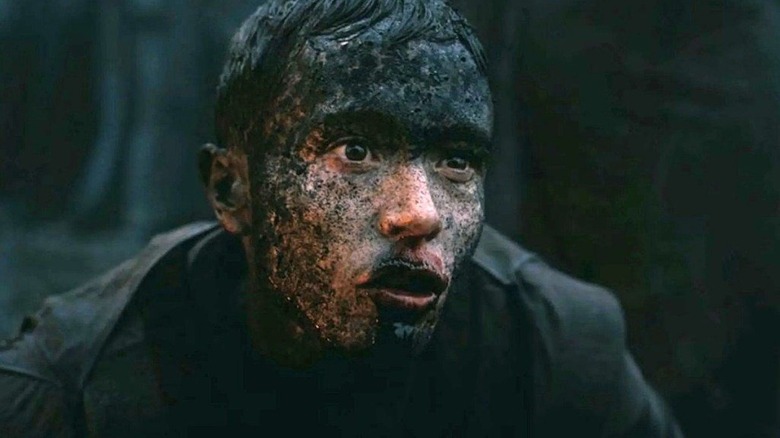
Christopher Nolan uses a non-linear narrative to tell the full story of "The Odyssey" — and a lot of it is characters like Odysseus sharing stories, which feels particularly appropriate to honor an epic poem that was always intended to be performed — and through flashbacks, we learn about the complicated history between young contemporaries Sinon (Elliot Page, who worked on "Inception" with Nolan years prior) and Antinous (Robert Pattinson). As Odysseus' loyal swineherd Eumaeus (John Leguizamo) tells Telemachus, Odysseus, looking for soldiers to join him in the Trojan War, employed a lottery system ... and when a young Antinous pulled a small metal rod that indicated he must serve, his father arranged for Sinon to end up with said rod and go in Antinous' place.
Sinon is the first person to die onscreen in "The Odyssey" and delivers a scathing, emotional monologue to Odysseus later when he and his men visit Hades and speak with the dead; there, Sinon tells Odysseus to return the hunk of metal to Antinous, now one of Penelope's odious and drunken suitors, and make it clear that Sinon paid Antinous' proverbial debt. Even though Sinon and Antinous' childhood interaction is shown several times in "The Odyssey," it can be a little confusing.
Who are those giant, armor-clad enemies that attack Odysseus and his men?
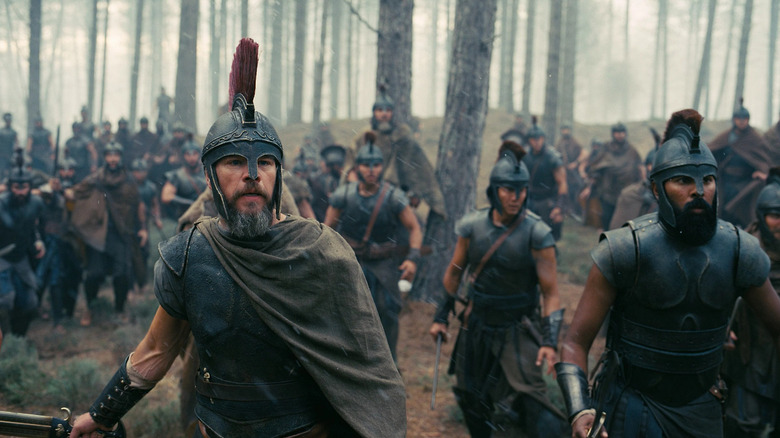
After Odysseus and his men — well, some of them — escape the cyclops in his cave (more on him shortly), they travel to a different island on their ships, desperate to find food and supplies for their long journey home. Wandering through the forest, they encounter a strange child clad in blue and silver crouched in the woods; when the mysterious child does acknowledge them, it begins to scream at the top of its lungs. Suddenly, enormous masked men in full suits of armor storm the woods, chasing Odysseus and his men — and they're brutal, powerful, and deadly. Odysseus and a much smaller group escape by the skin of their teeth, but two of his ships and a large swath of his men are lost to these mysterious fighters.
Christopher Nolan's movie actually never explains who these guys are, but if you're familiar with the text of "The Odyssey," you know that they're the Laestrygonians ... and they're man-eating giants. Yes, the monstrous men that Odysseus and his men encounter in these woods are cannibals, and they're also massively overpowered compared to Odysseus' puny human men.
Why does Athena appear to Odysseus?
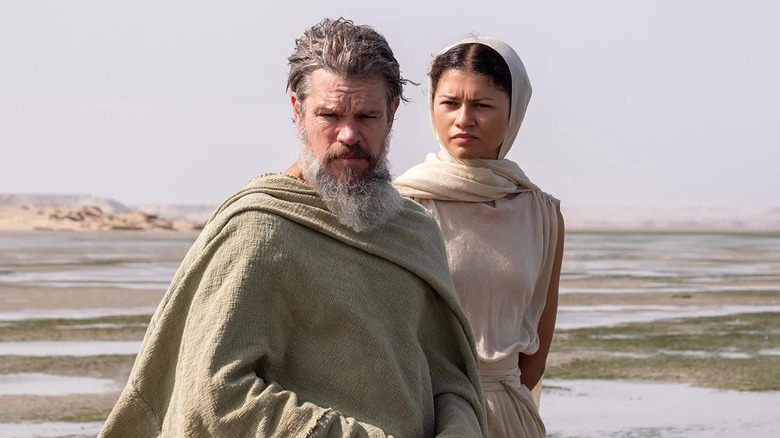
Like we mentioned earlier, Christopher Nolan's version of "The Odyssey" largely does away with the magical atmosphere of the poem, where Greek gods flit to and fro and meddle in the action. That's not to say the gods aren't present, though, and there certainly is some magic — but only one god "physically" appears in the film. That god? Athena, the goddess of wisdom, who's played beautifully by "Euphoria," "Dune," and "The Drama" star Zendaya. So why does Athena continue to appear to Odysseus, seemingly to give him counsel and comfort in the moments where he needs it the most?
There are, actually, two possible explanations here, and it feels safe to say that Nolan meant for there to be some ambiguity about Athena. At the end of the film, as Odysseus recounts the damage that he and his men inflicted upon Troy during the war, he remembers killing a young woman — one also played by Zendaya. It feels very likely that Nolan wanted us to see two potential outcomes: that the "Athena" that Odysseus keeps seeing was nothing more than a priestess that they killed at a temple in Troy, or that he actually killed the real goddess, Athena, who was disguised as a mere mortal during the sacking of Troy. In either case, though, it connects to the consuming guilt that Odysseus feels for what he and his army did to the innocents in Troy.
Circe's grudge against strange men, explained
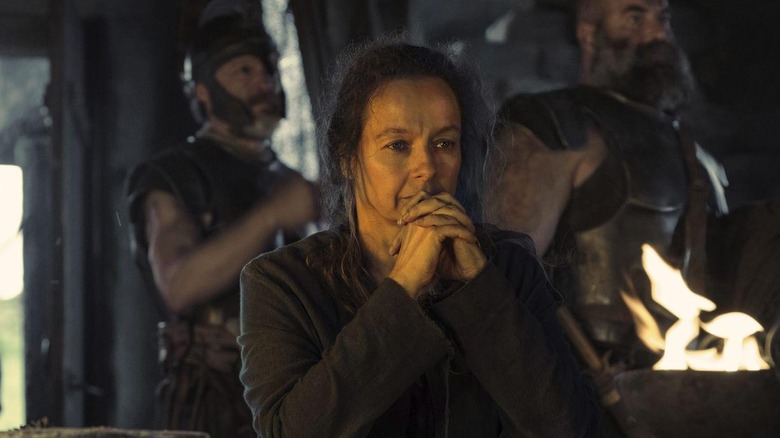
During one of the many trials that Odysseus and his men face on their doomed and treacherous journey back to Ithaca, they encounter Circe, a meek but incredibly powerful witch played by a truly amazing Samantha Morton. Angry at Odysseus for consistently leading them astray, the men decide to visit Circe's home on their own, and she feeds them a "special" stew that turns them into pigs, the animal she claims best represents their true nature. When Odysseus shoots a deer that immediately turns back into a man, he realizes Circe's full powers and confronts her, knowing what she can do; even though Odysseus' men did just ask her for food and never attacked her, she tells Odysseus that she knows they would have hurt her eventually.
This is due, in large part, to Circe's tragic backstory. Throughout Circe's life before the events of "The Odyssey," men like Jason (Medea's husband), Glaucus, and Picus, just to name a few, have wronged her in various cruel ways. Circe's impulse to turn Odysseus' men into pigs might seem extreme, except when you consider that she's endured trauma at the ends of strange men asking for food before. (If you're looking for a phenomenal re-telling of this story, "Circe" by Madeline Miller is a must-read.)
What's happening with Tiresias?
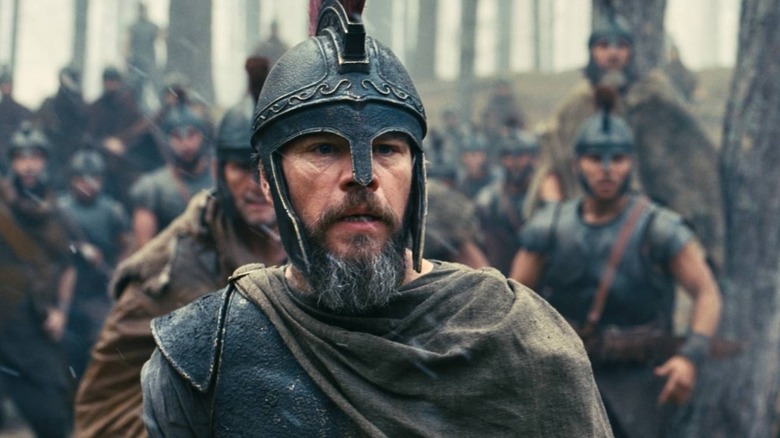
When Odysseus and his men journey to the underworld thanks to Circe's counsel, they meet Sinon and, shockingly, Agamemnon (Benny Safdie), the former Greek king of Mycenae and ally to Odysseus during the Trojan War. After Odysseus learns of Agamemnon's fate, he turns his attention to the main attraction of Hades, so to speak ... the blind prophet Tiresias, played by Christopher Nolan regular James Remar. (You might remember him from Nolan's massive Oscar-winning 2023 film "Oppenheimer" as Secretary of War Henry L. Stimson, who notes that he doesn't want to drop an atomic bomb on Kyoto in Japan because he has fond memories of honeymooning there, in one of the movie's most striking lines.)
Tiresias tells Odysseus about two upcoming challenges, the whirlpool Charybdis and monster Scylla, and says that six men will die while facing one of them but all of Odysseus' men will fall to the other. (This ends up coming true; six men are snatched and devoured by Scylla when they avoid Charybdis to find her.) Tiresias also informs Odysseus that none of his men will survive if they eat any of the cows on an island that belong to the sun god Helios; this also comes true as the men starve and feast on the livestock. Tiresias is a nifty plot device, to be sure, but he's also an all-knowing prophet who speaks the truth when Odysseus needs it.
Here's everything you need to know about Polyphemus the not-so-friendly cyclops
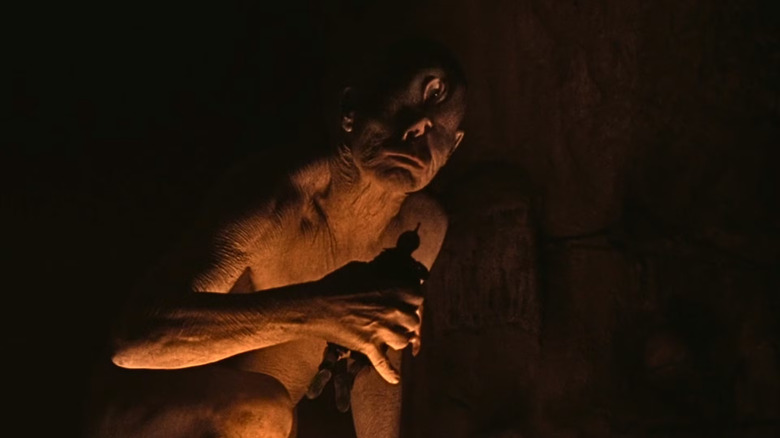
Portrayed by Bill Irwin (though you wouldn't know it from looking at him), the cyclops known as Polyphemus doesn't really receive a "proper" name during Christopher Nolan's take on "The Odyssey," but he's vitally important ... because he's the first trial encountered by Odysseus and his men. After Odysseus refuses to follow Agamemnon's ships back to Ithaca, claiming the wind will guide his ships to great fortune, he and his men land on an island and follow a flock of sheep into a cave. Unfortunately for them, that's the cave where Polyphemus lives, and he is hungry.
Polyphemus snatches up several of the men and devours them before they can even react, and from there, Odysseus and his men have to concoct a plan to sneak out of the cave that Polyphemus blocks with a massive stone each night. Not only do they use a flaming torch to stab the cyclops in his eye, enraging him, but Odysseus aims a final arrow at that eye when they actually do manage to escape, which brings about his downfall. Here's the problem: Polyphemus just so happens to be the son of Poseidon, a vengeful god of the sea who spends the entire rest of Odysseus' journey across the ocean sending storms and winds to wreck his boat and send him even further off course. Probably not a great idea to tick off a giant's dad who's also a god of aquatic travel when you're trying to get home!
Helen of Troy and her twin sister Clytemnestra's shared storyline is deeply tragic
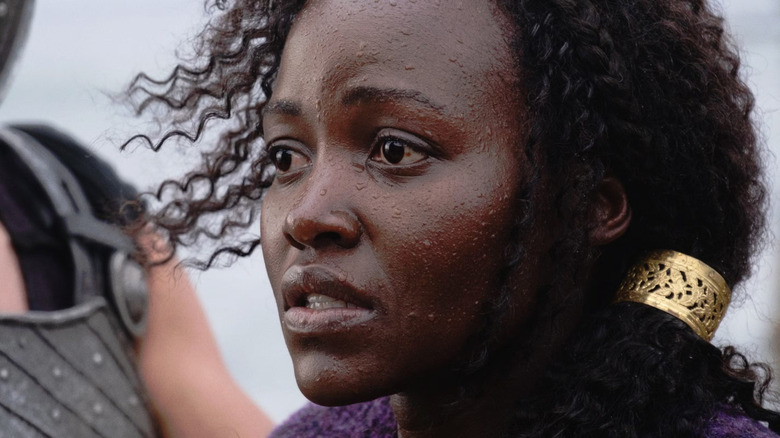
Lupita Nyong'o is one of the finest performers working today, and the only "problem" with her playing the dual role of Helen of Troy and her twin sister Clytemnestra in Christopher Nolan's version of "The Odyssey" is that she's barely in it. That's why some audience members might be a little thrown when they meet Nyong'o's equally angry sisters, who are both married to victors of the Trojan War who essentially took them as spoils: Menelaus (Jon Bernthal), the king of Sparta, and the aforementioned Agamemnon. When we see Menelaus and Helen together as Telemachus visits Troy to learn any potential news about his father's fate and whereabouts, Helen is kind and welcoming to Telemachus but pretty clearly hates her husband; scars on her face could explain why, especially as Menelaus makes a direct reference to her relationship with Paris of Troy that began the war in the first place.
So what of Clytemnestra? We only see her in flashbacks, but we learn that she's the one who killed Agamemnon. After Agamemnon sacrifices his and Clytemnestra's daughter (Iphigenia, according to the Greek myths) to appease the gods and help him achieve victory in the war, Clytemnestra hates him, and when he comes home from Troy, she lures him into her bed after bathing him and anointing him with oils ... and slits his throat. Ever heard the saying "hell hath no fury like a woman scorned?" Well, in this story, there's two women scorned.
The lotus flowers, fully explained
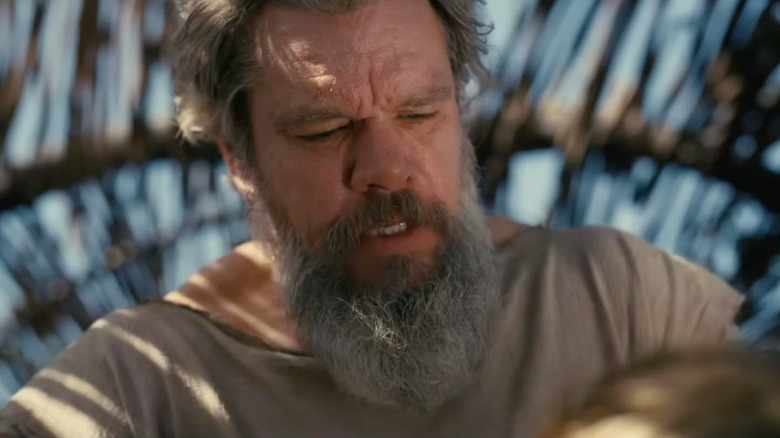
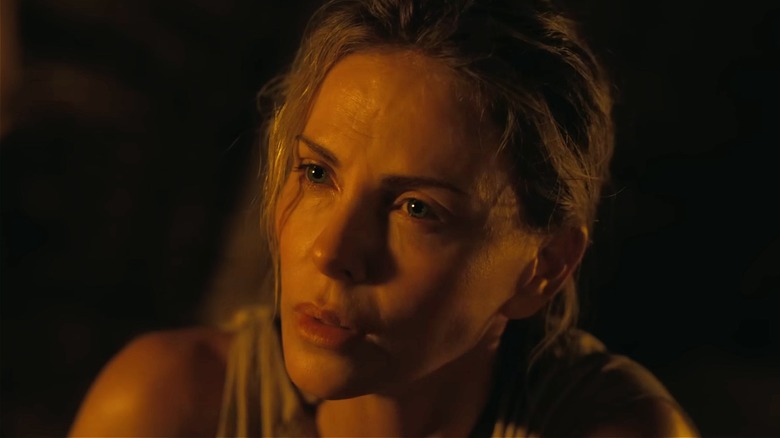
So where is Odysseus hanging out while he's missing from Ithaca? After his ship fatally crashes — the aftermath of his crew's feast on Helio's cows — Odysseus washes up on the shores of Ogygia and is discovered by the nymph Calypso (Charlize Theron). Calypso manages to treat all of Odysseus' intense physical injuries, but she finds she can't quiet his mind until she makes him tea from the lotus flowers, which make the one consuming the flowers feel peaceful and forget all that ails them. What happens, though, is that Odysseus forgets Penelope, Telemachus, his men, and all of the important details of his life in Ithaca.
Calypso, on the other hand, knows that Odysseus will remember eventually and want to go home, which is a struggle because she's fallen in love with the now-older soldier and is hesitant to let him leave the island behind. Still, she starts to withhold the lotus flowers and encourages Odysseus to share his stories, which is also how we learn about what happened on his harrowing journey on Poseidon's angry seas. It's deeply sad to watch Odysseus slowly regain his senses and realizes that he's left his family behind for years, but thanks to Theron's thoughtful performance, it's hard to see her Calypso as a true villain — rather, she's a caring woman who hoped to make a life with the man she loved before grappling with her own selfishness.
Who are the evil 'people of the sea' mentioned throughout The Odyssey?
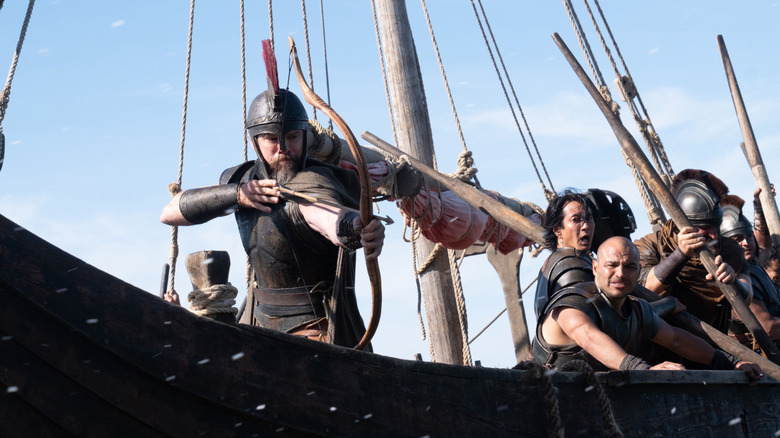
Throughout all of "The Odyssey," characters like Penelope and Telemachus keep mentioning the "people of the sea," viewed as evil forces that come ashore, disobey Zeus' Law (which boils down to "be kind to others so that they'll be kind to you), and could bring about the end of civilization. This looms large over the narrative because, frankly, you keep waiting for people to emerge from the sea and attack innocent civilians ... but as Odysseus reveals in a heartbreaking monologue to Penelope in the third act of the film, the myth of the ransacking, pillaging "people of the sea" comes from his own sacking of Troy. Throughout the years, the myth has been diluted so that Odysseus' name never comes into it, and the legends of his own warfare are frightening his wife and son.
The biggest way that Christopher Nolan's version of "The Odyssey" diverges from the source text is that it grapples with human failure, destruction, and hubris in a much more direct way, leading Odysseus to the heartbreaking revelation that he was the bad guy when he destroyed the city of Troy to win the war. The way this myth twists into something abstract in his absence just proves that, and furthers Nolan's point: it's not magic or gods who bring about utter ruin, but humans themselves.
"The Odyssey" is in theaters now.