

Toy Story 5 Ending Explained
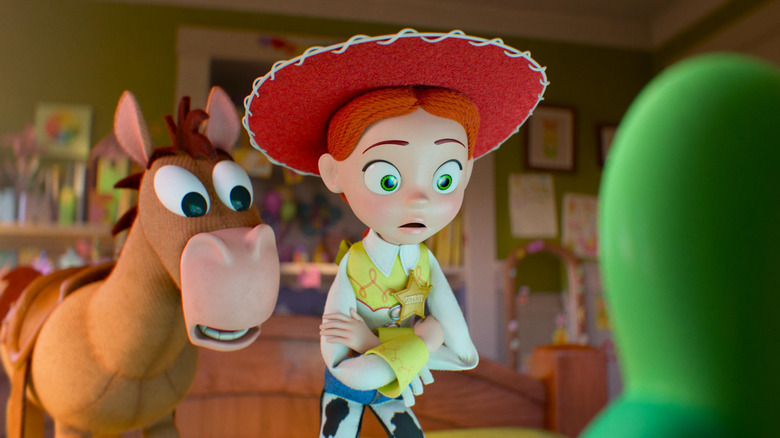
Is the iPad the death of childhood? Do today's kids have it worse than their parents? Will every toy eventually become a drone? "Toy Story 5" may not have concrete answers to these questions, but by the end, it spends plenty of time and an impressive degree of nuance wrestling with them. This deep into the "Toy Story" timeline — three decades and five feature films in — you might expect that the franchise has run completely dry on interesting new material. Yet somehow director Andrew Stanton delivers another clever, heartfelt, visually refreshing story about belonging, community, and why kids are growing up too fast.
It's not the most bombastic ending we've ever had. No toys strap themselves to a rocket, no one's on the brink of being sent to Japan, and there's certainly no climactic tearjerker moment at the level of the famous "Toy Story 3" incinerator hand-holding weepfest. "Toy Story 5" is, instead, more zoomed in. It's a very focused story about some of the unique challenges today's children face, more interested in quiet moments than animated pandemonium (though there's still some of that). Perhaps that's why the early reactions to "Toy Story 5" have been so strong.
Along the way, the film ruminates on how tech affects all of us, and what kids really need. Let's take a closer look at the ending of "Toy Story 5."
Toy Story 5 is all about Jessie and Bonnie
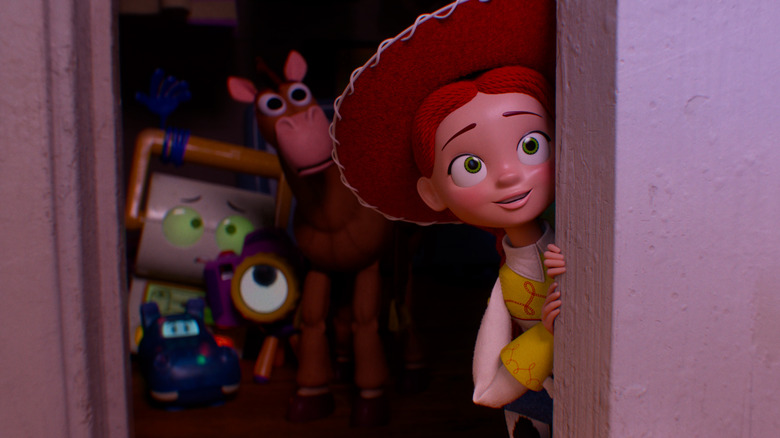
"Toy Story 5" makes a smart call right from the start by making Jessie (Joan Cusack) the protagonist. She's long been one of the most popular "Toy Story" characters, but she's never truly owned the spotlight; centering on her helps the franchise's fifth entry stay fresh. This is a story about Jessie and Bonnie (Scarlett Spears), in which even Buzz (Tim Allen) and Woody (Tom Hanks) are supporting characters.
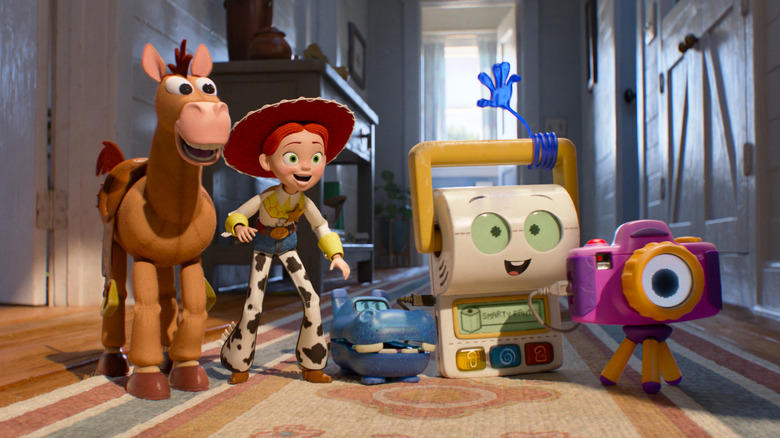
Bonnie is eight now and struggling to make friends with the other neighborhood kids, in part because of her own inherent shyness, and also because, as Jessie says at one point, she plays different. In an effort to help ease Bonnie into some social spaces, her parents buy her a Lilypad (Greta Lee) — a child-friendly tablet with its own built-in social media network called The Pond, complete with group text chats and multiplayer games. Bonnie goes to a sleepover with some dance class friends she connects with on the device, with Jessie and Bullseye tagging along. But when the other kids bully Bonnie for "still playing with toys," Jessie and Bullseye end up lost, only to be picked up by an elderly couple, who find the address of Jessie's first owner on her boot.
The duo is "returned" to the house where Jessie watched her first kid, Emily, grow up. When Jessie realizes that the girl who lives there now, Blaze (Mykal-Michelle Harris), would be a great friend for Bonnie, she gets help in connecting the two from a group of older tech toys. But when Bonnie finally shows up at the house to pick up Jessie and Bullseye, the bullying has gotten to her: she walks away without them, saying that she doesn't play with toys anymore.
What happens at the end of Toy Story 5?
When Bonnie leaves Blaze's house without taking Jessie and Bullseye, Jessie declares that she is too old to go through the same cycle of abandonment with another kid. She wanders out to the old tire swing where she and Emily used to play, where she discovers an engraving of "Jessie was here" carved into the tree. Buried beneath it, she finds an old lunchbox full of mementos and realizes that Emily went on to name her daughter Jessie. The revelation helps Jessie realize that all of her work has indeed been meaningful, and that kids growing up is just part of life.
Meanwhile, Buzz and Woody convene at the house to help Jessie and Bullseye, but they're intercepted by a squadron of new, high-tech Buzz Lightyear action figures. This group of toys are shown shipwrecked on a deserted island in the first scene, after a container from a ship falls overboard and washes ashore. Having journeyed across sea and land in search of "Star Command," whom they believe to be Jessie (given her star-shaped badge), the Buzzes agree to assist our toys in their quest.
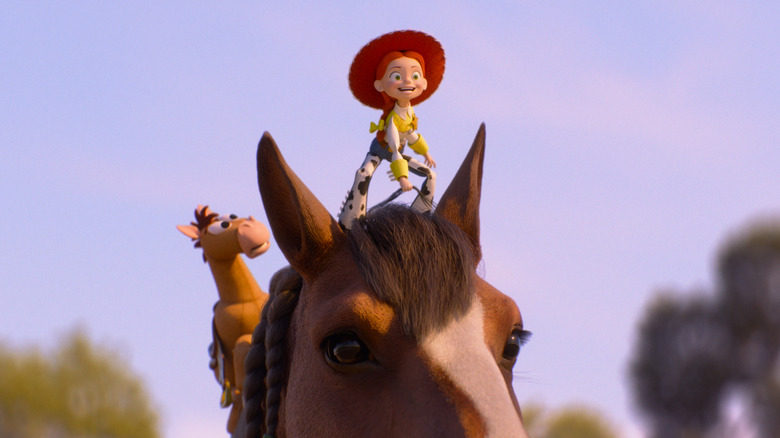
Determined to still help Bonnie and Blaze become friends, Jessie tries to reach out to Lilypad, despite their previous arguments over what's best for Bonnie. But after seeing Bonnie get bullied on The Pond, Lily has taken it upon herself to leave, leaping into a toy donation truck. Jumping aboard Blaze's collection of toy horses, Jessie and the crew chase the truck down. The Buzzes reveal that they can transform into drones, and they fly all the other toys to safety. After a bit more clever messaging, the toys finally get Bonnie and Blaze on a playdate, where both can express their imagination fully.
Is there a post-credits scene in Toy Story 5?
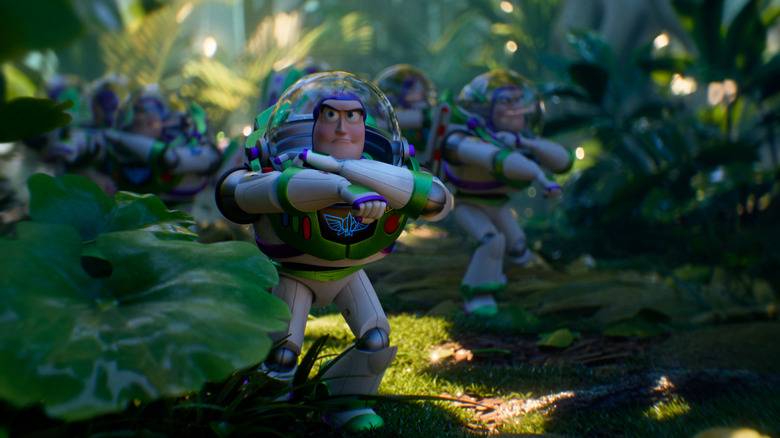
It is 2026, so even "Toy Story 5" must have a post-credits scene, but this one is actually really cute. After the first run of credits, the film cuts to a playground, focusing on a boy sitting by himself. One of the Buzz Lightyear drones descends from the sky, delivering itself to the boy, before the whole squadron of Buzzes follows suit, each pairing off with a different kid. It's a sweet moment, showing how the Buzzes have come to understand the deep meaning of a life spent playing with kids.
The brief scene pays off an earlier moment when one of the Buzz figures is found in the woods by a pair of kids on a camping trip. When his compatriots sneak into their tent to try to rescue him, he waves them off, and it's clear that he has found fulfillment.
The "Toy Story 5" post-credits scene also includes the appearance of a new high-tech Zurg toy, who declares himself, as he first did in "Toy Story 2," to be Buzz's father. Whether or not this is meant as a passing shot at "Lightyear," a somewhat maligned Pixar film that retconned that lineage, is up to the viewer to decide.
Are iPads bad for kids?
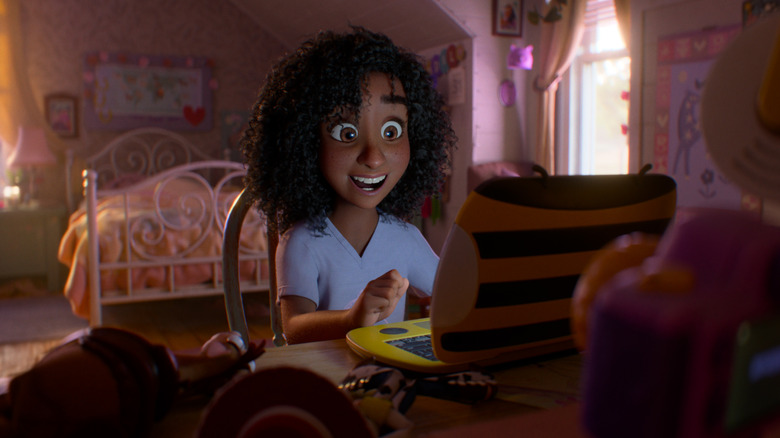
"Toy Story 5" is a story about the different ways kids play and socialize in a world now dominated by devices and digital spaces. For the toys, that's apocalyptic — the end of an age. And for most of the film, Lilypad operates as a pseudo-villain, who views toys as an outdated way for kids to interact.
By the end, though, the verdict on tech is at least a bit more nuanced. Lily helps Bonnie and Blaze connect, at Jessie's encouragement, when they wouldn't have met otherwise. While not overly emphasized, there's a positive message beneath the surface about how some kids who may struggle in traditional social spaces can benefit from certain aspects of digital play. That said, the film seems to argue that the end goal of such a connection is still an in-person connection, where kids can fully express themselves. In the climactic chase for the donation truck, an entire platoon of horse-riding Buzz Lightyears storms through a house full of adults and children, who all on their screens and don't even look up. The prevailing judgment on tech dependence is clear.
As always with this franchise, "Toy Story 5" puts the lion's share of faith in the kids themselves, even though some of them are prone to cyberbullying. Lily is assimilated into Bonnie's toy community because in the end, Bonnie is able to use her as part of something genuine and authentic. Even the twins whom she struggles so much to befriend in the opening scenes want to come and play once they see how much fun Blaze and Bonnie are having at the end. Most kids, "Toy Story 5" argues, just want to be included.
Toy Story 5 shows kids growing up too fast
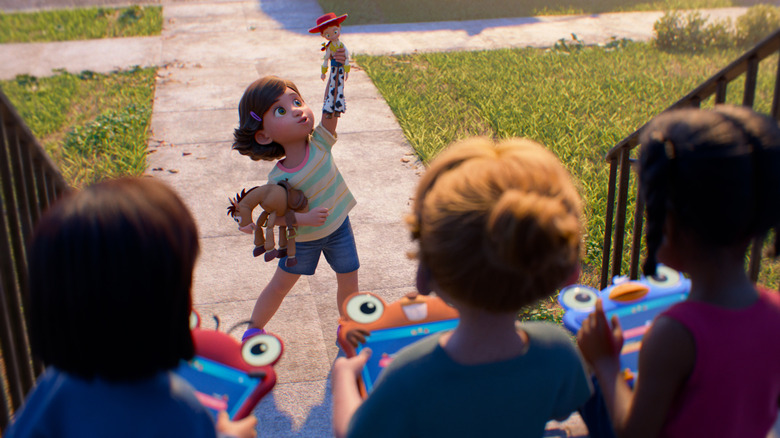
There are some things adults notice in "Toy Story" that kids naturally won't, and "Toy Story 5" has a lot to say on how the modern world is forcing kids to mature too soon. When Lilypad first shows up in Bonnie's room, her refrain is simple: "Bonnie is behind." She believes that by helping her "catch up" with her peers, she will remove the barriers to Bonnie's social development, but Jessie couldn't disagree more.
This idea of kids being too far behind or too far ahead is a running theme. When Jessie first arrives in Blaze's room, she comments to the toys there that it looks like the room of a teenager, even though Blaze isn't even 10 yet. Later, she accuses the tech toys of "making kids older," telling them, "you stole our time." There is a natural process of growing up, but those years of pure imagination and innocence are crucial, and Jessie sees all the ways in which a digitized world is pushing children out of their childhood prematurely.
Play is a sacred space
While the narrative of "Toy Story 5" is more focused and self-contained than some past entries (it doesn't even have a true villain), there is one specific space where the film expands on the creative blueprint of the earlier films. The "play" scenes are now depicted in an imaginative fantasy style, with hand-drawn backgrounds, genre-specific outfits for the toys, and heavy stylization.
"Andrew [Stanton] and Kenna [Harris] wanted to show the audience what Bonnie's imagination looks like, because Bonnie is different than Andy," visual effects supervisor Thomas Jordan explained in the film's production notes. "We used a pastel chalk drawing technique. It's very melodramatic, and there's an absurdity and a sort of tactile handmade quality to it that we all fell in love with." Even Bullseye gets a voice in one of these sequences, played by the incomparable Alan Cumming.
By setting up playtime as a visual set piece, the film anchors one of its prevailing messages — that play is a sacred space, essential for children. Midway through the film, after playing a game with Blaze's tech toys, Jessie corrects them by saying, "That's just a game, that's not playing." The distinction between socializing, games, and pure play, where the child is both creating and following their own natural instincts, is powerfully clear, in a way that really anchors the message of letting kids grow at their own pace.
What has the cast and crew of Toy Story 5 said about the ending?
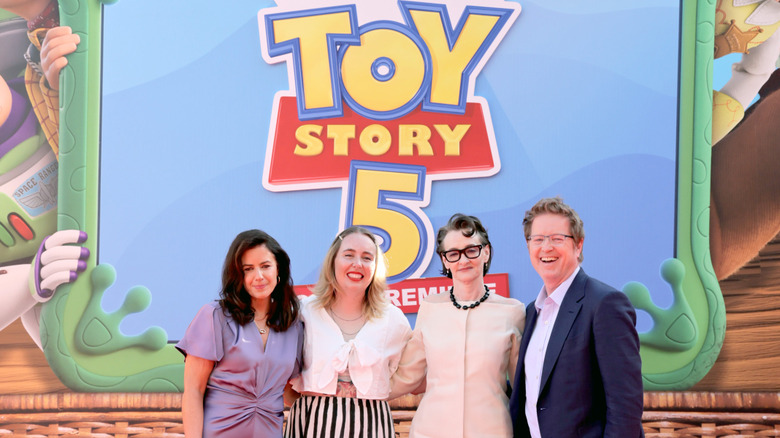
Director Andrew Stanton has been involved with the "Toy Story" franchise from the very beginning as a writer, though this is his first time in the director's chair for the series. Having worked on the films for more than 30 years, he had a particular perspective on their unique opportunities. "What broke my brain was that we can embrace time," Stanton told Entertainment Weekly, discussing the evolution of his work on the franchise. "Other stories don't have that luxury." The ending of "Toy Story 5" feels specifically tailored to that idea, with the toys reflecting on lives spent with multiple different kids, tech changing what play and social spaces look like, and Jessie finally accepting that she can't stop children from growing up, while realizing that's okay.
As to the lingering effects of tech on a child's development, the cast acknowledges that it's a complicated issue. "I know every parent in the United States worries about their kids," Joan Cusack told EW. "When do you get them involved in tech? What does that do to their brains? And that's what this movie's about. It's about humanity and playing and loyalty — and it makes me cry." Tom Hanks put it in more simple terms to The Guardian: "No toy hurts your feelings if you are playing with it."
Will there be a Toy Story 6?
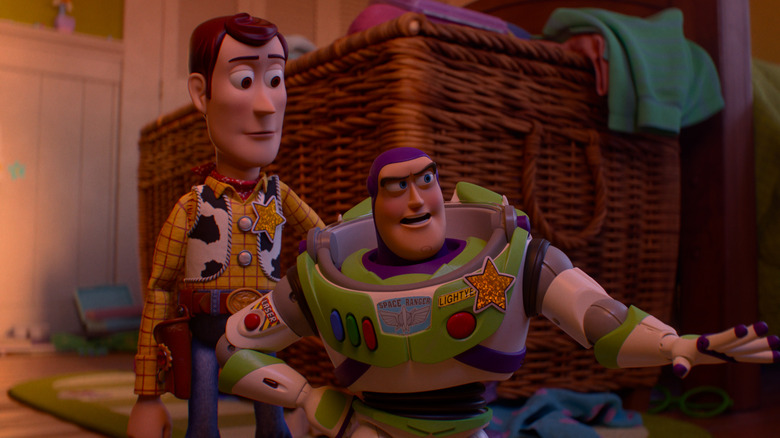
Will there be a "Toy Story 6"? There's certainly no reason why there couldn't be. Andrew Stanton has said that this will likely be his last hurrah with the franchise, but he's left the door open for others to continue, telling Entertainment Weekly that he believes there are multiple films' worth of story yet to be explored. Seeing that the last two have both cleared $1 billion in worldwide gross, and given the strong reviews for "Toy Story 5," the financial incentive is certainly there for Disney and Pixar to keep going.
An animated universe with immortal characters also lends itself to continued storytelling, though at some point, it may be hard to get all the actors back in the booth. Buzz and Woody are easily the most iconic Pixar duo, but "Toy Story 5" shows that these films can be just as strong with a different character in the lead role. Jessie's success there could pave the way for more installments sans Hanks or Allen, though that's entirely speculative.
For now, it's just nice to add another classic to the collection. Hanks told Entertainment Weekly that while he imagined "Toy Story 4" would be the natural ending for the series, he was drawn in after seeing the script for "5," calling it "vintage 'Toy Story.'" Indeed, that's the energy conveyed throughout. It's nostalgic, simple, and like its predecessors, excels at delivering plenty of heart.